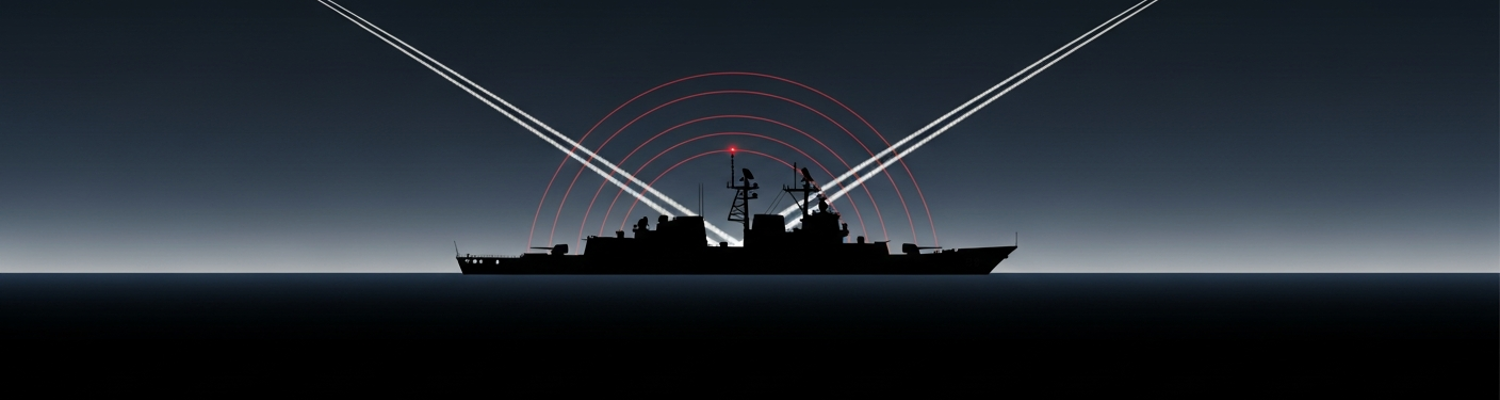

Gunslingers in a Jet Age
The victory celebrations of 1945 barely concealed a disturbing new reality for the United States Navy. The fleets that had swept the Pacific were built around a defensive doctrine perfected in the crucible of that war, a doctrine suddenly facing obsolescence. The core of this defense rested on two pillars: massed anti-aircraft artillery and propeller-driven combat air patrols. Against the Japanese, this combination proved formidable. Post-war analysis showed that while only 15% of attackers were intercepted by CAP, shipboard guns accounted for nearly 30% of those that broke through. Yet, the advent of the jet age, heralded by aircraft like the German Me 262, cast a long shadow over these statistics. The hard-won experience against conventional and even kamikaze attacks was a poor predictor of performance against future threats.
The piston-engine fighters forming the fleet's protective screen, like the Grumman F8F Bearcat and the venerable Vought F4U Corsair, were the apex of their kind. Their effectiveness, however, plummeted against the sheer speed of first-generation jet fighters. A Soviet MiG-15 could climb at over 10,000 feet per minute, easily outpacing a Bearcat's 4,465 feet per minute. The speed differential fundamentally broke the geometry of aerial interception. By the time a CAP could be vectored to intercept an incoming jet-powered intruder, the target was already closing on the fleet. The window for a successful engagement shrank from minutes to seconds. Below the fighters, the ships' batteries of 5-inch, 40mm, and 20mm guns faced a similar crisis. Systems like the Mark 37 Gun Fire Control System, a marvel of mechanical engineering, used an analog computer to calculate firing solutions. Against a target approaching at speeds exceeding 500 knots, its gears and servos could not compute and train the guns fast enough. The volume of fire required to guarantee a kill against a Mach 1 aircraft was statistically improbable. The conceptual threat of guided standoff weapons, a legacy of German wartime projects like the Fritz X and the rocket-boosted Hs 293, meant attackers would not even need to penetrate this wall of gunfire. They could launch their munitions from beyond the effective range of the fleet's guns, leaving the carrier groups perilously exposed.
The Electronic Gaze
The Navy's answer to the problem of speed was not more speed, but more time. The solution lay in pushing the fleet's awareness out beyond the visual horizon. This required a technological leap into a new kind of warfare, one conducted not with binoculars and tracers, but with radio waves and cathode-ray tubes. The late 1940s and early 1950s saw the introduction of the first generation of dedicated air-search radars, such as the Bendix and Westinghouse AN/SPS-6. Operating in the L-band, its large parabolic antenna swept the skies, emitting 500-kilowatt pulses. In its long-range mode, it could theoretically detect a fighter-sized aircraft at a distance of 80 nautical miles. This was paired with height-finding radars like the General Electric AN/SPS-8, an S-band set that could determine a target's altitude, a critical piece of data missing from earlier systems. For the first time, a ship's Combat Information Center, or CIC, could construct a three-dimensional picture of the airspace hundreds of miles around the task force.
This newfound electronic vision was not without its own fog of war. The flickering green screens of the plan position indicators were awash with clutter from waves, rain, and atmospheric conditions. False returns, or 'ghosts', were common. Operators, often young enlisted sailors in a dimly lit room filled with the hum and ozone smell of electronics, had to learn to interpret this abstract landscape. They had to distinguish between a flock of birds and a flight of hostile bombers. The ethical weight on the shoulders of the CIC crew and the ship's commander grew immense. A blip detected at 150 miles was just a piece of data. Was it a friendly patrol returning to the carrier? A commercial airliner straying off course? Or was it the leading edge of a Soviet bomber formation armed with nuclear weapons? The time to make that distinction, and to decide on a course of action, was shrinking. The decision to classify a contact as hostile and engage it at extreme range carried the risk of catastrophic error. This was a new moral calculus, where life and death decisions were based on interpreting phosphor dots on a screen, far removed from the physical certainty of visual identification.
To manage this flood of new information, the Navy embarked on one of its most ambitious projects: the Naval Tactical Data System, or NTDS. Initiated in the mid-1950s, NTDS was a revolutionary attempt to network the sensors of an entire task force, replacing grease pencils on plexiglass plotting boards with digital symbology. Using early digital computers like the UNIVAC AN/USQ-20 and high-speed data links, it could collate radar tracks from multiple ships and aircraft into a single, unified operational picture. The first service test systems were installed on ships like the carrier USS Oriskany and the destroyers USS King and USS Mahan in 1961. A commander could now see what every ship in the group saw, in near real-time. This shared awareness was essential for coordinating the complex air battle of the future. It also, however, began a process of centralizing command and automating the kill chain, further distancing the human from the final act of destruction. A missile could be launched from one ship based on targeting data provided by another, based on a decision made by a commander on a third. The responsibility for the act became distributed across a network of silicon and steel.
Forging the Missile Shield
The ability to see the enemy at a distance was useless without the ability to strike them at a distance. The limitations of guns and fighters forced a radical strategic shift from point defense of individual ships to the concept of a layered, fleet-wide "outer air battle." The fight had to be won far from the high-value carriers. This necessity drove the Navy's deep investment in surface-to-air missile research, a program born from the secret Operation Bumblebee that began as early as 1944 at Johns Hopkins University's Applied Physics Laboratory.
This effort produced the foundational "3-T" family of naval missiles: Talos, Terrier, and Tartar. Each was designed to fill a specific layer in the new defensive scheme. The massive RIM-8 Talos was the long-range sword of the fleet. A ramjet-powered behemoth, it was over 30 feet long and weighed more than 7,000 pounds. First becoming operational on the cruiser USS Galveston in 1958, Talos could reach out over 100 nautical miles at speeds of Mach 2.5, engaging high-altitude bombers long before they could release their weapons. Its guidance was a complex ballet of technologies, riding a radar beam from the launching ship's powerful AN/SPG-49 fire-control illuminator before its own semi-active radar homed in for the kill. Some versions were even tipped with the W30 nuclear warhead, raising the stakes of naval warfare to an apocalyptic level. This weapon system defined a new class of ship, the Talos cruisers like the nuclear-powered USS Long Beach.
The medium-range layer was the responsibility of the RIM-2 Terrier. Born from a supersonic test vehicle used in the Talos program, Terrier was a more compact, solid-fueled missile that could be fitted to a wider variety of ships. It provided defense out to 40 nautical miles, launched from the iconic twin-arm Mk 10 launchers that became a ubiquitous sight on cruisers and large destroyers. It required the dedicated AN/SPG-55 radar for guidance. Finally, for smaller destroyers and close-in defense, there was the RIM-24 Tartar. Essentially a Terrier without its booster rocket, Tartar was a lightweight system designed to give destroyer-sized ships a SAM capability for the first time. Guided by the AN/SPG-51 radar, it could engage targets that leaked through the outer layers, effective out to nearly 18 miles. These missile systems were technological marvels, but their development was fraught with challenges. Early versions were notoriously unreliable. The complex electronics, high-performance rocket motors, and delicate guidance systems were pushed to the very edge of what was possible with 1950s technology. Yet, their deployment fundamentally altered the nature of naval power. The first successful Tartar test in August 1958, which destroyed an F-6F drone, was a clear signal that the era of the gun was ending and the age of the missile had dawned.
The Commander's Burden
The integration of long-range radars, networked data systems, and supersonic missiles created a new kind of naval commander. Where a World War II admiral maneuvered fleets like pieces on a chessboard, the Cold War commander managed a dynamic, electronic system of immense destructive power. The ethical dilemmas inherent in this evolution were profound. The speed of the threat and the response compressed decision-making timelines from hours to minutes, and from minutes to seconds. The concept of pre-emptive engagement, once a strategic choice, became a tactical necessity. To wait for absolute certainty was to invite destruction.
This created a dangerous strategic paradox. As defensive systems like the 3-T missiles became more capable, they incentivized potential adversaries, primarily the Soviet Union, to develop more overwhelming offensive tactics. Soviet naval aviation doctrine revolved around saturation attacks, launching waves of anti-ship missiles from Tu-16 Badger bombers, like the massive Kh-22, to overwhelm the fleet's defenses. The Navy's response was to make their systems faster, more automated, and more lethal. This offense-defense spiral escalated the destructive potential of any future conflict. A commander's decision to engage a potential threat at 100 miles could trigger a sequence of events leading to a massive exchange of nuclear-armed missiles. The Rules of Engagement, or ROE, became fantastically complex documents, attempting to provide a legal and ethical framework for decisions that had to be made in seconds.
Commanders bore the moral responsibility for systems that offered less and less time for human deliberation. The NTDS operators in the CIC, the radar technicians, and the missile fire-control officers were all cogs in a complex, high-speed kill chain. While human operators remained in the loop, their role was increasingly to confirm or veto decisions recommended by the system. The ethical burden of a mistake, of a misidentified target like the tragic 1988 downing of Iran Air Flight 655 by the Aegis cruiser USS Vincennes, was a direct consequence of this new form of warfare. By the close of the 1960s, the US Navy carrier battle group had evolved. It was no longer an island of steel bristling with guns, but a node in a vast, invisible web of electronic sensors and standoff weapons. The shadow of the radar horizon had been pushed back, but in its place stood a new, more complex shadow, one filled with the moral weight of fighting a war at the speed of light.