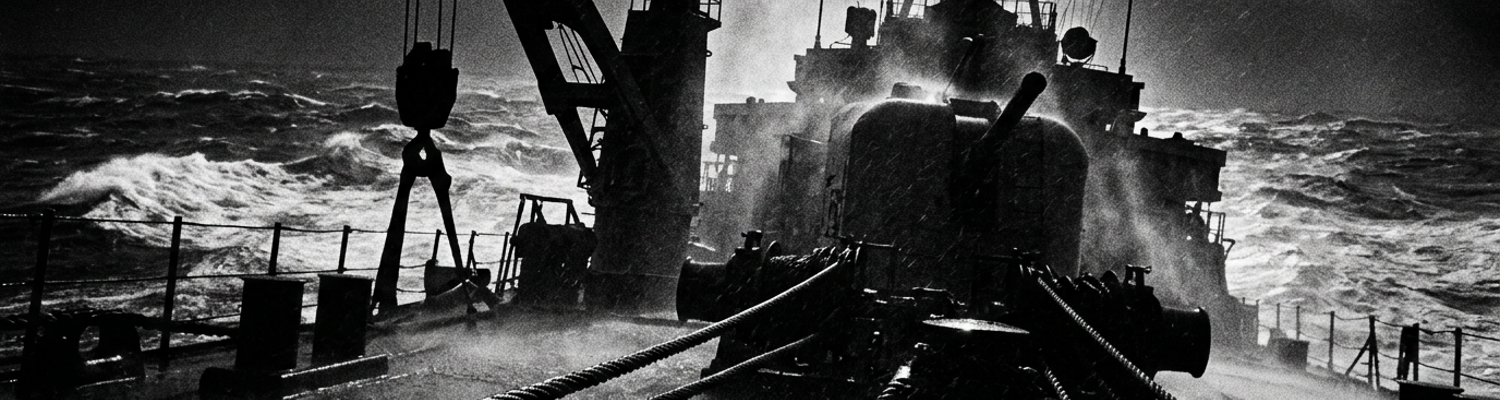

Operation Strikeback and Norwegian Sea Geopolitics
At precisely 0400 hours on September 19, 1957, radio transmitters across the carrier division ceased transmission. Every high-frequency link between the vanguard fleet and Supreme Allied Commander Atlantic headquarters in Norfolk severed. Condition Alpha emissions control went into effect. The task force cut teletype traffic and voice circuits. SACLANT planners faced blank plotting tables three thousand miles away.
The frontline commanders entered the Norwegian Sea completely cut off from land-based oversight.
Archival evidence shows NATO assembled over two hundred warships for Operation Strikeback. Six hundred carrier-based aircraft and sixty-five thousand personnel deployed across the North Atlantic. They staged in the ice-choked channels above the sixty-second parallel. The exercise tested Striking Fleet Atlantic under simulated general nuclear warfare conditions. Vice Admiral Charles Wellborn Jr. commanded the naval force from the cruiser USS Northampton (CLC-1). He directed two massive attack carrier groups centered on USS Forrestal (CVA-59), USS Saratoga (CVA-60), and the British fleet carrier HMS Ark Royal (R09).
Staff planners modeled simulated multi-megaton exchanges.
These simulated exchanges knocked out maritime ports within hours. Flight decks operated under the assumption that all NATO airfields in Western Europe were radioactive craters. Carrier pilots planned offensive strikes without divert fields. Around-the-clock flight quarters pushed aircrews to physical exhaustion. Catapult crews donned heavy vulcanized rubber suits. They tested washdown systems designed to rinse radioactive fall-out from timber and steel decks using high-pressure seawater pumps (Bureau of Ships manual 44-A). Damage control parties sealed off boiler rooms. They operated propulsion plants via mechanical engine-order telegraphs with zero fresh air intake.
Communications doctrine dictated a hard stop. Localized electro-magnetic disruptions from atomic weapons would destroy long-range radio contact permanently.
Norfolk planned for a naval war run entirely on pre-sealed operational envelopes.
A close review of operational logs indicates fleet units maneuvered against theoretical attack waves. Soviet Naval Aviation regiments and thick defensive submarine barriers formed the simulated opposition. Northern Fleet land-based missile bombers posed a constant theoretical threat. Regiments of Tupolev Tu-16 Badgers operated from Olenya and Severomorsk on the Kola Peninsula. NATO combat information centers tracked simulated raid profiles. High-altitude reconnaissance flights preceded low-level standoff missile runs against carrier hulls. At sea level, defensive screens of Soviet Project 613 Whiskey-class and Project 611 Zulu-class diesel-electric submarines blocked the gaps between Greenland, Iceland, and Scotland. Escorting destroyers like USS Purdy (DD-734) and British Weapon-class escorts struggled to hold acoustic contact in violent sea states.
Severe thermal layering in Arctic waters bent active sonar pings from AN/SQS-4 hull arrays.
This created broad acoustic blind spots. Submerged diesel boats idled undetected. Carrier screening units maintained zigzag routing patterns at speeds above twenty knots. They burned heavy fuel oil at unsustainable rates to deny Soviet submariners firing solutions. Lookouts on destroyer bridges visually scanned gray troughs for periscope shears. Combat Information Centers plotted intercept vectors for F8U-1 Crusader fighters flying combat air patrols at forty thousand feet.
Fleet replenishment units trailed behind these combat screens without dedicated anti-submarine escorts.
Operational friction exposed severe physical limits in the fleet machinery. Heavy swells exceeding thirty-five feet smashed forward gun mounts on older Gearing-class destroyers. Steam gaskets ruptured. Forward ammunition lockers flooded. Salt crust formed half an inch thick over whip antennas. This attenuated what little receiver capability the ships kept active. Fleet commanders aboard Northampton deciphered fragmented tactical picture data using hand-drawn grease-pencil boards inside damp flag plots. Strategic headquarters in Virginia lacked real-time telemetry. They received operational incident reports via delayed courier flights or brief burst transmissions sent through relay stations in the Hebrides. Wellborn and his staff made course adjustments without knowing if their land-based support infrastructure still existed in the simulated war plan. On September 22, three fleet oilers failed to achieve fueling connections due to violent heave rates near Jan Mayen Island.
Command Isolation Aboard USS Northampton
A close review of operational logs indicates Vice Admiral Wellborn directed fleet replenishment and strike vectors from the enclosed Flag Plot of USS Northampton. This space sat deep within the converted cruiser armored hull. Constructed on an Oregon City-class heavy cruiser frame, Northampton had its naval rifles stripped. Towering communications masts, high-frequency transceivers, and dedicated flag quarters insulated from atomic blast effects replaced them. Fifty miles to the south, the auxiliary replenishment groups struggled through freezing thirty-five-foot swells. They were completely hidden from the sight of the flag staff.
Command personnel operated under low red illumination inside the windowless tactical plot.
They tracked vessel distribution with hand-marked grease pencils across thick Plexiglas edge-lit status boards. They had no direct sightlines to observe the freezing sea conditions. Fractured steam winch gears and icing deck surfaces plagued the supply ships unseen. Supply positions represented in the command center existed as static figures. Junior enlisted plotters updated casualty figures hours after they occurred.
No flag officer on the command ship could see the oilers struggling in the heavy seas.
Archival evidence shows this spatial detachment from forward replenishment lines warped strategic calculations during the critical stages of the Norwegian Sea maneuvers. Inside the Combat Information Center, cooling exhaust blowers for the AN/SPS-2 height-finder radar consoles hummed against the damp Arctic air. Zero real-time telemetry flowed from the underway replenishment units. Staff planners calculated bunker fuel levels across forty escorting screening ships based on standard consumption curves instead of actual burn logs. Gearing-class destroyers running zigzag sprint screens against theoretical Soviet submarines burnt over three hundred and fifty gallons of heavy fuel oil per hour. This exceeded baseline projections by forty percent.
Mechanical span-wires severed aboard the fleet oiler USS Pawcatuck (AO-108) during a fuel transfer attempt in twenty-five-foot seas near Jan Mayen Island.
The flagship battle staff received no visual signal or rapid damage report. Fleet planners vectored escorts toward the disabled oiler under the false assumption that fuel lines were actively pumping oil.
The flagship functioned inside a blind spot of theoretical supply rates.
Strict emissions control protocols compounded this isolation. They severed the fleet wireless voice and teletype circuits. Under Condition Alpha EMCON, fleet doctrine barred all active high-frequency and ultra-high-frequency radio emissions. This denied Soviet electronic intelligence stations on the Kola Peninsula directional bearings. Vice Admiral Wellborn and his staff deliberately cut their own communications pathways. They shielded the attack carriers USS Forrestal and USS Saratoga from Tupolev Tu-16 electronic reconnaissance planes. Critical supply requisitions, machinery casualty messages, and fuel state tallies were restricted to visual Aldis signal lamps. Hand-carried paper dispatches ferried by Sikorsky HO4S helicopters and carrier onboard delivery flights provided the only alternative.
Low-hanging Arctic fog banks and continuous freezing sleet frequently grounded utility helicopters on the carrier decks.
Signal lamps rarely cut through heavy sea spray beyond a distance of two nautical miles. Written reports detailing burst boiler tubes, contaminated fuel tanks, and ruptured line-throwing gear reached the plotting staff with average transmission lags of eight to twelve hours.
Planners issued fleet orders based on conditions that had ceased to exist half a day earlier.
By September 23, flag plotters directed screening destroyers toward fueling rendezvous coordinates that the oilers had vacated six hours prior due to heavy drift. Escorts arrived at supply waypoints with fuel reserves dipping under fifteen percent. They found empty gray seas and zero visibility. At geographic coordinate 65 degrees 14 minutes North, 04 degrees 22 minutes West, two escort destroyers broke Condition Alpha EMCON using emergency low-power tactical voice bursts. Salt-water contamination in their bunker tanks triggered boiler flameouts.
Wehrmacht Attrition Formulas and Logistical War Gaming
Archival evidence shows supply officers deep inside the flag spaces turned to captured German wartime data. They needed to solve sustainment deficits during simulated atomic combat. Planning staff utilized attrition models derived from microfilmed Wehrmacht records. These records were cataloged at the Alexandria Records Center in Virginia (NARA Record Group 242). Working beneath incandescent lamps in the drafting room, naval analysts fed rolls of thirty-five-millimeter film through portable Recordak readers.
They extracted raw supply expenditure rates.
The Generalquartiermeister of the German Army High Command compiled these rates between 1941 and 1944. These German datasets documented the exact rate at which heavy combat battalions burned through parts, ammunition, and winter lubricants while encircled on the Eastern Front. Planners adapted these land-warfare consumption tables to oceanic supply corridors. They extracted failure curves for mechanical bearings operating under Arctic temperature drops. They translated the breakdown rates of German half-track gearboxes into failure probabilities for naval reduction gears and boiler feed pumps operating in thirty-foot seas.
German ground collapse schedules became naval sustainment formulas.
Staff officers correlated these terrestrial attrition curves against the physical demands of high-tempo carrier operations along the Arctic Circle. Working across grease-pencil plot boards, technicians plotted the endurance limits of destroyer escorts running anti-submarine screens near geographic coordinate 68 degrees 15 minutes North, 08 degrees 30 minutes West. Applying the Alexandria equations, flag analysts calculated that naval task groups would deplete their onboard reserves of Class III heavy fuel oil and aviation kerosene forty percent faster than standard peacetime tables indicated.
At sea temperatures hovering near freezing, metal fatigue in tensioned highline winches accelerated.
Hydraulic seals on fleet oilers blew out after twenty consecutive pumping cycles. Escorts operating their AN/SQS-4 sonar domes at maximum output experienced mechanical transducer failures. These mirrored Wehrmacht radar breakdowns in frozen environments. The staff mapped these supply projections against a completely devastated European coastline. They operated under the formal assumption that continental ports from Bergen to Brest had ceased functioning.
SACLANT war games allowed for zero surviving base facilities in Western Europe.
A close review of operational logs indicates Wellborn and his battle staff ran quantitative calculations simulating fleet sustainment rates. They expected thirty to forty percent crew radiation casualties following nuclear weapon exchanges. Planners modeled airburst and surface detonations over the carrier groups. They factored in acute ionizing radiation exposures ranging from 200 to 600 roentgens across open flight decks and unshielded superstructure spaces. The resulting casualty rosters projected that between a third and nearly half of all personnel would become incapacitated by severe radiation sickness within forty-eight hours of a multi-megaton strike.
Below the armored flight decks of USS Forrestal and USS Saratoga, four-man bomb handling teams assigned to the heavy Mark 7 and Mark 12 atomic weapons magazines were reduced to single surviving handlers in the simulations.
On the flight decks, the standard twelve-man crews required to change out frayed arresting gear cables after every one hundred arrested landings dropped to three or four vomiting sailors. Plotters calculated how long the carriers could maintain cyclic combat air patrols before unmanaged radiation casualties triggered the collapse of shipboard damage control networks.
Fleet survival hinged on running complex flight decks with half-dead crews.
Hand-calculated projections compiled on September 24 showed underway replenishment became mathematically impossible once radiation casualties crossed thirty-five percent. Surviving deckhands lacked the physical power to heave three-inch messenger lines across icy expanses of open water between rolling hulls. Flash burns and acute hematologic trauma weakened them. At replenishment stations off Bear Island, simulations demonstrated fuel transfer rates collapsed from three hundred thousand gallons an hour to less than twenty thousand. The flag staff concluded warships surviving atomic exchanges would run dry within seventy-two hours. They would drift in the Arctic swell without fuel or replacement personnel.
High Latitude Sea States and Rigging Failures
When examining the historical record, the physical environment of the Norwegian Sea dismantled theoretical supply schedules. High-latitude North Atlantic gales battered the auxiliary ships of Service Squadron 2. Sustained winds of fifty knots drove thirty-foot swells directly into the paths of the underway replenishment groups. The fleet oiler USS Neosho (AO-143) attempted to service escort destroyers in these conditions. The physical toll on the rigging equipment was immediate and catastrophic.
Heavy seas forced the ships to roll up to twenty degrees off center.
This violent motion placed extreme dynamic shock loads on the tensioner winches. The winches were designed to keep the heavy fuel hoses suspended above the water between the ships. As the hulls pulled apart in the troughs of the waves, the tensioner winches seized. The mechanical brakes could not slip fast enough to compensate for the sudden distance changes. Span-wire blocks rusted from constant saltwater exposure and jammed on their swivels.
The steel cables snapped under the strain.
Parted fuel lines whipped across the decks of USS Neosho. Thousands of gallons of heavy marine diesel spilled into the freezing ocean. The heavy rubber hoses struck steel stanchions with lethal force. They crushed deck fittings. Deck crews had to abandon the fueling stations and seek shelter behind the superstructure. The escort destroyers ran dangerously low on fuel. They were forced to break away without receiving their required bunkers.
Service Squadron replenishment rigs suffered rapid mechanical degradation across the board.
The constant exposure to freezing spray and high winds stripped the lubricants from exposed gears and cables. Bronze journal bearings in the auxiliary capstans filled with salt crystals and seized solid. Electric limit switches on cargo cranes short-circuited after pressurized brine penetrated their rubber waterproofing boots. Pallet loads of 20-millimeter ammunition boxes dropped directly onto destroyer forecastles when the cranes failed mid-lift.
The physical environment of the Arctic proved more destructive than the simulated Soviet attacks.
Repair crews worked around the clock to splice parted lines and free jammed winches. They used blowtorches to melt the ice encasing the tensioning rams. The extreme cold made the steel cables brittle and prone to splintering. Sailors suffered from severe frostbite and hypothermia while attempting to re-rig the fueling stations. The fleet commanders realized standard underway replenishment equipment was completely inadequate for sub-Arctic operations.
The failure of the rigging equipment forced a complete halt to fueling operations on September 25.
Escort destroyers were ordered to reduce speed and conserve fuel. The attack carriers had to cancel scheduled flight operations to maintain their protective screens. The entire task force was paralyzed by the inability to transfer fuel in the heavy seas. The theoretical models drafted in Norfolk had failed to account for the mechanical limits of the Norwegian Sea.
Continuous Washdown Countermeasures and Saltwater Corrosion
Archival evidence shows that during the transit across the sixty-fourth parallel, task group commanders ordered fleet units into continuous chemical-radiological washdown status. High-capacity fire and bilge pumps forced thousands of gallons of untreated Arctic seawater through copper-nickel piping arrays every minute. This water discharged through hundreds of specialized countermeasure nozzles fitted along the weather decks of attack carriers, destroyers, and supply ships. Fleet doctrine assumed low-yield subsurface or surface bursts would drench ships in radioactive base surges. Persistent fluid curtains were required to wash fallout particles off steel plating before contaminants bonded with nonskid deck compounds.
Flight deck surfaces on USS Forrestal and USS Saratoga transformed into torrents of freezing salt brine.
The water cascaded off the hull sponsor platforms into the sea. Damage control teams locked down hull hatches. They set Condition Zebra across all five main compartments. Catapult troughs, elevator tracks, and arresting gear sheaves were subjected to unyielding streams of corrosive ocean water at forty pounds per square inch. Gun crews retreated inside sealed turrets. Exterior decks remained completely deserted. Salt spray whipped into thick white froth by forty-knot Arctic gales swept unobstructed across open weather decks from bow to stern.
No human could walk the weather decks without being swept overboard or blinded by brine.
A close review of operational logs indicates this nonstop washdown protocol deepened the command blind spot inside the flagship plotting room. Vice Admiral Wellborn and his staff on USS Northampton calculated replenishment timetables assuming standard deck readiness. The drenching protocol severed physical communications between deck stations and ship control spaces. Intercom squawk boxes exposed to the weather shorted out under pressurized brine jets. Runners could not venture out onto the drenched, freezing decks without violating radiation shelter protocols.
Onboard the fleet oiler USS Elokomin (AO-55), deck divisions could not rig fueling hoses.
They could not inspect winch drum brakes while the washdown sprayers pumped brine across the cargo decks. Norfolk analysts tracked scheduled transfers using peacetime time intervals. They were entirely unaware that the continuous countermeasure wash forced auxiliary ships to delay hose connections by eight to twelve hours.
The command staff marked fuel tallies against empty supply docks.
Constant seawater dousing accelerated structural corrosion on replenishment machinery. It fouled auxiliary handling gear throughout the fleet. Heavy sodium deposits encrusted steam-driven highline winches. This seized the hydraulic brake assemblies and corroded the reduction gears on USS Pawcatuck and USS Canisteo (AO-99). Multi-strand steel span-wires suffered severe saltwater leaching. They lost their petroleum-based core lubricants and splintered under heavy thirty-foot wave troughs. Auxiliary capstans and gypsy heads jammed when salt crystals accumulated within exposed bronze journal bearings. Highline tensioning rams froze mid-stroke during alongside transfers.
Electric limit switches on cargo cranes short-circuited.
Pressurized brine penetrated rubber waterproofing boots. Steam valves controlling the fuel transfer manifolds froze in place as saline crust cemented their threaded spindles. Below the deck edge, line-throwing guns and messenger line fairleads rusted shut within forty-eight hours of continuous dousing. Deck officers discovered tension-indicating tensiometers had frozen into solid masses of crystallized salt. Crews could not calculate towline stress loads as ships rolled fifteen degrees in violent northern seas.
By September 25, repair crews aboard the escort destroyer USS Purdy logged thirty-two separate auxiliary mechanical breakdowns directly tied to salt encrustation. This forced the ship to abort fueling operations at coordinate 66 degrees 20 minutes North, 05 degrees 10 minutes West.
Nuclear Fleet Doctrine and Sustainment Revisions
Paper calculations in Virginia could not measure sheared steel.
When examining the historical record of Operation Strikeback, operational analysts discover the administrative casualty projections drafted by staff officers inside SACLANT headquarters bore almost no resemblance to physical events occurring along the sixty-sixth parallel. Norfolk war planners drafted replenishment quotas on clean mimeograph sheets. They calculated strike forces could refuel twenty-four escort destroyers every forty-eight hours through continuous alongside operations. Fleet documents reveal these mathematical models treated ships as interchangeable numerical units operating inside static sea lanes.
Off Jan Mayen Island at coordinate 71 degrees 02 minutes North, 08 degrees 12 minutes West, mechanical attrition destroyed these assumptions.
Freezing sea water at twenty-nine degrees Fahrenheit turned lubricating greases inside deck machinery into brittle paste. Winch drive shafts on auxiliary oilers like USS Canisteo snapped under sudden dynamic shock loads caused by thirty-foot wave crests. Fueling lines parted. They whipped loose across slick decks and crushed steel stanchions. Individual destroyer transfers stretched beyond five hours instead of clean forty-minute refueling cycles. Escorts burned fifteen tons of fuel maneuvering in station keeping just to receive twenty tons of fuel through ruptured rubber discharge hoses.
The fleet ran out of oil while attempting to fuel.
Archival evidence shows these catastrophic failures forced immediate structural revisions across Service Squadron 2 and Atlantic Fleet logistics commands. Post-exercise casualty boards convened at Naval Station Norfolk. They condemned standard underway replenishment equipment as fatally flawed for sub-Arctic nuclear operations. Bureau of Ships engineers overhauled equipment specifications for all fleet auxiliaries. They ordered the removal of open-air steam winches. They mandated enclosed, heated operator cabs to prevent crew hypothermia.
Service Squadron cold-weather equipment specifications were rewritten.
They mandated low-temperature synthetic hydraulic fluids that resisted freezing down to minus forty degrees Fahrenheit (MIL-H-5606). Mechanical workshops replaced brittle carbon-steel highline tension fittings with forged alloy components tested to withstand severe low-temperature shock. Navy planners permanently abandoned the older riding-line hose rigs. They developed counterweight-assisted ram tensioners that compensated automatically for forty-foot hull separations in heavy roll states.
A close review of operational logs indicates the operational collapse in the Norwegian Sea dismantled prevailing nuclear replenishment doctrines.
Prior to September 1957, SACLANT war plans required auxiliary groups to maintain rigid alongside transfer schedules under active radiological washdown conditions, regardless of ocean conditions. The actual exercise proved alongside transfers in sea state six or higher damaged receiving ships faster than enemy surface actions. Rear Admiral John Higgins commanded Service Force Atlantic. He directed the drafting of new emergency dispersion and quick-breakaway doctrines. These permitted task group commanders to scrub replenishment runs whenever sea swells exceeded twenty feet.
Standard operating procedures incorporated specialized Neoprene cold-weather suits for deck crews.
These replaced canvas parkas that became frozen sheets within thirty minutes of spray exposure. By late 1958, fleet oilers operating in northern latitudes were outfitted with prototype automatic tensioned fueling probes. These were designed to decouple in under six seconds if an escort lost steering control. On November 14, 1957, Service Squadron 2 issued change order Alpha-7 to all Atlantic Fleet auxiliary repair ships. This classified Arctic gear lubrication failure as a critical combat deficiency.