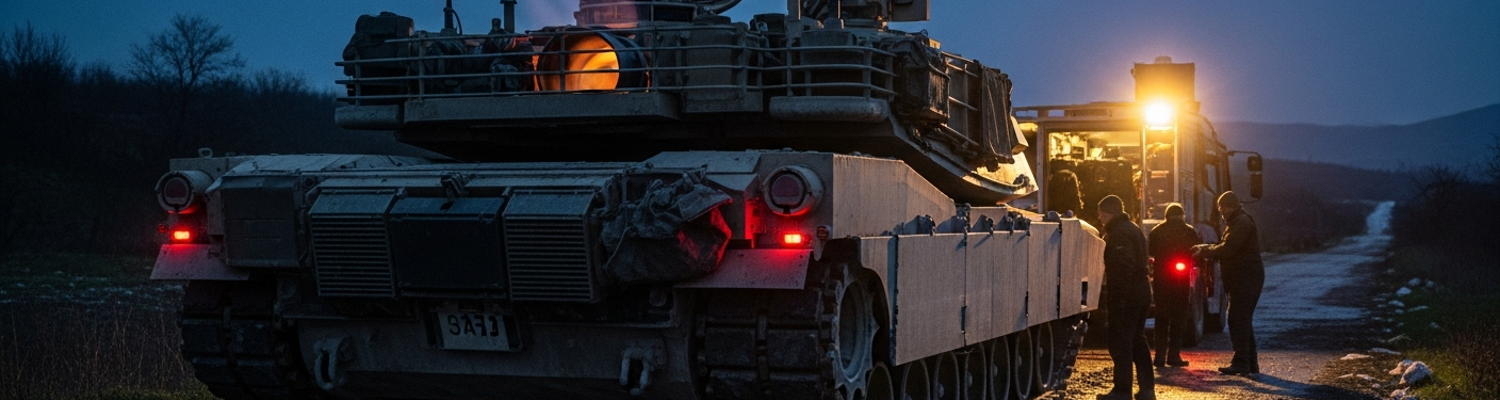

The first sign of trouble was not an explosion but a sound. A high-frequency electrical whine from the turret basket, a steady hum that accompanied the gyroscopic action of the M256 main gun’s stabilization system, suddenly changed pitch. The gunner felt it more than he heard it. A subtle grinding vibration transmitted through the floor plate. Within seconds, a caution light for the stabilization system illuminated his control panel. Operational logs from M1A1 crews deployed with the 1st Armored Division to Bosnia-Herzegovina in late 1995 show this was not an uncommon event. The Cadillac Gage gun turret drive and stabilization system, a complex assembly of hydraulic lines, actuators, and gyroscopes, was notoriously sensitive. In this specific instance, the failure originated in a hydraulic manifold responsible for maintaining pressure to the elevation actuator. The grinding was the sound of the system failing to compensate for a pressure drop. Its delicate equilibrium was lost. The 120mm main gun, now disconnected from the gyros that held it steady, became dead weight, slumping slightly in its cradle and subject only to gravity and the jolts of the terrain.
This mechanical failure occurred within the operational context of Task Force Eagle, the American-led component of NATO’s Implementation Force (IFOR). The unit was on patrol in the Multinational Division (North) sector, navigating a landscape that was the antithesis of what the M1 Abrams was designed for. Instead of the open plains of Central Europe, crews contended with narrow, winding roads cut into steep hillsides and tight, debris-strewn streets in towns bearing the fresh scars of conflict. This environment was brutal on equipment. The constant jostling and vibration of traversing poor road networks and off-road terrain placed immense stress on the tank’s systems. While the Honeywell AGT1500 gas turbine engine had the power to handle the inclines, the fine-tuned components of the fire control and stabilization systems were susceptible to the jarring. The mission was not open warfare but a tense peacekeeping operation where the ability to project overwhelming and precise force was the primary means of deterrence. The sudden appearance of a hostile recoilless rifle or anti-tank guided missile team was a constant possibility, making the ability to fire accurately while on the move a core tenet of crew survival.
The operational impact was immediate. With the stabilization system offline, the tank lost its fire-on-the-move capability, its single greatest tactical advantage over older platforms. A message, laced with static, went back to the platoon commander, informing him that the lead vehicle was now inoperable on stabilization. The gunner could still traverse the turret and elevate the gun, but to deliver accurate fire, the driver would have to execute a short stop. This was a practiced, but dangerously time-consuming, maneuver of coming to a complete halt before the gunner could re-lay the gun and fire. Those seconds, stationary and exposed, were an eternity in a potential ambush zone. The patrol’s posture was instantly compromised. Forward momentum was lost, replaced by a new, cautious calculus of risk. The mission, whether a simple presence patrol or escorting a convoy, was now dictated by the failure of a single hydraulic valve deep within the turret. The entire platoon had to adjust its speed and tactical dispersion, becoming slower and more vulnerable to ensure the crippled lead tank was not isolated. The incident cascaded through the logistical chain, necessitating a report to the maintenance teams at a forward operating base like the one in Tuzla and potentially diverting an M88 recovery vehicle, pulling assets from other tasks.
The constant, punishing vibration of operations in the former Yugoslavia inflicted a peculiar form of torture on the M1A1’s advanced systems. Archival evidence from Task Force Eagle indicates that the very geography conspired against the machine. Unlike the open desert plains for which its systems were refined, the narrow, potholed asphalt roads and unpaved mountain tracks of Bosnia generated a high-frequency, sustained jarring that proved deleterious to the tank’s electronics. The failures were not always as immediate as a loss of gun stabilization. Units reported intermittent faults in the Position/Navigation (POS/NAV) system, the tank’s internal GPS and inertial navigation unit. On a digital map, this manifested as a vehicle icon suddenly jumping to an incorrect location or freezing altogether, a disconcerting event during patrols in regions with poorly marked zones of separation. The same shaking took a toll on the delicate mirrors and sensors of the Commander's Independent Thermal Viewer (CITV) and the driver’s thermal sight, leading to imagery that would flicker, lose focus, or require repeated calibration. Each jolt was a micro-trauma, cumulatively stressing solder joints and connections never designed for this specific pattern of prolonged, uneven movement.
The 1,500-horsepower Honeywell AGT1500 gas turbine engine functions like a massive vacuum cleaner, consuming colossal volumes of air to operate. A component of this process is a bank of air filters, known as the V-pack, designed to prevent dust and debris from entering the turbine core. In the deserts of the Middle East, the system contended with fine, uniform sand. Balkan dust, however, was a different entity entirely. It was a composite of agricultural soil, fine clay from riverbeds, and the pulverized remains of concrete buildings and asphalt roads. This mixture proved especially effective at clogging the filters. Maintenance schedules designed for peacetime exercises or desert warfare were quickly found to be inadequate. Crews reported a tell-tale change in the engine’s sound, a deeper, more labored whine, as it struggled to breathe. If not addressed, this led to a noticeable drop in power and a sharp increase in fuel consumption. The prescribed cleaning procedure involved using the engine’s own pulse-jet system to blow the filters out, a process that had to be performed with a frequency that eroded available time for patrol or rest. A failure to perform this cleaning every 12 hours could result in engine damage, turning a frontline combat vehicle into a maintenance liability requiring a full power-pack replacement.
The operational tempo and harsh surfaces exacted a heavy price on the tank’s running gear. The 1st Armored Division tanks traversing Bosnia accumulated mileage at an accelerated rate. Some vehicles logged 1,500 miles in just four months, a distance they might travel over several years in Germany. This intense usage created a cascade of wear-and-tear failures. The T-158 track, with its replaceable rubber pads, was designed for a mix of terrain but was not optimized for the constant friction of broken asphalt interspersed with abrasive, rocky soil. Maintenance crews at hubs like McGovern Base saw a dramatic increase in the replacement rate of these pads. Beyond the pads, the torque and vibration of climbing steep grades and navigating tight urban corners placed extreme stress on road wheel arms and torsion bars. A common sound on patrol became the sharp crack of a failing torsion bar or the grinding protest of a road wheel bearing disintegrating. Each of these failures represented more than just a mechanical fault; it was a tactical problem that could halt a patrol, create a vulnerability, and send another urgent request down an already strained supply chain for parts that were being consumed far faster than planners had anticipated.
The arrival of the company-level field mechanic, a Specialist carrying the 91A Military Occupational Specialty, was announced by the clatter of his toolkit on the crippled tank’s fender. He moved with a practiced economy, his focus already narrowed to the problem. Maintenance logs from Task Force Eagle show that these initial on-site assessments were a filter, determining whether a vehicle could be returned to service with minor adjustments or if it required the heavy-lift capabilities of an M88 recovery vehicle. The air around the Abrams was thick with the smell of hot metal and the faint, acrid scent of atomized hydraulic fluid. The mechanic’s first actions were procedural. He confirmed the gunner’s report, watching the same stabilization system warning message flicker on the panel. He then attempted to run the system’s Built-In Test Equipment (BITE), a series of internal diagnostic routines designed to isolate faults. The test cycle completed with no definitive error code, a common and frustrating outcome when the failure was mechanical rather than purely electronic. A physical inspection was necessary. Squeezing into the already tight confines of the turret, made more cramped by the crew’s gear, the mechanic began a tactile search, his hands tracing the complex web of hydraulic lines leading from the turret manifold. He found it quickly: a wetness around a junction block for the elevation actuator, the metal stained dark by leaking fluid.
Communicating this finding became the next challenge. The tank commander, using his helmet comms, relayed the mechanic’s initial diagnosis to the platoon leader. The transmission, routed through the platoon’s Single Channel Ground and Airborne Radio System (SINCGARS) net, was a fractured mess of words broken by sharp bursts of static. The mountainous Bosnian terrain played havoc with VHF radio signals, causing multi-path interference where transmissions would bounce off hillsides, arriving at the receiver out of phase and garbled. A request for technical clarification from the platoon leader was met with a prolonged hiss. The tank commander repeated his message, his voice tight with frustration. He had to break down the complex mechanical issue into short, clear fragments that could punch through the interference. Each phrase was a discrete package of information, sent in the hope that enough of it would be pieced together at the other end. This broken dialogue, a routine feature of operations in the region, created significant delays in the decision-making process, stretching minutes into what felt like hours as the isolated crew waited for instructions.
With confirmation that the crippled tank was going nowhere, the focus shifted to improvisation. Field Manuals provided guidelines for battlefield damage repair, but they could not account for every scenario, encouraging mechanics to be resourceful. The 91A specialist, knowing that a proper replacement of the manifold was impossible without depot-level parts, attempted a field-expedient fix. He first tried to tighten the fittings around the leak, hoping the vibration of the patrol had simply worked a connection loose. The wrench turned, but the weeping continued. His next attempt was more desperate. Using a tube of high-pressure sealant from his kit, he meticulously cleaned the area and applied a generous amount around the failed fitting, a common but rarely successful tactic for containing hydraulic pressure. The crew watched in silence as the sealant was given time to cure. When the gunner cautiously reactivated the stabilization system, a fresh spray of hydraulic fluid instantly blew the makeshift patch apart. The internal pressure was simply too great. This final, failed attempt confirmed the initial assessment: the fault was internal to the manifold block and could not be patched. The request went up the chain, layered with more static: the tank required a tow. An M88A1, the 56-ton workhorse of armor recovery units, would need to be dispatched from the nearest forward operating base.
The arrival of the M88A1 recovery vehicle at a forward operating base like the one in Tuzla was only the beginning of a different conflict. Maintenance logs from Task Force Eagle reveal a systemic crisis rooted not in battlefield damage, but in the brittle nature of a high-tech supply chain stretched to its breaking point. Once a crippled M1 Abrams was dragged into a maintenance bay, the problem transitioned from the tactical to the strategic. The Honeywell AGT1500 gas turbine engine, while powerful, was a complex assembly of modules. A failure of a single internal component, such as a cracked turbine blade or a malfunctioning recuperator, theoretically required only the replacement of that specific module.
In Bosnia, these replacement modules were scarce. A request for a specific AGT1500 module would enter a bureaucratic labyrinth. The part was often not available in-theater, nor at the primary U.S. Army Europe depots in Germany. Instead, the entire four-ton power pack would be shipped to a depot like the one at Mainz, where it would join a queue of other dead engines. Technicians there would then have to requisition the specific failed module from a supply system in the continental United States that was no longer geared for rapid wartime production. The part might be pulled from strategic reserves or, in some documented cases, cannibalized from a tank on a training rotation. This created a circular, time-consuming process where a frontline tank in Bosnia was rendered inert for weeks, waiting for a single component to complete a journey across the Atlantic and back.
The tank's fire control system was just as fragile. The digital fire control system was susceptible to the constant, jarring vibrations of Bosnian roads. An examination of supply requisitions from the period shows frequent requests for specific electronic Line Replaceable Units (LRUs), particularly the delicate circuit boards that formed the core of the fire control computer. A field mechanic could run a diagnostic, identify the faulty board, and make the swap, but only if he had a replacement. These were not generic components. Each board was a highly specialized piece of late Cold War technology, often produced by a single defense contractor whose production lines had been significantly scaled back. A request for a new gunner’s primary sight processor board, for instance, would begin a slow journey through the over-taxed military procurement system, a request for an item that was no longer in mass production.
Germany was next door, but the parts were a world away. The fundamental issue was the rapid drawdown of the U.S. military presence in Europe after 1990. The dense, redundant, and robust network of supply depots built to withstand a full-scale war with the Warsaw Pact had been aggressively dismantled. Warehouses were closed, experienced logistics personnel were discharged, and the entire system was streamlined for peacetime efficiency. This post-Cold War framework was fundamentally unequipped to handle the demands of even a limited, high-tempo peacekeeping operation. A truck carrying a transmission component or a new thermal viewer, sourced after weeks of searching, could be delayed for days at a newly established border crossing between Hungary and Croatia, bogged down by customs paperwork and civilian transport contracts. The very structure of the new Europe, which the mission was meant to secure, had become a primary obstacle to sustaining the force.
Maintenance records from the 1st Armored Division’s deployment show that the most significant bottleneck was not the availability of mechanics, but the availability of the right kind of mechanic. The Army of 1995 was shedding its Cold War skin, and with it, the deep, institutional knowledge required to sustain its most complex weapons. A 91A Abrams Tank System Maintainer could diagnose a faulty Gas Turbine Control Unit or a failing laser rangefinder. They were trained to isolate the problem to a single Line Replaceable Unit, or LRU, a sealed black box of electronics, and swap it out. This was the extent of their charter. They were not trained, nor equipped, to open that box and repair the delicate circuit boards inside. That level of work was the domain of a shrinking cadre of senior warrant officers and civilian contractors, the very experts whose numbers had been aggressively reduced during the force drawdowns in Europe.
This personnel gap fed a far larger crisis in the supply chain. When a field mechanic in Tuzla requisitioned a new fire control processor board, the request entered a system that was no longer built for war in Europe. During the Cold War, vast depots in Germany held mountains of spares, ready to push forward to counter a Soviet invasion. By 1995, most of those depots were shuttered, their contents shipped home or disposed of. A search of the U.S. Army Europe theater inventory for the part would often come back empty. The request then had to jump the Atlantic, routed to a stateside facility like the Anniston Army Depot in Alabama. There, the part might be pulled from a tank being rebuilt from long-term storage or, in some cases, cannibalized from another vehicle. The United States had not produced a new M1 Abrams hull since the early 1990s; the entire fleet was sustained by stripping down and rebuilding older models.
Once a part like a new transmission pack or thermal sight was finally located, packaged, and shipped, it began its final, torturous journey back to the Balkans. The infrastructure of the former Yugoslavia was in ruins. Main Supply Routes, or MSRs, were tenuous lifelines dictated by which bridges were still standing and which roads had not been cratered by years of fighting. The main crossing into Bosnia for Task Force Eagle was a massive pontoon bridge thrown across the Sava River because the permanent structure had been destroyed. Convoys moved slowly, cautiously. A single truck, contracted under the Logistics Civil Augmentation Program, or LOGCAP, could be delayed for days at the new international border between Hungary and Croatia, mired in customs paperwork that was a non-issue just a few years earlier. This bureaucratic friction, a direct consequence of the political fragmentation the mission was there to manage, became a primary impediment to combat readiness. The sound of a broken tank was no longer just grinding gears; it was the deafening silence of a supply request lost in a system hollowed out by peace.
Operational records from Task Force Eagle reveal a persistent friction that had nothing to do with terrain or enemy action. When an M1 Abrams suffered a significant component failure, a faulty Gas Turbine Control Unit, for instance, the process for acquiring a replacement was a multi-stage bureaucratic marathon. It began on paper, with the crew chief filling out a DA Form 2404, the Army's standard Equipment Inspection and Maintenance Worksheet. This document, detailing the deficiency, would be signed by a maintenance supervisor and then transcribed into the Standard Army Maintenance System, or SAMS-1. From there, the request for a new part began its slow ascent. The digital requisition had to be validated at the battalion level, then approved by brigade logistics. Each step was an opportunity for delay, a point where an officer or senior NCO, juggling competing demands from dozens of other vehicles, could question the priority or request further justification. A tank deadlined in a maintenance bay at Tuzla was just one line item on a sprawling digital spreadsheet, its urgency diluted by distance and administrative procedure.
This was a system designed for a peacetime army, not a force on a high-tempo operational footing.
Political directives originating far from Bosnia exerted a powerful influence on this already sluggish system. Senior NATO and U.S. political leaders, needing to project an image of overwhelming strength and competence to enforce the Dayton Accords, placed pressure on commanders to maintain high operational readiness rates. A unit’s readiness, reported as a percentage of its vehicles ready for mission, became a key political metric. A brigade commander under pressure to report a 90% operational rate would allocate scarce, high-demand parts, like complete AGT1500 engine power packs or fire-control system computers, not necessarily to the tank that had been waiting the longest, but to the one that could be returned to service the fastest or whose absence was most visible. This created a shadow system of resource allocation, where a tank from a company slated for a visible patrol near a sensitive boundary line might receive a new transmission overnight, while another Abrams with the same issue, but in a less critical sector, was pushed to the back of the queue. The flow of parts for M1 Abrams repairs was often dictated by the need to manage perceptions in Washington and Brussels as much as by tactical necessity on the ground.
The official system’s failure forced the adoption of unsanctioned solutions. When a part was stuck in the supply chain for weeks, maintenance sections resorted to cannibalization. A specific M1 Abrams, often one with multiple hard-to-fix issues, would be designated as a hangar queen. A functioning thermal sight module would be stripped from the donor tank to get another Abrams back on patrol. A fuel pump from one engine would be pulled to fix another. Technical manuals for battlefield damage assessment and repair even provided guidelines for such expedient fixes, a tacit acknowledgment that the official system could not always be relied upon. This practice, while effective in the short term, carried significant risks and downstream consequences. Constant cannibalization created an administrative nightmare of incomplete records and could lead to a cascade of further mechanical issues. In more extreme cases, mechanics fabricated solutions entirely outside of doctrine, using welding torches to repair cracked suspension components designed to be replaced or splicing commercial-grade wiring into military-spec harnesses, creating the potential for catastrophic electrical failures. A welded road wheel arm, glowing cherry-red in the dark of a maintenance tent, became the physical manifestation of a supply chain’s collapse.
1st Armored Division maintenance records from Operation Joint Endeavor reveal a disconnect between reported readiness and the condition of the M1 Abrams fleet on the ground. The pressure from NATO command to maintain high operational readiness rates for political presentation created a system where tanks were reported as mission capable when they were, in fact, severely compromised. A vehicle with a flickering or non-functional thermal sight, for instance, might be counted as ready, though its ability to function at night or in adverse weather was gone. The same was true for tanks with intermittent faults in their stabilization or navigation systems. This practice created a paper-thin readiness that looked robust on briefing slides in Brussels but was dangerously brittle on the narrow roads of the Bosnian Zone of Separation.
The direct consequences manifested in a constant struggle against the machines themselves. The Honeywell AGT1500 gas turbine engine proved exceptionally vulnerable. Its appetite for air meant its filters were constantly being clogged by the unique Bosnian mixture of soil, clay, and pulverized concrete dust, requiring cleaning intervals far more frequent than doctrine dictated. Failure to do so would starve the engine, leading to a loss of power and potential turbine damage. Track pads, designed for a mix of terrain, were chewed apart by the broken asphalt of main supply routes, with some vehicles requiring pad replacement at a rate ten times higher than anticipated. Each of these failures, small in isolation, accumulated into a significant drain on maintenance resources and crew endurance, eroding the division’s actual combat power one component at a time.
Specific missions were dictated not by command intent, but by equipment limitations. A patrol from the 1st Squadron, 1st Cavalry, could find its entire scheme of maneuver undone by a single tank suffering a track failure on a tight mountain road. The column would halt, exposed, while mechanics worked to replace the damaged track section. Forward momentum was lost. The operational timeline, carefully planned at headquarters in Tuzla, became irrelevant. A quick reaction force, put on alert to respond to a violation of the Dayton Accords, might find its departure delayed because an M1's fire control computer refused to initialize, the result of countless vibrations taking their toll on delicate electronics. These delays had tactical consequences, creating windows of vulnerability and forcing commanders to constantly re-evaluate risk based on the state of their aging, over-stressed equipment. The crossing of the Sava River in December 1995 was a triumph of engineering, but it delivered the 1st Armored Division’s tanks into an environment that would wage a relentless war of attrition against them.
The deployment to Bosnia exposed the fragility of the post-Cold War logistical structure. The vast, redundant network of spare parts depots in Germany that had been built to sustain a war with the Warsaw Pact had been dismantled. Now, a request for a component, like a complete AGT1500 power pack or a specific electronic Line Replaceable Unit, could not be filled in-theater. The request would have to travel across the Atlantic to a depot in the United States, often Anniston Army Depot, where it would join a queue. This process could take weeks or months, leaving a multi-million dollar tank inert for want of a single part. This reality forced the widespread, unofficial adoption of cannibalization. Units designated specific, hard-luck tanks as hangar queens, stripping them for parts to keep other vehicles in the fight. This practice, while a short-term solution, wrecked maintenance records and ultimately reduced the total number of repairable hulls in the Army’s inventory, sacrificing the long-term health of the fleet for the immediate needs of a grueling peacekeeping mission.