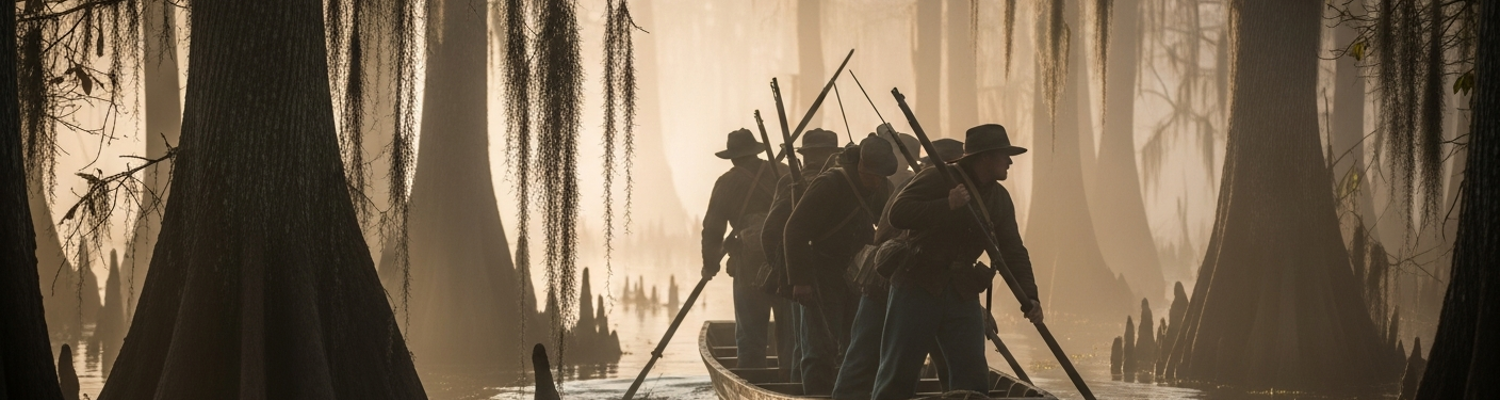

The Soundless Battlefield
The United States Army marched into the Florida territory confident in its doctrine. Forged on the open battlefields of the War of 1812 and honed in campaigns against Native American confederacies in the Old Northwest, its commanders understood warfare through a European lens. This framework depended on rigid formations, disciplined volley fire, and above all, clear communication. Drummers beat the long roll to signal an advance. Buglers sounded crisp, unambiguous calls for charges, skirmishes, and retreats. Officers on horseback used flags and hand signals to maneuver regiments across fields of fire. These were the instruments of command, the auditory and visual sinews that held the army together as a cohesive fighting force. When President Andrew Jackson ordered the enforcement of the Indian Removal Act of 1830, the Army expected a swift, conventional campaign against the Seminole people. Florida, however, would not provide a conventional battlefield. The territory itself became the primary antagonist, an active and suffocating force that systematically dismantled the Army's entire system of command and control before the first major shot was fired.
The Second Seminole War, which erupted in earnest in 1835, plunged the Army into a world for which it had no preparation. The subtropical wilderness was a labyrinth of cypress swamps, sawgrass prairies stretching to the horizon, dense hardwood hammocks, and winding blackwater rivers. This waterlogged, profoundly flat terrain immediately and completely neutralized the Army's standard signaling toolkit. The dense, layered canopy of the cypress domes and hammocks, thick with Spanish moss, absorbed visual signals entirely. A company of infantry could become separated from its main column by a mere hundred yards of palmetto scrub and be as blind to one another as if separated by a mountain range. The constant, oppressive humidity and the soft, absorptive quality of the muck, vegetation, and water-saturated ground deadened sound with shocking efficiency. A drumbeat that could carry for a mile across a firm Virginia field became a dull, useless thud within a few dozen yards. The sharp, brassy notes of a bugle, designed to cut through the din of battle, were swallowed by the swamp, their calls distorted and lost. Even a man's shout was muffled, soaked up by the sheer mass of wet leaves, wood, and water. This environmental silencing created a unique form of operational paralysis and psychological dread for the soldiers and their officers.
An Environment of Ambush
The Florida landscape actively worked against organized military effort. Columns marching on poorly charted trails became separated with alarming ease, unable to reestablish contact. A small unit, ambushed by Seminole warriors who moved through the terrain like ghosts, could fight and die in complete isolation. Its desperate volleys and cries for help would go unheard by a potential relief force just a short distance away.
The ultimate expression of this isolation occurred on December 28, 1835. Major Francis L. Dade led a column of 107 soldiers on a march from Fort Brooke (modern Tampa) toward Fort King (modern Ocala). As they marched through open pine woods bordered by thick palmetto, Seminole warriors initiated a devastating ambush. The soldiers formed a small defensive breastwork of logs, but they were alone. For hours they fought, completely cut off. No sound of their battle reached any other Army unit. By the end of the day, all but three of Dade's command were dead. The Dade Massacre became a chilling demonstration of the war's new reality. Victory would not depend on the size of an army, but on its ability to navigate and communicate within a landscape that broke armies into isolated, vulnerable pieces.
The physical properties of the environment were relentless. The sawgrass of the Everglades, with blades sharp enough to cut through canvas and leather, grew in water that could be inches or feet deep, concealing a treacherous limestone bedrock below. A line of advancing infantry would lose all cohesion as men struggled through the muck, their movements dictated by the terrain, not by their officers' commands. Visual signaling was impossible in this flat, grassy sea. Sound carried erratically, sometimes skipping across the water's surface in one direction while being completely deadened in another. In the dense mangrove tangles of the coast, visibility was often reduced to less than twenty feet. The intertwined roots and branches formed a physical barrier that was nearly impenetrable, forcing soldiers to hack their way through, one man at a time. In such conditions, a company ceased to be a military unit and became a collection of individuals, each fighting his own private battle against the vegetation.
Signals Born of Swamp Water
Cut off from their regulation methods, Army units began a painful, bottom-up process of adaptation. This was not a strategy dictated by the War Department in Washington. It was an evolution born of desperation in the field, driven by company-grade officers and senior non-commissioned officers who saw their men dying because of failed communications. They observed their Seminole adversaries and their own Creek and Delaware scouts, who used a subtle, nature-based communication system. A particular bird call, mimicked perfectly, could signal that a path was clear. A single, carefully placed column of smoke from a specific high point in the piney woods could alert scattered bands to a gathering point. The Army's attempts to copy these methods were clumsy but essential.
The most common ad-hoc signal was controlled smoke. A detachment pinned down by an attack could burn a pile of damp vegetation, sending up a thick plume of white smoke. This was not a complex message. It was a simple, desperate beacon that screamed, "We are here, and we are in trouble." Some units developed rudimentary codes. A single puff of smoke might mean 'enemy sighted,' while two puffs could signal 'rendezvous at this location.' These systems were crude and unreliable. A sudden rainstorm could extinguish the fire. A shift in the wind could disperse the smoke or send it in the wrong direction. Most dangerously, the smoke column that signaled a friendly unit could also serve as a perfect targeting marker for the Seminoles. Buglers also improvised. Unable to use their standard calls, which the Seminoles quickly learned to interpret, they worked with their commanders to create non-regulation signals. A simple, unique three-note sequence might mean 'form a defensive circle,' a call that would be meaningless to the enemy. At night, some units experimented with Congreve rockets, not as weapons, but as pyrotechnic signals. Fired into the air, their brief, bright flare could be seen for miles over the flat terrain, serving as a crude 'all clear' or 'danger' signal to distant forts or naval patrols, though their scarcity and weight made them a logistical burden.
Command, Control, and Chaos
The success or failure of these improvised signals directly shaped the outcomes of engagements across the Florida peninsula. The network of over one hundred small forts established by commanders like General Thomas Jesup and Colonel Zachary Taylor was intended to serve as a web of supply depots and communication hubs. In reality, they were often isolated, fever-ridden outposts. Communication between them relied on perilous journeys by horse-mounted messengers who were frequently ambushed. The ability of a column in the field to communicate with its base or with other pursuing columns was a matter of life and death.
The Battle of Lake Okeechobee on Christmas Day, 1837, stands as a stark example of command breakdown even with the commander present. Colonel Taylor's force of nearly 1,000 men attacked a strong Seminole position along the lake's shore. As the main assault began, the 6th Infantry plunged into sawgrass and mud that was waist-deep. Command and control vanished almost instantly. Companies became intermingled and disoriented. Officers' shouts were lost in the chaos and the thick vegetation. The soldiers, fighting as individuals rather than a coordinated line, suffered grievous casualties from the well-concealed Seminole warriors. Though Taylor's forces eventually took the position, the Seminoles inflicted disproportionate losses before slipping away into the Everglades, their escape facilitated by their ability to disperse and regroup without complex signals.
Conversely, small-scale successes often hinged on a single, successful signal. General Jesup's strategy of breaking his army into smaller, more mobile 'flying columns' depended entirely on their ability to coordinate. An officer's journal from this period describes a company using a series of pre-arranged, spaced-out rifle shots to warn a sister company of a Seminole party moving to flank them through a dense hammock. The timely warning allowed the second unit to shift its line and repel the attack. Riverine operations provided other examples. Supply boats navigating the St. Johns or Kissimmee rivers used smoke from their funnels or hoisted colored flags on poles to communicate with shore parties. A puff of black smoke might signal 'ambush ahead,' while a red flag could direct the land-based element to a suitable crossing point. These small, tactical victories, born from improvised communication, were the building blocks of the Army's eventual, grinding pacification of the region. The war was not won in a single battle, but through thousands of such small, brutal encounters where a successful signal meant survival and a failed one meant disaster.
A Hard Lesson in Adaptability
The long, costly struggle in Florida's swamps was a crucible for the U.S. Army. It burned away outdated, European-centric doctrine and forced the institution to confront the realities of irregular warfare. The failure of traditional communication methods was total and undeniable. The solutions were not found in technological manuals or West Point textbooks. They were invented on the spot by soldiers and junior leaders fighting for their lives. The war taught the Army a hard lesson in adaptability. It underscored the necessity for decentralized command, where small units could operate with a degree of autonomy because they could not rely on constant contact with a higher headquarters.
The experience in Florida, though brutal and often mismanaged, planted the seeds of a new way of thinking about military communication. It was a shift away from the rigid signals of the parade ground and toward the flexible, resilient, and multi-faceted methods required to fight and win in complex, unforgiving environments. The muffled drums in the Everglades were a quiet but profound signal of the changes to come.