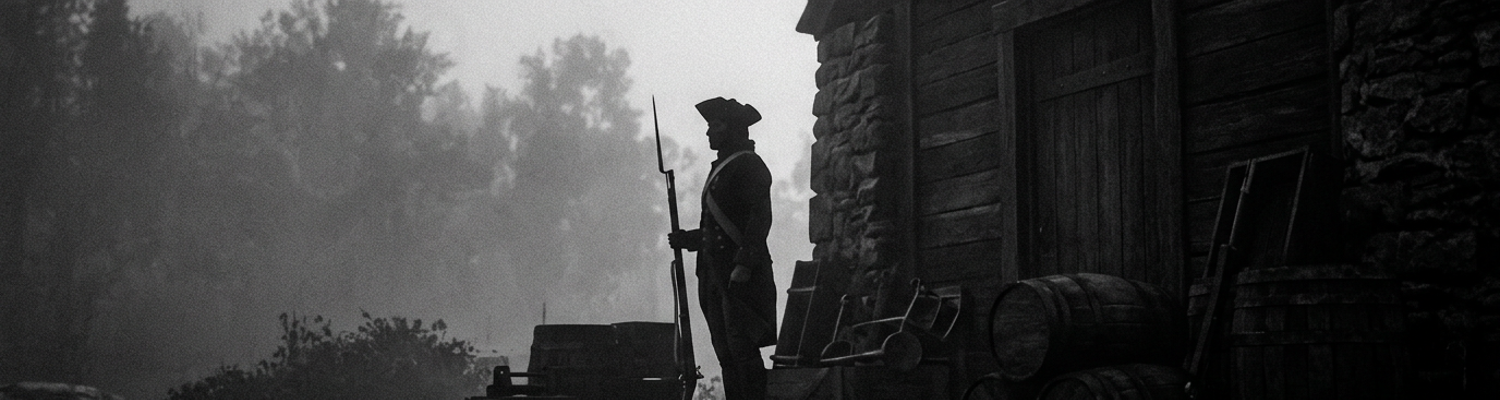

Post-Revolutionary Decay in Continental Army Arsenals
Archival evidence shows an exact accounting of the primary ordnance deposited across the northern department by late 1783. Four hundred and thirty-eight iron twenty-four-pounders. Two hundred brass twelve-pounders cast at Springfield. Ninety-six eight-inch siege howitzers. Forty thousand stands of French Model 1777 muskets. Roughly seven thousand wood-slatted casks held over four hundred tons of glazed black powder.
Each standard cask contained one hundred pounds of unstable propellant. The mixture required a ratio of seventy-five parts potassium nitrate, fifteen parts charcoal, and ten parts sulfur.
Distributed across depot points along the Hudson and Delaware river valleys, this material possessed enough explosive force to level major port cities on the eastern seaboard.
Congress left this stockpile of munitions entirely unattended.
A close review of operational logs indicates that on June 2, 1784, the Confederation Congress passed a resolution disbanding the remaining infantry regiments of the Continental Line. The entire national standing army shrank to eighty privates and a handful of junior officers. Twenty-five enlisted men received orders to secure Fort Pitt along the forks of the Ohio River. Fifty-five caretakers remained responsible for the complex fortifications and redoubts at West Point overlooking the Hudson.
The sprawling regional depot network across Pennsylvania and New York retained zero federal soldiers. This included the magazine compounds at Carlisle, the supply depots in Albany, and the municipal yards in downtown Philadelphia.
At Carlisle Barracks, cedar shingles rotted through during the torrential rains of May 1784. Water cascaded directly onto thousands of linen-wrapped musket cartridges and bulk wooden kegs. Moisture dissolved the potassium nitrate bindings. Volatile gunpowder turned into inert sludge or produced brittle, friction-sensitive crusts across floor beams. State executives in Albany and Philadelphia refused to assign local militia companies to picket duty. They pointed to depleted state treasuries, worthless Continental currency, and unresolved soldier pay disputes.
The operational burden of these decaying compounds collapsed onto one man.
When examining the historical record of the Department of Military Stores, Samuel Hodgdon exercised authority as Commissary General of Military Stores. His supply apparatus lacked the basic manpower to function. Hodgdon operated from an unventilated Philadelphia office. He held legal liability for securing hundreds of tons of wartime ordnance dispersed across hundreds of miles of poorly mapped territory.
Department guidelines required weekly rolling of oak powder casks to prevent the chemical settling of sulfur and charcoal. This operational standard broke down completely. Subalterns found themselves working alone in temperatures exceeding ninety-five degrees.
Vaults built below river grade along the Schuylkill filled with heavy sulfurous dust. This caused severe respiratory spasms and corneal swelling among the few civilian caretakers Hodgdon hired on personal credit.
Operational reports from subalterns stationed along the Mohawk and Delaware river corridors detail broken iron barrel hoops and split staves leaking black grains into dirt corridors. Nightly perimeter alarms became standard.
Sentries suffered profound sleep deprivation. They sat on powder crates in absolute darkness to avoid introducing lantern sparks. They listened to civilian scavengers pry iron fittings from surrounding wagons.
One incident in late August 1784 near Easton ended when an exhausted guard mistook a relief clerk for an intruder. He discharged a French-made carbine into his chest at point-blank range.
Hodgdon spent the following morning filing casualty paperwork and inventorying thirty punctured barrels of wet saltpeter.
Samuel Hodgdon and the Demobilization Directives
A close review of operational logs indicates that on May 31, 1784, Hodgdon issued emergency directives to regional depot commanders at Carlisle, Philadelphia, and West Point. Working by candlelight in his rented office on Philadelphia Market Street, the Commissary General dispatched riders with express instructions. They needed to fortify storage magazines against their own garrison troops.
Depots received orders to implement round-the-clock watches. They had to double-lock timber-reinforced magazine doors. Powder handling was stripped down to non-ferrous bronze tools.
Captain Joseph Stiles in Philadelphia received instructions to transfer thirty tons of loose powder from water-damaged cellars along the Delaware River to dry brick vaults inland.
At West Point, Major Sebastian Bauman received orders to survey the stone magazines tucked into the granite palisades above Constitution Island. Decaying wooden floorboards threatened to drop four hundred barrel casks onto jagged rock.
The message sent to Carlisle Barracks ordered the immediate sorting of wet powder batches. This aimed to prevent spontaneous heating from decomposing sulfur and saltpeter.
Hodgdon instructed his subalterns to impound all government draft horses. This stopped departing teamsters from seizing harness leather and wagons as back pay (NARA Record Group 93).
No money accompanied the couriers.
When examining the historical record of depot workbooks, the physical breakdown of these storage compounds accelerated through early summer. Ordnance subalterns stationed in the subterranean vaults at Carlisle worked eighteen-hour shifts in complete blackness. The site sat at forty degrees twelve minutes north latitude in Cumberland County.
They used horn lanterns with oiled paper windows. Naked flames or iron lanterns risked igniting airborne carbon dust.
Summer humidity saturated the wooden casks. White oak staves swelled until rusted iron hoops sheared off with loud cracks in the enclosed corridors.
Subalterns dragged three-hundred-pound copper-hooped barrels across gravel floors by hand. Civilian laborers had abandoned the worksite over eight months of unpaid wages.
At the Philadelphia laboratory compound, volatile fumes caused chronic nosebleeds, burning throat inflammation, and temporary blindness. Three remaining teenage apprentices were assigned to repack leaky cartridges.
Hodgdon demanded daily counts of copper tacks, dry-cask lids, and leather shoe covers. He wanted to eliminate spark-generating iron boot nails in the magazine corridors.
The entire supply apparatus ran on raw physical exhaustion.
Archival evidence shows that the orders preceded the June 2, 1784 congressional resolution. That measure formally disbanded the remaining regiments of the Continental Army by just forty-eight hours. Delegates sitting in Annapolis passed the measure with no contingency funding for ordnance security. They reduced the active army to eighty enlisted men. They abolished the regiments guarding these munitions before Hodgdon couriers reached their destinations.
The twenty-five soldiers detailed to Fort Pitt and fifty-five retained at West Point had to secure millions of dollars of French-supplied military hardware across three states.
Knowing the pending disbandment would dissolve all military discipline, Hodgdon drafted his orders to preempt widespread desertion and armed plundering. Soldiers had received neither pay settlements nor transportation home.
Paranoia overwhelmed the skeleton crews left behind.
At Carlisle, an exhausted corporal guarding the south powder magazine fired his musket into the perimeter brush at midnight on June 3. He struck a stray calf. This triggered a panic that kept the remaining four guards under arms for thirty-six consecutive hours.
Captain Stiles reported from Philadelphia that his depot guards consisted of two invalid veterans and an artillery sergeant suffering from recurring malaria.
Epidemic Disease Among Skeleton Depot Garrisons
A close review of operational logs indicates that by July 1784, fewer than one hundred enlisted caretakers remained on active duty across the primary ordnance depots of the United States. Following the structural liquidation of the Continental Army, muster rolls at Springfield Armory, Carlisle Barracks, Fort Pitt, and the Philadelphia storehouses shrank to fragmented squads of three or four men each.
Regional superintendents found themselves guarding millions of pounds of explosive stores with work details that could barely carry an empty powder chest.
At Fort Pitt, positioned at forty degrees twenty-six minutes north latitude, twenty-two active-duty soldiers of the newly styled First American Regiment answered morning roll calls. Three lay incapacitated with dysentery.
The Philadelphia magazine complex retained six caretakers. Four were classified as non-effective due to chronic lameness and unhealed wartime wounds.
These skeletal teams had to manually ventilate damp cellars, turn thousands of water-bloated white oak powder casks, and patrol perimeter palisades against civilian thieves.
Iron strapping on the carriage timbers rotted in the sun. Brass elevating screws seized solid inside their rusted brackets. No grease crews existed to service them.
Depot security across five states fell to eighty-seven able-bodied men.
Archival evidence shows that environmental contamination rapidly broke the few men left standing at West Point. Situated at forty-one degrees twenty-three minutes north latitude, the Hudson Highlands post anchored the northern defense line. Recurrent smallpox outbreaks and summer fevers incapacitated garrison detachments throughout July and August.
Out of the fifty-five caretakers assigned to Major John Doughty artillery company at the post, thirty-one were hospitalized by midsummer. They suffered from virulent pustular eruptions or daily bouts of shaking chills.
Mosquitos breeding in the stagnant marshes surrounding Constitution Island spread intermittent tertian malaria through the unscreened barracks at Fort Clinton.
Medical officers had neither Peruvian cinchona bark for fevers nor clean lint to dress ruptured pox lesions. Men scratched their infected skin until secondary staphylococcal infections set in. This swelled their limbs and rendered them incapable of gripping a bayoneted Model 1777 musket.
Smallpox pustules invaded the throat and lungs of invalid guards. Field surgeons isolated the infected in drafty pine sheds on the lower river flat. This stripped the main garrison of another seven experienced sentries.
Sentry rotations disintegrated completely.
When examining the historical record of West Point duty rosters, surviving corporals could no longer sustain standard two-hour watches across the redoubts. Sentry posts atop Fort Putnam, situated four hundred feet above the Hudson River on sheer granite cliffs, were abandoned between midnight and dawn. Relief detachments failed to muster.
The few soldiers capable of walking hauled their cartridge boxes through driving rainstorms. They stood continuous sixteen-hour vigils outside the Great Chain magazine.
Sleep deprivation induced waking hallucinations among guards watching the perimeter hemlocks.
On July 19, an exhausted sentry guarding Magazine Number Four collapsed into an epileptic fit brought on by a hundred-and-four-degree fever. He dropped his loaded weapon across the threshold. The flint struck the granite footing without discharging into the floorboards. It left the copper padlock unlatched and the cedar door ajar for five hours. A morning work detail found him unconscious in the brush.
Major Doughty reported directly to Hodgdon that three consecutive guard reliefs had failed to post. Every corporal in the garrison was either bleeding from smallpox sores or vomiting bile in the hospital shed.
Atmospheric Degradation of Confederation Gunpowder Reserves
Archival evidence shows that during the suffocating heatwaves of July 1784, ambient temperatures inside the uninsulated timber storehouses at Albany, New York, reached one hundred and four degrees Fahrenheit. Stationed at forty-two degrees thirty-nine minutes north latitude, an exhausted ordnance subaltern surveyed seventy-four thousand pounds of domestic and French-manufactured gunpowder. It deteriorated beneath rotting white pine roofs.
State governments had abandoned depot repairs in late 1783 due to empty regional cashboxes.
Violent summer cloudbursts repeatedly penetrated split roof shakes. They dumped hundreds of gallons of rainwater directly onto stacked white-oak casks.
Continental powder specifications called for a seventy-five percent potassium nitrate composition. This exceptionally high saltpeter ratio was designed for rapid combustion in siege artillery.
Rain saturated the unsealed barrel staves. The top tiers of dry grain turned into heavy, tar-like muck. Lower casks collapsed under the dead weight of waterlogged wood above them.
Split wooden hoops snapped under pressure as wet timber expanded. Black, muddy wash drained out of cracked barrel heads. It soaked depot floorboards and permanently dissolved the propellant value of two hundred separate powder lots purchased with wartime French loans.
Water destroyed seventy tons of frontline ordnance in eight weeks.
When examining the historical record of depot maintenance logs, the chemical breakdown of the surviving powder barrels posed an even more dangerous hazard than outright dampness. In the subterranean brick vaults of the Philadelphia arsenal, poor ventilation trapped heavy, moisture-saturated air against the stone floors.
Deliquescence set in rapidly across hundreds of half-empty storage casks. Potassium nitrate actively absorbed ambient water vapor from the humid cellar atmosphere. It separated completely from the mixed charcoal and sulfur elements.
This chemical migration leached pure saltpeter outward. It deposited dense, white crystalline sheets across exterior stave gaps and iron hoops.
Inside the barrel cores, the leaching left behind unstable, carbon-rich and sulfur-dense sediments. These depleted residues dried into friction-sensitive pockets prone to rapid ignition from mechanical shock.
Subalterns crawling into the dark vaults to inspect the barrels found the air thick with sulfur fumes. The gas irritated eyes, provoked nosebleeds, and burned throat tissue.
Rolling a hooped cask across the gritty stone pavers created a lethal friction hazard against dry potassium nitrate crusts lodged in the chime rings.
Every footstep risked triggering an uncontained blast.
A close review of operational logs indicates that psychological exhaustion rapidly unraveled the few junior officers ordered to monitor these volatile subterranean magazines. At Carlisle Barracks, an ordnance subaltern spent six straight weeks rotating seventy-pound casks by hand in total darkness to disrupt the settling chemicals.
Working without tallow candles or horn lanterns to avoid airborne dust ignition, caretakers moved through damp limestone corridors entirely by touch.
Subalterns developed severe respiratory inflammation. They coughed up black soot and complained of blinding headaches brought on by airborne sulfur dust in eighty-five-degree cellar heat.
Sustained isolation produced paranoid waking states. Guards on nighttime perimeter watches mistook windblown fence palings for armed looters. Skeletal depot detachments remained under continuous alarms.
On August 11, two sentries stationed at the north magazine gate fired simultaneously into the darkness at what they believed was an advancing raiding party. They killed a civilian teamster draft horse and drove five musket balls through a storehouse wall sixty yards from twenty tons of chemically decomposed powder.
Hodgdon received the Carlisle incident dispatch three days later. It arrived alongside an invoice for ninety-two ruined casks condemned as inert saltpeter sludge.
Volatile Powder Vaults and Accidental Detonations
A close review of operational logs indicates that by mid-August 1784, structural failure within the Carlisle Barracks magazines transformed ordinary storage bays into enclosed detonation chambers. Hundreds of white-oak barrels shrank under dry summer heatwaves. The staves separated by as much as a quarter of an inch. These barrels were assembled during the war with unseasoned timber and cheap split-ash hoops.
Fine-grain black powder sifted through these gaps. It coated the masonry floors in a continuous layer of combustible sediment.
Sulfur dust accumulated in the chime rings and iron hoop joints. This dust possessed an ignition threshold near two hundred and fifty degrees Celsius.
Vault atmospheres lacked draft ventilation. Airborne particulate matter became trapped in dense clouds that settled across stone sills, copper door latches, and wooden floorboards.
Dragging an ungreased hundred-pound cask across grit-covered flagstones generated enough friction to spark the dry sulfur concentrations lodged in the timber crevices.
On August 14, two caretakers attempted to shift ten barrels away from a leaking northern wall. A rusted iron hoop scraped against exposed limestone. This triggered a localized flash fire.
The resulting deflagration consumed twenty pounds of loose floor dust in a fraction of a second. Both men suffered thermal burns over eighty percent of their bodies. Three stacked kegs caught fire. Both men suffocated in the unventilated air.
Static friction against loose sulfur dust produced instant deflagrations in the sealed vaults.
Archival evidence shows that junior officers tasked with executing Hodgdon directives faced severe hazards inside the ordnance laboratories at Philadelphia and Carlisle. Hodgdon issued written orders demanding that all damp, moldering paper musket cartridges be broken down. Caretakers had to reclaim sixty-nine-caliber round balls and sift salvageable powder through brass-wire screens.
Personnel detailed to execute these directives were raw subalterns and convalescent sergeants shivering from tertian malaria and gastrointestinal infections.
Physical tremors compromised manual dexterity during powder handling. Severe mental fog brought on by sustained summer fevers worsened the situation.
At the Philadelphia laboratory on August 22, an unranked ordnance subaltern attempted to unroll swollen French paper cartridges. He dropped an iron scraper onto a zinc sorting bench.
Mechanical impact ignited a six-pound open tray of loose rifle propellant positioned directly between his knees.
The blast shattered the heavy pine workbench. It drove wooden splinters, unseated lead balls, and burning paper fragments into his face and chest. Blast trauma severed his left radial artery, ruptured both tympanic membranes, and tore open the timber sash windows of the workshop.
Unsteady hands handling sensitive black powder cartridges turned routine depot maintenance into severe traumatic casualty events.
When examining the historical record of depot workbooks, Hodgdon administrative pressure accelerated these operational disasters across multiple posts. Depot circulars demanded complete cartridge reclamation without supplying non-sparking bronze implements. Caretakers improvised with iron pliers and rusted pocketknives.
Subalterns stationed at Albany recorded seven separate accidental flashes in the span of three weeks. Friction during the manual sorting of corroded paper packets caused each one.
In one incident on September 2, an ordnance conductor suffering from recurring chills crushed a dry primer crust against an unplaned table edge. This triggered an immediate explosion that ignited forty pre-measured charges.
Expanding combustion gases collapsed an interior pine partition. Falling ceiling joists crushed two civilian laborers. The supervising lieutenant sustained third-degree thermal burns across his arms and neck.
Hodgdon recorded the loss of three skilled ordnance subalterns in his September ledger alongside an order for forty replacement copper shovels.
Sentry Paranoia and Perimeter Fratricide Incidents
A close review of operational logs indicates that by mid-August 1784, guards assigned to remote magazine compounds had gone fourteen consecutive months without receiving hard coin. Paymaster General accounts held zero cash. Promissory notes issued by Robert Morris traded among local merchants at fifteen percent of face value.
At Carlisle Barracks, positioned at forty degrees twelve minutes north latitude in the Cumberland Valley, caretakers lacked shoes, clean shirts, and basic meat rations. Men survived on weevil-infested cornmeal and stagnant well water.
Physical isolation in the dense Pennsylvania brush severed depot detachments from civil authority. This bred open insubordination among the eight invalid soldiers surviving on the muster roll.
On August 18, two corporals armed with French Model 1777 muskets confronted an ordnance subaltern outside the south gate. They leveled their bayonets. They refused to mount perimeter guard until back wages were delivered in silver.
The subaltern attempted to place both men in irons. The other six caretakers shouldered their weapons, forced the release of the prisoners, and dismantled the guardroom stove for scrap metal.
Insubordinate detachments across New York and Pennsylvania routinely pried lead counterweights from depot scales. They traded fifty-round cartridge boxes to frontier settlers in exchange for whiskey, salt, and tobacco.
Command authority collapsed into armed defiance.
Archival evidence shows that chronic isolation and continuous duty rotations drove the surviving depot sentries into severe physical and cognitive breakdown. Skeleton detachments at West Point maintained twenty-four-hour perimeter watches without relief for five straight days. The post sat at forty-one degrees twenty-three minutes north latitude.
Prolonged sleep deprivation triggered acute auditory and visual hallucinations among caretakers posted along the outer granite redoubts. Recurrent bouts of tertian malaria compounded the issue.
Thick nighttime fog rolling up from the Hudson River distorted silhouettes against the tree line. Wind-whipped mountain laurel bushes transformed into advancing bands of armed scavengers in the minds of the guards.
Sentry watches were performed in complete darkness to avoid providing target markers to civilian marauders operating around Constitution Island.
Finger muscles cramped solid against iron trigger guards. Nervous exhaustion produced rapid trigger responses to routine wilderness sounds.
Delirium turned routine perimeter patrols into fatal combat zones.
When examining the historical record of Hudson Highlands post records, this psychological disintegration culminated in an armed friendly fire skirmish in the early hours of August 29.
At zero two hundred hours, an invalid private standing guard outside Magazine Number Two atop the Fort Putnam ledge heard heavy footsteps cracking dry hemlock brush along the supply path. Shivering from a hundred-and-three-degree fever and hallucinating, he bypassed the standard military challenge for a countersign. He brought his French-made flintlock to his shoulder and discharged a sixty-nine-caliber lead ball into the darkness.
The projectile struck Corporal David Miller. Miller was an off-duty caretaker returning from securing an unlatched timber gate. The ball tore through his left lung and splintered two thoracic vertebrae.
Gunfire immediately ignited panic among two guards stationed eighty yards downhill at the water battery. Believing the magazine was under general assault by river thieves, both sentries fired six rapid buck-and-ball loads toward the muzzle flash.
They peppered the cedar door of the powder vault. Three lead balls drove through the thigh of a second caretaker who ran outside to drag Miller to cover.
Miller bled out across the damp magazine steps forty minutes before sunrise.
A close review of operational logs from the Delaware River depot indicates that perimeter fratricide repeated itself eight days later outside Philadelphia. On September 6, an artillery veteran guarding the Schuylkill storehouse fired his carbine through a split timber palisade. He mistook a relief clerk for an armed burglar.
The tumbling sixty-nine-caliber ball struck an unarmed seventeen-year-old depot apprentice in the groin. It severed his femoral artery and caused death in under four minutes.
Samuel Hodgdon recorded the casualty in his quarterly ledger on September 9. He itemized the loss alongside an administrative requisition for six cords of pine burial boards and twenty replacement flints.
Depletion of National Heavy Ordnance Stocks
A close review of operational logs indicates that throughout the late summer of 1784, more than three hundred iron and brass siege guns sat exposed to open-air weathering in unroofed artillery parks across Pennsylvania. At the Carlisle Barracks depot, sixty-eight heavy iron twenty-four-pounders, forty-two eighteen-pounders, and thirty-six brass twelve-pounders captured during the Yorktown campaign lay directly on bare earth.
Samuel Hodgdon repeatedly requisitioned barrels of whale oil, beef tallow, and heavy hemp tarpaulins to protect the metal tubes from driving autumn rains. The Continental treasury furnished neither supplies nor procurement credit.
Rainwater pooled inside unstopped muzzles. It corroded the smoothbore iron lands and scoured the brass bores with thick copper-carbonate verdigris.
Without protective tallow greasing, moisture penetrated the vent channels. It widened the quarter-inch touchholes through deep rust flaking. This rendered the iron breeches structurally unsafe for heavy service charges.
Down along the Southwark riverbank in Philadelphia, another one hundred and forty cast-iron naval cannons sank into damp river mud. Their unpainted white-oak field carriages disintegrated.
Elevating screws froze solid inside rusted iron brackets. Trunnion caps corroded to the metal frames. Caretakers required sledgehammers and cold chisels to free seized joints.
Oxidation and rot locked two hundred heavy artillery tubes to their decaying wooden beds.
Archival evidence shows that local civilian scavenging joined atmospheric moisture to eradicate the surviving strategic gunpowder reserves. Outside the perimeter of the Carlisle magazine, regional farmers and blacksmiths systematically stripped unguarded outbuildings. They took wrought-iron strap hinges, copper vent fittings, pintles, and carriage tires to sell as scrap.
Opportunistic frontier settlers bypassed sleep-deprived sentries at night. They pried open wooden barrel heads to extract dry propellant for hunting rifles and agricultural stump blasting.
Along the Delaware River wharves in Philadelphia, civilian dockworkers siphoned powder directly from broken staves left sitting in open warehouse sheds.
Inside the subterranean vaults, chemical decay finished what looters overlooked. Severe deliquescence leached the water-soluble potassium nitrate out of damp casks. This created useless crusts of mineral salts along the cellar floorboards. It left the sulfur and charcoal cores desensitized and non-reactive.
An ordnance subaltern tested eighty sample charges pulled from the central Philadelphia magazine in mid-September 1784. Seventy-six failed to ignite against standard slow match. They smoldered merely as foul, smoky sludge. This produced insufficient pressure to drive a sixty-nine-caliber lead ball from a musket barrel.
The national combat-ready propellant reserve fell below twelve serviceable barrels.
When examining the historical record of departmental ledger entries, the combined destruction of hardware and propellant left the central government with near-zero operational artillery capability by October 1784. A formal survey prepared by an exhausted subaltern at Carlisle recorded that out of ninety-two thousand pounds of bulk powder once rated for field and siege batteries, less than eight hundred pounds retained sufficient chemical viability to fire light saluting charges.
Hodgdon dispatched emergency notices to the Confederation Congress sitting in Trenton. He warned that the United States could not assemble, transport, or supply a single four-gun battery in the event of an Indian uprising along the Ohio frontier or a British naval incursion against New York harbor.
Congress lacked the quorum required to authorize emergency ordnance appropriations or dispatch maintenance teams.
The crisis left Hodgdon with no administrative recourse. He watched his lone civilian storekeeper in Philadelphia dismantle cracked gun carriages to sell the timber as winter firewood. He used the proceeds to settle municipal cartage debts.
Administrative Paralysis and the Winter of 1784
Archival evidence shows that by November 1784, the Department of Military Stores ceased all coordinated field operations. Samuel Hodgdon operated entirely on personal credit to keep his remaining clerks fed. The Confederation Congress had relocated to Trenton, New Jersey, leaving the Philadelphia ordnance offices isolated from legislative authority.
Winter temperatures dropped below freezing across the Hudson Valley. Major Sebastian Bauman reported from West Point that his remaining thirty caretakers lacked winter coats, blankets, and firewood.
The Hudson River froze solid by mid-December. This severed the only viable supply route between the highland forts and the municipal depots in Albany.
At Fort Pitt, the twenty-two men of the First American Regiment barricaded themselves inside the blockhouses. They burned structural timber from abandoned barracks to survive the sub-zero nights.
Hodgdon received a final inventory report from Carlisle Barracks on December 14. The document listed four thousand ruined muskets, eighty collapsed powder casks, and three dead sentries buried in unmarked graves beyond the perimeter fence.
The Commissary General drafted a formal petition to the Board of Treasury. He requested immediate funds to hire civilian teamsters to transport the surviving brass field pieces away from the collapsing sheds.
The Board of Treasury returned the petition unsigned. They cited a complete lack of federal revenue.
When examining the historical record of correspondence from late 1784, Hodgdon abandoned all attempts to maintain the national strategic reserve. He issued standing orders to his remaining subalterns to simply lock the magazine doors and abandon the deteriorating compounds.
Caretakers at Philadelphia nailed heavy pine boards over the windows of the laboratory compound. They walked away from thousands of pounds of unstable chemical sludge.
At West Point, the remaining artillerymen retreated into the stone casemates. They left the outer redoubts and the Great Chain magazines completely unguarded against winter scavengers.
The Continental powder crisis concluded not with a formal resolution, but with total administrative abandonment.
Hodgdon closed his ledger book on December 31, 1784. He recorded a final entry noting the loss of over three hundred tons of military ordnance to weather, disease, and neglect.
The United States entered the new year with no functioning arsenals, no viable gunpowder, and no soldiers left to guard the ruins.