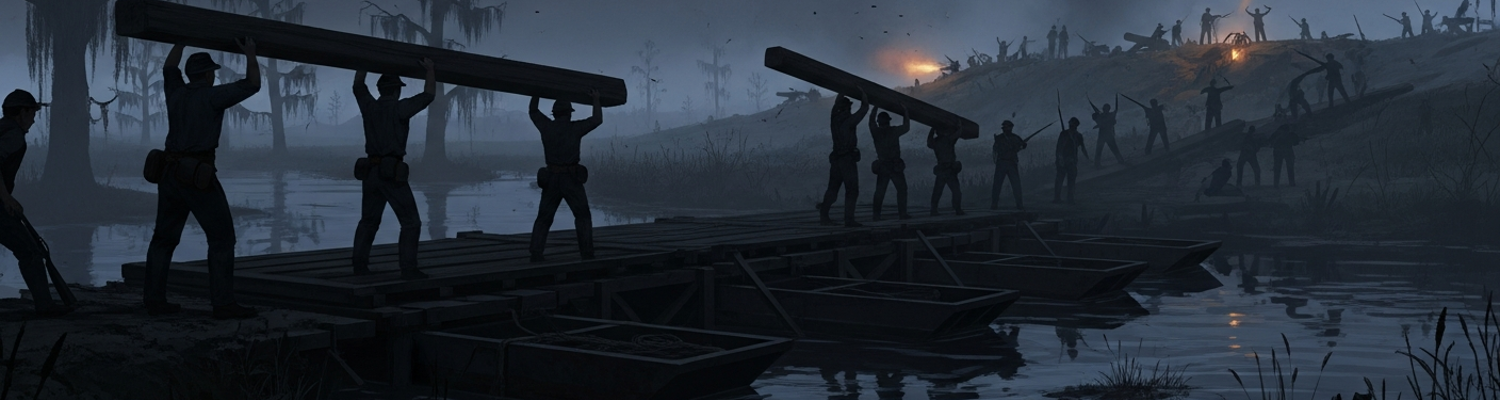

The strategic calculus for Major General George B. McClellan’s Army of the Potomac shifted irrevocably after the Battle of Gaines’ Mill on June 27, 1862. The Confederate offensive, orchestrated by General Robert E. Lee, rendered the Union supply line, the Richmond and York River Railroad, untenable. This forced McClellan into a hazardous tactical decision: to abandon the siege of Richmond and execute a change of base, a full scale fighting retreat, toward the James River. The survival of the largest Union army now depended not on grand assaults, but on the brute force labor, technical skill, and grim determination of its engineers. Under the overall direction of Chief Engineer Brigadier General John G. Barnard, a career officer steeped in the fortification theories of West Point, the U.S. Engineer Battalion and volunteer regiments like the 15th and 50th New York Engineers became the instruments of the army’s salvation during the Seven Days’ Battles. Their work across the swamps and bluffs of the Virginia Peninsula was a grinding, physical contest against time, terrain, and a relentless Confederate pursuit.
The Arduous Road South
The retreat began with destruction. To extricate an army of over one hundred thousand men, with its miles of wagons and thousands of animals, required buying time. The first step was to deny the enemy the very infrastructure the Union had relied upon. On June 28 and 29, as the bulk of the army began its arduous march south, engineer troops and designated rear guards put the torch to the massive supply depot at Savage's Station. Clouds of black smoke billowed into the Virginia sky as mountains of hardtack, barrels of salted meat, uniforms, and equipment were systematically destroyed to prevent them from falling into Confederate hands. The scale was immense. What could not be moved was burned. In a striking act of engineered demolition, a train loaded with ammunition was sent careening down the tracks and plunged into the Chickahominy River off the end of a wrecked bridge. This act was not just about denying supplies; it was a clear signal to both armies that the Union advance on Richmond was over. The lifeline was severed. Along with the supplies, engineers ensured the railroad itself was rendered useless, destroying tracks and bridges that had taken weeks to secure and build.
A Swamp Becomes a Gateway
Before it could be a barrier, the White Oak Swamp had to be a conduit for the retreating army. The movement of the massive force, with its logistical tail of some four thousand wagons, across this formidable natural obstacle was a primary engineering challenge. The Army of the Potomac had entered the campaign with a substantial bridging capability, bringing six portable bridge trains to the Peninsula. These were not uniform. They consisted of two primary types, each with advantages and disadvantages. The older, French style system used heavy wooden bateaux, durable but cumbersome to transport. The newer system employed lighter, inflatable India rubber pontoons, which were far more portable but vulnerable to puncture from debris or enemy fire. The engineers had to select the right equipment for the job, often under immense time pressure. A standard train was a logistical behemoth, consisting of dozens of specialized wagons. Pontoon wagons, each pulled by six horse teams, carried the thirty one foot long flat bottomed wooden boats or the deflated rubber floats. Chess wagons carried the heavy timber planks, or chesses, that formed the roadway. Balk wagons carried the long wooden stringers that connected the pontoons. Tool and forge wagons carried the ropes, anchors, and metal fittings required for assembly. The volunteer engineers of the 50th New York and the regulars of the U.S. Engineer Battalion had spent May and June constructing numerous bridges over the Chickahominy and its tributaries as the army advanced. Now, these skills were reversed for the retreat. Engineers guided the army’s columns toward the viable crossing points. They directed thousands of infantrymen in the backbreaking labor of laying corduroy roads, felling trees and laying the logs perpendicular to the direction of travel, to firm up the swampy approaches for the thousands of wagons and heavy artillery pieces. The process of bridging was a disciplined drill. Pontoons were launched and anchored in sequence. The long balks were manhandled into place to connect them, and then the chesses were laid across the balks to form a solid roadbed. The entire operation was a race against the approaching Confederates.
Barring the Pursuit
The most critical engineering operation of the retreat occurred on June 30 at the White Oak Swamp Bridge. After the last elements of the Union rear guard, the VI Corps under Major General William B. Franklin, had crossed the swampy creek, they turned to face the pursuit. The VI Corps crossed the swamp and immediately took up defensive positions on the southern high ground, demonstrating the seamless integration of engineering and infantry tactics. The engineers worked to keep the route open as long as possible, facilitating the passage of the main body before executing the final demolition that would protect the army’s rear. Once the last wagon was clear, the single wooden bridge spanning the waterway was destroyed. When Major General Thomas J. “Stonewall” Jackson’s command, numbering some twenty five thousand men, arrived at the north bank around noon, they found their path blocked. The destruction of the bridge was a simple but profoundly effective act of tactical engineering. It brought Jackson’s entire force to a halt. While his chief artillerist, Colonel Stapleton Crutchfield, deployed thirty one cannons to engage in a long range duel with Union batteries, Jackson ordered his own engineers to begin rebuilding the crossing. The effort was futile. From the commanding heights on the south bank, Union infantry, acting as sharpshooters, and well placed artillery systematically disrupted any attempt to work on the bridge. For eight critical hours of daylight, as the main Battle of Glendale raged miles away, Jackson was effectively neutralized. The simple act of destroying a bridge, defended by a determined rear guard, had prevented a substantial portion of Lee’s army from joining the main assault. This failure contributed directly to the Army of the Potomac’s escape from encirclement. The sequence, bridging for passage then destroying for delay, was the core operational rhythm that allowed McClellan’s army to move through terrain that would have otherwise trapped it.
Earthworks on the James
As the army fell back, engineers were tasked with creating a sanctuary. After the brutal but successful defensive stand at Malvern Hill on July 1, the exhausted Army of the Potomac completed its retreat to Harrison’s Landing on the James River. Here, under the protection of Union gunboats, the army would finally be safe. But safety had to be guaranteed by land as well. Under Barnard’s direction, the engineers immediately began to fortify the position. The principles they employed were those of Professor Dennis Hart Mahan of West Point, whose treatises on field fortifications were the standard text for army officers of both sides. Lieutenant Colonel Barton S. Alexander, an engineer officer on Barnard’s staff, documented the frenetic activity. In a report from Harrison’s Landing dated July 12, 1862, he detailed the process of laying out a defensive perimeter. The line of fortifications took advantage of the terrain, stretching between Kimage's Creek and Herring Creek, both of which provided natural obstacles on the flanks. Alexander assigned specific officers to supervise the different sectors, with Lieutenant Comstock taking the left, Lieutenant Farquhar the right, and Captain McAlester the center. Infantry troops, provided with tools by the engineers, performed the immense physical labor of digging. The resulting earthworks were extensive. They consisted of earthen walls, known as parapets, thick enough to stop artillery fire, fronted by deep, dry moats. In front of the moat, engineers directed the creation of abatis, formidable barriers made from felled trees with their branches sharpened and pointed toward the enemy. Batteries for dozens of artillery pieces were constructed. These were not simple mounds but carefully designed lunettes and redoubts, with earth covered bombproofs to protect the gun crews and ammunition. Traverses, which were thick earthen walls perpendicular to the main parapet, were built to protect gun positions from enfilading fire. Rifle pits connected the main forts, creating a continuous line of defense from which infantry could pour fire into any attacking force. Within days, the exhausted army was ensconced behind a formidable defensive perimeter that deterred any Confederate assault. The fortifications at Harrison’s Landing were the final product of the engineers’ campaign. They had shepherded the army across swamps, delayed the enemy with calculated destruction, and now had enclosed the army in a secure base. This work concluded the harrowing retreat and ensured the survival of the Army of the Potomac. Its existence meant the war would continue, denying the Confederacy the decisive victory that might have secured foreign recognition and changed the course of the conflict.