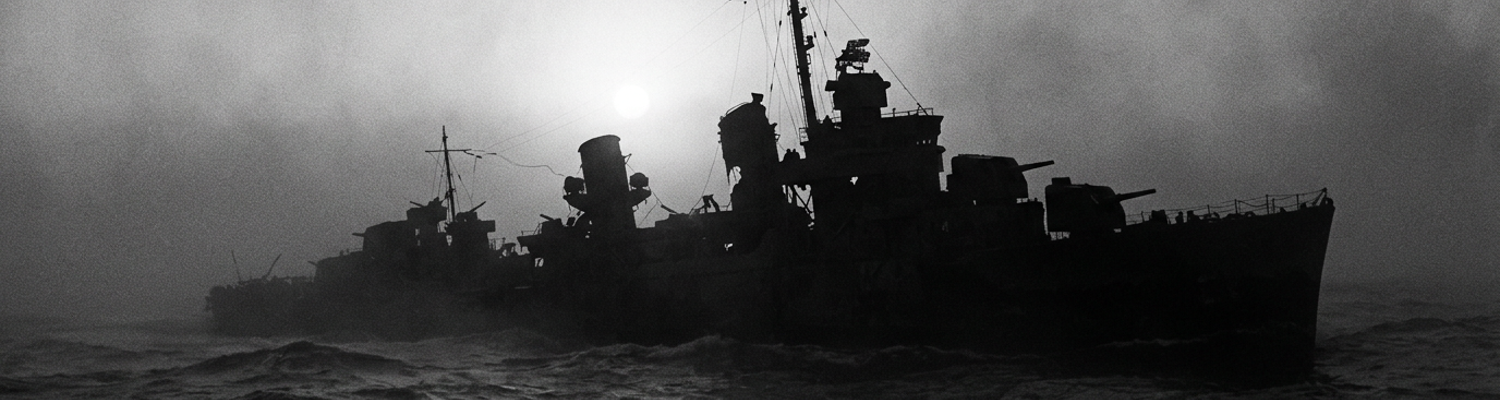

Prewar Naval Doctrine and Aleutian Operating Conditions
Archival evidence shows that Task Force 16 operating protocols broke down against the daily weather patterns of the Bering Sea. Vice Admiral Thomas C. Kinkaid committed over one hundred warships and thirty-four thousand American and Canadian troops to seize Kiska Island at coordinates 52 00 N, 177 35 E. Thick fog covered the sea surface. Visibility dropped to fifty yards for days at a time. Tactical doctrine demanded tight destroyer screening formations around transport groups. Radar sets failed to distinguish jagged sea stacks from enemy patrol craft. SG surface search radar scopes cluttered with sea return echoes from heavy swells. Navigators dead-reckoned off inconsistent tidal currents and inaccurate Russian navigational charts (dated 1894). Bridge officers on destroyers such as Abner Read, Ammen, and Farragut posted lookouts who could not see their own bow flags through the mist. Lookouts listened for surf breaking against volcanic cliffs to guess their position. Ship maneuvering manuals offered no procedures for tracking friendlies when short-range radio signals scattered in atmospheric inversions. Fleets drifted blind through jagged shoals.
Cold water stripped away peacetime medical assumptions.
A close review of operational logs indicates that the United States Navy Bureau of Medicine and Surgery structured fleet casualty treatment around combat in the Caribbean or the South Pacific. Peacetime fleet regulations mandated battle dressing stations deep inside the hull. These regulations assumed ships would retain active 440-volt electrical grids to power incandescent overhead surgical lamps and ventilation fans. Blast damage on Abner Read severed primary shipboard service lines instantly. The forward dressing station fell into freezing darkness. Medical corpsmen held emergency battle lanterns between their teeth while attempting vascular ligations on shivering shock victims. Standard shock protocols instructed staff to administer warm saline infusions and wrap patients in light blankets. These methods were calculated for tropical sea temperatures of eighty degrees Fahrenheit. In the subarctic waters off Kiska, ocean temperatures hovered at thirty-four degrees. Hypothermia killed men before vascular shock could be stabilized. Morphine syrettes froze solid in medical pouches. Glass plasma bottles shattered when unheated steel bulkheads chilled surgical compartments below the freezing point within twenty minutes of auxiliary generator failures.
Repair parties aboard the crippled destroyer improvised casualty containment without steam heat or emergency suction pumps.
Compartment temperatures dropped to thirty-two degrees within an hour of the stern separating from frame 170. Medical officers poured straight medicinal alcohol over exposed wounds. Sterilizing water required electric hot plates that no longer received current. Corpsmen wrapped wounded sailors in greasy canvas engine covers retrieved from forward storage lockers to halt rapid core heat loss. Survivors were transferred by manual litter hoist to the relief vessel USS Bancroft at 0355 hours. Forty-seven men were confirmed dead. Twenty-two were severely wounded. The medical response relied entirely on physical endurance and mechanical improvisation. Standard operating procedures from the prewar era provided no guidance for operating in absolute darkness while standing in freezing saltwater.
Operation Cottage Mine Strike on USS Abner Read
Archival evidence shows that commander Thomas Burrowes steered USS Abner Read along a five-mile patrol arc off the southeastern approaches to Kiska Island at five knots. Operating under Task Group 16.17 during the early hours of August 18, 1943, the 2,050-ton Fletcher-class destroyer maintained a continuous sonar sweep between Vega Point and South Head at coordinates 51 57 N, 177 30 E. Thick fog banks reduced horizontal visibility to zero. The bridge crew was blind. Radar screens reflected false echoes off floating kelp beds. Allied planners believed thousands of Imperial Japanese Army soldiers still manned fortified revetments onshore. They were unaware that an evacuation fleet had pulled all five thousand one hundred defenders off Kiska three weeks earlier. Operating orders forced Abner Read to hold close proximity to known defensive mine lines to interdict Japanese evacuation vessels that did not exist. Burrowes executed alternating figure-eight turns to keep his QC sonar transducer oriented across the bay entrance. He fought twelve-knot tidal rips that pushed the destroyer northeast into an unswept minefield. Contact occurred without warning.
A moored Type 93 Japanese naval mine detonated against the starboard quarter beneath frame 170.
The blast energy struck with enough upward force to sever seventy-five feet of the stern section. It ripped open the outer structural plating. A close review of operational logs indicates that the explosive shock wave tore through the aft crew berths. It sheared off transverse steel bulkheads and expelled sleeping sailors into thirty-three-degree salt water. Two twin-track depth charge release rails and six K-gun projectors tore loose from their deck mountings. The entire aft compartment sheared away from the main hull. Forty hydrostatic depth charges tumbled free into the ocean wake behind the ship. Standard blockade readiness doctrine mandated that crews set depth charges on live hydrostatic arming pins while patrolling combat sectors. The falling ordnance armed itself as it sank through the water column. The charges exploded at preset hydrostatic depths of fifty and one hundred feet directly beneath the drifting wreckage. These secondary underwater concussions ruptured the surviving internal fuel compartments. They crushed lungs and fractured limbs of sailors swimming through the oil slick.
Freezing water entered the exposed engineering spaces immediately.
When examining the historical record, shipboard damage control teams faced complete hydraulic and electrical separation throughout the after half of the vessel. The severed propeller shafts pulled free of their strut bearings. This destroyed the packing glands and allowed water to surge forward toward the reduction gears in the aft engine room. Chief Machinist Mate J. H. Powell directed his crew to manually dog down the quick-acting watertight doors on bulkhead 157. They worked under water jets pouring from buckled deck seals. Steam lines feeding the aft turbines burst open. Three men were scalded before auxiliary valves could be closed with chain wrenches. Lieutenant Commander Burrowes counterflooded forward peak tanks to raise the submerged break point at frame 170 above sea level. He fought a twelve-degree starboard list. The ocean surface swallowed seventy-one crew members who died from the blast impact, hypothermia, or the underwater detonation of their own depth charges. Navy fleet tug USS Ute intercepted the floating forward hull three hours later at 0505 hours. It secured wire towlines across the bow to tow the remainder of Abner Read toward Adak Harbor.
Blackout Triage and Primary Emergency Damage Control
Archival evidence shows that the detonation at frame 170 severed the 440-volt main power distribution busbars running through the port and starboard cable trunks. Both 350-kilowatt Westinghouse turbo-generators tripped offline instantly. High-pressure steam supply lines ripped apart in the after machinery spaces. Emergency diesel generators in the forward engine room failed to start. Shock loads had cracked the starting air manifolds and knocked lead-acid battery banks off their mounting racks. Darkness was absolute below the main deck within two seconds of the blast. Navy medical manuals stipulated that corpsmen evaluate trauma cases under direct illumination in sterile dressing bays. They were supposed to use color changes in skin and capillary refill to diagnose arterial hemorrhaging. Pharmacist Mate First Class William Campbell and surviving hospital apprentices crawled across slick linoleum floors holding brass Type-E battle lanterns between their teeth. The lanterns cast feeble six-volt beams that could barely penetrate smoke, suspended fuel vapor, and steam. Corpsmen used bare fingers to find severed femoral arteries. They felt through pooling oil for the rhythmic pulsing of arterial blood before clamping hemostats blindly into mangled muscle tissue.
Standard field dressings failed to stick to flesh coated in bunker oil.
A close review of operational logs indicates that personnel converted the officers wardroom into a forward emergency aid station. Seawater rushed into the compartment through buckled joiner doors. The primary battle dressing station near the aft galley had vanished along with the severed stern section. Medical staff laid mangled survivors across the wardroom dining table and upholstered settees. Water reached ankle depth across the deck. Seventy-one crew members were dead or missing in the Bering Sea. The remaining medical team treated forty-seven wounded sailors suffering from traumatic amputations, shattered pelvic bones, and thermal flash burns. Corpsmen ran out of dry stretchers. They hauled men forward using wool bunks stripped of bedding. Cold seawater contaminated plasma transfer needles. Morphine syrettes had to be thawed inside the mouths of corpsmen before the frozen liquid could pass through hypodermic needles. Men with open thoracic wounds coughed up swallowed fuel oil while lying shoulder to shoulder on grease-stained wool coats.
Every breath in the wardroom drew freezing mist into broken chests.
When examining the historical record, damage control parties under Lieutenant Junior Grade John D. Futch confronted catastrophic forward structural stress with zero electrical pumping capacity. Power loss neutralized the centrifugal fire and bilge pumps. This eliminated any mechanical means of dewatering. Freezing seawater surged against transverse bulkhead 157 and the forward engine room bulkhead. It threatened to overwhelm the structural integrity of the remaining hull. Damage control men wedged four-by-four-inch Douglas fir shores against vibrating steel plates. They drove wedges home with eight-pound sledgehammers while standing waist-deep in thirty-four-degree water. Crewmen stuffed mattresses, kapok life jackets, and heavy sea bags into punctured seams. They caulked breaches where sheared rivets had popped out of the framing. Bucket brigades formed along the ladderways. They passed five-gallon galvanized pails of freezing oily water up to the open weather deck to reduce free surface effect. The men secured screw jacks against cross-deck stringers to brace sagging overhead bulkheads. They held the structural barrier intact until lines could be rigged to USS Bancroft.
Blind Acoustic Rescue and Escort Interventions
Archival evidence shows that horizontal visibility around Kiska dropped below thirty yards immediately after the detonation. It smothered the sea surface in an impenetrable wall of subarctic mist. USS Bancroft (DD-598) patrolled six miles off Vega Point under Lieutenant Commander Ray M. Pitts. The ship detected the heavy underwater shock on hull sensors but found its radar equipment completely blinded. Surface-search radar screens displayed a solid ring of green backscatter caused by suspended sea spray and steep volcanic headlands. Electronic tracking was useless. Standard tactical communication doctrine broke down. Radio operators struggled against severe atmospheric interference caused by thermal inversions. Pitts ordered his bridge crew to silence all topside activity. He positioned lookouts along the bridge wings with handheld stopwatches. Steaming into the blind perimeter at three knots, Bancroft began emitting three-second blasts from its steam whistle at five-minute intervals. Surviving deck officers on Abner Read answered by striking the bronze bell and sounding compressed-air whistles powered by residual reservoir pressure. Bridge watchstanders on Bancroft rotated sound-ranging bearing indicators by ear. They timed the acoustic delay across the dead calm water to calculate distance through trial and error.
Sound traveled through the Bering fog with treacherous inconsistency.
A close review of operational logs indicates that cold air pockets refracted sound waves unpredictably. They bounced whistle echoes off the volcanic bluffs of South Head and created ghost signals across the bay. Bancroft drifted within fifty feet of submerged volcanic pinnacles twice. Acoustic echoes appeared to originate from open water. Navigators could not rely on celestial sights. Gyrocompass repeaters had tumbled during sudden course adjustments. Dead reckoning against unpredictable eight-knot tidal currents failed. Lookouts relied exclusively on their ears to distinguish the low-frequency rumble of surf crashing against sheer cliffs from the shrill hiss of ruptured steam lines on Abner Read. Bancroft finally broke through the gray gloom alongside the crippled destroyer at 0300 hours. The two steel hulls almost collided in the swell. Pitts managed to rig a temporary wire line to stabilize the hulk. The single-line tow lacked sufficient displacement to control the yawing, rudderless forward section against the outgoing ebb tide.
Every drift calculation pointed directly toward the rocky shoreline.
When examining the historical record, fleet tug USS Ute (ATF-76) reached the coordinates at 0355 hours. Lieutenant William F. Lewis commanded the vessel. It felt its way through the mine-infested sector without surface search gear. The truncated hull of Abner Read was missing eighty-eight feet of its after body. It wallowed without auxiliary electrical steering. It had drifted into three fathoms of water near the reef perimeter off Vega Point. Lewis backed his 1,200-ton tug within throwing distance of the forecastle. He operated purely by acoustic calls shouted through megaphones into the fog bank. Bosuns mates aboard Abner Read unbolted a dog-eared deck hatch in total darkness. They lowered themselves into a flooded forward chain locker. They extracted a twelve-pound steel towing shackle without showing a single flashlight beam to the invisible shore. Working across oily deck plates slick with freezing salt spray, deckhands secured the two-inch main wire towing hawser to the port anchor chain. Lewis brought the diesel-electric plant up to speed. He took up slack on the drum until the hawser lifted dripping out of the sea at 0440 hours. The steel cable arrested the drift sixty yards from the outer breaker line. It turned the sheared frame of Abner Read away from the shoals to begin the slow crawl toward Adak.
Subarctic Casualty Evacuation and Naval Medical Reforms
Archival evidence shows that standard high-line transfer protocols collapsed into immediate mechanical failure. USS Bancroft attempted to evacuate casualties from the wallowing forward hull of USS Abner Read. Fleet medical instructions drawn up during the 1930s specified transferring litter patients between ships steaming side by side at eight knots. They mandated the use of whip lines, wire travelers, and standard steel-mesh Stokes litters. Heavy Bering Sea swells off Vega Point pitched the two hulls out of horizontal alignment by twenty vertical feet with every wave cycle. Winch brakes on Bancroft slipped on iced drums. Manila lines coated in subzero spray froze into unyielding rods within minutes. They jammed traveler blocks and snapped cross-deck hemp hawsers under sudden dynamic tension. Open twenty-six-foot motor whaleboats dispatched into the chop took on freezing salt spray. This coated wounded men in ice crusts. It drove core body temperatures below eighty degrees Fahrenheit before the boats could cross a fifty-yard gap.
Standard wire-mesh litters caused acute contact frostbite.
When examining the historical record, the disaster off Kiska completely dismantled peacetime assumptions held by the Bureau of Medicine and Surgery regarding open-sea casualty handling. Standard medical texts mandated stabilizing vascular trauma and internal hemorrhage aboard the stricken vessel using intravenous plasma, whole blood warming, and heated blankets before attempting transshipment. None of these measures functioned aboard a sheared hull devoid of steam lines and internal power. Saltwater washed through the forward mess deck at thirty-four degrees. It washed grease and freezing ocean brine over open bone fractures. Corpsmen trying to package wounded men into standard wire litters discovered that bare human skin froze to the zinc-coated iron mesh upon contact. Patients in severe shock died of ventricular fibrillation. This was induced by rapid core cooling during the three-minute transit across the water gap. Medical officers concluded that exposure killed faster than blast trauma when wet litters dangled over subarctic water.
Peacetime casualty transit manuals assumed calm tropical water.
A close review of operational logs indicates that the loss of life prompted the United States Navy to issue immediate structural and tactical overhauls across North Pacific combat operations. Chief of Naval Operations directives issued in late 1943 ordered the Bureau of Ships to redesign damage control lighting architecture on all destroyers and auxiliaries assigned to northern waters. Peacetime installations relied on branch lines drawing directly from the 440-volt alternating-current electrical grid. Any structural shearing knocked out every light fixture across dozens of compartments simultaneously. The revised doctrine mandated independent, decentralized lighting units. Technicians installed self-contained Type-JR relay lanterns equipped with six-volt dry-cell batteries across every engineering flat, trunk passageway, and battle dressing station. Built with internal magnetic solenoids, the units detected power failure in the primary busbars. They snapped battery beams on automatically without human intervention.
Auxiliary lighting operated independently from the main grid.
Naval authorities overhauled cold-weather survival mandates with equal speed. Standard fleet issue had previously limited deck personnel to blue cotton dungarees, light pea coats, and buoyant kapok vests. These vests absorbed freezing seawater within thirty seconds. Revised North Pacific equipment directives required all combat vessels north of fifty degrees latitude to stock multi-piece rubberized immersion suits, wool pile trousers, and sheepskin-lined foul-weather jackets for all damage control and topside watch personnel. Ships heading for North Pacific duty received orders to weld heavy steel storage lockers directly to weather decks. These housed portable, self-powered gasoline dewatering pumps, warm-air thermal resuscitators, and canvas-covered insulated litter blankets. Fleet maintenance yards at Dutch Harbor and Adak stripped old brass-bracketed bulk lanterns out of forward berthing compartments. They replaced them with forty-eight individual dry-cell units per destroyer hull.