
The strategic anxieties of the early 1980s Cold War directly fueled a deeply technical United States Air Force program. Archival evidence shows its formal inception occurred in late 1981, born from a series of classified after-action reports identifying deficiencies in NATO’s rapid reinforcement capabilities. The core problem was command and control. Existing tactical airlift operations, particularly those involving the C-130 Hercules fleet, relied on a patchwork of analog radio communications and manual calculations. This system was brittle, susceptible to jamming, and created dangerous delays during time-sensitive deployments. A close review of operational logs from contemporary exercises reveals that formation integrity and drop zone accuracy degraded exponentially with each added layer of complexity, such as poor visibility or radio silence.
Project HCRI-AO, standing for Hercules Command & Ranging Integration - Autonomous Operations, was conceived as a technological leap to solve this. The program’s central component was a new, ruggedized computer architecture (designated the AN/AYK-15A processing suite) built around a Unix-like operating system. This was a significant departure from the proprietary, closed-off systems that characterized most military hardware of the era. The choice of a Unix-based protocol was driven by its perceived modularity and networking potential. Planners envisioned a system where each aircraft in a formation would act as a networked node in a distributed computational system. The goal was to integrate new sensor data, from ground-proximity radar, doppler navigation systems, and newly developed inertial navigation units, into a single, coherent operational picture shared across the entire flight. The hardware was housed in shock-mounted racks installed in the cargo bays of specially modified MC-130 Combat Talon I aircraft, designated as airborne command posts. These racks contained refrigerator-sized computers that processed targeting and flight-path data, feeding it directly to the pilots’ and navigators’ displays through a newly installed digital bus.
This digital architecture was meant to enable precision mass troop deployment in near-zero visibility conditions. The doctrine, developed at Pope Air Force Base and tested in theory at the Nellis Test and Training Range, called for formations of up to twelve C-130s to execute a fully-automated, computer-sequenced drop. The HCRI-AO system would calculate individual release points for each aircraft based on its exact position in the formation, wind shear data relayed from the lead plane, and the complex topography of the drop zone. By automating these calculations, the Air Force sought to shrink drop zone dispersion patterns from kilometers to mere meters. This would allow special operations forces to land as a cohesive fighting unit, ready for immediate action without a lengthy and vulnerable consolidation phase on the ground. The objective was to guarantee the ability to place a battalion-sized force behind enemy lines, anywhere in the world, under the complete cover of darkness.
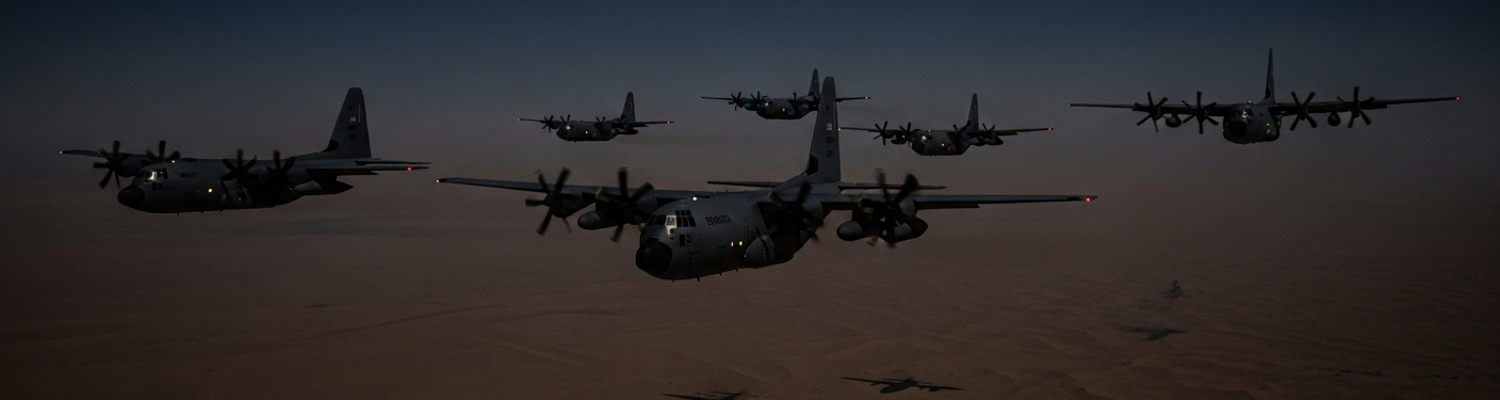
Exercise Crimson Sky, held over three weeks in the fall of 1982, was the culmination of the HCRI-AO program’s initial development phase. A close review of operational logs shows the exercise was centered at Nellis Air Force Base, Nevada, leveraging the vast, unpopulated expanse of the Nevada Test and Training Range. Planners designed Crimson Sky to be the ultimate stress test not just of the new technology, but of the doctrine it enabled. Unlike previous exercises such as Red Flag, which focused on air-to-air combat, Crimson Sky was exclusively about deep, clandestine penetration and mass delivery of ground forces. The exercise construct called for a twelve-ship formation of C-130E Hercules from the 317th Tactical Airlift Wing, augmented by two MC-130E Combat Talon I aircraft from the 1st Special Operations Squadron acting as command-and-control pathfinders. Their objective was to insert a battalion of U.S. Army Rangers onto multiple, unprepared drop zones deep inside a simulated enemy air defense network, all under the cover of total darkness.
This was the system’s definitive trial.
The mission profile was unlike any standard airlift operation. It demanded the C-130 formation fly a multi-hour, low-level ingress at altitudes below 500 feet to mask their approach from simulated enemy radar. Flying this tightly at night, with over a dozen heavy aircraft, was exceptionally hazardous. Navigation depended on the still-analog instrumentation of the standard C-130E, which featured inertial navigation systems prone to drift over long distances. The pilots and navigators had to contend with the immense strain of formation flying in near-total blackout conditions, relying on faint visual cues from their sister ships and disciplined radio communication. The entire premise of the infiltration rested on the formation arriving at the Initial Point, a precise geographic coordinate in space, as a cohesive unit. From there, the HCRI-AO system was intended to take primary control of the drop itself.
Success depended on the flawless performance of the new command-and-control system. The two MC-130E pathfinders, designated Talon 1 and Talon 2, housed the computer racks that formed the network’s core. As the formation approached the drop zones, the HCRI-AO system would activate. It was designed to network all twelve C-130s, using a secure AN/ARC-164 UHF data link to create a shared, real-time picture of the battlespace. The system integrated data from the lead Talon's terrain-following radar, doppler sensors, and INS to create a single, highly accurate navigational solution. This data was then supposed to be transmitted across the formation, feeding directly into newly installed monochrome CRT displays (designated IP-1548/A) in each C-130’s cockpit. This display would show each pilot their precise position relative to the lead aircraft and the ground. The system was programmed to automatically calculate the optimal release point for each aircraft’s payload, accounting for individual position, altitude, airspeed, and the forecasted wind shear over the target.
The precise moment of systemic failure occurred just as the twelve-ship C-130 formation, flying under the callsign Rhino, made its final turn toward the initial point. Aboard the lead pathfinder, Talon 1, the navigator stared at the primary HCRI-AO terminal as the monochrome screen dissolved into a cascade of corrupted data blocks and error codes. The secure UHF data link that networked all fourteen aircraft had flatlined. Post-mission analysis logs indicate a complete and unrecoverable crash of the primary processing computer. The system, designed to integrate sensor data and transmit refined targeting solutions, began sending out sporadic and nonsensical information before failing entirely. Within seconds, cockpit displays in all twelve C-130E transports either froze on obsolete data or went blank. The promise of a fully networked, automated drop evaporated, leaving fourteen aircrews flying at 500 feet, in total darkness, and suddenly disconnected. The crews immediately fell back on their analog training, a chaotic process of voice commands over the radio that the HCRI-AO system was specifically designed to prevent.
Forensic examination of the system’s salvaged magnetic tape backups and hardware revealed two distinct and compounding causes for the failure. The first was a latent software incompatibility buried deep within the system’s code. The Unix-based operating system running on the computers aboard the MC-130 Pathfinders was a bespoke creation, heavily modified for the mission. The simpler display controllers installed in the older C-130E airframes ran on a different and more primitive firmware. A last-minute software patch, intended to improve the refresh rate of the tactical displays, created a fatal exception in how the two systems exchanged data packets. This flaw remained dormant during sterile lab testing. The second cause was environmental. The low-level flight path over the dry Nevada terrain, combined with specific temperature and humidity conditions that night, created an unusually high level of atmospheric interference. This phenomenon, known as tropospheric ducting, caused the UHF radio waves of the data link to scatter unpredictably, leading to a high rate of packet loss that the primitive error-correction protocols could not handle. The combination of corrupted data requests from the C-130s and the intermittent signal loss overloaded the primary processor on Talon 1, triggering the catastrophic shutdown.
This technical collapse quickly spiraled into a tactical crisis. With the master HCRI-AO system offline, some aircraft displays froze, showing a valid, but now dangerously old, release point. Other systems, in their final moments, processed corrupted data packets as legitimate commands. A close review of operational logs and crew debriefs highlights a near-fratricide event between Rhino 04 and Rhino 07. The corrupted data feed momentarily directed Rhino 04 to execute a hard left bank for a drop sequence that placed it on a direct collision course with Rhino 07. Only the quick manual intervention of Rhino 04’s pilot, who disconnected his flight controls from the malfunctioning system and pulled the aircraft up, prevented a mid-air disaster. In the ensuing chaos, the formation broke apart. The mission commander, reverting to emergency procedures, gave the order for each aircraft to execute its own drop based on individual, uncorrected inertial navigation system data.
A complete failure of the exercise’s primary objective.
Instead of a cohesive battalion landing within a few hundred meters, the Ranger companies were scattered over a fifty-square-mile area of unforgiving desert terrain. Some sticks landed miles from their intended drop zones, in canyons and on rocky plateaus that posed a significant hazard. It took ground units nearly 18 hours to consolidate even a fraction of their force, an impossible timeline in a real combat scenario.
A subsequent technical review, convened under the authority of the Hercules Command & Ranging Integration - Administrative Office (HCRI-AO), was a deep, forensic exercise. The physical hardware from the lead MC-130E, Talon 1, including the entire computer rack and its magnetic tape data recorders, was impounded and analyzed in a secure facility at Wright-Patterson Air Force Base. Initial findings from the joint Air Force and contractor engineering team pointed to the latent software bug triggered by the last-minute display patch. This provided a convenient and technically precise explanation, but it was an incomplete one. Deeper within the after-action reports and crew debriefs was a more troubling pattern. The established training protocols, developed in simulators and sterile flight environments, had created a dangerous sense of confidence in the system’s resilience. The program’s entire doctrine was built on the assumption that the HCRI-AO system would either work perfectly or fail completely into a predictable, safe state. There was no contingency training for a partial, corrupted failure.
The investigation uncovered that the training protocols had drastically underestimated the randomness of real-world electromagnetic clutter. Laboratory tests and flights in controlled airspace over established ranges had modeled for simple signal degradation, a predictable loss of data packets that the system could counter with error correction. The conditions on the night of Exercise Crimson Sky, however, produced something entirely different. Post-mission meteorological analysis confirmed the presence of severe tropospheric ducting, an atmospheric phenomenon where temperature and humidity layers trap and reflect radio waves. Instead of a steady decline in signal quality, the UHF data link experienced chaotic, intermittent periods of perfect signal followed by total dropout. This unpredictable oscillation was something the Unix-based system’s error-correction algorithms were not programmed to handle. The machine interpreted the sudden reappearance of a perfect signal as a network reset, flooding the primary processor with new data requests before it had cleared the backlog from the previous dropout. This cycle of signal loss and frantic re-acquisition created a processing bottleneck that ultimately triggered the system-wide crash.
This environmental failure exposed human-system interface limitations. The core design philosophy of HCRI-AO was to reduce crew workload and automate complex drop-zone calculations, but its failure mode achieved the exact opposite, inducing a level of cognitive overload that nearly proved fatal. In the C-130E cockpits, which still used largely analog instrumentation from the 1960s, the HCRI-AO interface consisted of a single, small monochrome CRT display bolted to the side of the main instrument panel. When this screen went blank or froze, the crew had to instantly shift their focus from this single source of automated truth back to their primary flight instruments, their uncorrected INS readouts, and the disorienting blackness outside the cockpit. The near-collision between Rhino 04 and Rhino 07 was a direct consequence of this design flaw. The pilot of Rhino 04 was not just following a bad course; he was physically fighting his own aircraft. The HCRI-AO system had partial authority over the flight controls to make minor course corrections, and when it received corrupted data, it initiated a bank without pilot input. There was no single, guarded kill switch to immediately sever this connection. The procedure to disengage the system was a multi-step process that was not practiced under high-stress conditions, as training assumed a clean and obvious system failure.
The system malfunction during Exercise Crimson Sky triggered an immediate response from the highest levels of the United States Air Force. Within weeks, a formal directive from Tactical Air Command convened a Blue Ribbon Panel, a specialized investigative body composed of systems engineers, combat-veteran aircrew, and doctrine specialists from the Air Force Systems Command. Their mandate was not simply to assign blame for the HCRI-AO failure, but to perform an uncompromising analysis of the entire digital integration philosophy that underpinned it. A close review of the panel’s declassified summary report reveals a fundamental shift in thinking. The core architectural design of HCRI-AO, a powerful, centralized computer aboard a single pathfinder aircraft acting as the control unit for the entire formation, was now identified as a systemic vulnerability. The failure demonstrated that a single point of failure, whether from a software bug or environmental interference, could instantly cripple an entire multi-ship operation. The Cold War context made this an existential problem; the imperative to insert forces behind Warsaw Pact lines meant that abandoning night-time digital operations was not an option.
The panel’s findings forced a re-evaluation of how digital systems should be integrated into combat aircraft, directly impacting Cold War-era technological doctrine. The central lesson learned was that creating a single, all-powerful digital command unit was a recipe for collapse. The new mandate, which heavily influenced the development of the next generation of special operations aircraft like the MC-130H Combat Talon II, was built on the concept of decentralized processing and network resilience. Instead of one master computer dictating commands to passive terminals, the new doctrine called for a distributed network of intelligent nodes. Each aircraft in a formation would need its own robust, independent mission computer capable of navigating and calculating drop solutions on its own. The network’s role would shift from that of a commander to that of a collaborator, sharing sensor data and position updates that each aircraft’s system could choose to integrate or reject. If the network failed, each crew could continue the mission using their own, fully functional onboard systems, preventing the total breakdown seen over the Nevada desert. This shift represented a large-scale change in USAF acquisition and design philosophy, moving away from monolithic systems and toward a more modular, fault-tolerant approach that would later define programs like the Joint Tactical Information Distribution System (JTIDS).
The gap between sterile training scenarios and the chaotic demands of the exercise became the investigation’s most damning exhibit. The HCRI-AO crews had trained extensively in simulators, but these sessions were built around a binary concept of failure: the system either worked perfectly, or it failed into a safe, predictable mode. There were no training scenarios for a partial or corrupted failure, where the system would lie to the crew with convincing authority. The near-miss between Rhino 04 and Rhino 07 was dissected as a prime example of this doctrinal disconnect. The pilot was not just flying blind; he was actively fighting a system that was feeding him dangerously flawed information while simultaneously making unauthorized flight control inputs. In response, the re-evaluation mandate called for a complete overhaul of simulator training. New programs were ordered to specifically model degraded states: intermittent data links, corrupted data packets, and sensor failures. Crews would now be rigorously drilled on how to identify a rogue system, disengage it under extreme stress, and immediately revert to analog instruments and manual formation flying, a skill that had atrophied under the promise of total automation. The new doctrine mandated that a pilot must always be able to rapidly and cleanly separate from the machine, a direct lesson from the chaos of Crimson Sky.