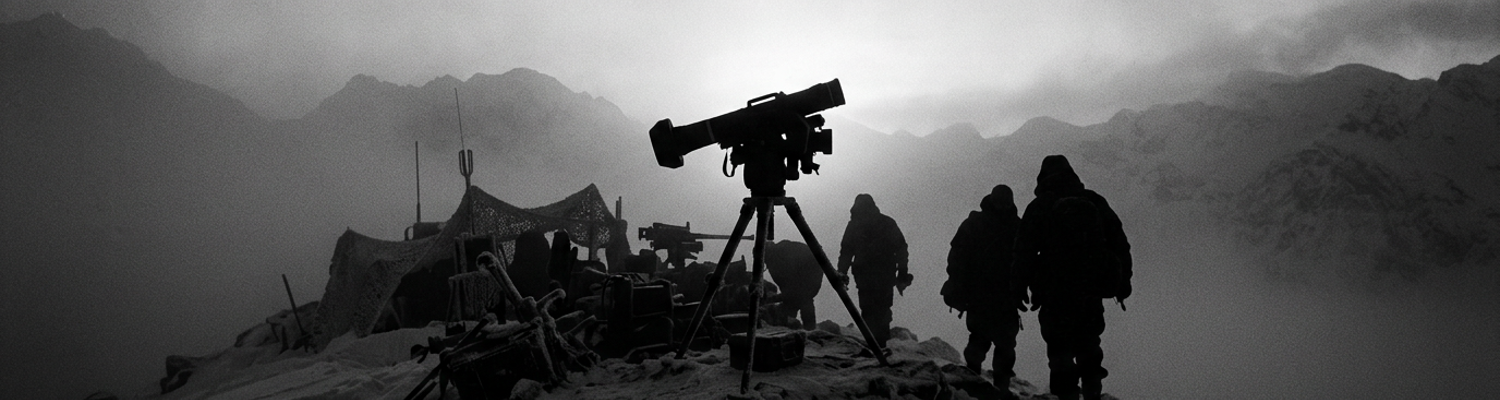

Hughes Aircraft Arctic Missile Requirements
Across the Kola Peninsula and the Finnmark approach corridors, Soviet war plans positioned 640 T-55 and T-62 main battle tanks directly against three understrength Norwegian border companies. A single Soviet motorized rifle division deployed enough organic 100mm and 115mm smoothbore guns to saturate every mountain pass from Kirkenes to Troms within 48 hours. Archival evidence shows that Allied Forces Northern Europe planners assigned to the High North faced an armor to infantry imbalance exceeding twelve to one along the Pasvik River valley. Western military strategy along the northern littoral required dug in, man portable defenses capable of locking down narrow defiles between sheer granite cliffs and frozen bogs before air support could arrive from southern depots. Planners in Oslo and Washington calculated that stationary infantry positions along the Lyngen line had to break armored spearheads at standoff distances or be overrun within the first morning of combat. The Pentagon needed a weapon that three men could drag into a snowdrift to destroy an advancing armored column from three kilometers away without revealing their position.
The numbers offered no room for error.
To meet this operational demand, the United States Army turned to the BGM-71A. Hughes Aircraft designed the system under contract DAAH01-68-C-0832. Engineers built the baseline weapon system around a modular, man portable architecture consisting of a tripod, a traversing unit, an optical sight, and an encased missile tube weighing a collective 160 pounds. The missile itself measured 46 inches in length and 5.9 inches in diameter. It housed a 3.9 kilogram shaped charge warhead packed with Composition B explosive. Propulsion relied on a dual stage solid propellant Hercules motor. An initial blast motor expended all fuel inside the fiberglass launch container within 0.05 seconds. A flight motor then delivered thrust across a 3,000 meter operating envelope. Steering commands traveled through two thin copper clad steel wires paying out from aft mounted bobbins at speeds approaching 900 feet per second. Optical tracking depended on an infrared xenon thermal source in the missile tail. An optical sensor in the sight unit tracked the infrared wavelength and transmitted microsecond analog voltage corrections directly down the trailing wires.
Hughes built the machine for the plains of Central Europe.
When examining the historical record from the Hughes facility in Culver City, California, serious deficiencies emerge in how the contractor validated extreme cold operability. Factory environmental certification relied on brief, eight hour temperature chamber cycles down to minus 25 degrees Fahrenheit at the Redstone Arsenal test complex in Alabama. These baseline tests ignored the physical consequences of continuous 72 hour Arctic cold soaks. Technicians never assessed how sub zero wind chills of minus 40 degrees would stiffen the petroleum based lubricants coating the wire spooling mechanism. The dual nickel alloy control wires, coiled tightly inside aluminum housings, relied on pliable grease that congealed into a brittle glaze under true polar exposure. Hughes quality assurance teams also failed to measure ignition delays within the thermal battery cells. These cells relied on molten salt electrolytes that struggled to melt when cold soaked steel casings drained away the initial chemical heat. Solid propellant grain within the Hercules motor shrank during dry sub zero storage. This shrinkage developed microscopic structural fractures that led to pressure spikes during static bench tests.
The contractor stamped the system combat ready anyway.
Material Failures in Sub Zero Guidance Systems
Archival evidence from the Norwegian Army Brigade Nord trials at the Setermoen training grounds in February 1972 records an ambient air temperature of minus 38 degrees Celsius. At grid coordinates 68 degrees 51 minutes North, 18 degrees 21 minutes East, gunners unboxed factory fresh BGM-71A rounds directly from insulated transport crates into 30 knot Arctic gales. Trouble began the instant the missiles cleared the launch tube. The command wire dispenser, fitted to the aft section of the missile airframe, housed two precision bobbins wound with over 9,000 feet of high tensile copper clad steel line. Hughes had molded these bobbins from a standard injection molded phenolic plastic rated for tempered climates. Polar cold rapidly stripped the synthetic resin of its plasticizers. Under sustained exposure, the phenolic flanges shrank and developed microscopic stress fractures along their guiding lips.
When the missile accelerated away at nearly 900 feet per second, the payoff friction violently dragged the payout lines across brittle flange edges. Jagged plastic burrs severed the 0.005 inch wire strands within 400 meters of launch. This cut all analog telemetry and sent unguided weapons spinning into frozen peat bogs.
The telemetry wire snapped instantly.
A close review of operational logs reveals equal devastation inside the weapon sight unit. The optical tracker and optical collimator assembly depended on a dry nitrogen internal atmosphere to isolate sensitive sensors from ambient moisture. Hughes engineers had sealed these optical chambers with standard industrial nitrile elastomer O rings. When temperatures dropped below minus 30 degrees, the elastomer rings contracted by 12 percent and hardened into stiff rings that could not maintain mechanical pressure against aluminum housings.
Hermetic integrity vanished.
Pressurized nitrogen escaped within three hours of outdoor deployment. Damp polar air drew directly across the internal desiccant canisters. The calcium sulfate desiccant rapidly saturated, leaving the optical core defenseless against internal condensation. Frost crystallized across the inner surfaces of the beam splitter prisms and objective glass. Gunners stared into completely opaque viewports. The internal infrared sensor lost the trailing xenon bulb in a blur of scattered light.
The optical sight fogged over completely.
Propulsion failures proved equally destructive to missile flight profiles. Static test firings by the United States Army Arctic Test Center at Fort Greely recorded severe thermal degradation within the Hercules M114 solid propellant motor. Extended cold soaks chilled the double base nitrocellulose propellant grain to its lower ignition threshold, slowing the initial deflagration rate. Ignition delays jumped from a nominal 50 milliseconds to over 180 milliseconds. These erratic burns threw off the missile exit velocity as it parted from the fiberglass launch container. Launch velocity plummeted from the planned 250 feet per second down to barely 160 feet per second.
The missile fell directly into the snowpack.
Leaving the tube without proper aerodynamic speed, the heavy nose pitched downward into deep drifts before the flight motor could reach operational thrust. Launch site telemetry logs show the onboard analog guidance computer attempted to correct the trajectory drop using baseline Central European aerodynamic algorithms. The electronic unit commanded extreme pitch up corrections. This drove the steerable tail fins to maximum deflection angles in dense, sub zero air. Overcompensated servo movements stalled the sluggish airframe. The airframe dipped 50 yards off the firing line, dragged severed wires through the crusted snow, and detonated against an unmapped granite outcrop 400 yards short of the target line.
Fort Greely Cold Regions Environmental Testing
Archival evidence shows that in January and February 1972, the United States Army Arctic Test Center at Fort Greely, Alaska, subjected the BGM-71A to extensive static and dynamic live fire evaluations across the Jarvis Creek and Bolio Lake test grids. At coordinates 63 degrees 53 minutes North, 145 degrees 44 minutes West, ambient temperatures plunged to minus 45 degrees Fahrenheit with surface winds sustaining 35 knots across the open tundra. Test officers from the 172nd Infantry Brigade manned the firing lines. They ran 18 production weapon sets through simulated combat ambushes against remote controlled M48 tank hulls towed at 15 miles per hour across the frozen brush.
Dynamic firing runs required three man infantry crews to manpack the 160 pound systems across wind scoured ice, assemble the subassemblies against a running stopwatch, and achieve tracking lock within 30 seconds of target emergence. Static firings exposed unheated missile rounds to continuous 96 hour cold soaks in open racks before ordnance crews triggered the firing circuit from remote blast bunkers. Out of 22 missiles launched during dynamic runs across the Bolio Lake impact sector, 14 suffered structural command wire breaks, motor thrust dropouts, or unrecoverable guidance deviations within 600 yards of the firing line.
Internal gears locked completely.
When examining the historical record of the weapon sight unit, severe mechanical binding destroyed the gunner ability to track targets across the horizon. Hughes Aircraft had packed the traverse and elevation gearboxes of the optical tracking head with standard MIL-G-23827 synthetic grease rated only for temperate zones. This grease solidified into an unyielding paste once temperatures dipped below minus 30 degrees Fahrenheit. Fine wind blown powdered snow infiltrated the unsealed traversing ring housing through the tolerances of the azimuth bearing race. Inside the assembly, internal heat radiating from the optical tracker electronics melted the airborne crystals into moisture. This moisture instantly refroze into dense crystalline rime against the hardened gear teeth.
Operators attempting to swing the optical sight across a 10 degree arc to track moving targets encountered over 45 foot pounds of resistance on the manual traverse handwheels. Cast gear teeth sheared under the forced hand cranking of freezing gunners wearing thick Arctic mittens. Target tracking failed as the traverse mechanism seized completely or jumped in erratic, five mil steps that broke the optical sensor line of sight tracking lock on the missile infrared thermal source.
The optical head jammed in place.
A close review of operational logs reveals equal instability at the base of the firing platform. Standard infantry tripods and M151A2 light vehicle pedestals had been engineered for compacted European topsoil rather than sub zero Arctic conditions. At the Fort Greely firing points, test teams attempted to seat the tripod spades into permafrost that possessed the structural resistance of reinforced concrete. Standard steel anchor pins bent or shattered under five pound sledgehammers without biting more than a half inch into the frozen ground. Deprived of ground penetration, the three legged mount rested unsecured on top of three feet of unconsolidated powder snow.
Ignition of the Hercules blast motor generated over 600 pounds of instantaneous launch thrust. Force violently threw the front spade upward while driving the rear legs deep into the shifting snowpack. On pedestal equipped M151 gun trucks assigned to the 172nd Infantry Brigade, the vehicle suspension compressed unevenly when the launcher traversed 30 degrees off the centerline. Leaf springs bound solid under the sub zero chill. This transmitted raw recoil through the unyielding vehicle frame and kicked the optical crosshairs two degrees off target during the critical initial flight phase.
The launch unit overturned into the powder drift.
Frontline Armorer Modifications and Snow Adaptations
Archival evidence shows that during the sub zero firing schedules at Bardufoss and Fort Greely, frontline maintenance units had to intervene directly when factory issued power systems collapsed. Standard nickel cadmium BB-286 battery packs powering the optical tracker assembly experienced rapid electrolytic freezing at minus 35 degrees Fahrenheit. Internal operating voltage dropped from 28 volts direct current to beneath 21 volts within 20 minutes of outdoor deployment. This dropped below the operating threshold of the guidance unit printed analog circuit boards. The sight unit electronic chopper circuits failed to synchronize, throwing azimuth error readings into wild oscillations before missile ignition.
Ordnance mechanics assigned to the 56th Ordnance Detachment at Fort Greely and Norwegian Brigade Nord armorers responded by fabricating insulated thermal wraps directly in field workshops. Technicians stripped heavy wool lining from damaged cold weather parkas and surplus Arctic vehicle engine blankets. They fashioned tight fitting canvas covers secured by heavy duty brass snaps around each external battery casing. Active heat came from low draw resistance heating pads salvaged from M151A2 vehicle windshield defrosters, spliced directly into the auxiliary 24 volt utility circuits of idling transport trucks. Modified jackets kept the battery cells stabilized at positive 40 degrees Fahrenheit, preventing sudden voltage dropouts during launch sequencing.
Guidance computers shut down the instant terminal bus pressure slipped below 22 volts.
When examining the historical record from the Setermoen trial range, firing line safety officers reported severe secondary hazards caused by the Hercules launch motor. An initial 0.05 second deflagration expelled a high velocity exhaust cone containing toxic hydrogen chloride gasses and aluminum oxide particulate matter at velocities exceeding 3,000 feet per second. Across uncompacted snowfields, this supersonic shockwave scoured the loose powder surface down to the frozen earth. It kicked up a 60 foot blinding cloud of crystalline snow and caustic gas that lingered in the stagnant Arctic air.
Gunners tracking outbound missiles through the daysight lost line of sight tracking for up to eight seconds while caustic combustion products burned exposed facial skin and corroded optical coatings. Brigade Nord armorers fabricated custom backblast deflector shields to route these exhaust gases away from the operator station. Work crews cut sheets of woven chrysotile asbestos salvaged from base heating plant steam boilers, layering the fireproof mineral fabric between sheets of eighth inch rolled scrap steel plate. Field welders mounted these curved deflector cowlings at 45 degree outward angles to the steel pintle frames behind the launch tube breech. Blast forces channeled laterally upward, deflecting the primary exhaust plume away from the snowpack and preventing sight obstruction.
A single blast unshielded over loose powder blinded the tracking reticle completely.
A close review of operational logs indicates that ground stabilization posed an equally severe mechanical challenge on deep sub zero snowfields. Hughes designed the standard BGM-71A tripod with narrow pointed steel spades engineered to anchor into packed Central European soil. Across the soft taiga snow of Finnmark and central Alaska, these narrow points offered zero resistance against the 160 pound mass of the loaded launcher. Observers watching test runs recorded tripod legs sinking 12 to 18 inches into the powder layer under manual traversing pressure alone. Forward mount displacement threw the sighting head out of level by up to 12 degrees while gunners traversed the optical tracker.
Launch recoil from the blast motor worsened this displacement, snapping trailing guidance wires against the snow crust when the launcher chassis settled unevenly. Field workshops counteracted this sinkage by constructing wide oval snow skids for each tripod foot. Mechanics cut 20 inch sections from broken magnesium and birch military cross country skis, drilling center brackets that bolted straight through the spade pin sockets. Expanded surface contact distributed system mass across three wide contact planes. This reduced ground pressure from 15 pounds per square inch to under 0.4 pounds per square inch to keep the launch chassis seated evenly on top of crusted snowpacks during flight guidance.
The skis kept the heavy weapon floating above the powder.
Arctic Border Infiltration Models and Static Doctrine
Archival evidence shows that by late 1972, Allied Forces Northern Europe headquarters at Kolsas had integrated monthly joint intelligence models directly into perimeter defense assignments across northern Norway. Working alongside the Norwegian Intelligence Service and field analysts from the Central Intelligence Agency station in Oslo, staff officers correlated cross border surveillance data from the Kola Peninsula to project mechanized thrusts from the Soviet 45th Motorized Rifle Division. These monthly models calculated seasonal ice thickness along the Pasvik River, tracked snow accumulation depths in the border marshlands, and identified 15 discrete invasion avenues entering the Kirkenes basin. Defense planners updated the tactical deployment footprints for the Garrison of Sor Varanger every four weeks based on these intelligence updates.
Missile teams received revised dispersal coordinates matching the projected movement speeds of enemy armor columns.
Static weapon sites occupied sectors where seasonal melt freeze cycles forced heavy combat vehicles into narrow linear formations.
War plans depended on mathematical predictions of frozen mud.
When examining the historical record from the Finnmark defense sector, Norwegian Army engineers blasted hardened anti tank revetments directly into granite outcrops overlooking the narrow transit defiles of European Route E6. Siting teams positioned these reinforced weapon positions at geographic choke points near coordinates 69 degrees 43 minutes North, 30 degrees 04 minutes East. Vertical rock faces bordered one side of the road and impassable, meter deep peat bogs hemmed in the opposite shoulder. Combat engineers surveyed pre ranged impact points throughout the transit corridors, embedding color coded distance markers on dead trees and boulders at intervals of 1,000, 1,800, and 2,800 meters. Gun crews mapped these visual indicators directly onto the reticle crosshairs of the BGM-71A day sight.
Overhead splinter roofs constructed of four inch Norwegian pine logs covered by two feet of crushed granite rock protected the weapon pits from Soviet 122mm artillery fragmentation.
Only a narrow eight inch firing embrasure angled down into the kill zone.
Leaving the cleared asphalt meant drowning a 40 ton tank in six feet of muskeg powder.
A close review of operational logs from regional border posts reveals that human biology and thermal physics complicated static defensive doctrine. Temperatures routinely dropped past minus 35 degrees Fahrenheit, threatening gunners with stage two hypothermia while threatening the launch electronics with thermal failure. Commanders instituted a strict 20 minute rotational watch cycle for missile detachments. Two sentries manned the exposed firing platform while three off duty crewmen rested inside insulated, sub surface snow shelters heated by small kerosene stoves. Standard operating doctrine strictly prohibited bringing the BGM-71A launcher, optical sight, or uncrated missile casings into heated personnel shelters. Moving cold soaked aluminum and optical glass into warm air caused immediate condensation. This coated circuit boards in liquid moisture and froze into solid ice layers once re exposed to polar air.
The weapon stayed outside in the cold while the men cycled through the shelter.
Field crews swapped positions under stopwatch timing enforced by detachment non commissioned officers. Relieving gunners spent their final five minutes inside the warming shelter wearing dual layer wool liners under heavy deerskin mittens, warming their fingers over dry air to prevent skin from freezing to bare metal on contact. Once on the firing step, the fresh gunner immediately performed a three point mechanical check. They verified zero moisture accumulation on the sight objective lens. They cleared loose drift snow from the launch tube muzzle cover. They tested the manual traverse gears through a five degree arc to prevent grease crystallization. Outgoing sentries turned over the optical traverse locks, transferred the battery cable connections, and moved down into the shelter crawlway before shivering compromised fine motor coordination.
Backblast Trauma and Ski Equipped Aeromedical Evacuation
Archival evidence shows that confined weapon pits at the Setermoen trial range near coordinates 68 degrees 52 minutes North, 18 degrees 24 minutes East transformed backblast concussions into localized shock chambers. The Hercules solid fuel launch motor generated an instantaneous acoustic overpressure peak of 188 decibels, discharging over seven pounds per square inch of static pressure against frozen trench revetments. Shock waves ricocheting off packed snow parapets ruptured the tympanic membranes of three Norwegian gunners and produced severe pulmonary barotrauma, causing alveolar hemorrhaging in personnel stationed within 15 feet of the launch tube breech. United States Army medical officers noted that the sub zero density of Arctic air magnified the concussive pressure wave, transmitting destructive energy through standard issue combat helmets and foam ear protection.
The launch plume deposited an aerosolized cloud of hydrogen chloride vapor and molten aluminum oxide across the firing pit. When these caustic chemical residues settled onto facial skin dampened by sweat and blowing snow, the acidic compounds reacted instantly before flash freezing under 30 knot gales at minus 36 degrees Celsius. The resulting chemical frostbite destroyed epidermal tissue and fused rubber gas mask seals directly to facial skin.
The skin peeled away with the frozen rubber facepieces.
When examining the historical record from the Bolio Lake impact zone at Fort Greely, guidance wire failure introduced catastrophic physical trauma directly along the static firing line. As the outbound BGM-71A accelerated past 300 yards at 900 feet per second, congealed lubricant inside the sub zero bobbin housings seized the payout line. This instantly transferred hundreds of foot pounds of kinetic energy into the dual 0.005 inch strands of copper clad steel. The lines stretched past their structural yield limit and sheared under tension. Snapping wire whipped rearward toward the launch position, flailing across the firing platform within 60 milliseconds of guidance interruption.
High velocity wire coils sliced through three layers of canvas cold weather parkas, severed flesh along the hands and necks of launch crews, and cracked the polycarbonate lenses of optical tracking heads. Field surgeons treating wounded personnel from the 172nd Infantry Brigade recorded deep tissue lacerations that bled profusely before extreme cold clotted the wounds around imbedded metal shards.
High tension steel filaments severed exposed fingers down to the bone.
A close review of operational logs from the 222nd Aviation Battalion indicates that severe polar whiteouts grounded and delayed ski equipped aeromedical evacuation sorties across interior firing axes. Ski mounted Bell UH-1H Iroquois helicopters deployed from Fort Greely and Bardufoss Air Station struggled against persistent ground blizzards that reduced flight visibility to near zero across the frozen Delta and Bardu river valleys. As helicopters slowed to hover above casualty collection points along European Route E6 at coordinates 69 degrees 41 minutes North, 30 degrees 02 minutes East, downward rotor wash whipped four feet of unconsolidated snow into an impenetrable blizzard funnel. Flight crews lost all horizon references below 100 feet. Pilots aborted repeated landing approaches to keep tail rotors from striking invisible snowbanks. Delayed evacuation sorties left blast overpressure casualties stranded in sub surface snow trenches for up to eight hours, where ambient temperatures of minus 42 degrees Fahrenheit froze intravenous blood expanders and overwhelmed chemical field heat packs.
The blood pressure cuffs froze solid inside the flight medics bags before the evacuation helicopter could clear the southern ridge.
Winterization Legacy and Anti Armor Weapon Obsolescence
Archival evidence shows that by November 1972, United States Army Materiel Command headquarters at Alexandria, Virginia, had compiled over 4,000 pages of telemetry data and component failure logs generated across the Bolio Lake impact zone. Command analysts cross referenced telemetry recordings with metallographic failure analyses of shattered tripod spades, frozen traversing gears, and severed control wires recovered by the 172nd Infantry Brigade. Project managers at the U.S. Army Missile Command at Redstone Arsenal translated these field incident reports into the BGM-71A cold weather retrofit program, formally designated under engineering change project AMCPM-CW-73.
Depot facilities at Anniston Army Depot and Sharpe Army Depot began stripping front line BGM-71A launchers down to bare aluminum castings to receive upgraded subassemblies. Maintenance teams replaced hardened MIL-G-23827 lubricants with low temperature synthetic hydrocarbon greases formulated under specification MIL-G-81322, allowing manual azimuth traversing gearboxes to rotate freely at minus 50 degrees Fahrenheit without gear shearing. Field modification work orders mandated the installation of silicone jacketed external wiring harnesses, resistance heated battery blankets drawing continuous 24 volt vehicle current, and fluorosilicone rubber O rings capable of retaining pressurized dry nitrogen envelopes around optical prisms down to minus 55 degrees.
Redstone Arsenal engineers processed 62 separate component modification work orders before the Alaskan ground thawed.
When examining the historical record from Hughes Aircraft facilities in Culver City and Tucson, contractor engineers initiated extensive structural re engineering of the missile internal propulsion and dispensing bays during early 1973. Microscopic analysis of returned aft casings proved that standard injection molded phenolic bobbins developed brittle micro fractures along their guide lips under sustained Arctic cold soaks, slicing the twin copper clad steel guidance wires during high speed payout. Hughes replaced the fragile synthetic resin with CNC machined 6061-T6 aluminum spooling bobbins coated in polytetrafluoroethylene fluoropolymer films, incorporating calibrated beryllium copper spring dampeners to maintain uniform payout drag across ambient temperatures ranging from positive 100 to minus 50 degrees Fahrenheit.
Solid propellant supplier Hercules simultaneously redesigned the ignition train within the M114 motor assembly to resolve catastrophic launch delays. Chemical engineers discarded standard boron potassium nitrate squibs, which burned sluggishly in sub zero combustion chambers, substituting fast acting zirconium potassium perchlorate ignition pellets. Technicians embedded auxiliary chemical heating pads around the propellant grain face, ensuring chamber pressure surged to operating thresholds within 35 milliseconds of trigger pull regardless of ambient atmospheric temperatures.
Machined aluminum replaced phenolic resin across every production wire spool.
A close review of operational logs indicates that depot level retrofits and field winterization kits could not resolve the baseline BGM-71A fundamental vulnerabilities to Arctic atmospheric interference. The manual optical sight system, completely reliant on human eyesight and clear lines of sight through falling snow, remained blind in the dense ground blizzards and thermal inversions common to Finnmark and central Alaska. Beginning in 1976 with the development of the BGM-71C Improved TOW and accelerating with the BGM-71D TOW 2 program in 1982, the Department of Defense shifted procurement away from upgraded A models toward factory winterized systems. Production lines built the follow on TOW 2 variants with permanent, factory integrated environmental sealing, closed cycle cryogenically cooled AN/TAS-4 and AN/TAS-4A thermal night sights, and digital flight control microprocessors that automatically recalculated fin deflections for sub zero air densities.
Sealed fiberglass missile cases incorporated integral internal desiccants alongside automated low temperature battery activation squibs, rendering improvised field heating pads and mechanic built deflector cowlings obsolete. United States and NATO commanders stripped baseline BGM-71A units from active frontline border units, transferring remaining unsealed inventories to training centers and second line Army National Guard arsenals by 1985.
By 1986, the 172nd Infantry Brigade had transferred its last baseline BGM-71A missile to a target range in Idaho.