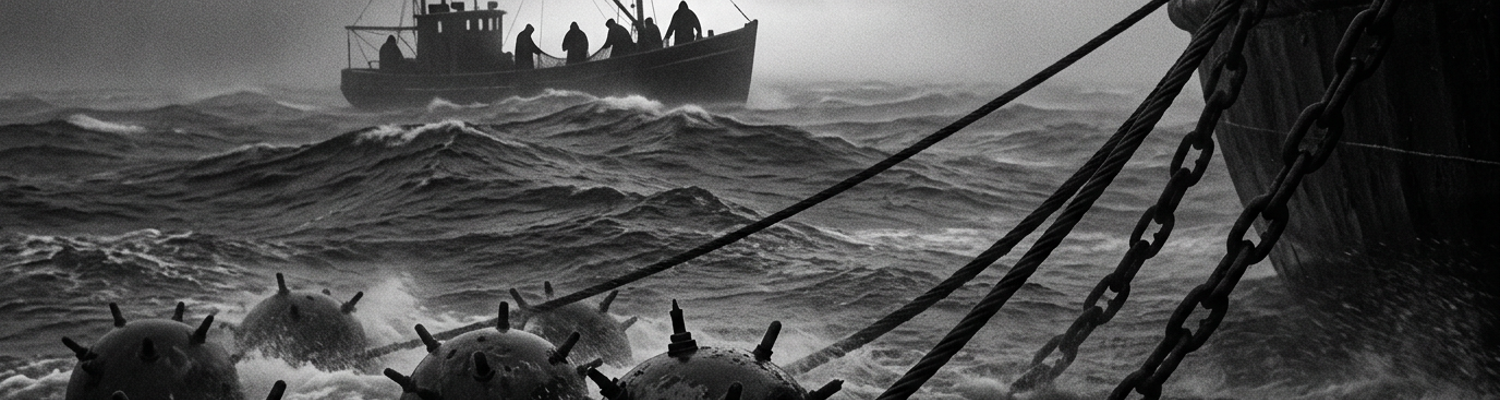

Defensive Minefields at Kodiak Base
Soldiers of the 201st Infantry Regiment and naval construction details slogged through knee deep glacial mud across Kodiak Island. Thirty six continuous hours passed without hot rations. Freezing sleet blew horizontally off the North Pacific. Standard issue wool service coats froze into rigid sheets of ice. Frozen cloth abraded bare skin with every step. Marching up the roadless ravines between Buskin Lake and the coastal heights above Chiniak Bay, the infantrymen dragged heavy timber framing and communications wire by hand. Field rations consisted of unheated tinned meat and waterlogged biscuits. Men swallowed this food while standing knee deep in muskeg. Exhaustion caused physical breakdowns across the marching columns. Men dropped from hypothermia along the cliffs long before the Japanese fleet appeared on northern reconnaissance horizons.
Sleep was replaced by black coffee and fear.
Archival evidence shows that in January and February 1942, defense planners at Naval Operating Base Kodiak operated under extreme panic. Captain Ralph C. Parker commanded the Alaskan Sector. He coordinated directly with Brigadier General Charles H. Corlett to fortify the island against an impending Imperial Japanese Navy offensive. Tactical priorities centered around preventing an air assault similar to the raid on Pearl Harbor. Positioned along the shoreline of Women's Bay, the base housed the primary repair docks, subterranean diesel fuel bunkers, and PBY Catalina flying boat ramps of Patrol Wing Four. Intelligence summaries warned of Japanese carrier divisions. These ships could exploit persistent Aleutian fog banks to launch sudden strikes against exposed facilities. Covert undersea incursions presented equal danger. Imperial Japanese Navy I class submarines routinely scouted the Gulf of Alaska. These boats carried deck guns and folding floatplanes to interdict shipping lanes. Coastal defense units of the 215th Coast Artillery positioned themselves along Buskin Beach. They possessed tractor drawn 155 millimeter guns but lacked radar fire control. Spotters had no way to detect or engage a submarine running submerged through the coastal narrows under nocturnal conditions. Protecting the interior fleet anchorage from airborne destruction and undersea torpedo runs required a physical barrier across the water.
Moored naval mines offered the only area denial weapon available on short notice.
A close review of operational logs indicates that naval tenders and converted district vessels began deploying Mark 6 naval minefields across the deep channels of Chiniak Bay in early 1942. Every Mark 6 mine consisted of a buoyant steel sphere holding 300 pounds of cast TNT. A high tensile steel wire cable moored the sphere to a heavy cast iron anchor box. Galvanic copper horns projected from the top hemisphere. These horns contained glass ampoules filled with electrolyte. The glass crushed on contact with a ship hull to complete an electrical firing circuit. Laying these weapons in sub Arctic conditions tested shipboard equipment to absolute breaking points. Crews working on ice sheathed decks struggled with the erratic bathymetry of Chiniak Bay. Submarine trenches dropped abruptly from ten to sixty fathoms around Woody Island and Long Island. Winches frequently seized under encrusted spray. Automatic cable plummets repeatedly failed to seat on the uneven volcanic rock bottom. Work vessels seeded dense mine rows across the approaches despite gear failures and blinding squalls.
When examining the historical record, a minor technical modification introduced at the depot level triggered severe operational failures across the anchorage. Chiniak Bay experienced extreme Gulf of Alaska tides. Water levels fluctuated by up to twelve feet twice daily. Strong lateral currents pulled the buoyant mine spheres far below their designated operating depths during flood tides. This created gaps through which shallow draft Japanese vessels could slip undetected. Mine depot technicians responded by shortening the steel mooring cables. They also recalibrated the internal hydrostatic bellows mechanisms. This adjustment kept the firing horns at lethal contact depth during high water. Low water cycles exposed the full hazard. The buoyant steel spheres breached the surface completely. They floated uncovered among the rolling swells directly inside friendly navigation lanes.
Sub Zero Tidal Surges and Mechanical Failures
Archival evidence shows that ambient air temperatures over Chiniak Bay dropped past ten degrees below zero Fahrenheit during the sub zero blizzards of late February 1942. This supercooled surface waters already churned by eight knot tidal currents running through the narrows between Woody Island and Cliff Point. Naval ordnance crews operating out of the Naval Operating Base Kodiak depot discovered a major mechanical fault. The extreme thermal drop disabled the internal firing chain of the moored Mark 6 mines. This happened before they could ever intercept an enemy keel. In normal operations, the weapon armed itself only after submergence. It relied on an external hydrostatic port. This port allowed surrounding seawater to exert ambient pressure against a flexible rubber and bronze hydrostat diaphragm. The diaphragm compressed under sea pressure. It then depressed a spring loaded mechanical plunger. This action closed the internal safety arming switch connecting the dry cell battery to the galvanic firing circuit.
Rapid tidal rushes forced supercooled surface water and frazil ice crystals directly into these narrow hydrostatic inlet channels.
Ice formed solid plugs inside the pressure chambers within hours of immersion. This prevented the hydrostatic bellows from expanding. Mine depot inspection reports (NARA Record Group 181) logged dozens of cases where the expansion of trapped freezing water deformed the bronze diaphragms beyond factory tolerances. The ice sheared delicate mechanical pins. It locked the contact mechanisms in a permanently inert state.
Ice rendered defensive weapons entirely harmless against enemy hulls.
A close review of operational logs indicates that the physical violence of Chiniak Bay destroyed the ground tackle holding the remaining live mines in place. The seabed across the naval approaches between St. Paul Harbor and Long Island consisted of sharp volcanic basalt shelves. Fractured slate ledges and glacial boulder fields covered the bottom. Standard US Navy mine moorings relied on five sixteenth inch galvanized steel wire rope. This rope fastened between the buoyant fourteen hundred pound case and a heavy cast iron anchor box. Twelve foot tidal variations combined with twenty foot North Pacific swells. The buoyant surface spheres began snatching continuously against their anchors. This violent vertical heaving imposed cyclic dynamic shock loads far exceeding the breaking strain of standard mooring cables. Down on the rocky bottom, the constant lateral sweep of the current dragged the steel lines back and forth across sharp basalt formations. The rocks ground down the metal strands. Technicians examining recovered gear noted heavy damage. Outer wire strands were stripped clean of zinc protection and abraded to frayed threads in less than seventy two hours of salt water immersion.
Mooring lines snapped across every seeded row in the bay.
Records kept by Captain Ralph C. Parker and his staff document how this mechanical breakdown created an uncontrolled crisis for local defenders. Freed from their anchors by cable failure, buoyant Mark 6 mines drifted toward open sea. Surging tides also swept them inward into the primary navigation channels of Women's Bay and Buskin Beach. Some severed spheres stayed mechanically armed. The hydrostat switch had frozen in the engaged position prior to line separation. The six knot ebb tide swept these drifting weapons into coastal reefs. They detonated violently against submerged shoals. The blasts rattled shore installations and triggered false anti submarine alerts across Fort Greely. Patrol craft screening the entrance to St. Paul Harbor had to dodge uncontrolled floating explosives in heavy sea fog without functioning radar. Minesweeping details from Section Base Kodiak lacked heavy wire drags capable of clearing shattered cables entwined in bottom crevices. Harbor craft had to detonate rogue floaters with rifle fire from open foredecks at ranges under forty yards.
Field Expedient Modifications to Mark 6 Mines
Inside the unheated repair sheds of Naval Operating Base Kodiak, depot machinists took blowtorches and hand drills directly to live ordnance.
Archival evidence shows that torpedo repair details and civilian contractors at the Women's Bay maintenance yard acted entirely on their own initiative by early March 1942. They wanted to solve the hydrostat freeze ups. Salt water spray and sub zero air repeatedly turned the copper bellows and spring plungers of the Mark 6 arming assemblies into solid ice blocks before the weapons could submerge. Mechanics operated inside corrugated tin shacks with temperatures hovering near zero. Ordnance technicians fabricated crude pre heating systems using commercial kerosene wick burners and soldered copper tubing. Mechanics wrapped these hand shaped copper coils directly around the exterior brass housing of the hydrostatic safety switches. They routed small fuel feed lines to one pint kerosene reservoirs clamped alongside the main galvanic battery pockets. The open flame warmed the sensitive bellows assembly on the staging skids. This kept the hydrostatic ports clear of ice crystals while deck crews wrestled the weapons onto mine laying tracks.
Hot fuel dripped over wet planking inches away from the 300 pound cast TNT explosive charges.
Technicians used open flame blowtorches to heat the solder joints on these improvised fuel lines. Active dry cell firing batteries sat uninsulated on neighboring metal workbenches. Safety protocol dissolved under the press of harbor defense.
When examining the historical record, a second unauthorized modification compromised the mechanical anchor machinery of the entire Chiniak Bay mine inventory. Standard Bureau of Ordnance blueprints specified that the Mark 6 anchor box used calibrated soft brass shear pins inside the plummet operated cable drum assembly. These factory installed brass pins were designed to yield under precisely two hundred and fifty pounds of dynamic pull. This locked the mooring line at the exact moment the descending plummet struck bottom to establish the preset flotation depth. Rapid twelve foot tidal surges through the Woody Island channel exerted heavy hydrodynamic drag. This drag repeatedly severed these soft factory pins during deployment. The winches jammed prematurely. This stranded mine cases forty feet below their planned intercept levels. Depot officers ordered machine shop crews to drill out the factory brass sleeves. They inserted non standard case hardened steel bolts into the release collars. Mechanics shimmed the internal spring packs with scrap boiler plate to more than triple the tension rating. They completely bypassed the Bureau of Ordnance engineering staff in Washington. Technical circulars explicitly banned field alterations to these anchor mechanisms. Hardened steel transferred dynamic wave shocks directly into the brittle cast iron anchor housings instead of absorbing them.
The modified steel pins held fast against the sea.
A close review of operational logs indicates that this depot level recalibration destroyed the weapons during placement. Converted tenders dropping mines along the basalt ledges between St. Paul Harbor and Long Island reported instantaneous structural failures. The altered ground tackle struck the water. Heavy anchor boxes tumbled down the seventy fathom submarine slopes. The hardened steel pins refused to shear under the plunging weight of the plummet weights. Dynamic shock waves snapped the cast iron axle flanges of the winch drums. The brittle housings cracked into iron fragments under thirty fathoms of water. Released from their mooring drums, hundreds of feet of five sixteenth inch steel wire unspooled wildly into the underwater boulder fields. Unanchored mine cases shot straight back toward the surface at fifteen feet per second.
Mooring Collapses and Arctic Slush Failures
Slush turned the modified weapons into lead weights.
Archival evidence shows that dense fields of frazil ice and semi frozen surface slush drifted out from the mouth of the Buskin River into the northern approaches of Chiniak Bay by mid March 1942. Standard Mark 6 mine cases presented a smooth spherical thirty four inch painted steel surface. This allowed freezing seawater to wash off before ice shelves could adhere. That hydrodynamic profile no longer existed on the modified units. Field welded copper heating coils, reservoir mounting brackets, and exposed solder joints created dozens of irregular catch points along the lower hemisphere. Spilled kerosene residue from the improvised wick heaters formed a greasy film. This film held Arctic slush against the cold steel plates. Water temperatures hovered near twenty eight degrees Fahrenheit. This semi solid slurry congealed into thick rinds of anchor ice along the underside of every altered casing. Each mine sphere possessed only four hundred pounds of positive reserve buoyancy when fully dry.
Accreted slush and frozen spray added up to six hundred pounds of deadweight to the exterior shells within seventy two hours of salt water immersion.
Submerged spheres lost all upward lift. The top heavy cases sank into the deep mud of the channel floor instead of holding station at their prescribed combat depth of twenty feet below the surface. They buried their galvanic contact horns in bottom silt.
The bay swallowed the mine line whole.
A close review of operational logs indicates that the underwater drag on these ice sheathed spheres created structural forces the ground tackle could not sustain. Strong eight knot tidal currents funneling past the Woody Island shelf struck the enlarged distorted profiles of the fouled mine cases. Each slush encrusted casing generated thousands of pounds of continuous hydrodynamic drag against the anchor assemblies below. They did not smoothly shed the rushing water. Inside the plummet lock mechanisms, the non standard brittle steel pins installed by depot machinists lacked the metallurgical ductility of factory specified soft brass. Twenty foot North Pacific swells surged over the deep troughs of Chiniak Bay. Dynamic shock loads hammered the rigid mooring joints. The unyielding steel pins shattered under the sudden cross channel shear stresses. Fastener heads sheared off cleanly inside the mooring collars. This released the drum pawls and severed the wire terminations.
Forty two fully armed contact mines broke loose in thirty minutes.
When examining the historical record, the severed mines rose rapidly through the water column. Surging wave action stripped portions of the slush rinds during the breakaways. Their hydrostatic arming switches jammed shut by internal ice deformation. The weapons did not safe themselves when line tension dropped to zero. Loose Mark 6 spheres drifted north northwest on the incoming flood tide. They floated directly across the primary transit lane between St. Paul Harbor and the open sea. Harbor defense tugs and converted patrol craft from Section Base Kodiak found themselves surrounded by unanchored live explosives wallowing in the trough of four foot waves. A free drifting mine struck the rocky shoreline of Near Island at 0415 on March 18. Its three hundred pound TNT charge detonated against the shore road. The blast severed primary telephone lines connecting Fort Greely to the coastal artillery batteries at Cliff Point. Captain Ralph C. Parker ordered all naval vessel movements across Chiniak Bay halted for four days. Patrol craft engaged floating spheres with deck mounted .50 caliber machine guns at ranges under fifty yards.
Adrift Mines Across Naval District Corridors
Tidal currents transformed harbor defenses into roving surface hazards.
Archival evidence shows that the counter clockwise sweep of the Alaska Coastal Current caught free floating Mark 6 cases between March 19 and March 26, 1942. The current pulled them straight out of Chiniak Bay into the main maritime corridors of the North Pacific. The buoyant thirty four inch steel spheres swept past Cape Chiniak at velocities exceeding four knots. They entered the fifty fathom trench connecting Kodiak to the Gulf of Alaska trunk route. Water temperatures warmed slightly away from the river estuaries. This melted the encrusted anchor ice and restored roughly three hundred and eighty pounds of positive buoyancy to each casing. This sudden return of flotation lifted the live galvanic horns directly to wave trough level. North Pacific swells masked the dark green metal shells from lookouts. Patrol planes from Patrol Wing Four spotted sixteen unmoored weapons drifting seventy miles offshore along the primary submarine patrol corridor running toward the Kenai Peninsula by March 22. Heavy sea states dispersed the spheres over an arc spanning from 57 degrees 20 minutes North to 58 degrees 10 minutes North. This arc lay directly across the sealanes used by deep draft supply vessels running between Puget Sound, Prince William Sound, and the Aleutians. Deck crews aboard the district patrol boat YP 72 recorded four separate near collisions with free floating ordnance while running in dense sea smoke ten miles east of Spruce Cape.
Every shipping lane into southcentral Alaska contained floating contact explosives.
A close review of operational logs indicates that the sudden presence of armed ordnance along these deep water routes forced the Seventeenth Naval District command to issue an emergency freeze on all outbound and inbound military maritime traffic. Captain Ralph C. Parker ordered an indefinite routing shutdown for the Gulf approaches on March 23. This stranded thirteen merchant vessels and military transports laden with dry provisions, structural steel, and crated aircraft engines outside the swept zones. The 5,000 ton freighter SS Mount McKinley carried four hundred tons of 155 millimeter artillery ammunition earmarked for coastal defense batteries at Fort Greely. The ship was halted forty miles southeast of Kodiak and ordered to heave to in open water. Tankers loaded with hundred octane aviation fuel for the forward bomber staging strip at Cold Bay were held in Port Wells. They were unable to transit past the mine strewn approaches of Kodiak Island without active minesweeping escorts. The district command possessed only two converted wooden purse seiners, YMS 101 and YP 87. These boats had improvised cable sweep gear that lacked acoustic or magnetic detection systems. These auxiliary craft could clear no more than five square miles of channel per twenty four hour shift. Merchant convoys remained dead in the water. They consumed bunker oil while drifting in submarine threat zones.
Defensive preparations on Kodiak had cut their own sea lines.
When examining the historical record, this paralysis directly degraded the combat readiness of naval aviation units preparing to contest Imperial Japanese Navy carrier movements. Mechanics at Naval Air Station Kodiak began siphoning aviation gasoline from the wing tanks of operational PBY 5A reconnaissance planes to keep base power generators running. This cut the number of daily anti submarine sorties in half. Construction battalions on the newly begun airfields at Dutch Harbor and Umnak ran out of concrete aggregate and runway pierced steel planking for eleven days. They were deprived of scheduled barge shipments from Seattle. Coastal lookout stations at Cape Greville and Narrow Cape reported spotting three unanchored Mark 6 mines washing onto the beaches beneath their gun emplacements between March 27 and March 29. Each weapon detonated upon contact with surf boulders. The blasts severed buried power feeds to early warning radio towers.
Shipping Paralysis During the Dutch Harbor Raid
War arrived while the supply lines were frozen by friendly ordnance.
Archival evidence shows that carrier strike aircraft from the Imperial Japanese Navy carriers Ryujo and Junyo attacked Dutch Harbor on June 3, 1942. Naval Operating Base Kodiak could neither deploy relief convoys nor clear its own channels for naval escorts. Rear Admiral Robert A. Theobald needed immediate fuel replenishments and anti aircraft munitions from the depot stocks at Women's Bay for Task Force 8. Nothing moved past Spruce Cape. The prior depot modifications to the Mark 6 mine assemblies had seeded the main deep water egress routes with unmapped contact hazards. Captain Ralph C. Parker declared Chiniak Bay non navigable to deep draft shipping on the morning of the attack. Three fleet auxiliaries lay immobilized at anchor off Fort Greely with full steam up. These included the ammunition transport USAT Chirikof and the high octane gasoline tanker SS Derblay. They were unable to cross the twenty fathom shelf where unmoored mines floated at random depths. Shore commandants refused clearance for destroyer escorts to sort out into the Gulf of Alaska. They feared that five hundred pound contact spheres would strike steel hull plating before the warships cleared Woody Island channel. Oil storage tanks burned and thirty three soldiers died at Dutch Harbor six hundred miles to the west. Ammunition reserves at Kodiak sat boxed inside depot holds because harbor exits were sealed by domestic weapons.
The Navy had trapped its own fleet.
A close review of operational logs indicates that Seventeenth Naval District authorities initiated the emergency seizure of the Kodiak commercial fishing fleet on June 4 to break the operational dead end. Regular naval minesweepers were completely absent from the sector. The Navy had committed them to escort runs between Dutch Harbor and Puget Sound. District officers dispatched armed shore patrols down to the St. Paul Harbor municipal cannery piers. They commandeered private commercial wooden purse seiners and halibut schooners directly from civilian crews. Wooden hulls provided two specific mechanical advantages. Their shallow eight foot drafts allowed the craft to ride over submerged Mark 6 spheres without striking the galvanic horns calibrated for ten feet. Their soft timber construction absorbed low energy shock waves better than unarmored steel plates. Machinists from the naval repair depot stripped salmon winches and purse line gurdies off nine requisitioned fishing vessels. They replaced them with hand welded steel towing bitts, mechanical wire cutters, and serrated five eighths inch steel drag lines. Civilian skippers were enrolled on the spot as temporary boatswain mates. They were ordered to pilot their small fifty foot diesel craft back and forth across the volcanic trenches between Cliff Point and Broad Bay at three knots.
Civilian salmon boats became the frontline defense against American explosives.
When examining the historical record, these improvised sweeping operations nearly foundered under severe gear attrition and high risk mechanical clearance tactics. The commercial winches were built to lift wet cotton twine rather than multi ton iron anchor assemblies. They burned out their clutch linings within six hours of dragging steel sweep lines across the jagged basalt bottom of Chiniak Bay. Deck crews aboard the seized purse seiner Foremost rigged twin sixty pound kedge anchors on thirty fathoms of wire rope. They dragged the sea floor to hook the severed mooring cables of adrift mines. When a sweep line hooked an anchor cable, the wooden boat had to pull the live contact weapon to the surface by brute engine power. This exposed open wooden sterns to three hundred pound TNT explosions if a rolling wave brought the mine case against the vessel hull. These fishing boats snagged twenty seven live Mark 6 mines inside the channel approaches between June 5 and June 8. Japanese forces were simultaneously landing ground troops on Attu and Kiska. Navy gunners stationed aboard the fishing decks detonated the caught spheres one by one with .30-06 Springfield rifle fire at point blank distances of thirty yards. The concussions shattered wheelhouse windows and cracked structural timbers along the civilian vessel keels.