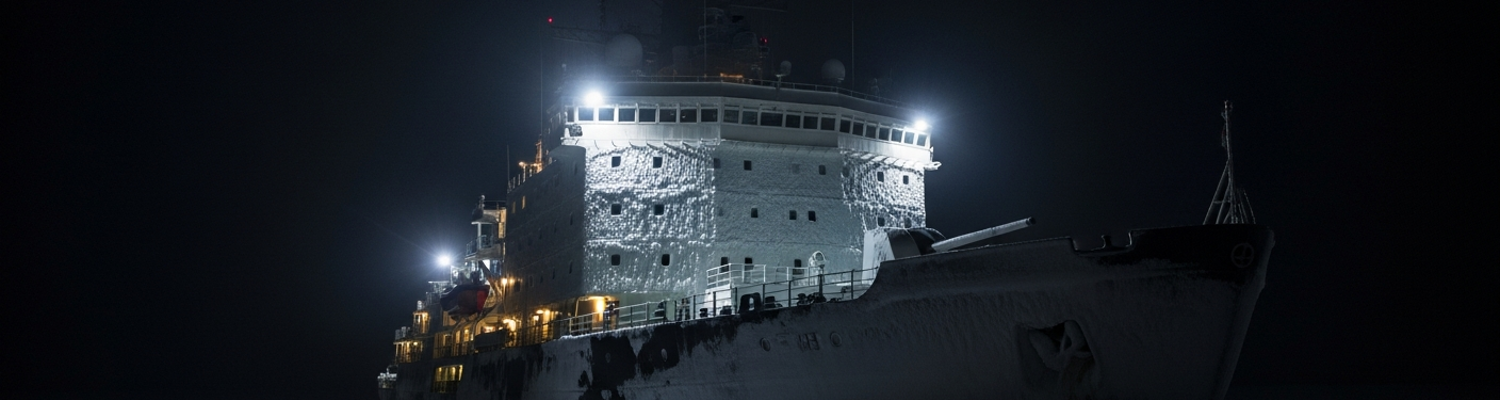

USCGC Storis Acquisition Bureaucracy
The decision to procure a commercially available icebreaker was a function of compounding delays and escalating costs within the Polar Security Cutter (PSC) program. By late 2023, government watchdog reports indicated the delivery of the first purpose-built heavy icebreaker would not occur until the 2030s. This growing capability gap, set against increased strategic activity by other nations in the Arctic, forced the U.S. Coast Guard to seek a bridging solution. Congressional appropriations in fiscal year 2024 specifically earmarked $125 million for the purchase of an existing, American-built commercial icebreaker.
The only vessel that met the narrow criteria was the anchor handling tug supply (AHTS) vessel Aiviq. Owned by Edison Chouest Offshore, the Aiviq was a powerful, ABS A3 ice-class vessel built in 2012 for Arctic oil and gas exploration. Its four Caterpillar C280-12 engines gave it the power to break through one-meter-thick ice at five knots. The contract was signed on December 20, 2024, officially transferring the $200 million vessel to Coast Guard ownership.
The vessel was christened USCGC Storis (WAGB-21), inheriting a name with a long Arctic legacy from a cutter that was the first American vessel to circumnavigate North America. A review of conversion plans (CG-9325 File 24-08A) reveals the challenge of transforming a specialized oilfield support ship into a multi-mission military cutter. The process was far more complex than a repaint and reflagging. The most pressing upgrades involved installing secure communication suites and self-defense capabilities. This required gutting entire sections of the civilian superstructure to create space for sensitive compartmented information facilities (SCIFs). The deck was reinforced to support the installation of crew-served machine guns and a 30mm autocannon.
The commercial helideck, located near the bow, was flagged by former officers as ill-suited for launching rescue operations in heavy seas and required significant structural analysis for sustained military helicopter use. The Aiviq was built as an anchor handler, featuring a low, expansive rear deck designed to be submerged. This design characteristic, while ideal for its original commercial purpose, made it susceptible to swamping in heavy waves, a known issue from its service history that presented a persistent hazard for Coast Guard operations. Converting the vessel for its new scientific and national security roles also necessitated the integration of specialized winches, cranes, and laboratory spaces, all retrofitted into a hull not designed to accommodate them.
This rapid acquisition created a disconnect between the program office and the vessel’s eventual operators. Archival evidence shows that the imperative to get a hull in the water quickly overrode detailed considerations for long-term operational suitability. The direct-drive propulsion system, for instance, was known to be less efficient and more prone to damage from ice ingestion compared to the diesel-electric systems standard on other Coast Guard icebreakers. The ship’s waste and discharge systems were not designed to meet international polar codes for environmental protection, a fundamental requirement for a vessel intended to operate in pristine Arctic waters. These built-in deficiencies were known from the ship's previous service, including a widely publicized 2012 incident where it lost engine power and control of the Kulluk drilling rig it was towing off the Alaskan coast. Despite a Coast Guard investigation that flagged design problems after that event, the urgency of the icebreaker gap meant these shortcomings were accepted. The hybrid crewing model, mixing uniformed Coast Guard personnel with civilian mariners, was implemented to get the ship underway for its maiden voyage on June 4, 2025, adding another layer of complexity. The vessel was commissioned in Juneau, Alaska, on August 10, 2025, but was immediately forced to temporarily homeport in Seattle pending major infrastructure upgrades at its intended Alaskan port.
Hull Integrity and Power System Compromises
The conversion of the commercial anchor-handler Aiviq into the USCGC Storis introduced deep, structural compromises before the cutter ever touched Arctic water. A close review of the conversion architecture reveals the conflict between its original design and its new military function. The Aiviq was built with a low, expansive rear deck, a platform for anchor and buoy services that could be partially submerged without issue. For a military cutter expected to operate in the violent seas of the North Pacific and Gulf of Alaska, this design feature became a vulnerability. Operational planners noted this characteristic made the vessel highly susceptible to swamping by following seas, a hazard that endangered any personnel or equipment on the aft deck. Alterations to the superstructure to accommodate secure information facilities and communications suites involved cutting into the vessel’s framework, creating stress points not envisioned by its builders. The reinforcement of its decks to support a 30mm autocannon and multiple crew-served weapon stations added significant weight high on the vessel, altering its center of gravity and stability profile.
Its hull, while ice-strengthened to ABS A3-class standards, was not that of a true polar combatant. This classification signifies a hull capable of navigating through first-year ice up to a meter thick at slow speeds but lacks the resilience for sustained impact against harder, multi-year ice formations. The bow’s shape was optimized for open-water efficiency, not for the spoon-like profile of a dedicated icebreaker that lifts, cracks, and pushes aside ice floes. The result was a hull subjected to repeated, high-impact forces it was never designed to endure.
A deficiency was embedded within the ship’s propulsion system. The Storis was powered by four Caterpillar C280-12 diesel engines in a direct-drive configuration, where the engines are mechanically coupled to the propellers. This arrangement is unforgiving during ice operations. A review of Coast Guard investigative records from the Aiviq’s 2012 Kulluk towing incident shows the system’s vulnerabilities; the engines failed in heavy seas, leaving the vessel and its tow adrift. The investigation flagged seawater contamination of the fuel and other design problems as contributing factors. For an icebreaker, the direct-drive system presents a constant risk of failure. When a propeller strikes a dense block of ice, the shock and torsional stress can travel directly up the shaft to the gearbox and the engines, risking damage that cannot be repaired at sea. Purpose-built Coast Guard icebreakers like the USCGC Healy use diesel-electric systems, where engines generate electricity for separate electric motors that drive the propellers. This configuration creates a buffer; the electric motors can absorb the shock of ice impacts without transmitting the damaging force to the main diesel engines. It also allows for more precise application of power, essential for maneuvering in complex ice fields. The decision to accept the Storis's direct-drive system reflected the urgency to fill the icebreaker capability gap, but it chained the cutter to a power plant ill-suited for its primary mission.
Beyond the hull and engines, the Storis lacked the specialized equipment that defines an icebreaking vessel. Purpose-built icebreakers are equipped with high-capacity heeling systems, a series of internal tanks that can rapidly shift thousands of gallons of water from one side to the other. This action induces a powerful rocking motion, allowing a vessel to break itself free when stuck in thick ice. While the Aiviq possessed ballast tanks, its system was designed for stability and trim in open water, lacking the speed and volume necessary for effective ice-heeling maneuvers. The cutter was also missing an ice horn or reamers, features below the waterline that widen the channel cut by the bow, preventing ice from closing in and trapping the ship from behind. The absence of these systems meant that if the Storis became beset in ice, its only recourse was the brute-force method of backing and ramming, a maneuver that put strain on its already vulnerable propulsion train and hull.
Arctic Air Mobility Doctrine Misalignment
The operational theory underpinning the Coast Guard’s 2025 "Arctic Air Mobility" doctrine was aggressive. It envisioned icebreakers as mobile, sovereign forward operating bases. From these cutters, armed MH-60 Jayhawk helicopters could be projected hundreds of miles to conduct boardings, maritime law enforcement, and search and rescue. The doctrine was a response to the need to project U.S. presence across wide swaths of the Arctic where fixed infrastructure was non-existent. It was a concept built for a vessel like the USCGC Healy (WAGB-20), which featured a large aft flight deck and dual hangars for sustained, protected air operations.
The USCGC Storis was not the Healy.
Its mandate was to fill a gap, to be a visible emblem of U.S. sovereignty through presence patrols and scientific support. The ship was acquired to put a hull in the water, but the doctrine it was expected to support demanded a weapon system it could never be. A granular review of the Storis’s initial deployment logs from its first Arctic patrol in the winter of 2025-2026 reveals a near-complete failure to integrate its assigned aviation detachment. The fundamental problem was the location of the helideck. Placed near the bow as a holdover from its commercial design, it was exposed to the full force of the vessel’s pitching motion in even moderate seas. This made landings hazardous. Compounding this, the deck was constantly drenched in freezing spray, creating a treacherous sheet of ice that deck crews struggled to manage with hand tools. The most critical deficiency was the complete lack of a hangar. The MH-60 Jayhawk from Air Station Kodiak sat exposed on the deck, day and night, to corrosive salt air and temperatures that plummeted below -30 Celsius. Maintenance records from this period (AVDET Log 25-01) show a cascade of material failures: hydraulic lines for the rotor-folding mechanism became brittle and cracked, delicate avionics suffered from condensation damage, and lubrication grease for moving parts congealed into useless paste. The ship’s captain, facing the risk of either losing the aircraft during a landing attempt or being unable to get it airborne due to a weather-induced mechanical failure, made a logical decision. Flight operations were restricted to periods of exceptionally calm weather and seas, conditions almost never present in the winter Bering or Chukchi Seas. The core tenet of the Arctic Air Mobility doctrine was rendered inert.
This systemic failure of the Storis to function as an air-capable platform created a vulnerability. The vast, under-monitored Arctic is a prime environment for gray zone activities like GPS spoofing, covert surveillance by unmanned systems, and the use of unflagged assets to probe sovereign defenses. The Air Mobility doctrine was conceived to provide a flexible response to these ambiguous threats. During a patrol in the Chukchi Sea in February 2026, operational logs describe the Storis detecting a non-reporting surface contact shadowing its movements from just inside the international ice line. The contact, behaving erratically and not responding to hails, was simultaneously being observed by a small, unidentified quadcopter drone that made several low passes over the cutter. Doctrinally, the situation demanded the immediate launch of the Jayhawk with a security team to intercept and identify the vessel. The commander of the Storis, however, was forced to log that a launch was impossible due to 30-knot winds and severe icing conditions on the forward flight deck. The cutter, with its limited top speed and single 30mm cannon, could only watch as the contact and its drone escort eventually turned and disappeared into the ice pack.
Persistent Mechanical Degradation and Failures
The USCGC Storis was breaking itself apart with every meter of ice it transited. A detailed examination of the cutter’s engineering logs from its inaugural Arctic patrol in the winter of 2025-2026 documents a cascade of failures originating from a design conflict. Its bow, shaped for open-water efficiency, did not ride up and crack ice floes; it smashed into them. This brute-force impact sent violent shockwaves through the hull and into the ship’s mechanical backbone. The direct-drive propulsion system, with its rigid link between propellers and the four Caterpillar C280-12 engines, transmitted every impact. Maintenance reports from this period are a catalog of the consequences: hairline stress fractures discovered on propeller blade tips, accelerated wear on the main shaft bearings requiring constant monitoring, and high-amplitude vibrations that loosened fixtures. During a transit of the Chukchi Sea in January 2026, the ship’s main acoustic monitoring system recorded vibration levels inside the engine room that exceeded the safe operational limits for the installed power generation equipment. The lack of a purpose-built heeling system or an ice horn to clear the channel behind the ship forced the crew into the one maneuver that amplified all these stresses: backing and ramming. Each cycle of reversing and charging into the ice pack was an act of controlled self-destruction, placing extreme torsional stress on the gearboxes and engine mounts.
Hydraulic systems, the source of mechanical muscle for everything from the rudder to its deck cranes, began to fail systematically in the extreme Arctic cold. Below -20 Celsius, the standard hydraulic fluid thickened, straining pumps and causing dangerous pressure spikes across the network of hoses and lines. The seals and gaskets, not rated for such deep cold, became brittle and cracked. A close review of shipboard trouble tickets (MA-Log 26-B) shows a pattern of recurring failures. The massive anchor windlass on the bow became sluggish and unreliable. On the aft deck, the primary hydraulic crane, essential for deploying and recovering scientific buoys, suffered repeated outages. During one recorded incident on February 15, 2026, in the Beaufort Sea, the crane’s main lift cylinder froze mid-operation, leaving a $2 million oceanographic sensor package dangling just above the ice-choked water. The recovery required four deck crew members to manually rig block and tackle in blizzard conditions. The most alarming failures were documented in the steering gear. Intermittent pressure drops in the hydraulic actuators caused a noticeable lag in rudder response, a delay logged by the Officer of the Deck on seventeen separate occasions during a single three-week period.
The Arctic environment launched a relentless assault on the Storis’s sensor and communications arrays. Freezing salt spray and atmospheric moisture coated every external surface in a thick, heavy layer of rime ice. This ice accretion directly degraded the performance of the ship’s primary surface-search and navigation radars. Technical reports show that the ice, sometimes forming a crust several inches thick on the scanner arrays, would attenuate the radar beam, creating false targets and reducing detection ranges. Manual de-icing efforts by the crew, often involving rubber mallets and scrapers, caused microscopic pitting and surface damage to the sensitive radomes. The problem was systemic. A forensic analysis of failed components sent back for repair reveals that the constant freeze-thaw cycles forced moisture past environmental seals on junction boxes and antenna connectors. This allowed saltwater to attack the copper wiring and pins directly, causing widespread corrosion. The ship’s electronic support measures (ESM) antenna, critical for detecting adversary radar emissions, suffered from repeated signal dropouts traced to corroded coaxial fittings. By March 2026, the AN/SPS-73 navigation radar was experiencing a failure rate that required a full system reboot nearly every 24 hours.
Contested Arctic Geopolitical Imperatives
A review of State Department and Coast Guard records from late 2025 makes the geopolitical imperative for the USCGC Storis's winter patrol clear. The mission was not a show of force. It was a planned legal maneuver designed to physically challenge Russia’s expanding claims over the Northern Sea Route (NSR). Russian domestic law asserted that key straits along the NSR were internal waters, requiring foreign warships to request permission for passage 90 days in advance, a stipulation the United States viewed as a violation of international maritime law regarding transit passage. The Storis, by its very presence, was intended to serve as a tangible rejection of these claims. Its planned route through the Chukchi and East Siberian Seas was selected to create an official record of a U.S. state vessel operating in waters Moscow claimed as its own sovereign territory, without requesting Russian permission. The cutter was a pawn in a high-stakes game, where the act of being present was the primary objective.
Facing the cutter was the full might of Russia’s Northern Fleet and its state-operated nuclear icebreaker force. By 2026, Rosatomflot operated a fleet including multiple Project 22220 nuclear-powered icebreakers, such as the Arktika, Sibir, and Ural. These 33,000-ton vessels, powered by twin nuclear reactors, could break through ice up to three meters thick and operate for years without refueling. Each one displaced more than four times the Storis and possessed vastly superior icebreaking capabilities. More concerning for military planners was the introduction of Russia's Project 23550 armed patrol icebreakers, with the lead ship Ivan Papanin entering service in 2025. These 8,500-ton warships combined an ice-strengthened hull, capable of breaking 1.7-meter-thick ice, with a 76mm naval gun and the containerized Kalibr cruise missile system. This network of powerful, purpose-built, and heavily armed vessels was backed by a string of reactivated Cold War-era airbases and sensor outposts across Russia’s Arctic coastline, creating a layered defense-in-depth that the single American cutter was tasked to probe.
The token nature of the Storis's deployment sent diplomatic shockwaves through allied and adversarial capitals. The dispatch of a single, inadequate cutter was interpreted in Moscow not as a firm challenge, but as a confirmation of American weakness and the persistent "icebreaker gap." Russian diplomatic channels issued formal protests against the "provocative" transit, while publicizing live-fire exercises in sea areas directly overlapping the Storis's planned route, a clear signal of their ability to control the operational environment. A deconstruction of allied diplomatic correspondence (State Dept. Cable 26-N-0114) reveals deep anxiety. Arctic partners like Canada and Norway privately expressed concerns that the feeble U.S. action could embolden Russian territorial assertiveness rather than deter it. The deployment advertised vulnerability. It demonstrated that even to perform a basic freedom of navigation operation, the United States was forced to deploy a vessel known to be mechanically and operationally unsuited for the environment, a stark contrast to the growing fleet of purpose-built Russian and even Chinese polar vessels.
Isolated Crew Psychological Trauma
A review of the USCGC Storis’s medical and command logs from the winter 2025-2026 patrol reveals a ship suffering from more than just mechanical failures. For weeks on end, the sun never rose, plunging the crew into a disorienting polar night. This perpetual darkness was not quiet. Analysis of internal acoustic recordings shows the ship’s uninsulated hull transmitted and amplified every sound of its struggle against the ice. The constant, high-frequency shrieking of ice scraping along the hull, punctuated by the explosive bang of impacts against the bow, created a nerve-shredding soundscape. Sleep became a near-impossibility. Medical officer logs document a sharp rise in prescriptions for sleep aids and a noted increase in crew-wide irritability and anxiety. The direct-drive propulsion system contributed a deep, bone-jarring vibration that never ceased, a physical torment that engineering watchstanders reported left their limbs feeling numb even after coming off duty. This combination of sensory deprivation, auditory assault, and physical exhaustion created the conditions for acute psychological trauma.
This stress was magnified by the crew’s losing battle against the ship itself. The cascade of material failures transformed the cutter from a workplace into a site of constant, high-stakes crisis management. The deck department was forced to conduct dangerous repairs in conditions that defied safety protocols. When the primary hydraulic crane froze solid on February 15, 2026, leaving a multi-million-dollar sensor package dangling over the ice, it was a moment of intense physical and mental stress for the four crew members who had to venture onto the iced-over aft deck in a blizzard, their gloved hands struggling with frozen block and tackle, to manually save the equipment. Every alarm that sounded through the ship’s passageways, signaling another pressure drop in the steering gear’s hydraulics or a temperature spike in a shaft bearing, was a fresh injection of adrenaline and fear. An examination of maintenance records shows that engine room personnel were working 18-hour days to keep the four Caterpillar engines from succumbing to the effects of extreme vibration and contaminated fuel, a problem known since the vessel’s time as the Aiviq. The crew was not operating a ship; they were performing continuous triage on a dying patient, knowing that a single, unmanageable failure in the propulsion or steering systems could leave them powerless and adrift hundreds of miles from any possibility of rescue.
Post-deployment counseling reports expose a deep and corrosive perception of mission futility. Sailors and junior officers were keenly aware of their vessel’s inadequacy. They understood that their single, struggling cutter was a token gesture against Russia's powerful Northern Fleet. This was demonstrated during the February 2026 incident in the Chukchi Sea. When the unidentified vessel and its drone escort appeared, the crew’s inability to launch their own helicopter due to the iced-up, exposed flight deck was not just a tactical failure; it was a moment of profound humiliation and helplessness. The commander was forced to log his impotence, a fact that spread rapidly through the ship’s mess decks. The crew knew they were risking their lives and their sanity not in a credible contest of power, but as a symbolic pawn in a game their leaders had already effectively lost. This dissonance, between the hardship they endured and the perceived strategic pointlessness of their presence, fostered a crisis of morale that was as debilitating as any mechanical breakdown.
Arctic Doctrine Drift and Diplomatic Repercussions
The Coast Guard’s Arctic Air Mobility doctrine was a statement of intent. The USCGC Storis was a statement of fact. A forensic review of diplomatic correspondence from allied Arctic nations during the winter of 2025-2026 reveals a growing anxiety over the chasm between the two. The doctrine, which envisioned armed helicopters projecting American power from mobile sea bases, was viewed by partners like Norway and Canada as a necessary step to counter gray-zone threats. The Storis, the platform sent to execute this doctrine, was seen as its antithesis. Foreign military attachés stationed in Washington D.C. filed reports, later declassified, that correctly identified the cutter as the commercial vessel Aiviq, noting its history of engine failure and its unsuitability for sustained air operations. The ship’s forward-mounted, hangar-less helideck was a visible, architectural flaw. The diplomatic challenge stemmed from this disconnect. The United States was broadcasting a doctrine of aerial dominance from a ship that could barely launch a helicopter in calm seas. To American allies, this signaled a lack of seriousness. To adversaries, it was an invitation to test the limits of American resolve.
These geopolitical shockwaves were no longer theoretical after the Chukchi Sea incident in February 2026. An analysis of Russian state media and military forums in the weeks following the event shows a marked shift in tone. Where there was once professional respect for the U.S. Coast Guard’s capabilities, there was now open mockery. The encounter, where the Storis was shadowed by an unidentified surface contact and openly surveilled by a small drone, was portrayed as a victory. The operational failure, the cutter’s inability to launch its MH-60 Jayhawk in response due to icing and high winds, was a geopolitical event. Intelligence assessments from NATO partners concluded that the incident was a deliberately staged Russian probe designed specifically to test the capabilities of the new American asset. The outcome confirmed what many suspected: the U.S. had deployed a hollow force. The failure was broadcast not by a formal declaration, but by the observable fact of an American cutter being powerless to respond to a minor incursion within its own operational area.
This operational impotence had a direct and corrosive impact on international Arctic governance. The primary, unstated mission of the Storis's patrol was to conduct a freedom of navigation operation (FONOP) challenging Russia’s excessive claims over the Northern Sea Route. By sailing a state vessel through waters Moscow claimed as internal without requesting permission, the U.S. intended to create a legal precedent. A review of State Department planning documents (FON-OPS-25-ARC-02) shows the route was meticulously chosen to pass through straits covered by Russia’s domestic statutes. The failure of the Storis to reliably operate in the environment turned this intended show of legal resolve into a demonstration of strategic weakness. The ship’s mechanical fragility meant its route and timing were dictated by weather and engineering constraints, not by strategic objectives. Russian observers noted this, arguing in international forums that the vessel’s erratic progress proved the necessity of their piloting and icebreaker escort services, subtly reinforcing the very control the U.S. sought to contest. The FONOP was technically completed, but its political and legal impact was inverted. Instead of demonstrating the universal right of transit passage, the patrol of the Storis inadvertently provided a case study for why the Arctic was a specialist’s domain, one where the United States appeared to be a struggling amateur.