
Air Force Space Command Preparations
A close review of operational logs indicates that at 0314 hours on December 12, the main azimuth drive gearbox inside Radome 3 atop P-Mountain stripped four hardened steel teeth off its secondary planetary gear assembly. Sub-zero arctic drafts penetrating the uninsulated pedestal base congealed the MIL-PRF-5606 hydraulic fluid into a gel. The ring gear ran dry during a high-speed repositioning slew toward a polar-orbiting weather satellite. Pressure in the primary hydraulic line crashed from 2,200 pounds per square inch to zero in less than a second. The drive coupling sheared clean off under the motor torque. Grinding metal fragments choked the scavenge filters. The thirty-eight-foot parabolic dish seized at an unusable sixty-degree elevation angle.
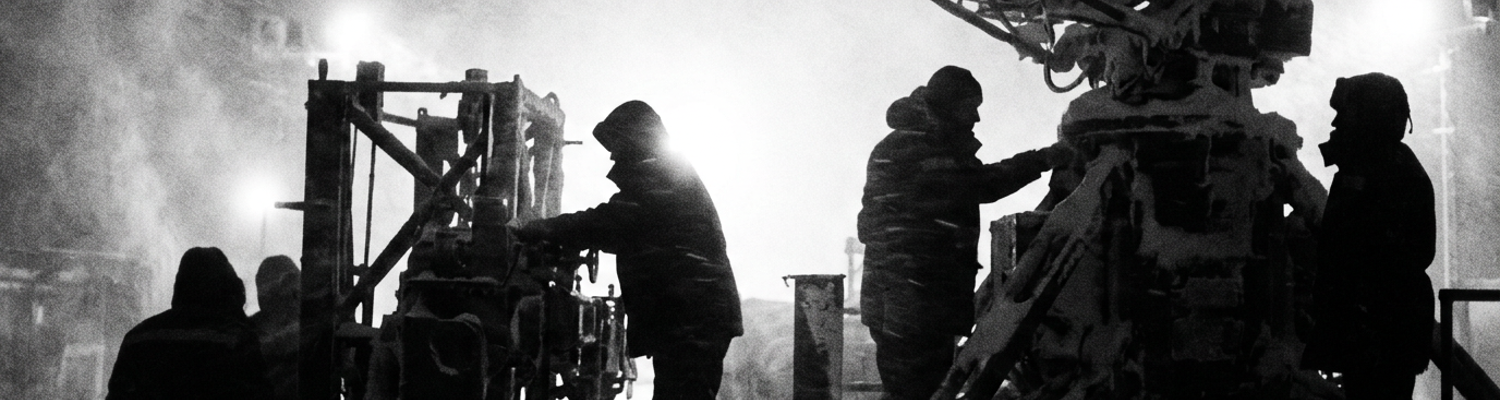
Four technicians scrambled onto the exterior catwalks.
They carried blowtorches and hand cranks through fifty-knot gale winds. Wind chill registered at fifty below zero. Air Force Space Command mandated cold-soak stress testing on polar satellite tracking antennas under sustained operational duty cycles across late 1998. Units executed continuous twelve-hour automated tracking loops. They simulated worst-case communications blackouts while outdoor temperatures plunged to minus forty-five degrees Fahrenheit at 76 degrees North latitude. Headquarters sought to prove that mechanical lubricants, servo amplifiers, and feed-horn de-icing elements could withstand weeks of unyielding automated tracking. Extreme thermal shocks cracked the ceramic heater collars on two secondary feed cones. This produced thirty decibels of signal attenuation on high-latitude automated remote tracking links.
Shifts stretched to forty-eight hours.
Inside unheated radomes, ground crews inspected torque limits on elevation jackscrews every four hours around the clock. They battled hypothermia beneath frozen canvas parkas. Barely three hours of rest separated alert sirens. Airmen suffered frostbitten fingers and severe mental fog. Archival evidence shows that Peterson Air Force Base ordered round-the-clock firmware audits conducted on the AN/FPS-120 phased-array radar system in December 1998. The goal was to ensure beam-steering computers would not register phantom missile tracks at the midnight rollover. Assigned to the 12th Space Warning Squadron, technical teams dismantled thousands of solid-state transceiver boards. They cross-referenced microcode line by line against paper schematics dating back to the radar installation in 1987. Operators stared at green phosphor screens in windowless signal-processing vaults for fourteen hours at a stretch. They checked each digital pulse-compression board for hardcoded date routines. Higher headquarters refused to take the phased array off strategic warning alert. Programmers injected diagnostic test scripts during narrow sixty-second windows between operational search sweeps. Any delay in restarting the primary tracking cycle created gaps in coverage over the submarine launch corridors in the Arctic basin.
One corrupted memory address risked blinding early warning networks.
Maintenance logs reveal that junior software specialists worked seventy-two straight hours without bunk relief during the third week of December. Severe sleep deprivation eroded fine motor control. Two exhausted programmers entered invalid hex strings into the active tracking database. That single input error triggered parity alarms across the signal routing buses. The ballistic missile warning displays froze at 2240 hours on December 19. Squad commanders ordered the remaining engineering staff onto unapproved stimulant rations to finish the firmware rewrite before midnight on New Year Eve. They disregarded the persistent tremors and hallucinations recorded in base clinic intake logs.
Sustained Operational Tempo and Crew Fatigue
A close review of operational logs indicates that Air Force Space Command instituted mandatory eighteen-hour shifts across Thule Air Base starting on December 14, 1998. At 76 degrees North latitude, the installation had been plunged into continuous polar night since late October. Personnel lacked all daylight. Operational directives issued by Peterson Air Force Base required continuous diagnostic testing of the telemetry tracking antennas. Technicians entered unbroken eighteen-hour duty rotations with only six hours of off-duty downtime. During these narrow six-hour intervals, airmen trekked through minus-forty-degree winds between the radar compound and the uninsulated billeting modules. They ate cold rations. They attempted to sleep. The complete absence of solar cues shattered the biological endocrine systems of the ninety-six technicians assigned to Detachment 1 of the 22nd Space Operations Squadron.
High-intensity broad-spectrum lamps failed.
Medical officers recorded persistent non-24-hour sleep-wake patterns, chronic insomnia, and disorientation across eighty percent of the duty roster within seven days. Exhausted airmen frequently lost spatial awareness in the underground connecting tunnels. Three technicians were found wandering in utility crawlspaces after suffering episodes of somnambulism. Archival evidence shows that this relentless schedule caused measurable mental decline among maintenance teams tracking microsecond system clock discrepancies across the station AN/FPS-120 radar. Timing technicians cross-referenced the base dual rubidium atomic frequency standards against GPS ephemeris signals every thirty minutes. They calculated time-drift ratios to prevent data corruption during simulated century-date rollovers. Under standard operating protocols, a technician required sixty to ninety seconds to compute fractional frequency errors down to single nanoseconds using an analog Tektronix oscilloscope and reference charts. By the second week of eighteen-hour shifts, the average time required to complete a single offset calculation exceeded nine minutes. Performance evaluations recorded by shift supervisors show that mathematical error rates on simple drift calculations spiked from less than one percent to forty-two percent. Technicians repeatedly inverted positive and negative drift signs on their balance sheets. They confused phase leads with phase lags. The calculations dictated the physical adjustments sent to the master timing bus. These basic arithmetic mistakes introduced artificial time errors instead of correcting them.
Sleep deprivation turned seasoned radar specialists into functional amnesiacs.
Base dispensary files document that twenty-two maintenance airmen presented with acute sleep-deprivation psychosis between December 20 and December 28. Base flight surgeons recorded involuntary micro-sleep episodes lasting up to fifteen seconds while technicians stood actively monitoring the phased-array control panels. Tremors in the hands became so pronounced that specialists could no longer manipulate the fine vernier dials on the signal synchronizers without bending the potentiometer pins. Base medical staff recommended mandatory forty-eight-hour stand-downs in writing. Squadron leadership kept the full testing tempo active to fulfill Strategic Command exercise goals. Technicians consumed non-prescription stimulant pills alongside double rations of black coffee to stay conscious at their consoles. At 0418 hours on December 28, an exhausted timing technician failed to record a six-microsecond phase divergence between the local clock and the NORAD master feed. That unchecked drift destabilized the beam-steering pulse processors. The radar dropped thirty-two consecutive synthetic target tracks across the Greenland Sea.
Replacement components sat untouched on depot pallets.
Logistics personnel lacked the mental acuity to verify serial numbers against technical orders. Shift leads with ten years of service were discovered sitting motionless on equipment crates. They stared blankly at maintenance manuals without turning pages. By the morning of December 30, the 12th Space Warning Squadron tracking station operated with a technical error backlog of four hundred unresolved calibration alerts. Command post logs show that four separate missile detection channels drifted completely out of phase with Peterson Air Force Base during the final forty-eight hours of 1998. The Arctic early warning sector operated on unverified internal clocks.
Phase III Blizzard Impact on J-Site
At 2100 hours on December 30, 1998, Arctic storm winds surpassed eighty-five knots across the barren plateau of J-Site. This triggered an immediate Phase III base defense lockdown.
The blizzard buried the auxiliary power building.
A close review of operational logs indicates that twenty-foot wind-packed drifts formed within six hours of onset. Located twelve miles northeast of Thule main airfield at 76 degrees 34 minutes North, the remote J-Site installation relied on four twelve-cylinder Caterpillar 3512 diesel generator sets. These maintained baseline wattage for early warning processing units. Snow densities reached fifty-five pounds per cubic foot. Horizontal gusts rammed pulverized ice through the exterior louver dampers of the exhaust plenum. Heavy drift accumulation formed a solid ice plug over the roof vents. This trapped high-pressure exhaust gasses inside the discharge manifold. At 0142 hours on December 31, the backpressure inside generator bank number two spiked beyond twenty-two pounds per square inch. Shear pins failed along the steel exhaust risers. The eight-inch exhaust piping completely detached beneath forty tons of settling snowpack seconds later. Carbon monoxide poured directly into the primary air intakes of the auxiliary plant. This automatically tripped the emergency shutoff solenoids and killed all primary auxiliary power across the compound.
Toxic fumes forced the seven-man civil engineering watch to seal the blast doors.
They abandoned the generator bays entirely. Archival evidence shows that the electrical failure transferred the station entire sensor load onto a secondary bank of flooded lead-acid uninterruptible power supplies. Outside, ninety-knot crosswinds exerted extreme dynamic loading across the exposed ninety-foot gantry bridge. This bridge carried the primary RG-220 coaxial transmission trunks between the AN/FPS-120 radar transmitter building and the subterranean operations bunker. Packed rime ice four inches thick coated the braided cable bundles. This added seven thousand pounds of unsprung deadweight to the suspension brackets. Structural cross-braces sheared on the western pylon at 0315 hours. The falling steel framework snapped six primary coaxial feeds simultaneously. It stripped the copper jackets and severed the central conductors against the jagged rock face of the ridge. Without these high-frequency coaxial pathways, the phased-array signal processors could no longer push radar returns or track files to the communications center. Telemetry links to Peterson Air Force Base dropped instantaneously. Voice and data connectivity with North American Aerospace Defense Command severed completely.
Fourteen radar tracking specialists were cut off from the outside world.
When examining the historical record, facility logs reveal that internal temperatures inside the signal control vault plunged to twenty-two degrees Fahrenheit within two hours of generator failure. Station commander Captain Marcus Vance ordered the tracking team to remain at their cold consoles under red emergency lanterns. They attempted manual fault-isolation checks while wearing full arctic exposure suits. Sleep deprivation combined with sub-zero interior drafts degraded mental reasoning among the operators. They had spent the preceding forty-eight hours running high-tempo Y2K tracking drills without rest. Two airmen suffered acute disorientation. They tore away their protective gloves to pick at frozen panel fasteners until their bare flesh stuck to the cold metal plates. Medical logs note that the crew chief experienced auditory hallucinations. He repeatedly reported incoming launch sirens that never registered on the diagnostic scopes. Vance refused requests to retreat into the insulated survival shelter. He compelled his crew to rewire secondary patch panels with frostbitten fingers to restore the damaged feedline loop.
Maintenance logs indicate a seven-hour repair attempt.
The team spliced frozen fifty-ohm jumper cables under fifty-watt emergency lamps. Hypothermic shivering eventually forced the last operator to drop his wire strippers.
Thermal Collapse and Telemetry Desynchronization
Silicon shatters when cooled too fast.
Archival evidence shows that by 0430 hours on December 31, ambient air temperatures inside the J-Site terminal shelter plunged to eighteen degrees Fahrenheit. The drop rate registered twelve degrees every sixty minutes. Cold drafts poured through unsealed conduit penetrations along the floor trenching. Freezing air enveloped the AN/FPS-120 solid-state radar processing racks. This sudden chill threatened hundreds of delicate gallium-arsenide integrated circuits and hybrid beam-steering phase shifters with catastrophic thermal shock. The ceramic carrier bodies and copper circuit board traces contracted at wildly different rates. Surface-mount solder joints began to fracture under physical stress. Internal micro-fissures propagated through the fragile silicon substrates of the digital down-converter boards. This severed gold bond wires measuring less than twenty-five micrometers in diameter. Shift engineers from the 12th Space Warning Squadron watched diagnostic monitors flag dozens of intermittent impedance spikes and channel-drop errors across forty-eight separate beam-forming modules. Phase alignment between the array elements slipped out of synchronization by eleven nanoseconds per minute. If the temperature inside the equipment bays dropped below ten degrees, brittle fracture would destroy the entire pulse-compression array before the blizzard abated.
Sub-zero air dismantled the strategic warning line from the inside.
A close review of operational logs indicates that Captain Marcus Vance ordered the six remaining radar maintenance specialists to strip emergency heat sources from vehicle depots and survival kits. They needed to save the signal processors. At 0515 hours, personnel hauled two gasoline-powered Herman Nelson portable heaters into the unventilated cable vestibule. They ran flexible canvas ducts directly into the intake plenums of the beam-steering computer chassis. Toxic exhaust risks forced technicians to monitor combustion gasses with hand-held chemical detection tubes. They directed thirty-amp electric heat guns along rows of frozen printed wiring assemblies. Ambient shelter temperatures fell to fourteen degrees Fahrenheit. This was well below the freezing threshold required to operate military-specification microelectronics. Crew members placed chemical hand warmers directly against the rubidium frequency standard enclosures to prevent the crystal oscillator ovens from dropping out of thermal lock. Specialists rotated every twenty minutes. They wrapped aluminized Mylar space blankets around the exposed backplanes. They used electric soldering pencils to warm individual multi-layer circuit traces. Two technicians suffered skin tears after their sweat-soaked fingertips froze solid against sub-zero card guides while reseating fifty-pin ribbon connectors.
Exhausted airmen warmed microchips with their bare hands.
When examining the historical record, maintenance logs document that the radar synchronizer racks required at least sixty-eight degrees Fahrenheit to maintain phase coherence across the antenna array. Operating on twenty-four-volt direct-current emergency battery taps, the team rigged four 500-watt halogen floodlamps inches away from the digital timing generators. This created temporary warm zones around the clock distribution modules. Uneven radiant heat warped the multi-layer fiberglass cards. The circuit boards bent until internal copper ground planes shorted out on three master signal comparator assemblies. Telemetry streams back to Peterson Air Force Base desynchronized completely at 0612 hours. The cold-soaked reference clocks drifted ninety-four microseconds past allowable operational tolerances. Technicians worked on their knees on the frozen concrete decking. They trembled violently from stage-two hypothermia while attempting to manually solder jumper wires across cracked traces. Station records confirm that despite five hours of continuous heating efforts, twenty-six receiver channels failed basic loopback calibration tests. The northern early warning corridor went blind during the final six hours before the Y2K operational deadline.
Simulated Date-Rollover Injections and Ephemeris Corruption
At 0800 hours on December 31, 1998, Peterson Air Force Base commanded J-Site to execute test sequence Alpha-Zero-Two.
A close review of operational logs indicates that this diagnostic script forced synthetic year-2000 clock pulses directly into the core memory banks of the AN/FPS-120 signal processing computers. Programmers scripted the exercise to evaluate how the station array controllers would process century-date transitions during active tracking loops. Instead of handling the time-stamp advance cleanly, the outdated firmware in the radar coordinate transformation units misread the century digit. The Julian date register wrapped backward ninety-nine years. This temporal jump instantly scrambled the Keplerian element sets stored in the volatile memory buffers. Semi-major axis values, eccentricities, and right ascension parameters for twenty-four high-inclination polar satellites were overwritten with corrupted hexadecimal noise. The radar beam-steering computers reacted by shifting the phase arrays away from actual orbital paths. They directed multi-megawatt tracking pulses into empty quadrants of the upper atmosphere. In the signal room, radar operators suffering from forty hours of sleep deprivation stared at scrambled vector readouts. They could not distinguish between synthetic test anomalies and catastrophic hardware crashes. Two technicians from the 12th Space Warning Squadron attempted to manually override the orbital tables. Hypothermia stiffened their hands. This led to repeated keyboard entry syntax errors that permanently locked the target identification bus.
The early warning radar swept empty sky.
Archival evidence shows that this local software crash triggered an immediate breakdown along the communication trunks running south. Real-time polar telemetry feeds generated at J-Site routed through Thule AN/GSC-52 satellite communications terminal. These beamed mission data across Defense Satellite Communications System transponders down to the Cheyenne Mountain Operations Center in Colorado. When the corrupted ephemeris files generated out-of-sequence track numbers, the communications buffer overflowed with unsynchronized telemetry packets. Time-stamp discrepancies between the Greenland site and the master timing clocks inside the Colorado bunker exceeded four hundred milliseconds. This caused the cryptographic line encryptors to drop frame synchronization. At Cheyenne Mountain, strategic display consoles flickered. They dumped Greenland entire early warning sector from the tactical air picture. Alarm chimes rang across the Missile Warning Center. Automated monitoring software registered the sudden silence from Thule as a suspected decapitation strike against the northern tracking perimeter. Staff officers in the mountain bunker initiated emergency voice verification loops over high-frequency backup radios. Ionospheric storming across Baffin Bay garbled the return transmissions into static.
Cheyenne Mountain lost positive control of the Arctic radar corridor.
When examining the historical record, maintenance logs document the psychological collapse inside the frozen J-Site bunker as the team realized their diagnostic drill blinded North American air defenses. Captain Marcus Vance ordered his five remaining radar operators to purge the system memory manually. They attempted to reload baseline satellite ephemeris parameters from twelve-inch magnetic tape reels. The tape drive motors cold-soaked down to twenty-eight degrees Fahrenheit. The brittle magnetic tape stretched and jammed in the capstan rollers. Breathing through thermal balaclavas, one junior technician suffered a panic attack after his frozen fingers snapped the primary bootstrap tape during a loading sequence. Vance shoved the airman off the console platform. He attempted to type raw hex orbital coordinates directly into the diagnostic teletype interface from memory. Sleep exhaustion caused Vance to transpose three coordinate registers. He injected an erroneous perigee height that crashed the primary input-output channel. At 0945 hours, the master timing distribution chassis drew an internal power spike and blew its main ceramic bus fuse.
Manual Orbital Computations and Psychological Strain
At 1015 hours on December 31, paper ephemeris logs replaced the dead beam-steering mainframes.
A close review of operational logs indicates that five radar operators from the 12th Space Warning Squadron were ordered to calculate satellite trajectories by hand inside the unheated J-Site operations room. Ambient temperatures hovered at sixteen degrees Fahrenheit. Pencil graphite snapped repeatedly against frozen paper calculation sheets. Senior Airman David Keller and Staff Sergeant Wayne Hogue used hand-crank mechanical flight computers and handheld Hewlett-Packard HP-48GX calculators to process two-line orbital element sets printed forty-eight hours earlier. Each pass prediction required solving Kepler equation for eccentric anomaly through repeated iterative approximations. They converted mean anomaly to true anomaly. They translated topocentric coordinates into discrete azimuth and elevation angles for the phased-array transmitters. Stiffened fingers slipped across calculator keys. Airmen scratched out multi-variable matrix transformations on grease boards under battery-operated lantern light. Shivering uncontrollably, Keller required twenty-two minutes to complete a single orbital vector baseline. Automated computers normally processed this in three milliseconds. His handheld calculator battery pack froze solid at 1120 hours. Keller switched entirely to paper log tables. He cross-referenced sine and cosine values across five-figure trigonometric charts while squinting through an ice-fogged flight visor.
Three technicians collapsed over their clipboards within four hours.
Archival evidence shows that psychological fatigue crossed clinical thresholds as the watch crew struggled to sustain continuous ballistic missile warning coverage. Standing in freezing darkness, the operators carried the operational burden of North America northern early warning umbrella. They knew a single undetected sea-launched ballistic missile booster burn over the Norwegian Sea could trigger military catastrophe. Captain Marcus Vance enforced unbroken alert shifts at the tactical display consoles. He refused to rotate personnel into the warming shelters despite visible manifestations of combat exhaustion. By 1300 hours, Hogue experienced severe perceptual distortions. He misinterpreted static pulses on the manual oscilloscope as incoming multi-warhead re-entry vehicles arcing over the polar ice cap. Panic escalated rapidly when two radar technicians entered acute catatonic states. They sat rigid on their metal console stools and refused to acknowledge verbal commands from their shift supervisor. When Vance attempted to force an airman back to his calculation table, the technician suffered a hyperventilating panic attack. He clawed at his survival parka before vomiting bile onto the concrete floor. Medical intervention was impossible. Blizzard winds exceeding ninety knots prevented the base flight surgeon from traveling the twelve miles from the main compound.
Hallucinations spread unchecked through the command vault.
When examining the historical record, dispatch logs from Peterson Air Force Base indicate that Cheyenne Mountain demanded tactical confidence assessments every fifteen minutes over high-frequency voice radio. Vance had to confirm that J-Site maintained positive sensor coverage across Soviet-era submarine patrol zones. His technicians lost the mental capacity to distinguish between mathematical signs. One radar operator began weeping into his headset at 1415 hours. He was convinced that silent radar displays meant an exchange of nuclear weapons had already destroyed his family hometown in Nebraska. Sleep deprivation exceeding fifty-four continuous hours induced severe auditory degradation. The watchstanders heard phantom launch klaxons echoing from the abandoned generator corridors. To prevent personnel from abandoning the warning consoles, Vance locked the heavy blast hatch from the inside. He pocketed the mechanical key. Airmen continued calculating missile intercept vectors with shaking hands. Their pencil lines veered off paper margins as micro-sleep episodes severed their focus every few seconds. At 1530 hours, an unchecked calculation error placed a routine Cosmos debris track directly into the re-entry corridor for Minuteman missile fields in North Dakota. This triggered an automated red-alert scramble inside NORAD command bunker.