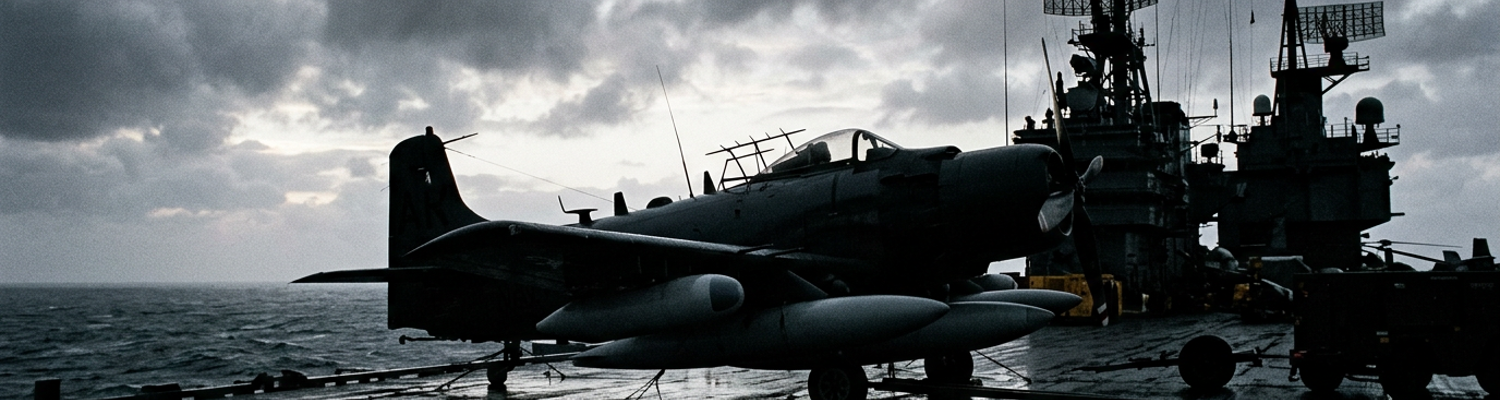

TACRON 1 Deployment and Airborne Tactical Air Control
A close review of operational logs indicates that on 21 September 1951, detachments from Tactical Air Control Squadron 1 boarded the primary fleet carriers of Task Force 77. The flight deck of the USS Essex pitched against six-foot swells. Catapult crews tensioned the bridle on an AD-2 Skyraider. Fifth Air Force planners in Seoul demanded that all fixed-wing sorties operate under centralized Joint Operations Center tasking. Their T-6 Mosquito controllers lacked the loiter capacity and naval radio bands to operate over east coast targets. Carrier Division commanders deployed TACRON 1 personnel directly into carrier air groups to counter this command void. Operating from carriers like Essex, Bon Homme Richard, and Antietam, these naval detachments took control of naval strike packages right at the shoreline.
The administrative system failed over the Korean terrain.
Mechanics stripped obsolete radar countermeasure gear from AD-3N and AD-4Q fuselages. They needed space to accommodate auxiliary VHF transmitter stacks and heavy-duty ARC-27 UHF transceivers. These communications bundles allowed observers sitting behind the pilot to monitor both carrier tactical nets and ground-based tactical frequencies. The modified Skyraiders carried 300-gallon external fuel tanks to stretch mission endurance past five continuous hours. Archival evidence shows that extended loiter profiles over coastal targets produced severe mechanical strain. Wright R-3350-26W radial engines frequently fouled their lower spark plugs after hours of low-RPM operation. This fouling triggered violent cylinder misfires. High operating temperatures in unpressurized cockpits cooked transceiver crystals. Communications severed mid-mission. Lead aircraft sustained heavy small-arms fire through unarmored fuselage panels during low-altitude passes over the valleys.
Air Force commanders demanded submission to their land-based air clearing system.
Naval aviators rejected those demands. They created dedicated airborne coordination doctrines built specifically to break heavily defended interdiction choke points along the east coast. North Korean and Chinese engineers had heavily fortified the coastal transport arteries between Hungnam, Wonsan, and the front lines. They planted dual-purpose 37mm automatic weapons and radar-directed 85mm anti-aircraft batteries along the cliff walls of Route 1. Standard horizontal bombing runs produced catastrophic losses against these defiles. Under the doctrine formalized by TACRON 1, the orbiting Skyraider entered the target area fifteen minutes ahead of the main strike. The coordinator evaluated cloud ceilings and identified active gun pits. The coordinator marked camouflaged revetments and rail tunnel portals using 2.25-inch sub-caliber aircraft rockets loaded with white phosphorus. Smoke bloomed. Incoming flights of Vought F4U-4 Corsairs and Grumman F9F-2 Panthers stacked vertically across three-thousand-foot blocks. They fed into sequential dive runs that suppressed flak before bomb-laden Skyraiders delivered one-thousand-pound ordnance.
Shipboard air controllers launched early-morning strike sweeps before land-based coordination centers completed their breakfast briefings.
On 16 October 1951, a TACRON 1 controller directing strikes at Majon-ni spent four hours orbiting through concentrated flak. He guided thirty-two separate naval aircraft onto three train engines trapped inside a collapsed bypass. An empty main fuel tank forced him to glide toward the carrier task force.
Fifth Air Force JOC Command Jurisdiction Disputes
When examining the historical record, the friction between services centered on the Joint Operations Center located at Taegu Air Base. This facility was designated K-2 (Far East Command File 44-A). Under doctrine drafted by Far East Air Forces, Fifth Air Force commanders insisted on absolute centralized targeting authority over all combat aircraft operating above the Korean peninsula. Inside the bunker at Taegu, Air Force staff officers stood before twenty-foot plotting boards. They attempted to schedule every sortie through pre-planned daily tasking orders twenty-four hours before launch. This rigid system functioned reasonably well for stationary rear-area depots or artillery positions along the main battle line. Staff officers assigned specific grid squares. They designated restricted corridors. They required all incoming flights to request clearance through land-based radar monitoring stations before dropping ordnance. The Air Force command apparatus treated carrier-based aviation as an auxiliary pool of airframes. They expected naval units to plug into land-based allocation charts. They ignored the organic flexibility of naval fleet operations.
Naval commanders refused to surrender operational autonomy.
Archival evidence shows that Task Force 77 representatives clashed with Air Force sector controllers over real-time strike authorization and regional airspace sovereignty. Vice Admiral Arthur D. Struble and carrier division commanders rejected the notion that Seventh Fleet strike packages were subordinate to an Army and Air Force joint center three hundred miles away in southern Korea. Tactical Air Control Squadron personnel aboard the fleet carriers maintained their own combat information centers. They tracked targets along the jagged eastern coastline between Hungnam and Wonsan. Fifth Air Force flight controllers demanded that naval pilots check in through regional ground-control intercept posts. They specified the radar station on Cho-do or ship-to-shore VHF relay nets. Atmospheric ducting and coastal mountain ridges rising four thousand feet above the shoreline routinely severed these fragile radio circuits. Constant jamming degraded the signals further. When naval pilots lost contact with Taegu, Air Force controllers directed strike leaders to jettison their live ordnance in designated sea lanes. They ordered pilots to return to their flight decks without attacking.
Carrier coordinators countermanded those orders over fleet tactical radio nets.
They cleared their pilots to attack armed positions directly.
A close review of operational logs indicates that procedural delays originating from the Taegu bunker crippled interdiction efficiency along the eastern coast. Fifth Air Force intelligence teams processed target clearing requests through a teletype confirmation loop. This loop took between four and eight hours to approve an unlisted strike coordinate. North Korean logistical units exploited this administrative lag. Rail engineers along the Wonsan to Hamhung line operated steam locomotives exclusively at night or during sudden snow squalls. They raced between fortified rail tunnels in fifteen-minute bursts before disappearing into deep granite caverns. Small flotillas of wooden sampans and motorized junks unloaded ammunition boxes along the beaches of Wonsan harbor under heavy fog banks. They dispersed cargo into coastal caves before noon. Waiting for a formal strike clearance from an Air Force captain at Taegu meant watching these fleeting opportunities slip into hiding.
Carrier air groups chose immediate engagement over procedural obedience.
Pilots from Carrier Air Group 5 flying off the USS Essex and Carrier Air Group 19 aboard the USS Princeton executed armed reconnaissance sweeps using onboard strike directives. They did not wait for Joint Operations Center authorization. Division leaders hunting along the rail lines near Kowon and Munchon struck locomotives the instant their boilers vented steam across the snow. On 8 November 1951, a four-plane division of F4U-4 Corsairs spotted two supply trains maneuvering near the Yonghung rail yards. This occurred fifteen minutes after an Air Force liaison officer at Taegu refused their initial armed reconnaissance request. The Corsair pilots rolled into forty-degree dives. They dropped eight 500-pound general-purpose bombs. The explosions destroyed both locomotives and collapsed sixty yards of track.
Counterintelligence Audits and Escalating Service Paranoia
When examining the historical record, classified counterintelligence inquiries focusing on Pan-Slav intelligence penetrations sparked deep mutual suspicion between Naval Intelligence and Far East Air Forces. Security officers from the Counterintelligence Corps in Seoul and the Office of Naval Intelligence aboard Task Force 77 flagships suspected that Soviet intelligence networks had infiltrated regional logistics nodes in Pusan. They suspected similar infiltrations at supply depots outside Incheon. Air Force intelligence directors feared that hostile informants embedded among local civilian technical contractors were transcribing flight dispatch schedules. They worried about courier flight routes originating from K-2 Air Base at Taegu. Naval Intelligence investigators took a harsher stance. They alleged that loose security screening within Fifth Air Force liaison networks permitted foreign operatives to funnel carrier launch coordinates and task force positions directly to Soviet advisory groups stationed in Vladivostok and Pyongyang. Air Force counterintelligence detachments subjected naval courier pouches traveling between Yokosuka Fleet Base and Korean operational centers to unscheduled inspections. Staff officers traded written accusations across command channels. They questioned whether service-specific clearances were sufficiently stringent to prevent hostile penetrations of regional headquarters.
Mutual trust between the service branches evaporated.
Archival evidence shows that the AEA 3114 signal security audits intensified distrust between service branches regarding command radio vulnerabilities and communications leaks. Conducted across regional relay centers and afloat combat information stations, these technical evaluations inspected the mechanical condition of SIGABA ECM Mark II cipher machines (serial block 400-899). They evaluated tactical VHF transceivers. Inspectors discovered that copper rotor contacts inside shipboard cipher wheels suffered from corrosion induced by salt air. This corrosion created signal distortions during encrypted teletype bursts between Task Force 77 carriers and land-based sector commands. Field reports compiled under AEA 3114 identified severe electronic discipline violations along high-frequency voice circuits. Air Force ground monitors regularly broadcast uncoded target grid references over AN/GRC-9 field sets. Carrier pilots flying AD-4 Skyraiders frequently chatted across open 116 to 156 megahertz bands during climb-outs over the Sea of Japan. Far East Air Forces communications officers asserted that these naval radio breaches compromised mainland strike plans. Fleet signal officers countered by pointing out that poorly grounded landline teletypes linking the Taegu command bunker to forward radar posts on Cho-do produced electromagnetic emissions. Soviet intercept trailers across the Yalu River could detect these emissions.
Neither command would concede that its transmissions were insecure.
A close review of operational logs indicates that suspicions regarding breached communications channels directly compromised operational coordination across Joint Operations Center staff desks. Inside the concrete bunker at Taegu, Air Force operations officers sat opposite naval strike coordinators under the glare of industrial light banks. Information sharing ground to a virtual halt. Air Force desk officers became convinced that unencrypted naval voice traffic compromised planned interdiction corridors. They began withholding reconnaissance photographic mosaics and radar warnings from their naval counterparts until minutes before carrier catapult cycles began. Naval coordinators retaliated by refusing to post Task Force 77 flight tracks and ordnance loads on the main twenty-foot grease-pencil operations board. Flight planners from Carrier Air Group 5 kept their target coordinates restricted to handwritten fleet dispatches. They concealed ingress routes toward the rail junction at Kowon and bridges near Munchon. Strike divisions of Vought F4U-4 Corsairs launched into combat without updated reports on active enemy flak positions. Fifth Air Force fighter sweeps entered North Korean airspace unaware of carrier strike packages crossing their flight paths below ten thousand feet.
Operational security concerns superseded common tactical purpose.
On 27 November 1951, carrier strike controllers requested immediate radar-jamming support from Fifth Air Force ground stations. They needed to shield twelve Skyraiders attacking rail tunnels outside Majon-ni. The duty officer at Taegu suspected an eavesdropping risk along the landline connection. He declined to transmit the required jamming frequencies over the liaison circuit. The naval aircraft bombed the granite tunnel approaches without electronic cover. They sustained heavy damage from radar-directed 37mm anti-aircraft batteries positioned along the mountain ridges.
Target Clearance Delays and Flak Corridor Withholding
When examining the historical record, the Joint Operations Center at Taegu withheld time-critical flak corridor intelligence from Task Force 77 aircrews operating over active coastal operational zones. Fifth Air Force intelligence officers retained updated overlays of North Korean anti-aircraft deployments inside land-based target rooms. They treated reconnaissance photographs gathered by RF-80 Shooting Stars as service-exclusive property. Carrier intelligence personnel aboard the USS Essex and USS Antietam received morning flak summaries that were frequently forty-eight hours out of date. Chinese and North Korean air defense units exploited this information blockade. They shifted mobile anti-aircraft artillery across the coastal sector between Munchon and the outer defense rings of Wonsan. Soviet-supplied 37mm M1939 automatic weapons and 85mm M1939 heavy guns were towed by tracked tractors into newly blasted revetments along the mountain defiles during the night. Staff inside the Taegu bunker tracked these relocations through radio direction finding and ground radar monitoring. Staff officers delayed transmitting updated gun coordinate sheets across naval radio teletype channels. Naval flight leaders pushed across the coastline with obsolete threat maps. They flew directly into newly established kill zones.
Administrative delays in southern command bunkers decided who survived over northern targets.
A close review of operational logs indicates that Air Force controllers repeatedly stalled strike clearances. This forced carrier-based forward air controllers to enter extended holding patterns over contested rail choke points. TACRON 1 controllers flying modified Douglas AD Skyraiders arrived over the Kowon rail bypass and the tunnel networks at Majon-ni. They found ground-directed radio channels blocked by procedural administrative demands. Air Force duty officers in Taegu insisted on cross-referencing naval coordinates against theater-wide bombing lists. They wanted to ensure Fifth Air Force medium bombers had not claimed the tracks for later night interdiction. Land-based controllers ordered carrier coordinators to hold east of coastal ridgelines at five thousand feet while staff cross-checked flight numbers. Naval pilots circled in tight orbits above mountain defiles. They watched their auxiliary fuel reserves drain away. Mechanical strain accumulated rapidly. Wright R-3350-26W radial engines idling at low manifold pressures fouled their lower spark plugs with lead deposits. This triggered violent cylinder misfires.
Circling over enemy batteries destroyed any element of speed or stealth.
Archival evidence shows that extended loiter times over Wonsan stripped naval strike packages of tactical surprise. This compounded anti-aircraft exposure across every flight division. Flight groups launched from Task Force 77 brought Grumman F9F-2 Panthers and Vought F4U-4 Corsairs to assigned operational boxes expecting immediate roll-in markers from the airborne coordinator. Rigid Joint Operations Center clearing rules forced these armed strike flights into visible holding stacks directly above Wonsan harbor between four thousand and eight thousand feet. North Korean optical observers and acoustic tracking detachments across the Kalma Peninsula plotted the altitude, airspeed, and turn radius of every formation. Coastal gun crews adjusted optical rangefinders. They oriented their fire-control radars while naval aircraft consumed fuel overhead. Strike authorizations finally crackled over UHF frequencies twenty to thirty minutes late. This sent naval pilots into heavily prepared kill pockets. Batteries along the hills blanketed dive-bombing corridors with pre-ranged box barrages of 85mm fragmentation bursts. Splintered metal tore through unarmored oil coolers on F4U-4s. It punctured high-pressure hydraulic lines inside F9F-2 wheel wells. Multiple crippled aircraft ditched in the freezing waters off Yo-do.
Soviet Air Defense Networks and Low-Altitude Attrition
Soviet advisory detachments turned the granite basin surrounding Wonsan into an interlocking kill zone.
A close review of operational logs indicates that naval forward air controllers operating over the coastline entered the lethal envelope of weapons systems deployed under direct Soviet military guidance. Soviet antiaircraft specialists assigned to the 64th Fighter Aviation Corps positioned batteries of dual 37mm M1939 automatic cannons and 85mm M1939 heavy guns across the ridge spines overlooking the Yonghung and Munchon rail defiles. These weapons were paired with optical PUAZO-3 directors and SON-4 range-finding radars concealed in camouflaged revetments along the Kalma Peninsula. Airborne coordinators from Tactical Air Control Squadron 1 orbited in modified Douglas AD-4Q Skyraiders at four thousand feet. They found themselves pinned within these engagement cones without radar countermeasures or fighter escort. Soviet instructors trained North Korean gun crews to disregard decoy maneuvers and concentrate on slow-moving single airframes. These crews tracked the controllers using interlocking quadrant fire. Fragments from contact-fuzed 37mm high-explosive rounds shredded unarmored rudder cables. They penetrated canopy plexiglass. They punched jagged holes through Wright R-3350 engine accessory sections. Controllers frequently reported losing secondary VHF radios and cockpit instruments to shrapnel while attempting to mark target revetments with five-inch high-velocity aircraft rockets.
Holding patterns in narrow mountain corridors invited destruction.
Archival evidence shows that procedural hold directives issued by the Joint Operations Center in Taegu forced carrier strike flights to circle inside pre-sighted flak corridors. They circled until low fuel and accurate ground fire dismantled entire divisions. Strike leaders from Carrier Air Group 19 aboard the USS Princeton and Carrier Air Group 5 aboard the USS Essex waited twenty to forty minutes for administrative release over the target grid. Communist gun crews refined their range calculations during this delay. When clearance finally arrived, Vought F4U-4 Corsairs and Douglas AD-2 Skyraiders had to execute steep 45-degree dive profiles through pre-set fragmentation blankets. They dropped 1,000-pound general-purpose bombs on rail bridges. Low pull-outs below one thousand feet brought the aircraft into range of rapid-fire 12.7mm DShK heavy machine guns and rapid-cycling 37mm batteries concealed in revetments along riverbanks. Armor-piercing incendiary projectiles penetrated the unarmored lower oil tanks of Pratt and Whitney R-2800 radial engines powering the Corsairs. Oil pressure dropped to zero within ninety seconds. Skyraiders suffered severed elevator push-pull rods and catastrophic wing-root fires when 37mm shells detonated inside 20mm cannon ammunition bays. Crippled aircraft crashed into the mud flats of Yonghung Bay. Others attempted ditchings in twenty-eight-degree coastal waters. Hypothermia killed downed aircrews before amphibious rescue Sikorsky HO3S-1 helicopters could reach them from Yo-do island.
The carrier ready rooms filled with empty bunks.
When examining the historical record, escalating airframe write-offs and relentless exposure to low-altitude flak produced severe psychological exhaustion across Task Force 77 air groups throughout December 1951. Carrier flight surgeons stationed aboard the USS Bon Homme Richard and USS Antietam documented alarming increases in operational fatigue, motor tremors, and clinical depression among senior strike leaders. Aviators confronted the fact that doctrine forced them to risk high-performance carrier aircraft and their own lives against low-priority earthen rail beds, wooden trestles, and empty boxcars already zeroed in by enemy gunners. Resentment toward Fifth Air Force staff officers festered during post-strike debriefings. Pilots openly cursed the distant planners in Seoul and Taegu whose clearance bottlenecks left strike packages circling over target areas in plain view of tracking radars. Combat attrition thinned veteran ranks. Certain attack squadrons lost over twenty percent of their assigned pilots and thirty percent of their original airframes within sixty days of continuous interdiction operations. Junior officers flying replacement F4U-4s and AD-4s arrived on carrier decks to discover hollowed-out rosters. They found weary division leaders who openly questioned the tactical sanity of the Joint Operations Center interdiction program. Flight deck crews spent twelve-hour shifts scrubbing carbon and blood out of damaged cockpits. Ordnance crews loaded bombs onto airframes bearing patched structural frames.
On 14 December 1951, Carrier Air Group 19 lost three Corsairs to light antiaircraft fire over the Kowon rail cut in less than twenty minutes.
Casualty Influx and Trauma Surgery on USS Princeton
A close review of operational logs indicates that the surgical spaces aboard the USS Princeton entered a severe medical crisis as wounded aviators from Carrier Air Group 19 overwhelmed the medical department. Located two decks below the armored flight deck, the primary sickbay was designed to handle routine fleet injuries and isolated combat trauma. It contained only two active operating tables and twelve recovery cots. Between 5 and 15 December 1951, flights of damaged Douglas AD Skyraiders and Vought F4U-4 Corsairs returned from low-level strikes across Wonsan with dying pilots slumped forward against their stick grips. Flight deck crews pulled blood-soaked flight suits from shredded cockpits. They lowered pilots through narrow access trunks into sickbay spaces already choking on the stench of ruptured bowels and singed nylon. Navy medical officers established an ad hoc triage station in the aft mess hall. They laid stretchers across aluminum dining tables while corpsmen cut away anti-G garments with trauma shears. The blood bank ran perilously low. Laboratory technicians drew whole blood straight from off-duty boiler technicians and catapult operators. Surgeons operated continuously for thirty-six hours without relief.
Gauze ran out before the carrier cleared the outer mine belts.
Archival evidence shows that Navy surgical teams faced a sudden surge of emergency traumatic amputations caused by Soviet-pattern 37mm anti-aircraft shells detonating inside narrow cockpit floorboards. High-explosive fragmentation projectiles pierced the thin aluminum skin beneath rudder pedals. The blast turned aluminum foot-rests, steel brake cables, and lower armor plating into secondary missiles. Pilots flying close-support runs over Kowon absorbed these fragmentation cones directly through their lower extremities. Flight surgeons encountered limbs shredded into pulped muscle and splintered bone. High-velocity fragments severed popliteal and femoral arteries inside the cockpit wells. Tourniquets fashioned from pneumatic G-suit inflation hoses frequently failed to halt arterial hemorrhaging during forty-minute return flights over the freezing waters of the Korean Gulf. Surgeons operated aboard a hull pitching against rough winter swells. They used bone saws and Liston knives to execute rapid open-circular guillotine amputations. They sacrificed lower legs below the knee to halt gas gangrene. They cleared mangled tissue wedged with hydraulic fluid and cockpit dirt.
Bone dust settled over the instrument trays.
When examining the historical record, treating severe white-phosphorus burns posed an even deadlier challenge for the medical staff of the Princeton. Airborne controllers loaded their wing pylons with 2.25-inch sub-caliber marking rockets and phosphorus smoke canisters to mark targets for diving Corsairs. Heavy flak hits near rail tunnels at Majon-ni repeatedly detonated these wing-mounted marking canisters. Flak shattered cockpit floorboards where emergency signaling flares were stowed. This blew burning phosphorus particles directly into pilot compartments. Particles of white phosphorus burned at temperatures exceeding four thousand degrees Fahrenheit. The chemical continued to melt through flight suits and deeply into subcutaneous muscle tissue whenever exposed to air. Corpsmen kept surgical basins filled with cold water and saturated wet dressings. They frantically irrigated open wounds to starve the embedded chemical particles of oxygen. Navy surgeons washed scorched flesh with a one-percent copper sulfate solution. This turned the invisible chemical residue into black cupric phosphide deposits. Surgical teams scraped these deposits out of charred muscle beds with mechanical curettes. The absorbed chemical toxins produced systemic poisoning. This triggered acute renal failure, hypocalcemia, and lethal cardiac arrhythmias before patients could leave the post-operative ward.
Phosphorus smoke continued to drift through the sickbay ventilation shafts.
Medical logs from Carrier Division Three reveal that by 18 December 1951, surgical consumable stocks on the Princeton had reached absolute depletion. Medical officers had expended over one hundred units of dried plasma. They used eighty vials of procaine penicillin. They exhausted every roll of surgical wire mesh aboard the ship. The carrier broke radio silence off Songjin to request emergency medical air-drops of calcium gluconate ampules and sterile scalpel blades from fleet supply ships stationed at Sasebo.