
Marble Mountain Air Facility and Marine Reductions
Marine Corps doctrine manuals promised balanced air-ground teams with massed infantry protecting every landing zone, but flight crews at Marble Mountain Air Facility faced an increasingly stripped-down reality. Salt air from the South China Sea corroded metal skins on the flight line while mechanics worked through the night to keep aging transport helicopters flight-worthy without adequate spare parts. Senior officers inside the air facility headquarters tracked daily flight commitments across the northern provinces with grease pencils on plastic wall maps, watching their available squadrons shrink. Marine pilots stretched thin across the vast tactical zones flew continuous sorties to haul ammunition, evacuate wounded soldiers, and insert reconnaissance teams across hundreds of miles of rugged jungle terrain.
Jungle terrain surrounding the bases offered little security as Keystone Robin troop withdrawals accelerated operational strain by pulling thousands of seasoned infantrymen and aviation technicians out of South Vietnam. Planners at higher headquarters in Saigon and Da Nang operated under strict political deadlines and statistical redeployment goals rather than physical maintenance capacity. Staff officers continued to assign demanding flight tasks while ground security around the Marble Mountain perimeter deteriorated, forcing exhausted flight crews to stand sentry duty between transport missions. Maintenance teams cannibalized grounded airframes for rotor heads, hydraulic lines, and turbine parts just to push a bare minimum of working helicopters out to the flight line each morning. Flight operations officers stared at status boards that showed fewer operable aircraft each dawn, yet tactical requests from regional commanders continued to climb.
Flight operations officers staring at those status boards soon received couriers delivering classified operational orders that expanded mounting requests into an unprecedented offensive, directing aviation units to prepare immediate combat support for a South Vietnamese cross-border assault into Laos. Planners had to organize this major air offensive under strict prohibitions that banned American ground troops and military advisors from crossing the border into Laotian territory. Staff officers sat in isolated headquarters rooms studying topographical contour maps of the Laotian panhandle, plotting flight routes and landing zones without any firsthand reports from forward observers. Marine pilots faced the assignment of carrying South Vietnamese infantry directly into fortified enemy positions without American ground units available to secure the jungle clearings. Squadron leaders repeatedly questioned how their crews could locate and rescue downed aviators in a hostile country where American soldiers were legally forbidden to set foot.
Squadron leaders questioning the mission parameters forced commanders inside the concrete operations bunker to attempt to resolve this tactical dilemma by drafting rigid radio protocols and theoretical flight routes. Delayed teleprinter messages and conflicting intelligence reports from forward army posts left the headquarters staff isolated from the true scale of North Vietnamese anti-aircraft strength along the border. Staff officers miles away from the target areas established strict flight schedules based on standard cruising speeds, ignoring the mountainous jungle terrain and heavy seasonal cloud cover. Marine crew chiefs loaded extra machine-gun ammunition, survival radios, and paper navigation charts into their cargo bays as the launch date drew near. Mechanics pushed the last flyable transport helicopters out of the maintenance hangars and parked them inside concrete revetments along the runway, locking the wheel brakes in preparation for the opening morning of the offensive.
Combat Debut of the AH-1J Sea Cobra
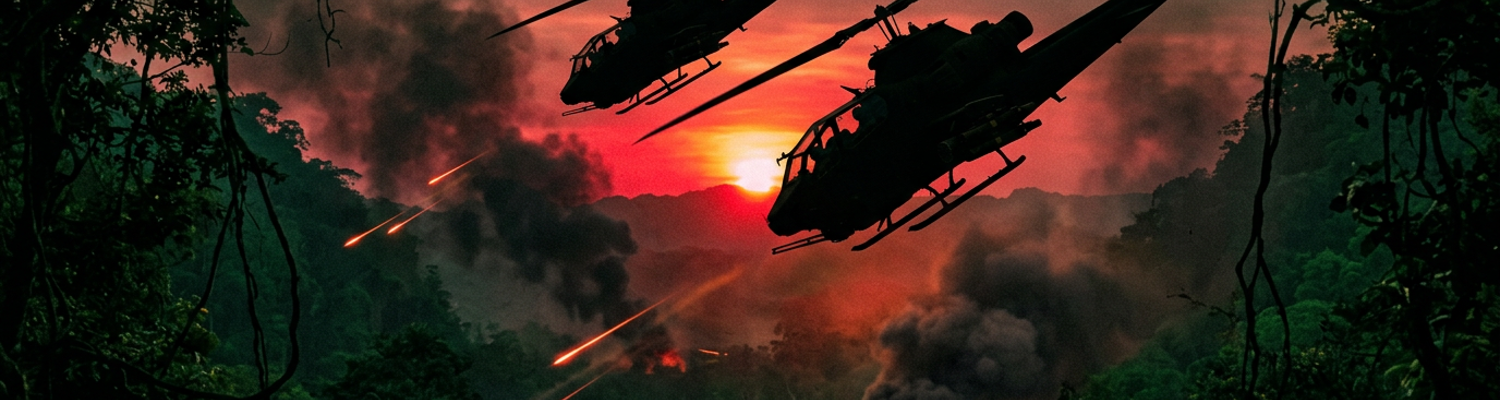
Wheel brakes released as pilots climbed into the narrow cockpits of the newly arrived AH-1J Sea Cobra gunships, marking the combat debut of the twin-engine attack helicopters in Southeast Asia. Marine Aircraft Group 16 had just received these upgraded airframes to replace older single-engine models that struggled in the hot and high environments of the Annamite Range. Twin turboshaft engines provided the necessary power to carry heavy loads of rockets and machine gun ammunition over the steep mountain passes dividing South Vietnam from Laos. Ordnance crews strapped belt after belt of 20mm ammunition into the chin-mounted turret magazines while armorers loaded folding-fin aerial rockets into the stub-wing pods. Flight leaders ran through their pre-flight checklists under the harsh ramp lights, verifying that the dual hydraulic systems and redundant flight controls functioned correctly before lifting off into the dark.
Lifting off into the dark required precise coordination as the heavy gunships formed up with the slower transport helicopters heading toward the border. Pilots navigated by dim red cockpit instruments and the faint silhouettes of the mountain ridges rising ahead of them. Twin-engine power allowed the gunships to maintain a high-altitude overwatch position above the transport formations, a tactical advantage that earlier single-engine helicopters could never achieve with full weapons loads. Navigators plotted their progress using paper maps and compass headings, relying on dead reckoning to find the designated crossing points along Route 9. Engine exhaust heat blurred the starlight behind the formations as the combined assault package crossed into Laotian airspace just as the sun began to illuminate the jungle canopy below.
Jungle canopy below hid extensive networks of enemy troops that the new gunships were specifically deployed to hunt and destroy. Forward air controllers flying light observation planes marked suspected enemy staging areas with white phosphorus rockets, directing the Marine gunships toward the rising smoke plumes. Cobra pilots pushed their cyclic sticks forward, dropping the sleek helicopters into steep dives that accelerated them well past the speed capabilities of older attack models. Gunners in the front seats squeezed their triggers, sending streams of 20mm cannon fire tearing through the dense foliage and shattering the wooden bunkers hidden beneath the trees. High-explosive rockets followed the cannon fire, detonating against the steep hillsides and sending shockwaves through the valleys as the gunships pulled out of their dives and climbed back into the protective cloud cover.
Cloud cover provided only brief sanctuary before the gunships had to dive again to protect the vulnerable transport helicopters approaching the landing zones. Enemy ground fire erupted from multiple concealed positions, forcing the Cobra crews to rely on their upgraded armor plating and redundant flight systems to survive the gauntlet. Heavy machine gun rounds struck the armored seats and reinforced fuselage panels, testing the structural integrity of the new airframes during their first major combat operation. Warning lights flashed across the instrument panels as shrapnel severed secondary hydraulic lines, but the twin-engine design kept the rotors turning and allowed the pilots to maintain control. Marine aviators fought through the intense ground fire, expending all their ordnance to suppress the enemy trenches before banking hard toward the forward staging bases to refuel and rearm for another immediate sortie.
North Vietnamese Anti-Aircraft Networks Along Route 9
Sorties pushing past the staging bases and steering toward the Laotian border immediately triggered a defensive trap that outstripped every operational plan issued by the rear command bunkers. Staff officers inside Military Assistance Command Vietnam and XXIV Corps had drawn up flight corridors assuming the aviation units would face only scattered rifle fire and isolated machine gun nests. Initial intelligence estimates failed to detect the scale and coordination of enemy air defense concentrations hidden beneath the jungle canopy. Analysts working inside air-conditioned command posts in Saigon and Da Nang relied on outdated aerial photo strips and vague sensor readouts, completely missing how thoroughly the enemy had fortified the border region over the preceding months. Planners plotted safe transit altitudes and straight approach vectors on clean topographic charts, sending aviation units into Laos under the false assumption that American air superiority would easily suppress any local resistance. Senior commanders assumed their gunships and escort jets could clear landing zones with standard pre-assault rocket barrages, leaving transport pilots unprepared for the heavy concentrations of fire waiting along the border ridges.
Border ridges concealed North Vietnamese Army regiments deploying mutually supporting anti-aircraft batteries consisting of 12.7mm, 23mm, 37mm, and radar-guided 57mm guns directly beneath those plotted flight paths. Crews on heavy machine guns and rapid-firing 23mm autocannons dug deeply revetted weapon pits into ridgelines overlooking key valley choke points to engage low-flying helicopters. Camouflaged positions higher up the steep mountain slopes housed medium 37mm cannons and radar-guided 57mm guns capable of tracking high-altitude support aircraft, observation planes, and forward air controllers. Wire communications linked these separate gun pits into an integrated firing network, allowing battery commanders to track incoming American formations across multiple sectors without revealing individual positions early. Gunners held their fire as scout aircraft passed overhead, waiting until heavily loaded transport formations committed themselves to narrow mountain gaps. Crews unleashed coordinated crossfires on command, filling whole valleys with interlocking streams of armor-piercing ammunition that caught pilots from multiple angles at once.
Pilots navigating through these crossfires discovered that the single east-west highway offered no room for evasive maneuvering. Massed flak ambushes saturated traditional ingress paths along the Route 9 corridor, turning the designated flight paths into corridors of continuous anti-aircraft fire. Shrapnel tore through thin aluminum fuselages, shattered cockpit windscreens, and severed hydraulic control cables as helicopters entered low-altitude landing zones ringed by hidden gun pits. Heavy smoke from burning brush and exploding shells blinded flight leads, forcing following aircraft to scatter into unmapped ravines where additional machine guns waited in ambush. Marine crew chiefs emptied door-mounted machine guns into the dense jungle foliage without seeing the well-concealed bunkers directing the fire. Flight leaders transmitted urgent distress calls over tactical frequencies, reporting that enemy anti-aircraft fire was too intense for unescorted transports to set down their troops.
Troops trapped in the crossfire prompted commanders stationed at headquarters posts miles behind the border to struggle to comprehend the catastrophe unfolding along the ridgelines. Static and rugged mountain terrain scrambled radio transmissions between front-line cockpits and XXIV Corps operations centers, delaying reports of heavy aircraft losses by crucial hours. General officers who had designed the invasion timetable treated early requests to cancel insertion missions as groundless panic, insisting that pilots follow the preplanned flight schedules. Operations officers continued to push fresh waves of helicopters toward the smoking corridor, relying on grease-pencil maps that showed none of the active anti-aircraft batteries tearing the assault force apart. Delayed teleprinter updates and filtered field reports reinforced the isolation of senior planners, who ordered transport squadrons back into the fire to maintain the cross-border momentum. Duty officers marked another round of departure times on plastic status boards while ground crews back at coastal airfields scrambled to patch dozens of riddled airframes.
Tactical Demands on CH-53D Sea Stallion Transports
Airframes patched by those ground crews flew back toward the border as Heavy Marine Helicopter Squadron 463 utilized CH-53D Sea Stallions to insert and displace South Vietnamese artillery batteries across forward landing zones. Operations planners miles away in rear headquarters viewed these artillery movements as routine ferry flights, expecting standard flight timetables to function smoothly over the rugged Laotian frontier. Marine flight crews attached heavy 105mm howitzers and ammunition pallets to external cargo hooks beneath their fuselages, lifting the heavy steel artillery into the sky. Twin turboshaft engines ran at full power as the immense helicopters climbed toward the distant ridgelines where infantry required continuous fire support. Flight leaders monitored their fuel gauges and gross weight charts, knowing that staff officers in the rear operations bunker had calculated aircraft load limits using standard sea-level manuals rather than real mountain conditions.
Mountain conditions along the Laotian border produced severe atmospheric challenges, where high density altitudes and tight jungle clearings strained CH-53D hover performance during external sling-load deliveries. Thin, heated air reduced the lift generated by the six-bladed rotor systems, forcing pilots to pull maximum collective pitch just to keep their aircraft airborne above the trees. Pilots struggled with sluggish flight controls as heavy howitzers swung beneath the belly hooks, threatening to pull the helicopters sideways into surrounding tree trunks and jagged rocks. Crew chiefs peered through open floor hatches to guide pilots downward yard by yard, shouting torque warnings over internal headsets while engines consumed fuel at rapid rates. Holding a steady position over the tight clearings pushed turbine exhaust temperatures to dangerous limits while the heavy helicopters remained motionless in the air.
Helicopters hovering motionless over the landing zones exposed heavy transport fuselages to heavy anti-aircraft and mortar fire from gunners hidden in the surrounding jungle. Enemy mortar crews walked heavy shell patterns directly onto the cleared landing pads while Marine pilots held position waiting for ground crews to unhook cargo cables. Shrapnel punctured titanium rotor spars, sliced through external fuel tanks, and severed hydraulic control lines running along the upper cabin walls. Crew chiefs fired window-mounted machine guns into the tree lines, attempting to suppress enemy gun positions while artillery crews scrambled under direct machine-gun fire. Crippled transports jettisoned their sling loads into ravines to prevent catastrophic crashes, retreating across the border with leaking fluids and failing systems.
Systems failing on retreating helicopters generated reports that commanders stationed inside the XXIV Corps bunker received but refused to alter their daily flight quotas. Staff officers miles behind the front line remained isolated from the physical reality on the ridges, relying on static maps and treating helicopter transport capabilities as theoretical numbers on paper. Delays in radio traffic meant that headquarters personnel recorded landing zones as operational long after intense mortar fire had made hover approaches impossible. Squadron officers who requested permission to cancel dangerous single-ship artillery insertions faced direct orders to press the missions regardless of anti-aircraft fire. Mechanics at coastal airfields received another wave of punctured helicopters at sunset, stripping functional components from wrecked airframes to assemble enough flyable transports for the next morning.
Communication Bottlenecks Between Da Nang and XXIV Corps
Morning flight preparations saw crews preflighting those newly patched helicopters in the dark while operations officers tried to contact forward command posts along the Laotian border. Radio signals suffered severe degradation across the Annamite Range, breaking contact between forward elements and rear command cells. Steep granite peaks and dense cloud cover blocked line-of-sight electronic transmissions, scattering ultra-high frequency calls before words could reach coastal monitors. Pilots skimming through jungle passes dropped below the reach of mountain relays, cutting off tactical updates right when North Vietnamese gunners opened fire. Command cells at Marble Mountain Air Facility stared at silent speaker boxes, unable to learn if their morning flight packages had reached the border or crashed in the ravines.
Ravines hiding crashed helicopters forced airborne command relays circling over the lowlands to try bridging this electronic gap, but these aircraft could not overcome transmission delays between XXIV Corps forward headquarters at Quang Tri and Da Nang. Army communications technicians inside modified relay planes retransmitted voice traffic across multiple radio nets, creating signal interference and long queues for open airtime. Urgent combat requests sat in radio queues for ten to fifteen minutes while operators sorted out overlapping frequencies between different service branches. Staff couriers at Quang Tri rushed paper carbon copies across mud-soaked command compounds to bypass clogged circuits, yet physical messages moved far too slowly to keep pace with changing combat conditions on the border. General officers at the forward headquarters made tactical choices using maps marked with outdated troop markers, then dispatched orders down land lines that frequently failed in the monsoon rains.
Monsoon rains and broken wire networks left Marine air commanders at Da Nang operating in an informational vacuum, receiving casualty and damage figures hours after missions concluded. Operations officers marked helicopter availability charts with outdated estimates, assuming shot-down aircraft were still flying fuel and ammunition runs into Laos. Wounded pilots and crew chiefs often landed back at Marble Mountain before their squadron leaders even learned that the flight had taken heavy anti-aircraft fire. Flight leaders stepped down from bullet-riddled cockpits to deliver hand-drawn maps of active gun positions directly to intelligence officers who had already cleared following flights into those same sectors. Staff officers watched helplessly as subsequent waves of transport helicopters took off on missions scheduled under obsolete tactical assumptions.
Tactical assumptions drawn up in air-conditioned Da Nang bunkers bore no resemblance to the actual battlefield that helicopter crews encountered on those scheduled sorties. Assault forces at forward landing zones needed immediate emergency evacuations and suppressive fire, but their requests traveled through three different headquarters before reaching Marine flight dispatchers. Army staff officers at Quang Tri continually altered landing coordinates without notifying MAG-16 planners in Da Nang until transports were already low on fuel over the mountains. Marine pilots improvised their own landing approaches under fire, making life-or-death decisions while senior generals argued over inaccurate radio reports miles away. Ground crews at Marble Mountain readied more fuel hoses and ammunition belts for returning transports, bracing for whatever damaged aircraft managed to fly back through the mountains.
Aeromedical Evacuation in Contested Laotian Landing Zones
Mountains separating the bases from the combat zones forced Marine transport crews to guide their helicopters back toward the Laotian border to conduct emergency extractions of wounded soldiers under direct fire at Landing Zones Ranger and Hotel. Staff officers inside the XXIV Corps operations bunker miles to the east continued to log these flights as standard medical pickups, unaware that North Vietnamese infantry had already surrounded the isolated hilltops with heavy machine guns and dug-in mortar positions. Dense smoke from artillery rounds hung across the tight clearings, forcing Marine aviators to drop their heavy aircraft into clearings where every approach route passed directly over active enemy gun pits. Exploding shells shook the airframes the moment the tires touched the red dirt, scattering hot metal into open cargo doors while South Vietnamese soldiers scrambled out of foxholes toward the safety of the ramps. Door gunners returned continuous fire into the surrounding brush to suppress enemy rifle squads that had advanced within grenade range of the landing zones. Marine pilots held their collective controls steady amidst the flying dirt and exploding rounds, keeping their rotor blades spinning while incoming small-arms fire punctured fuel sponsons and cracked forward canopy glass.
Glass fragments showered the cockpits as crew chiefs dragged dozens of injured South Vietnamese soldiers across the vibrating metal ramps while rifle fire tore open the thin aluminum skin of the fuselage. Aircrews performed urgent in-flight triage without specialized medical personnel aboard aircraft riddled with shrapnel, working in cramped cargo bays soaked with engine oil and blood. Gunner mechanics dropped their machine-gun spade grips between firing passes to rip open first-aid kits, using whatever combat bandages and tourniquets they had on hand to stem arterial bleeding. Headquarters planners had dispatched these aircraft on theoretical flight schedules without assigning flight surgeons, medical corpsmen, or dedicated litter equipment to the squadrons. Marine crewmen tied makeshift splints onto fractured limbs and packed gaping chest wounds with field dressings while the aircraft shuddered under secondary hits from anti-aircraft batteries along the ridgelines. Exhausted aviators accelerated out of the landing zones at maximum engine torque, banking through valleys to escape the concentration of heavy flak.
Flak concentrations forced pilots to wrestle with erratic flight controls as severely damaged aircraft returned to forward fuel bases with severed control lines and leaking hydraulic fluid. Red master caution lights illuminated instrument panels across the cockpits, warning pilots that main boost pressure had dropped below safe operating levels. Flight crews at forward airfields such as Khe Sanh and staging strips along Route 9 watched crippled transport helicopters flare awkwardly over runway thresholds, their tail sections blackened by fire and trailing streams of red fluid. Marine aviators pumped manual brakes and fought unresponsive rudders to set their punctured helicopters down on packed dirt before control cables snapped completely. Operations officers in rear command posts marked these returned airframes as operational assets on grease-pencil wall boards, completely unaware that mechanical failures had put the aircraft out of action. Mechanics ran out to the shutdown pads with fire extinguishers and hydraulic patch kits, discovering sliced wiring bundles and deep shrapnel gouges across the flight controls.
Flak Suppression Tactics and Forward Air Control Adjustments
Flight controls damaged by shrapnel gouges on returning aircraft proved that standard, gradual approaches over ridgeline positions invited disaster. Headquarters planners in rear command posts had laid out steady descent corridors on grease-pencil flight boards, expecting pilots to glide down in orderly lines toward jungle clearings. Marine aircrews and forward air controllers abandoned gradual glide paths in favor of steep spiral descents through localized cloud cover. Pilots climbed to high altitudes above the effective reach of automatic weapons, positioned their heavy airframes directly over the target zones, and dropped almost vertically through narrow breaks in the overcast. Tactical descents of this kind cut exposure time from minutes to mere seconds, denying North Vietnamese gunners the angle and lead time needed to track the falling helicopters. Forward air controllers flying light observation planes circled directly above the cloud layers, marking anti-aircraft batteries with smoke rockets and guiding transport pilots down between the granite peaks.
Granite peaks along the Laotian border concealed fortified North Vietnamese anti-aircraft positions that routinely ambushed descending transports. Headquarters doctrine instructed gunship crews to fly passive defensive formations alongside the troop carriers, waiting to return fire only after an enemy position revealed itself. Marine pilots recognized that waiting for ground fire guaranteed aircraft losses against heavy 23mm and 37mm anti-aircraft batteries. Cobra gunships shifted from reactive escorts to aggressive flak suppression using folding-fin aerial rockets and high-explosive warheads. Attack teams charged ahead of the main assault packages to hunt down camouflaged weapon pits before the slower transports arrived. Marine aviators fired high-explosive rockets directly into reinforced bunkers and launched steel flechette warheads across surrounding trenches to drive enemy crews away from their weapons.
Weapons expenditures from these continuous suppression runs quickly drained ammunition bays and burned through helicopter fuel reserves. Staff officers at XXIV Corps headquarters in Quang Tri scheduled flight missions on paper without understanding how quickly high-power combat maneuvers emptied fuel tanks. Tactical operations relied on rapid rearming and refuel turnarounds at the Khe Sanh forward staging area to keep helicopters in the air. Marine ordnance crews ran into the rotor wash at Khe Sanh, loading heavy rocket tubes by hand while fuel technicians pumped hundreds of gallons of aviation gas through high-pressure hoses. Mechanics inspected hot engine cowlings right on the packed dirt taxiways without shutting down turbine engines, working through choking dust to shave minutes off ground times. Ground crews cleared rearmed helicopters for takeoff within ten to fifteen minutes of touchdown, launching flight packages back toward Laos before enemy artillery could target the staging pads.
Staging pads taking artillery shells underscored the wide gap between frontline survival and rear-echelon decision-making. Command bunkers in Da Nang and Quang Tri remained insulated from the constant mortar impacts and burning fuel trucks that defined daily operations at the forward strip. General officers tracked helicopter movements on grease-pencil wall charts hours after tactical situations had completely shifted, issuing flight orders based on outdated supply reports. Staff planners repeatedly demanded that squadrons adhere to standardized flight corridors, ignoring urgent pilot reports that North Vietnamese gunners had zeroed in on those exact coordinates. Marine aviators and forward air controllers responded by quietly bypassing official flight paths, coordinating their own low-altitude approach routes and rocket strikes over local radio nets. Flight leaders pointed to hand-drawn maps on the Khe Sanh dirt line, sending newly armed Cobra teams back across the border to blast open anti-aircraft nests before the next transport wave arrived.
Rear Headquarters Command Isolation and Strategic Aftermath
Transport waves arriving behind Cobra gunships diving into border valleys absorbed heavy ground fire, yet the growing wreckage piling up across the Laotian ridgelines never registered accurately on the situation maps back at headquarters. Geographic distance and corrupted reporting masked the rate of helicopter attrition from senior planners stationed hundreds of miles away in Da Nang and Saigon. Staff clerks at rear bases logged severely punctured helicopters as fully operational assets if their turbine engines still turned, while radio message traffic routinely dropped reports of aircraft shot down in remote mountain gorges. Senior commanders examined clean status boards that showed continuous flight schedules, completely unaware that ground crews at Khe Sanh were cannibalizing wrecked airframes on dirt revetments to keep a dwindling fraction of the fleet flight-worthy. Teleprinter cables between forward command tents and coastal headquarters lagged by as much as twenty-four hours, producing flight schedules that ordered decimated helicopter squadrons back into active flak corridors. Corps staff officers treated these paper rosters as proof of tactical success, sending urgent demands to coastal air stations for dozens of additional daily transport missions into northern Laos.
Laos missions generated intense friction as Marine liaison officers stationed inside the XXIV Corps operations bunker clashed directly with Army leadership regarding sustainable sortie rates in high-threat environments. Marine aviators representing MAG-16 pointed out that continuous flight rotations into intense 23mm and 37mm anti-aircraft fire were burning out turbine engines, exhausting flight crews, and stripping away the last flyable transport reserves in I Corps. Army generals rejected these warnings and demanded maximum flight tempos, insisting that helicopters had to keep flying supply and troop extraction runs regardless of the anti-aircraft rings surrounding forward bases. Marine representatives argued that treating heavy transport helicopters as expendable utility vehicles ignored the catastrophic loss of experienced pilots and threatened to leave American forces in northern South Vietnam completely without air mobility. Corps planners brushed aside the Marine objections and locked in heavy flight quotas for the following morning, ordering MAG-16 squadrons to stage at sunrise for renewed insertion assaults into Laos.
Sunrise insertion assaults sent helicopter crews lifting off directly into the anti-aircraft traps that rear headquarters staff had refused to acknowledge. Operation Lam Son 719 demonstrated the operational risks of executing high-density airmobile operations when command staff are decoupled from forward realities. North Vietnamese gunners dismantled entire transport formations over Laos, shooting down more than one hundred American helicopters and damaging over six hundred more beyond immediate field repair. Aviation planners who had built their assault plans around optimistic training doctrines watched the operational strength of MAG-16 and Army assault aviation collapse under the reality of massed anti-aircraft weapons. Senior commanders responded to the catastrophic equipment losses by abruptly ordering all remaining American aircraft to pull back across the border, abandoning battered South Vietnamese ground forces to fight their retreat on foot. Mechanics at Marble Mountain Air Facility pushed the surviving, shrapnel-torn helicopters back into maintenance hangars, stripping bent rotor heads and perforated tail booms to assemble enough flyable machines for the next defensive patrol.