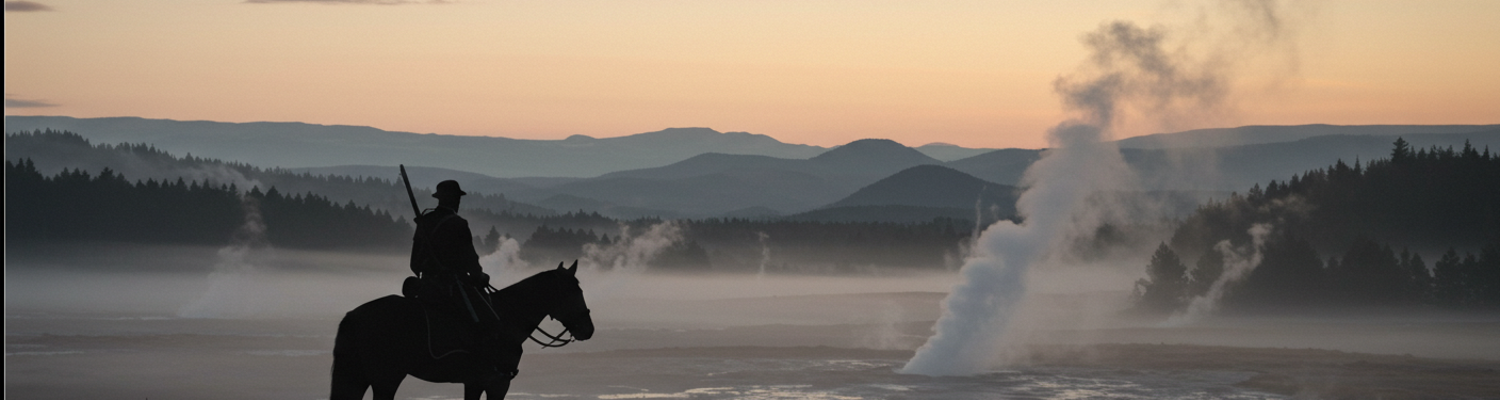

A Park on the Brink
By 1886, Yellowstone National Park was an experiment in catastrophic failure. Created in 1872 as a radical idea, a "public park or pleasuring-ground for the benefit and enjoyment of the people," it existed largely as lines on a map. For fourteen years, a Gilded Age Congress focused on industrial expansion and railroad grants refused to appropriate meaningful funds for its protection. A series of civilian superintendents were appointed, but they were toothless commanders. They had little pay, no staff, and zero legal authority to punish wrongdoers. The park, a vast expanse of 2.2 million acres, was left to the mercy of commercial interests and casual vandals. The results were devastating. Market hunters, operating with industrial efficiency, slaughtered elk by the thousand, sometimes leaving hundreds of carcasses to rot after taking only the hides and teeth. The park's last wild bison herd, a remnant of the millions that once covered the plains, was being systematically exterminated. Tourists, armed with axes and hammers, hacked apart the delicate silica formations of the geyser basins for souvenirs. Unlicensed developers set up shoddy hotels, saloons, and even laundries that piped the thermal waters of Mammoth Hot Springs directly into their tubs. The world's first national park was being plundered into oblivion. Facing a complete collapse of civilian administration, Secretary of the Interior Lucius Q.C. Lamar made a final, desperate appeal to the only federal entity capable of imposing order on the lawless frontier: the United States Army.
The Cavalry Responds
The War Department acted. General Philip Sheridan, a man who understood the American West, ordered troops to the park. On August 20, 1886, Company M of the First U.S. Cavalry rode out of Fort Custer in Montana Territory. Commanded by Captain Moses Harris, a pragmatic and experienced Civil War veteran, the fifty troopers were hardened by years of frontier duty and campaigns against Native American tribes. This new assignment, however, was entirely different. Their mission was not to fight a war but to prevent one against nature itself. They arrived at Mammoth Hot Springs and established a simple tent encampment they named Camp Sheridan. Their orders were ambiguous. They were to take control, but they possessed no specific legal jurisdiction over civilians. Their only explicit power was the authority to evict trespassers from the park, a blunt instrument for a complex task.
Harris immediately recognized the inadequacy of his mandate. The park was a territory larger than Delaware and Rhode Island combined. His small company could not be everywhere at once. He implemented a new strategy, establishing a network of small, spartan outpost stations at key locations like the geyser basins, Yellowstone Lake, and the Grand Canyon of the Yellowstone. From these points, his men began conducting constant patrols, their blue uniforms becoming a symbol of a new, unwelcome authority for the poachers and vandals who had previously operated with impunity.
Establishing Order Without Law
In the early years, Captain Harris and his successors operated in a legal gray zone. Lacking the power to arrest or fine, they relied on military discipline and creative enforcement. When soldiers caught a poacher, they could not bring him to trial. Instead, they confiscated his rifle, his traps, his horses, and all of his supplies. Then, they would escort the disarmed and humiliated man to the park boundary on foot. This extra-legal process of seizure and eviction proved to be a powerful deterrent. The financial loss of expensive equipment often outweighed any potential profit from illegal hunting. Similarly, tourists found defacing geyser formations were detained in the company guardhouse for a day or two before being unceremoniously marched out of the park.
The psychological impact of a uniformed, armed cavalry presence had an immediate effect. The casual, blatant destruction began to subside. The soldiers' duties were relentless and varied. They were the park's first effective firefighters, developing techniques for digging firebreaks and using wet saddle blankets to beat back flames. They served as tourist guides, explaining the geology of the geysers and sternly warning visitors away from dangerous thermal features. They became gamekeepers, tracking wildlife populations and guarding them from hunters. The work was arduous and often thankless, demanding a new kind of soldier, one who could navigate a blizzard on skis as proficiently as he could handle a carbine.
The Winter War on Poachers
The greatest operational challenge was winter. Deep snow, with drifts reaching dozens of feet, isolated the park's interior for more than half the year. This was the poachers' prime season. Animals, weakened by the cold, were easy targets. Before the Army's arrival, poachers could operate for months without fear of discovery.
The cavalry changed that. Soldiers, outfitted with long, Norwegian-style skis and snowshoes, began conducting long-range winter patrols. These were grueling expeditions, lasting weeks at a time in temperatures that could plummet to forty degrees below zero. Troopers traveled in small detachments, carrying their own food and sleeping in primitive snow caves or remote patrol cabins. Their primary target was the poacher, and their primary mission was the protection of the last 200 bison.
The conflict came to a head in March 1894. A patrol led by Captain G.L. Scott, guided by famed scout Felix Burgess, tracked a notorious poacher named Edgar Howell through the deep snow of Pelican Valley. They caught him red-handed, standing over the carcasses of six bison he had just killed. With him was a journalist, George Bird Grinnell, editor of Forest and Stream magazine, who had been invited to witness the Army's work. Howell, knowing the soldiers' legal limitations, was arrogant. He expected nothing more than eviction.
But Grinnell's explosive article, complete with photographs of the slaughtered bison, created a national firestorm. An outraged public demanded action. Within two months, Congress passed the Lacey Act of 1894. The new law, officially titled An Act to Protect the Birds and Animals in Yellowstone National Park, finally gave the Army what it had lacked for eight years: the legal authority to arrest poachers and bring them before a federal magistrate for prosecution. It was the turning point in the war to save Yellowstone.
Engineers Against the Wilderness
While the cavalry patrolled the wilderness, another branch of the Army was taming it. Beginning in 1883, the U.S. Army Corps of Engineers was tasked with building the park's transportation infrastructure. Under the brilliant direction of officers like Captain Hiram M. Chittenden, the engineers undertook a monumental construction project. They built over 350 miles of roads and 230 bridges, transforming the park from an inaccessible wilderness into a destination. Their work was a masterpiece of landscape-conscious engineering. The road blasted through the volcanic rock of Golden Gate Canyon was an engineering marvel of its time. Chittenden designed the first permanent bridge across the Yellowstone River near the falls, a structure that still bears his name.
The engineers pioneered a style that would later be called "National Park Service Rustic," using local materials and designing structures that blended with the natural environment. This philosophy was a direct counter to the exploitative mindset of the Gilded Age. The Army was not just imposing order, it was building a park designed for preservation, not just for passage.
Their road network dictated how millions of future visitors would experience Yellowstone, carefully guiding them to scenic wonders while protecting the fragile surrounding landscape.
The Transition to Civilian Command
The Army's administration of Yellowstone was never intended to be permanent. It was a stopgap measure that lasted for thirty-two years. During that time, the cavalry's success became the primary argument for creating a new, dedicated civilian agency to manage all national parks. The regulations developed by military superintendents like George S. Anderson, who created the first comprehensive rules for tourist conduct and wildlife protection, became the doctrinal foundation for this future agency.
When the National Park Service (NPS) was finally created in 1916, its first director, Stephen Mather, studied the Army's methods intently. The initial handover of power that year was a failure. The first batch of civilian rangers were largely political appointees with no training or experience in law enforcement or wilderness management. Poaching and vandalism immediately spiked. The situation deteriorated so quickly that Secretary of the Interior Franklin K. Lane formally requested that the War Department retake control in 1917.
The Army returned for one more year, providing a security screen while the NPS recruited and trained a professional ranger corps modeled directly on the cavalry trooper's skillset. In 1918, the final transfer of authority occurred. The last cavalry troops rode out of Fort Yellowstone, leaving behind a permanent legacy. They had saved the bison from extinction, protected the geysers from destruction, built the park's foundational infrastructure, and, most importantly, proven that large-scale wilderness preservation was a practical and achievable mission. The trooper on horseback, once a figure of frontier conflict, had been remade into an enduring symbol of American conservation.