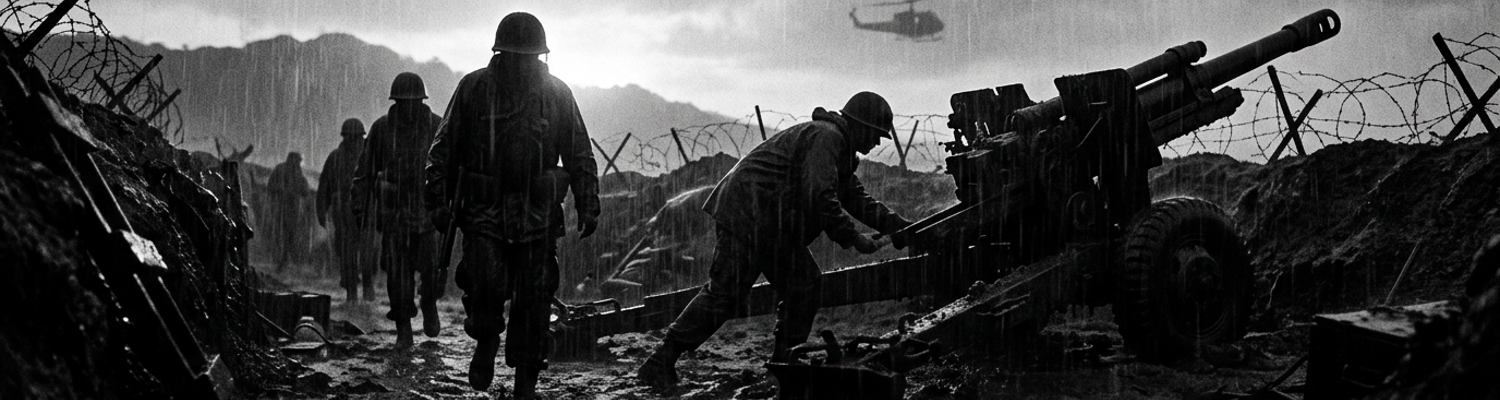

Route 9 Fortifications and Southern DMZ Deployments
By January 1968, four full North Vietnamese Army divisions had concentrated more than thirty-five thousand frontline infantry and heavy artillery crews along the narrow border corridor of Quang Tri Province. These units included the 304th, 320th, 324B, and 325C divisions. Facing them were fewer than eight thousand United States Marines scattered across isolated outposts. This imbalance exceeded four to one. It caused immediate alarm inside the Johnson administration and the Military Assistance Command in Vietnam. American intelligence analysts plotted enemy regiment concentrations that grew larger each morning. They watched divisional command posts shift southward into striking distance of the Demilitarized Zone. Every aerial reconnaissance report delivered to the Joint Chiefs of Staff confirmed that the defending units were surrounded by massed infantry formations carrying Soviet-supplied automatic weapons and heavy mortars. The sheer mass of the opposing divisions meant any coordinated offensive would overwhelm localized defensive perimeters before external reinforcements could navigate the monsoon-damaged roads.
The defenders ran out of room to maneuver.
Archival evidence shows that the Third Marine Regiment bore the primary burden of this geographic confinement. They anchored fixed positions strung along the unpaved surface of Route 9. Regimental headquarters operated out of Camp Carroll. This artillery base sat on an open plateau at grid coordinates XD 950550. Its assigned battalions held fragmented defensive sectors stretching westward toward the limestone crag known as the Rockpile. Second Battalion, Third Marines occupied the mud-slick perimeter of Camp Carroll itself. They guarded the Army M107 175mm long-range guns of the 8th Battalion, 4th Artillery. High sustained rates of fire wore out the hydraulic recoil cylinders of these heavy cannons within weeks. Ordnance teams had to cannibalize parts from deadlined chassis under daily intermittent rocket fire. Further west, First Battalion guarded the narrow river valley around the Rockpile at Hill 230. Resupply CH-46 Sea Knight helicopters frequently took small-arms hits through their hydraulic lines while trying to hover over vertical landing zones. The unpaved supply route connecting these garrisons suffered from deep mud ruts caused by winter monsoon rains. Supply trucks became immobilized and completely vulnerable to roadside command-detonated mines.
Visibility across the northern border favored the enemy.
A close review of operational logs indicates that North Vietnamese Army forward observers and sharpshooters had systematically established fortified positions along the high bluffs north of the Ben Hai River. These bluffs overlooked Marine perimeter wires. Spotters from the PAVN 84th Artillery Regiment utilized subterranean bunkers reinforced with heavy teak timbers and deep soil berms inside the Vinh Linh district. They used stereoscopic rangefinders to track every vehicle and troop assembly area inside Con Thien and Camp Carroll. Marine counter-battery AN/MPQ-4A radar systems repeatedly failed to locate these positions. The North Vietnamese crews fired their 130mm M-46 guns from deep caves using flat, high-velocity trajectories that skimmed beneath the radar line of sight. Sharpshooters equipped with scoped Mosin-Nagant rifles crawled into concealed spider holes along the southern drainage banks of the river. They picked off Marine engineers attempting to lay concertina wire or repair ruptured diesel pipelines. These sniper teams operated with complete fire discipline. They held their shots until Marine bulldozers or communications specialists entered open kill zones. This pinned entire platoons inside waterlogged trenches without any direct line of return fire.
Monsoon Degradation of Marine Defensive Revetments
Archival evidence shows that the winter northeast monsoon dumped over fifty inches of rain across the DMZ strip between November 1967 and January 1968. This turned the defensive works of the Third Marine Regiment into waterlogged hazards. At forward strongpoints like Con Thien and the C-2 perimeter at grid coordinates YD 128643, the ground consisted of dense red laterite soil. This soil transformed into liquid slurry within hours of steady downpours.
Trench walls collapsed without warning.
Individual fighting holes dug five feet deep into the clay quickly took on standing water up to the chest level of the riflemen occupying them. Marine units tried to shore up their deteriorating parapets using rough-cut timber stringers and standard-issue burlap sandbags. The saturated red soil expanded. It doubled in weight until structural beams snapped under the load. Saturated burlap rotted within forty-eight hours. Hundreds of tons of liquid mud spilled back into the communication trenches and buried weapons caches under red silt. Gas-powered Homelite utility pumps brought in to dewater the living spaces failed continuously. The thick grit shredded the rubber impellers and choked the intake filters.
Water dissolved the static defenses faster than North Vietnamese artillery could shatter them.
A close review of operational logs indicates that repairing this destruction fell upon raw infantry working parties and pioneer elements from the 3rd Engineer Battalion. They were forced to work completely in the open. Third Marine Division orders demanded that collapsed revetments be rebuilt immediately to maintain fire lanes. This pushed Marines out of their subterranean bunkers during daylight hours. Enemy spotters from the PAVN 84th Artillery Regiment sat on high ground north of the Ben Hai River with stereoscopic optics. They watched Marine details shovel wet soil into new sandbags without any overhead protection. Battery positions around Cap Mui Lay routinely laid down time-on-target salvos of 130mm high-explosive shells whenever repair crews gathered along the trench rims. Fragment sprays caught Marines waist-deep in mud. They were unable to drop prone before the airbursts detonated. Shell splinters tore through utility uniforms and flak jackets. This inflicted lethal puncture wounds and traumatic head injuries on troops attempting to carry structural timbers across exposed mud flats.
Every shovel of wet earth cost blood.
When examining casualty logs from Third Battalion, Third Marines, historical records document that work details sustained more fragment casualties per square yard than combat patrols during the first three weeks of January. Stretcher teams found it almost impossible to evacuate wounded personnel. The supply trenches were choked with knee-deep mire. Four-man teams had to carry litters over open, fire-swept ground. Underground battalion aid bunkers offered little respite. Persistent ground saturation caused bunker ceilings to drip contaminated runoff directly onto medical tables and plasma bottles. These rising injury reports went directly into intelligence briefings read by Defense Secretary Robert McNamara and congressional committees in Washington. Officials watched casualty counts mount along static positions that produced zero territorial gains. Marine field commanders repeatedly requested permission to abandon the low-lying fixed revetments in favor of mobile operations on higher ground. The Joint Chiefs of Staff rejected these requests out of political panic. Giving up named outposts would appear to be a strategic retreat on national television.
By the end of the month, Third Marines had lost two hundred men just to keep their defensive parapets above the rising mud.
North Vietnamese Sharpshooters and Tactical Attrition
A close review of operational logs indicates that North Vietnamese Army sharpshooters from the 320th Division turned the southern boundary of the Demilitarized Zone into a persistent killing zone throughout the early months of 1968. They operated from spider holes tunneled beneath dead bamboo root mats near the C-2 perimeter at grid coordinates YD 128643. Paired marksmen used scoped 7.62mm Mosin-Nagant Model 1891/30 rifles to paralyze everyday base operations. Working parties humping wooden crates of 81mm mortar rounds and five-gallon water cans toward the forward fighting holes of Second Battalion, Third Marines made primary targets. Any helmet cresting an unrevetted sandbag parapet for more than three seconds drew a high-velocity steel-core round through the eyelet or chinstrap. M8A1 trench periscopes suffered shattered mirror assemblies as North Vietnamese rifle fire cracked the upper prism housings. This blinded Marine squad leaders to enemy crawling parties laying directional mines outside the tactical wire. Riflemen quickly learned to drag supply bundles with ropes through communication trenches rather than carry them upright. Even handling parties ducking past collapsed trench sections took fatal neck and shoulder hits from angles as far out as eight hundred meters.
Sentries died without hearing the muzzle blast.
Archival evidence shows that six miles south along the jagged roadbed of Route 9, North Vietnamese spotters maintained direct visual control over every vehicle moving between Cam Lo and the Rockpile. PAVN mortar crews dug their 82mm Type 53 smoothbore tubes into the reverse slopes of limestone outcroppings. They zeroed their fire tables onto narrow bypasses and wooden trestle bridges. Convoys of M35A2 two-and-a-half-ton cargo trucks loaded with crated artillery charges suffered ruptured radiators, punctured fuel tanks, and severed hydraulic brake lines as high-explosive mortar fragments swept across the red clay. Burning trucks blocked the single-lane dirt passage. This trapped soft-skinned ambulances and engineering flatbeds under direct line-of-sight sniper fire from the surrounding high ground. Medical evacuation operations along this corridor broke down completely under the persistent bombardment. Flight logs from Marine Medium Helicopter Squadron 262 indicate that CH-46A Sea Knight helicopters attempting to lift wounded troops from roadside clearings took heavy 7.62mm fire through their engine nacelles and unarmored rotor hubs. Litter teams crouched in muddy drainage ditches while rounds tore through canvas stretchers. Pilots had to lift off prematurely with wounded Marines sliding across blood-slicked cargo ramps.
Field aid stations ran out of blood plasma before noon.
When examining the historical record, this relentless tactical attrition sent immediate tremors across the highest levels of American military and civilian leadership. General William Westmoreland reviewed daily casualty cables at MACV headquarters in Saigon. These cables showed Third Marines losing an entire rifle company every two weeks to invisible fire without fighting a single pitched defensive battle. Robert McNamara and his civilian analysts in the Pentagon flagged the DMZ casualty rate as unsustainable. They warned that static attrition favored Hanoi in both manpower reserves and domestic American political tolerance. President Lyndon Johnson tracked daily convoy losses and helicopter aborts on three-dimensional terrain models installed in the White House Situation Room. He was haunted by the specter of a catastrophic supply failure along Route 9. Marine commanders on the ground formally requested permission to mount an armored cross-border assault to destroy the mortar bunkers and sniper complexes north of the Ben Hai River. National security advisors vetoed the operational plan to avoid provoking Chinese military intervention.
Third Marines were ordered to remain stationary in their muddy ditches under direct observed fire.
Operational Breakdown of the Electronic McNamara Line
Washington expected silicon microcircuits and remote radios to replace combat infantrymen along the seventeenth parallel.
Archival evidence shows that the Department of Defense authorized Project Practice Nine as a high-technology solution to border infiltration. They scattered thousands of air-dropped and hand-emplaced acoustic and seismic sensor packages across the southern boundary of the DMZ. At forward surveillance monitoring centers, technicians tracked data pulses transmitted by Acoubuoy acoustic listening devices and subterranean Air-Delivered Seismic Intrusion Detectors. These remote electronic sentries failed mechanically under local combat conditions. Tropical monsoon downpours battered the flexible radio antennas. This snapped fiberglass receiver whips and shorted out internal battery packs within forty-eight hours of drop impact. Thick jungle canopies suspended thousands of parachute-dropped sensors high in the mahogany trees. Their acoustic microphones remained completely deaf to ground footfalls. Ground-spike geophones driven into the laterite soil suffered catastrophic signal noise. Heavy winter rains saturated the upper soil strata. Dense sheets of water transmitted vibration spikes that mimicked moving truck columns. Trotting baboon troops, water buffalo wandering through bamboo stands, and falling branches routinely tripped the sensitive relays. This triggered false movement contacts every six minutes. Reconnaissance aircraft patrolling overhead picked up continuous static instead of identifiable enemy troop footsteps. The million-dollar detection grid became useless for targeting incoming North Vietnamese regiments.
Every false electronic blip burned through American artillery rounds.
A close review of operational logs indicates that the physical construction of this electronic barrier strip diverted riflemen from the Third Marine Regiment into full-time ditch diggers and manual laborers. MACV planners in Saigon demanded a cleared obstacle trace extending six hundred meters wide across the red clay between Gio Linh and Con Thien. Marine rifle companies dropped their M16 rifles to wield axes, shovels, and steel sledgehammers under direct daylight observation from North Vietnamese artillery observation posts on the northern bank of the Ben Hai River. Caterpillar D7E bulldozers operated by the 3rd Engineer Battalion broke their hydraulic lift linkages against deep underground granite shelf formations. Marine infantry working parties had to clear the dead vegetation by hand. Platoons dragged heavy wooden crates of razor-sharp triple-strand concertina wire. They laid thousands of linear meters across raw mud flats while carrying heavy timber support poles on their shoulders. Riflemen spent twelve hours each day digging anti-tank ditches five feet deep and twelve feet wide. This was followed by six hours of night sentry duty inside water-filled holes. Constant physical engineering stripped Second Battalion, Third Marines of its ability to run aggressive reconnaissance sweeps. Entire frontline combat teams were tethered to repair details fixing washed-out sandbag retaining walls and shattered perimeter stakes.
Trained riflemen were reduced to exhausted target silhouettes behind barbed wire.
When examining the historical record, this tactical paralysis triggered fierce arguments inside the Johnson administration and the Pentagon. Robert McNamara had personally championed the barrier concept through the Jason Division of the Institute for Defense Analyses. He pitched it to congressional defense appropriations committees as an automated substitute for hundreds of thousands of draft-eligible American ground troops. Field reports crossing the desk of Marine Commandant Leonard Chapman Jr. told the opposite story. Four entire Marine engineer and infantry battalions had been immobilized along a muddy target ditch that failed to halt a single North Vietnamese regular. General William Westmoreland defended the electronic expenditure in urgent cables to the Joint Chiefs of Staff. He demanded thousands more replacement sensors even as daily maintenance work details sustained steady fragment casualties from PAVN 152mm howitzers firing from Cap Mui Lay. Classified briefings delivered to the White House Situation Room documented millions of dollars in sensor gear drowning in mud while enemy infiltration tallies climbed to over twenty thousand men per month.
Command Friction Between MACV and Marine Leadership
Archival evidence shows that General William Westmoreland viewed the fixed strongpoints along the Demilitarized Zone as non-negotiable anchors for containment. Operating from his Military Assistance Command, Vietnam headquarters at Tan Son Nhut, Westmoreland sent continuous directives to the northern front throughout late 1967 and early 1968. He demanded rigid defense of the linear barrier trace. He insisted that positions like Con Thien, Gio Linh, and Camp Carroll be held without an inch of retreat, regardless of seasonal flooding that filled frontline trenches with two feet of red laterite mud. In daily operational communications with the Joint Chiefs of Staff, the four-star general maintained that surrendering a single revetment would grant North Vietnamese forces direct access to the coastal lowlands of Quang Tri Province and produce an unacceptable political defeat. Third Marine Division casualty returns arrived on his desk daily. They showed hundreds of riflemen dead or wounded from incoming 130mm artillery fire while trapped in stagnant, waterlogged drainage ditches. Westmoreland dismissed suggestions of pulling troops back onto defensible high ground. He argued that static positions pinned enemy regular divisions in open terrain where American air power and heavy artillery could destroy them.
Saigon treated the flooded trace as an immovable wall.
When examining the historical record, Lieutenant General Robert Cushman and his staff at III Marine Amphibious Force in Da Nang formally opposed this static entrenchment strategy. Cushman submitted urgent operational assessments to Saigon warning that burying infantry battalions in flooded ditches stripped the Marine air-ground team of its core capabilities. Major General Rathvon Tompkins, commanding the 3rd Marine Division, joined Cushman in protesting the physical degradation of their units. Tompkins argued that troops forced to bail out water while taking indirect fire suffered continuous attrition without achieving tactical results. Marine doctrine prioritized high mobility, rapid helicopter-borne assaults via CH-46A Sea Knights, and flexible maneuver warfare designed to intercept enemy forces before they established artillery coordinates. Cushman requested formal authorization to abandon the low-lying revetments along the McNamara Line trace. He proposed instead that Third Marines execute aggressive reconnaissance-in-force operations through the high canopy west of Route 9. The III MAF commander argued that rifle companies should track and engage North Vietnamese regiments in fluid jungle maneuvers rather than wait for artillery rounds inside open dirt redoubts.
Generals in Da Nang wanted their battalions moving through the brush.
A close review of operational logs indicates that this dispute provoked severe command friction between MACV in Saigon and III MAF headquarters in Da Nang. Westmoreland rejected Cushman mobility proposals through written operational orders. He flatly instructed Marine commanders that abandoning constructed strongpoints violated national command directives. The confrontation reached the Joint Chiefs of Staff and Defense Secretary Robert McNamara. Civilian planners feared that moving troops away from the border would look like a military withdrawal on American television networks. Westmoreland used the tactical disagreement to question Marine leadership capabilities. He dispatched Army staff officers north to inspect Marine positions and evaluate trench maintenance at Con Thien and Camp Carroll. By mid-January 1968, Westmoreland initiated steps to strip III MAF of its independent aviation wing. He moved operational control of Marine fixed-wing strike aircraft directly under the Seventh Air Force commander, General William Momyer. This managerial challenge threatened traditional Marine command autonomy and triggered emergency meetings between Marine Commandant Leonard Chapman and the Joint Chiefs in the Pentagon.
On January 22, 1968, Westmoreland established MACV Forward at Phu Bai under Army Lieutenant General Creighton Abrams to oversee northern operations directly.
Pentagon Scrutiny and Congressional Inquiries
When examining the historical record, casualty returns filtering into the Office of the Secretary of Defense throughout early 1968 demonstrated that combat engineers and infantry work details were absorbing severe losses without entering direct ground combat. Along the cleared linear trace running between Con Thien and the coastal hamlet of Gio Linh, pioneer elements from the 11th Engineer Battalion and security platoons from the Third Marine Regiment were tasked with burying subterranean sensor cables, laying rows of barbed wire, and replacing defective battery canisters in forward geophone units. North Vietnamese forward observers in the Vinh Linh district tracked these work gangs in the open red dirt. They called in walk-up concentrations of 152mm artillery shells from coastal batteries near Cap Mui Lay. Shrapnel routinely cut down entire twelve-man trenching crews. Secondary detonations from newly laid M18A1 Claymore mines and disturbed cluster munitions shredded engineering equipment. Daily casualty cables transmitted to the Pentagon logged dozens of dead and wounded Marines each week exclusively tied to physical barrier upkeep. This rising body count alarmed civilian planners in the Office of the Secretary of Defense. They had designed Project Practice Nine under the assumption that automation would reduce American frontline casualties rather than multiply them.
Special assistants inside the Pentagon began tracking work-party casualty rates company by company.
A close review of operational logs indicates that Alain Enthoven, the Assistant Secretary of Defense for Systems Analysis, ordered urgent quantitative evaluations of barrier construction losses against documented infiltration rates. Enthoven and his civilian analysts discovered that Marine battalions along Route 9 were dedicating upwards of forty percent of their daytime manpower to clearing brush and repairing washed-out revetments instead of conducting counter-reconnaissance patrols. Defense Communications Planning Group director Lieutenant General Alfred Starbird flew directly to the DMZ to evaluate the mechanical and tactical breakdown firsthand. Starbird found construction deadlocked. Caterpillar D7E bulldozers were repeatedly disabled by command-detonated landmines. Sensitive AN/GSQ-99 sensor receiving terminals short-circuited under continuous humidity and mud exposure. His formal debrief to Defense Secretary Robert McNamara noted that keeping the cleared strip operable between coordinates YD 115703 and YD 218737 required continuous combat engineering beneath observable enemy fire. This operational burden was inflicting heavy casualties on the Third Marine Division without severing North Vietnamese supply trails.
Capitol Hill quickly noticed the climbing expenditures.
Archival evidence shows that the Senate Armed Services Preparedness Investigating Subcommittee, chaired by Senator John Stennis of Mississippi, opened sharp inquiries into the strategic rationale of the uncompleted project. Classified testimony revealed that costs for the barrier, originally budgeted at several hundred million dollars, had surged past one point six billion dollars across research, sensor procurement, and engineering infrastructure. Stennis and key members of the House Armed Services Committee confronted Pentagon representatives over the sharp contradiction between projected technological performance and actual field performance. Lawmakers pointed out that despite the massive financial outlay for thousands of air-dropped Acoubuoy acoustic listening transmitters and ground-vibration ADSID detectors, North Vietnamese regiments continued crossing the Ben Hai River in broad daylight. Congressional investigators demanded to know why American taxpayers were funding an electronic wall that stopped short of the Laotian border. This geographic gap left enemy logistical units free to bypass the entire sensor array by shifting westward into the mountains around Khe Sanh.
Committee members zeroed in on procurement contracts awarded to civilian electronics firms. They questioned the decision to deploy fragile vacuum-tube sensors and unshielded radio transmitters in a tropical combat zone. Representative L. Mendel Rivers, leading the House Armed Services Committee, challenged the Joint Chiefs regarding reports that Marine infantrymen were dying while manually replacing batteries inside remote detection spikes that failed within hours of ground impact. Congressional defense committees questioned whether the barrier had any measurable utility. They noted that after twenty-two months of continuous construction and billions of dollars in programmatic expenditures, not a single mile of the linear obstacle functioned as a fully automated, unmanned barrier. General William Westmoreland was forced to defend the installation during closed-door briefings. He faced direct challenges from senators who viewed the mud-covered trace as an expensive tactical dead end.
By late February 1968, the Senate subcommittee formally classified the automated barrier project as an inefficient drain on military manpower and departmental budgets. They froze secondary appropriations for Phase Two obstacle construction.
Diplomatic Repercussions and Tactical Policy Reversals
When examining the historical record, the visible collapse of the static barrier system along the seventeenth parallel dismantled the political framework constructed by the Johnson administration in late 1967. Throughout November and December, the White House had executed an aggressive domestic public relations campaign. They dispatched General William Westmoreland to Washington to assure congressional leaders and television audiences that the war had entered a phase where pacification was succeeding and enemy units were running out of men. Daily news dispatches from Quang Tri Province directly contradicted these optimistic assessments. Combat footage broadcast into American living rooms showed rifle companies from the Third Marine Regiment pinned in knee-deep mud inside waterlogged trenches at Con Thien and Gio Linh. They endured relentless 152mm artillery fire from North Vietnamese batteries stationed inside the DMZ. Intelligence summaries forwarded to the National Security Council revealed that the barrier was failing to impede four massed North Vietnamese Army divisions that moved supply trains across the Ben Hai River at will. Embassy officials in Saigon found their diplomatic leverage deteriorating. Foreign observers recognized that thirty-five thousand enemy regulars had successfully locked down American forces in defensive ditches weeks before the nationwide Tet Offensive erupted.
The official pacification claims unraveled on live wire service feeds.
Archival evidence shows that the tactical deadlock along the unpaved surface of Route 9 forced the Pentagon to scrap the entire concept of a fixed border barrier. Between Cam Lo and the forward operating base at Ca Lu, supply convoys operated by the 11th Motor Transport Battalion sustained catastrophic vehicle losses. North Vietnamese 82mm mortar teams and ambushing infantry targeted every bridge and narrow defile. M35A2 transport trucks burning on single-lane roads repeatedly cut off ammunition and medical supplies bound for Second Battalion, Third Marines at Camp Carroll and First Battalion at the Rockpile. Engineering teams from the 3rd Engineer Battalion could no longer operate Caterpillar D7E bulldozers without losing operators to scoped sniper fire from limestone ridges. Confronted with these mounting equipment losses and an immobilized infantry force, Defense Secretary Robert McNamara and the Joint Chiefs of Staff authorized a total reversal of border doctrine. Orders from the Pentagon terminated further funding and engineering construction for the linear obstacle trace. They replaced static trench defense with air-mobile counter-assault tactics.
Fixed earthworks gave way to helicopter rotors.
A close review of operational logs indicates that this reversal triggered rapid organizational adjustments across the northern tactical zone. Army Lieutenant General Creighton Abrams, operating from MACV Forward at Phu Bai, instructed military planners to phase out fixed defensive revetments in favor of aggressive helicopter insertions. Elements of the 1st Cavalry Division Airmobile were shifted north into Quang Tri Province to spearhead Operation Pegasus. They bypassed the muddy kill zones of Route 9 entirely by lifting infantry battalions into elevated fire support bases using fleets of CH-47 Chinooks and UH-1D Hueys. Marine regiments along the DMZ were systematically transitioned away from barrier upkeep to execute rapid company-sized helicopter drops into suspected enemy staging grounds throughout the Da Krong and A Shau valleys. This operational transformation sent immediate shockwaves through diplomatic channels in Southeast Asia. Officials in Washington had to quietly brief allied governments in Saigon, Bangkok, and Canberra on why a multi-billion-dollar automated barrier had been abandoned after less than a year of active development.
On March 31, 1968, President Lyndon Johnson announced his withdrawal from the presidential race. He ordered a partial bombing halt north of the twentieth parallel.