
Operation Dewey Canyon began with a fundamental miscalculation. In January 1969, the 9th Marine Regiment was inserted into the Da Krong valley, a territory long held by the North Vietnamese Army. The operational plan depended on a single, fragile supply line stretching back to Vandegrift Combat Base. That line had to cross the Da Krong River.
The crossing was the designated point of failure.
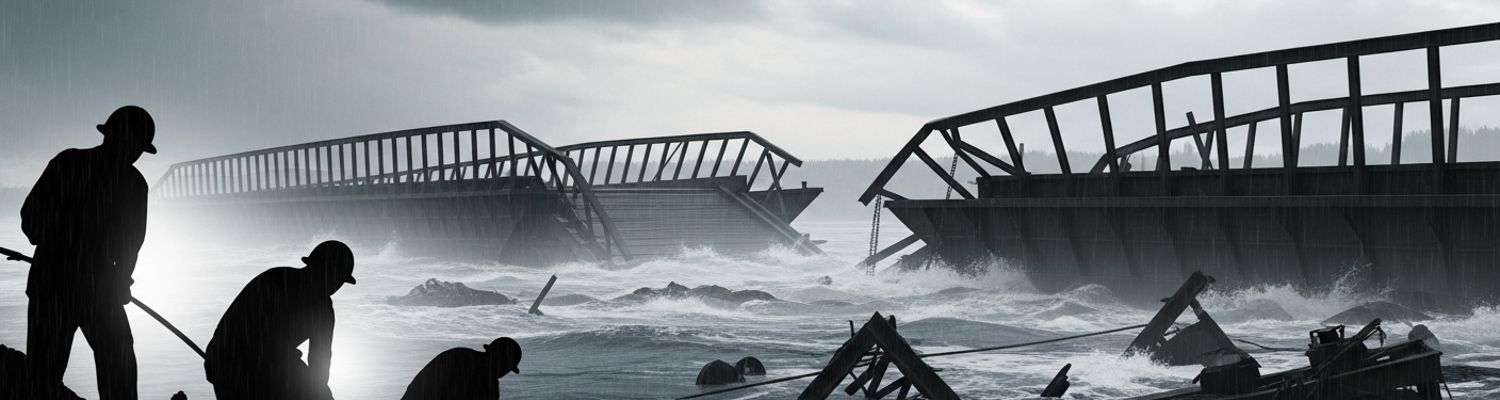
The entire offensive hinged on the swift deployment of an M4T6 pontoon bridge by the 8th Engineer Battalion. The M4T6 system was a product of battlefield engineering, comprised of hollow aluminum pontoons linked together and launched by a dedicated vehicle. Its hydraulic launching system was designed to push assembled bridge sections over the water. As engineers initiated the deployment, the monsoon season delivered its verdict. The Da Krong, swollen with torrential rain, transformed into a fast-moving, debris-choked torrent. The surge exerted immense lateral pressure on the bridge sections. Archival evidence points to a catastrophic failure within the hydraulic deployment mechanism. A primary pressure hose burst, spraying fluid and disabling the launch system. The force of the floodwaters, now pushing against a partially deployed and uncontrolled bridge section, caused connecting pins to shear and twisted heavy steel components into scrap.
The immediate effect was paralysis. The bridge's collapse created a massive bottleneck, halting the flow of supplies for the advancing Marine infantry. Convoys of M54 trucks, loaded with 105mm artillery rounds, C-rations, and medical kits, were stalled. The approach road became a parking lot of immobilized targets, exposing the operational plan’s dependency on this single crossing. Combat engineers were forced to improvise, working under pressure to establish a ferry system using individual pontoons and power boats. This ad-hoc solution was perilously slow. A convoy that should have crossed in an hour now took the better part of a day, with vehicles moved piece by piece across the current.
Consequences cascaded forward. Forward operating bases like FSB Cunningham and FSB Erskine, inserted deep in enemy territory, found themselves in a perilous state. These firebases were intended to provide artillery support and depended on a steady stream of ammunition. With the pontoon bridge gone, the resupply of these munitions slowed to a trickle. Operational reports from FSB Cunningham (as documented in 3rd MarDiv G-3 logs) describe artillery batteries rationing shells while under probe attacks from NVA units. The men on the firebases could hear the distant, frustrated sounds of convoy engines, yet the needed shells and food remained out of reach, stranded on the wrong side of a broken bridge.
The physical collapse of the M4T6 pontoon was a prelude to a more insidious problem. People's Army of Vietnam (PAVN) units began a systematic campaign to exploit the chaos. A review of after-action reports shows a sharp escalation in sapper-led attacks directed at the congested American position. These were not random probes. PAVN sapper units, specialists in infiltration and demolition, targeted the very elements required to fix the bridging problem: the men and equipment of the 8th Engineer Battalion. Under cover of darkness and monsoon rains, these small teams navigated the complex terrain of the Da Krong riverbanks. They bypassed Marine defensive positions to strike at generator trucks, power boats, and stockpiles of bridging components. Their methods were effective, relying on satchel charges and command-detonated mines placed with precision to cripple specific machinery, causing delays that stretched from hours into days.
The sappers were only the close-in threat.
From fortified positions on the high ground overlooking the valley, PAVN artillery and mortar crews began a campaign of indirect fire. The surrounding mountains, including the Co A Nang and Tam Boi hill masses, provided the PAVN with perfect observation of the entire operational area. From these concealed emplacements, they could watch every American move and bring down accurate fire. The stalled supply convoys presented an ideal target. The primary weapons were 82mm mortars and 122mm artillery pieces, weapons that could be fired and repositioned before counter-battery fire could locate them. The constant threat of incoming rounds turned the bridge site into a kill zone, forcing engineers to work in short bursts before taking cover. This fire was a form of area denial, preventing any sustained repair or ferry operations.
This two-pronged assault achieved its purpose with the severing of communications. The backbone of tactical communication for Marine units depended on PRC-77 manpack radios and landline field telephones. The PRC-77, a line-of-sight system, was already hampered by the mountainous terrain. PAVN sappers specifically targeted vulnerable hilltop relay stations, cutting physical telephone wires and destroying radio antennas with explosives. Mortar rounds rained down on command bunkers, destroying equipment and scattering personnel. The result was a near-total communications blackout. Company commanders were cut off from battalion headquarters. Battalion was cut off from the 9th Marine Regiment’s command element at Vandegrift. For commanders in the rear, the battle became a blank space on the map, a void from which only fragmented and delayed reports would emerge.
They were blind.
The repair teams of the 8th Engineer Battalion were on an island. The M4T6 failure had stranded them between a raging river and an active enemy. Declassified reports indicate their position was almost immediately bracketed by NVA artillery firing from the high ground of the Annamite range. This was a deliberate tactic of isolation. The threat of incoming 82mm mortar rounds turned the muddy riverbanks into a space where movement was a calculated dash across open ground.
This curtain of indirect fire severed the repair teams from their own support elements. The rest of the 9th Marine Regiment might as well have been on another continent. The NVA’s control of the overlooking terrain created a bubble of extreme vulnerability. Compounding this were the nightly incursions by NVA sapper units. These commandos used the storm-swollen river and dense foliage as cover, infiltrating the American perimeter to attack the engineers directly. Archival evidence (NARA Record Group 127) details a clear pattern of these teams targeting specific equipment: portable generators, welding tools, and the engines of the LCM-8 “Mike boats” being used as makeshift ferries. The engineers were fighting a war on two fronts: a technical battle against the river and a tactical battle against an enemy who could strike from any direction.
The ordeal became a cycle of construction and destruction. With the M4T6 bridge a wreck, the engineers shifted to an improvised ferry system, a desperate attempt to move vehicles across the Da Krong one at a time. Each night, NVA sappers would slip into the water, swimming silently to the mooring points. They attached explosive charges to the aluminum hulls of the pontoons or directly onto the engine cowlings of the boats. Morning would reveal the previous day's work undone. Punctured pontoons listed uselessly. Guide cables, essential for controlling the ferries in the powerful current, were found severed. The damage was rarely total, but it was always sufficient to render the components inoperable, forcing the engineers to start the repair process from scratch.
This relentless attrition inflicted agonizing delays on the entire operational timeline. The failure to secure a reliable crossing created a logistical jam that stretched for miles back along Route 9. What should have been a steady flow of material to the front became a static, vulnerable line of stalled trucks. A close review of operational logs shows the improvised ferry, on the rare occasions it was functional, could move only a few heavy vehicles per day. A convoy that was supposed to cross the river in under an hour now faced a multi-day wait. This delay left forward-deployed Marine battalions dangerously undersupplied, forcing them to ration ammunition while in direct contact with a well-supplied enemy.
A review of operational logs from January 1969 reveals the 3rd Marine Division headquarters, located miles away, was operating on a lagging timeline. Their strategic planning relied on signals intelligence (SIGINT) that was often days old by the time it was compiled into actionable briefs. This built-in delay meant that orders dispatched to the 9th Marine Regiment were based on a snapshot of enemy positions that was no longer accurate. Division planners, looking at maps marked with NVA unit locations from 72 hours prior, consistently underestimated the enemy’s speed. They failed to grasp that the PAVN units identified by SIGINT had already repositioned, using the same weather that hampered the Americans to mask their movements toward the bridge site.
The headquarters was fighting a ghost.
This flawed intelligence was then transmitted through a compromised communications network. The primary instrument for voice communication was the AN/PRC-77 manpack radio, a VHF system dependent on line-of-sight. In the steep, jungle-choked mountains, every transmission required a series of hilltop radio relay stations. As these relays were destroyed, the communication net began to fray. A staff officer at the division command post at Dong Ha would issue an order, but by the time it was passed from one static-filled relay to the next, its clarity was lost. Reports from the field, detailing the true severity of the river's flood stage, were subject to the same degradation on their journey back up the chain.
The compounding failures led to a misjudgment of the situation at the river. From the remove of a command bunker, the failure of the M4T6 bridge was perceived as a mechanical problem. Orders were issued to expedite repairs, betraying a disconnect from the conditions on the ground. A review of the M4T6’s own technical specifications shows it was not designed to withstand the lateral pressure exerted by a debris-filled, monsoon-stage river. The engineers of the 8th Engineer Battalion were not failing due to a lack of effort; they were being asked to defy physics while under observed fire. Division headquarters, blinded by outdated maps and deafened by failing radios, could not comprehend that the bridge site was not a construction zone but a kill zone. Their insistence on a bridging solution, when the tactical situation demanded a reassessment of the operational approach, bled the momentum from Operation Dewey Canyon.
A close analysis of the 3rd Marine Division’s planning documents reveals a foundational misjudgment. Headquarters based its equipment requisitions on the flawed assumption that the Da Krong valley would be traversed during the dry season. This led to the allocation of standard bridging equipment unsuited for the monsoon conditions. The M4T6 system was sent with hydraulic fluids and hose variants known to become brittle and fail under the combined stress of high-pressure use and cool, damp mountain air. There was also a shortage of specialized anchoring equipment, such as heavy-duty rock pitons and steel cabling, needed to secure a bridge against the force of a flooded river. The equipment manifest was designed for a placid crossing, not a raging torrent.
The crisis was tactical, and the response was slow. With PAVN artillery observers directing fire onto the crossing site, the stalled engineer teams were exposed. A review of air support logs for the period shows that requests for immediate, suppressive air strikes went unanswered for multi-hour periods. The reason was a problem of prioritization rooted in the command’s blindness. The few available Marine air assets, primarily AH-1 Cobra gunships and A-4 Skyhawk jets, were allocated to support infantry battalions already engaging enemy units deeper in the operational area. From the perspective of a commander at division headquarters, infantry in a firefight took precedence over an engineering problem in the rear. This decision failed to recognize that the bridge site was the operation’s center of gravity. Without air support to suppress PAVN artillery, the engineers could not work, the bridge could not be fixed, and the forward battalions would run out of supplies.
Operation Dewey Canyon was designed as a swift raid to disrupt the PAVN logistical hub in Base Area 611. The initial helicopter assaults positioned the Marines perfectly for this disruption. But the failure at the Da Krong River halted the ground-based supply chain. The hand-to-mouth ferry system was a desperate stopgap, capable of moving only a tiny fraction of the required tonnage. Operational records from the forward firebases detail the consequences: artillery batteries were forced to strictly ration firing missions, sometimes unable to respond to calls for support from infantry patrols. The offensive slowed from a sprint to a crawl, giving PAVN forces invaluable time to assess the American plan and reinforce their positions. The 9th Marines had penetrated the enemy’s sanctuary, but their lifeline had been cut, leaving them unsupported at the precise moment they needed to press their advantage. The battle for the Da Krong bridge was not a sideshow; it was the decisive engagement of the operation, lost before the main infantry battles were fully joined.