
In the waning years of the 19th century, a palpable anxiety gripped naval strategists. The age of sail had definitively given way to steam and steel, yet the doctrinal bedrock of sea power, the heavily armored battleship, faced an asymmetric threat that promised to upend naval warfare. This threat came not from a rival battleship but from a vessel a fraction of its size and cost, the torpedo boat. For the United States Navy, just beginning to emerge from the post, Civil War doldrums often called its 'Dark Ages', this technological disruption forced a hard re-evaluation of its coastal defense posture. The process was crystallized by the acquisition of a single, revolutionary vessel born from a new national will to project power.
The Herreshoff Answer to Naval Stagnation
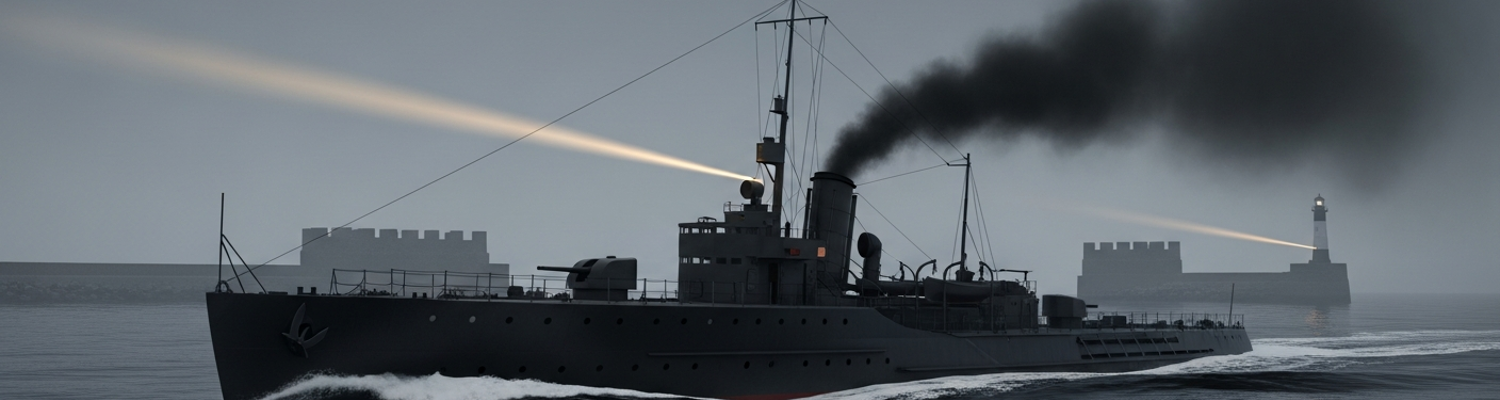
The commissioning of USS Cushing (TB-1) on April 22, 1890, marked a pivotal moment. It was a tangible result of the naval renaissance championed by figures like Secretary of the Navy William C. Whitney. The Navy of the 1870s and early 1880s was a fleet of aging Civil War monitors and rotting wooden cruisers, a force completely outmatched by European navies. The authorization of the first steel warships, the 'ABCD' ships Atlanta, Boston, Chicago, and Dolphin in 1883, signaled a change. The act of Congress on August 3, 1886, that authorized Cushing was part of this 'New Steel Navy' initiative. The vessel was the nation’s first steel-hulled torpedo boat, a sleek and dangerous-looking craft designed by the brilliant Nathanael Greene Herreshoff and built by his Herreshoff Manufacturing Company in Bristol, Rhode Island. Named for the audacious Civil War hero William B. Cushing, who had famously sunk the Confederate ironclad CSS Albemarle with a spar torpedo, the new vessel was intended to carry a far more sophisticated weapon.
At 140 feet in length with a displacement of just over 100 tons, Cushing was a study in minimalist design focused on speed and a powerful punch. Herreshoff, already famous for designing lightning-fast racing yachts, applied his mastery of lightweight, high-strength construction to the warship. Her two vertical quadruple-expansion steam engines, fed by advanced Thornycroft boilers, could push her to a remarkable 23 knots. This speed was her primary defense. Her armament initially consisted of three 6-pounder rapid-firing guns and, most importantly, three 18-inch torpedo tubes. One tube was fixed in the bow, a feature that proved impractical and was later removed, while two trainable mounts were located amidships. Under the command of Lieutenant C. M. Winslow, Cushing was not just a warship but a floating laboratory.
Her initial service involved extensive experimental work as part of the Squadron of Evolution, a unit specifically tasked with developing tactics for the new steel navy. A key figure in her early trials was Lieutenant Commander George A. Converse, who served as the Navy’s on-site inspector during her construction and later led the Torpedo Board at Newport. Cushing’s early career was dedicated to testing torpedo outfits and gathering the data that would inform the Navy’s nascent torpedo doctrine. The boat was designed to fire the Howell torpedo, a complex flywheel-driven weapon. Production delays and reliability issues with the Howell meant that Cushing would soon be adapted to work with the more successful Whitehead torpedo, a compressed-air-propelled weapon that became the international standard.
A Crisis of Doctrine for the Gun and Fort
The arrival of the torpedo boat sent a shockwave through the world’s navies. The logic of naval conflict, which for decades had been a contest of armor and heavy guns, was suddenly challenged. A small, inexpensive boat, barely visible on the horizon, could theoretically disable or sink a multi-million-dollar battleship. This created a strategic crisis, particularly for the United States. Its navy was still rebuilding and its extensive coastline was a primary defensive concern. The dominant coastal defense strategy had long been the purview of the Army and its Corps of Engineers, relying on massive masonry fortifications. By the 1880s, advances in rifled cannon had rendered these forts obsolete. In 1885, the Endicott Board was convened to modernize these defenses, recommending reinforced concrete batteries with disappearing guns and, critically, underwater minefields controlled from shore. This was a static, Army-controlled vision of defense.
The torpedo boat fit uneasily into this paradigm. It was a naval asset, yet its primary function was defensive, a high-speed picket and harbor defense vessel. Its existence fueled the arguments of naval theorists who believed in a 'mosquito fleet' that could deter a superior enemy through sheer asymmetric threat. The fear was that a foreign power would hesitate to attack a major American harbor if it meant navigating a channel defended by swarms of fast-moving torpedo boats. The reality, however, was more complex. Early torpedo boats were fragile and had extremely limited range. Their effectiveness was largely confined to coastal waters and relatively calm seas. They were notoriously poor sea boats. A harrowing 1898 incident aboard Cushing saw Ensign Joseph C. Breckinridge washed overboard and lost in heavy seas, a fatal reminder of the platform's limitations. Their weapons were still in their infancy. Torpedoes of the era were often unreliable, with flawed depth-keeping mechanisms and temperamental detonators. The idea of a successful massed attack against a maneuvering battle line was largely theoretical.
Despite these limitations, the perceived threat was enough to force a doctrinal response. Navies began to develop a counter, the 'torpedo boat destroyer.' These larger, more seaworthy vessels were designed to hunt and kill torpedo boats before they could get within range of the battleships. In a classic case of action and reaction, the torpedo boat’s challenge to the battleship ultimately spawned the forerunner of the modern destroyer, a vessel class that would dominate naval warfare in the 20th century.
Goat Island's Forge of Tactics and Technology
The heart of the US Navy’s torpedo enterprise was the Naval Torpedo Station at Newport, Rhode Island. Established on Goat Island in 1869 under the direction of Secretary of the Navy Adolph E. Borie, its initial purpose was to experiment with mines and explosives. With the arrival of the self-propelled torpedo, Newport’s role became absolutely central. On September 8, 1891, USS Cushing reported for duty at the station, beginning a long and fruitful association. Newport became the crucible where the theories of torpedo warfare were tested against the unforgiving realities of the sea. At the Torpedo Station, Cushing and the flotillas that followed were used to refine both technology and tactics. Under the guidance of officers like Lieutenant Frank Friday Fletcher, Cushing’s crew experimented with firing solutions and launch techniques. A significant innovation developed at Newport was the installation of trainable, swiveling torpedo tubes on Cushing in 1893, a major improvement over the fixed tubes that greatly increased tactical flexibility. The station was a center for manufacturing and instruction. It produced the Navy’s guncotton explosive and trained the officers and men who would form the new torpedo corps. The operational life of these early torpedo boats was intense but brief. They were high-strung machines, their powerful engines crammed into small, lightweight hulls. They required constant maintenance. While they served in picket and patrol duties during the Spanish-American War, with Cushing capturing several small Spanish vessels off Cuba, their primary contribution was as platforms for experimentation. After the war, Cushing returned to her duties at Newport before being assigned to the Reserve Torpedo Flotilla in Norfolk in 1901. By then, the Navy was already building larger, more capable torpedo boat destroyers, signaling the end of the pure torpedo boat’s prominence.
An Epilogue of Catalytic Failure
Was the torpedo boat revolution a strategic success or failure for the US Navy? The answer is nuanced. As a direct challenge to battleship supremacy, the early torpedo boat failed. It never achieved the decisive results its most ardent proponents envisioned. Its inherent weaknesses, poor seakeeping, short range, and unreliable weapons, meant it could never truly displace the capital ship. The development of the destroyer as a direct countermeasure effectively neutralized the torpedo boat as an independent offensive threat. The first US Navy destroyers, the Bainbridge class authorized in 1898, were specifically designed with higher freeboards for better seakeeping and a heavier gun armament to overmatch their smaller prey. They were a direct answer to the torpedo boat's flaws.
However, as a catalyst for change, the torpedo boat was an undeniable success. It shattered the complacency that had set in after the Civil War and accelerated technological innovation. The experiments conducted aboard Cushing and the training programs at the Newport Torpedo Station laid the essential groundwork for the Navy’s mastery of torpedo warfare in the 20th century. The fear these small boats inspired directly led to the creation of the versatile and powerful destroyer. The Gilded Age torpedo boats, once seen as a revolutionary threat, were rapidly superseded. Cushing herself was ultimately sunk as a target on September 24, 1920, a quiet end for a vessel that had once embodied a naval revolution. The torpedo boat, therefore, holds a paradoxical place in naval history, a short-lived platform whose ultimate failure was instrumental in forging the tools and tactics that would define the future of naval combat.