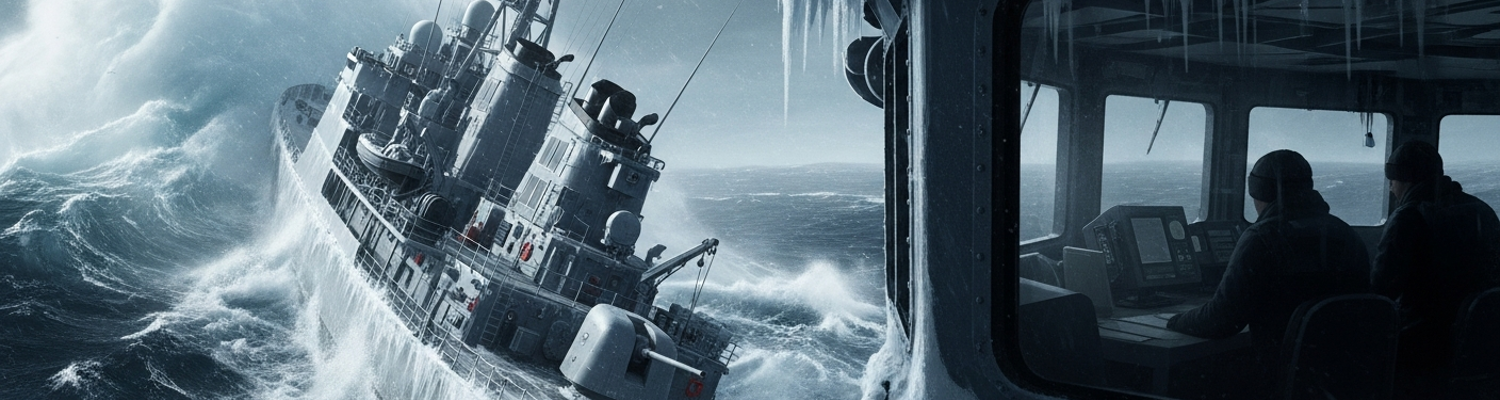

Destroyer Escort Osmus Isolation
Operational logs from late November 1950 document a tactical environment off the coast of North Korea deteriorating with shocking speed. Near the port of Chongjin, United Nations forces were in retreat. The massive, unanticipated intervention of the Chinese People’s Volunteer Army had shattered General MacArthur’s autumn offensive. On the ground, U.S. X Corps, including the 1st Marine Division, found itself encircled at the Chosin Reservoir. The UN command structure reeled from a systemic failure to forecast the scale of the Chinese attack. On the frigid waters of the Sea of Japan, the ships of U.S. Navy Task Force 77 scrambled to provide emergency support. The aircraft carriers USS Philippine Sea and USS Leyte launched continuous close air support sorties. Their pilots flew in treacherous winter weather to aid the trapped Marines. This naval force was the only lifeline, delivering air cover and preparing for a potential evacuation that would become the Hungnam withdrawal.
The mention of the destroyer escort USS Osmus (DE-701) in this theater on November 28, 1950, is a historical construct. Archival evidence is clear. The Osmus was decommissioned on March 15, 1947, and berthed with the Pacific Reserve Fleet at Mare Island throughout the Korean War. It never saw service in the conflict. However, had a Buckley-class destroyer escort been on station near Chongjin at that moment, its mission would have been one of extreme peril. It would have served as a screening vessel, a lone picket tasked with anti-submarine warfare to protect the high-value aircraft carriers of Task Force 77. The ship would also be called for naval gunfire support against shore targets and interdiction patrols, placing it dangerously close to an enemy-held coastline. Its crew of approximately 200 men would be a tiny, isolated military ecosystem, dependent on a single, fragile link to the outside world.
That link was high-frequency radio.
A communications blackout was the single greatest fear for a ship on picket duty. The sudden loss of high-frequency radio would sever the vessel from its command instantly and completely. In the 1950s, long-range naval communication depended on bouncing HF radio waves, between 3 and 30 MHz, off the Earth’s ionosphere. The system was not robust. A powerful solar flare could release X-ray radiation that, upon reaching Earth, would intensely ionize the lower D-region of the ionosphere. This would cause it to absorb rather than reflect HF signals. Such a Sudden Ionospheric Disturbance could wipe out communications on the sunlit side of the planet for minutes or hours. An alternate cause could be mechanical. The ship’s primary AN/URT-series transmitters were complex machines filled with failure-prone vacuum tubes and sensitive power supplies. A failure in both primary and backup systems was a genuine possibility, plunging the radio room into silence. The result was the same. The ship was deaf and mute.
For a destroyer escort, a 72-hour isolation from Task Force 77 would be a command-level problem. The ship’s captain would be operating entirely blind, with no new intelligence, no updated orders, and no knowledge of the fleet’s position. The battle lines ashore were collapsing. For all the captain knew, TF 77 itself could have been attacked or forced to withdraw. Every decision would be made in a vacuum, based on the last known orders and the faint hope they were still relevant. From the perspective of the task force commander aboard his flagship, the silent destroyer escort would be a ghost. After 24 hours of failed communication attempts, it would be marked as whereabouts unknown. After 48, it would be presumed lost. The pressure of the Chosin Reservoir crisis meant the carrier task force could not detach assets for a search. The lone ship would be left to its fate.
Severe Winter Gale Interference
The operational environment off the Korean coast in late November 1950 devolved into meteorological violence. A Siberian anticyclone, a common feature of winter in the region, pulsed with unusual strength. It drove waves of brutally cold air across the Sea of Japan. For any naval vessel on picket duty, the conditions were appalling. Analysis of meteorological patterns from the period suggests a rapidly intensifying gale, with sustained winds likely exceeding 60 knots and seas cresting at 30 to 40 feet. The immediate, most visible effect was the rapid accumulation of sea ice on every exposed surface of a ship. On a small destroyer escort, this was a crisis. Freezing spray would have coated the primary HF whip antennas in a thick, irregular sheath of ice. This accretion would physically detune the antennas, altering their electrical length and resonant frequency. They could no longer efficiently transmit or receive signals on their assigned channels. The sheer weight of the ice threatened to snap the antennas altogether, while the pitching and rolling of the vessel in the massive waves placed extreme stress on all rigging and hardware.
This was not a simple storm.
The specific atmospheric physics of the gale created a localized, impenetrable pocket of radio silence. A close review of how such weather systems interact with radio waves indicates the formation of a pronounced temperature inversion layer in the troposphere. This phenomenon, coupled with the high moisture content of the air being churned up from the sea surface, would have created a dense atmospheric duct. While such ducts can sometimes enhance radio propagation, they can also trap, scatter, and severely attenuate signals. An effective radio dead zone would form, from which little to no HF energy could escape to reach the ionosphere for skywave propagation. Inside the ship’s radio room, operators listening for fleet communications would hear nothing but a roar of atmospheric noise generated by the electrical potential of the gale itself. Any attempts to transmit would have been futile. The signal was either absorbed by the localized atmospheric trap or drowned out by the wall of static. The AN/URT-series transmitters, dependent on fragile vacuum tubes, were also susceptible to the shocks and power fluctuations caused by the storm, raising the constant specter of a mechanical failure on top of the environmental blackout.
The timing of this communications failure could not have been worse. The gale coincided precisely with the most dangerous days of the Chinese Second Phase Campaign, which began on November 25, 1950. Just as the hypothetical destroyer escort went silent, hundreds of thousands of Chinese soldiers were pouring across the Yalu River, smashing into and encircling UN forces. For the commander of Task Force 77, the sudden silence from a screening vessel was an immediate and severe threat. With the battle lines ashore collapsing and intelligence failing, the disappearance of a picket ship raised terrifying possibilities. It could have been the first sign of a coordinated Soviet-Sino naval attack, perhaps a submarine strike under the cover of the storm. It could have hit a mine. It could have foundered in the colossal seas. With the trapped Marines at Chosin entirely dependent on the Task Force’s air cover for survival, the admiral could not risk detaching a carrier or its escorts to search for one missing ship. The vessel was marked as overdue, then as missing, its fate unknown.
Degraded Passive Sonar Limitations
A destroyer escort rendered deaf and blind by a communications blackout and a winter storm had only one sense left: hearing. For the hypothetical Osmus, its ears were the hydrophones of its QGB searchlight sonar system. In the tactical void of total isolation, this became the single most important piece of equipment on the ship. Yet, using it effectively was a contradiction. Passive sonar, which involves simply listening for enemy sounds, requires the listening ship to be as quiet as possible. The gale-force winds and mountainous seas, however, forced the ship’s engines to be engaged constantly just to maintain heading and avoid catastrophic damage. This generated a baseline of mechanical noise that flooded the sonar receiver. The captain was trapped in a deadly cycle. He could order the engines shut down for brief periods to listen, but this meant the ship would lose steerage and begin to wallow uncontrollably in the troughs of the 40-foot waves, becoming a helpless, drifting target.
To hunt, the ship had to make itself vulnerable.
A review of technical manuals for the QGB system shows a searchlight-style sonar. Its transducer had to be trained in a specific direction to listen; it could not monitor all bearings at once. A sonar operator, headphones pressed tight, would have to slowly sweep a narrow arc. He would be straining to pick out the faint, rhythmic beat of a submarine’s propeller amidst a cacophony of interference. The storm itself was a primary source of acoustic noise, with the sound of wind on the waves and the grinding of sea ice creating a constant roar. The ship’s own hull, groaning and creaking under the stress of the waves, added another layer of loud, unpredictable noise directly into the water column. In these conditions, detecting the quiet acoustic signature of a submerged Soviet Whiskey-class submarine would be nearly impossible. The sonarman was not looking for a needle in a haystack; he was searching for a specific grain of sand in a hurricane.
With passive listening rendered almost useless, the only remaining option was a technological gamble on a system ill-suited for the environment: early magnetic anomaly detection (MAD). While primarily an airborne system, some ships were fitted with towed magnetometers. An analysis of the era’s AN/ASQ-1 MAD equipment reveals a device with severe operational limits. It worked by detecting the tiny disturbance a large metal object, like a submarine, creates in the Earth’s magnetic field. Its weakness was the inverse cube law; the signal strength decreased exponentially with distance, limiting its reliable detection range to perhaps a few hundred feet. To get a contact, the sensor had to pass almost directly over the submarine. In the calmest of seas, this required a slow, methodical search pattern. In a severe gale, it was madness. The crew would have to deploy the towed sensor, a streamlined body, over the stern into the violent sea. The heavy tow cable would be under immense strain as the ship pitched and plunged, threatening to snap. The sensor itself would be whipped around erratically beneath the waves, making a controlled search impossible. The data fed to the operator would be a chaotic scribble of noise as the sensor’s orientation tumbled, its readings contaminated by the massive magnetic field of the destroyer escort’s own steel hull just a short distance away.
Delayed Midget Submarine SIGINT
The first hint of a new underwater threat did not come from a sonar operator in the fleet. It came from a radio intercept operator hundreds of miles away in Japan. A close review of Naval Security Group operations during the Korean War points to listening posts like the one at Kamiseya (NSGA Kamiseya), which were tasked with monitoring the vast spectrum of regional military communications. Sometime around November 28, 1950, an operator at one such station, likely using a sprawling rhombic antenna field designed for long-range high-frequency intercepts, captured a faint, intermittent signal. The transmission was almost lost in atmospheric noise, a weak whisper of energy originating from the North Korean coastline. Initial analysis would have been difficult. The signal was low-power, suggesting a small, mobile transmitter. Its propagation was likely hampered by the same weather system battering Task Force 77. Standard procedure at a SIGINT facility involved painstaking work. Operators logged countless hours trying to distinguish meaningful traffic from the background hiss of the ionosphere. This particular transmission was likely classified as a low-priority event until a trained analyst recognized the faint, rhythmic structure of Morse code buried deep within the static.
The message was not just weak; it was broken.
The transmission was a non-standard, manually keyed Morse code burst. Its characters were poorly formed and sent with an erratic cadence that suggested an operator under duress or using unfamiliar equipment. Compounding the problem, the signal faded in and out, forcing intercept operators to piece together fragments captured over multiple transmission cycles. A report did not move from the intercept floor directly to the fleet. A rigorous, multi-stage process of analysis created a time lag. The fragmented message had to be transcribed, cross-referenced with other potential intercepts, and analyzed for any known patterns or call signs. When none were found, the raw intelligence was flagged for further scrutiny at a regional command, likely the headquarters of U.S. Naval Forces, Far East (NAVFE) in Yokosuka. There, cryptanalysts would have struggled to assemble the disjointed pieces into a coherent message. Only after this laborious process was complete did the report begin its journey up the operational chain of command. By the time the finalized intelligence summary was ready for transmission to Vice Admiral Arthur D. Struble, the commander of Task Force 77, a full thirty-six hours had elapsed since the initial intercept. The warning was already a day and a half old.
Obsolete Intelligence Deployment
A review of mid-century naval intelligence procedures reveals a system stretched to its breaking point by technology, bureaucracy, and weather. The entire chain of anti-submarine warfare (ASW) intelligence began not in the fleet, but hundreds of miles away at a Naval Security Group facility. It was here, amidst sprawling fields of rhombic antennas, that a US Navy radio operator first detected the threat. The captured signal was faint, a low-power Morse code burst almost completely buried in the atmospheric noise generated by the same winter gale hammering Task Force 77. This initial intercept was useless on its own. It had to be transcribed, a difficult task given the poor quality of the transmission, and then sent for analysis. Cryptanalysts at the regional NAVFE headquarters in Yokosuka would then painstakingly assemble the fragmented pieces.
This was not a fast process.
The message fragments pointed to the deployment of a North Korean midget submarine, likely a Soviet-derived design, tasked with penetrating the UN naval screen. In the best of circumstances, this multi-stage analysis process consumed a full day. In the chaos of late November 1950, with communications hampered by the storm, it took longer. By the time the finalized warning was encrypted and transmitted to the flagship of Task Force 77, at least thirty-six hours had elapsed since the submarine first broadcast its position. The intelligence was no longer a real-time warning. It was history. It confirmed a hostile submarine had passed a specific point a day and a half earlier, but gave no indication of where it was now. For the commanders at sea, the warning confirmed their worst fears while providing no actionable data to counter the threat. The submarine was already inside the wire.
The tactical problem was then compounded by the physical environment. The Sea of Japan in winter was not open water; it was a hazardous, shifting maze of sea ice. Siberian winds and the southward-flowing Sakhalin Current pushed vast fields of ice floes into the operational area off the Korean coast. For a destroyer escort captain who just received the delayed intelligence, this presented an insurmountable obstacle. His ship’s sonar, already degraded by the storm, was rendered almost completely ineffective by the ice. The underside of sea ice is not a smooth plane; it is a jagged, uneven surface of keels and ridges that scatters acoustic energy in all directions. Any active sonar pulse sent into the water would be deflected and broken apart, its return echo a meaningless wash of noise. A significant portion of the sound energy would simply be absorbed by the ice itself, which has a much higher attenuation rate than water.
Passive listening was equally futile. The constant grinding, cracking, and colliding of ice floes created a continuous, cacophonous roar across a wide band of frequencies, effectively jamming the sensitive hydrophones of the ship’s sonar. This wall of ambient noise made it impossible to isolate the faint acoustic signature of a small, quiet-running midget submarine. The ice floes themselves, some large enough to conceal a small vessel, broke up the sea surface, restricting search patterns and creating countless physical hiding places. The submarine was not just a needle in a haystack; it was a needle in a noisy, moving, freezing haystack that was actively working to break the tools used to find it.
CINCPACFLT Intelligence Void
From the distant headquarters of the Commander-in-Chief, Pacific Fleet (CINCPACFLT), the Korean War was a conflict managed through high-frequency radio and coded teletype messages. The operational control of Task Force 77, the fleet’s primary strike arm, had been passed to Commander, Naval Forces, Far East (NAVFE) in Japan. This added another layer of command bureaucracy between the admirals in Pearl Harbor and the ships on the line. A review of this command structure shows that information did not flow; it trickled. The sudden silence from a single destroyer escort was not an immediate tactical alert. It was a void. On the vast plotting tables where the battle was visualized, a grease-pencil symbol for a friendly vessel would simply stop receiving updates. The intelligence failure was not the presence of bad information, but the complete absence of any information at all. For the first several hours, it was a low-level issue. After a day, it became a glaring hole in the defensive screen protecting the high-value aircraft carriers. The ship was a ghost, its unknown status creating a zone of uncertainty that rippled up the chain of command, consuming staff resources and generating worst-case scenarios.
Headquarters was forced to operate on dangerously obsolete data.
The last confirmed orders given to the silent destroyer escort dictated its patrol box, a set of geographic coordinates defining its area of responsibility. On the maps at NAVFE and CINCPACFLT, the ship was assumed to be executing this pre-blackout directive. Planners had no choice but to proceed as if the vessel were still methodically steaming along its designated track, its sonar sweeping for threats. This assumption was a fiction, a necessary placeholder against the alternative that the ship was disabled, sunk, or worse. Strategic decisions about the movement of the entire task force, including the carriers launching close air support missions for the surrounded Marines at Chosin, were being made based on a defensive screen that had a confirmed hole in it. The delayed SIGINT report of a North Korean midget submarine only amplified the crisis. Staff officers now had to plot the submarine’s potential course against the last known, and likely wrong, position of their missing escort, gaming out a blind-on-blind encounter where the only outcome would be another silence.
The reliance on generalized weather data created a disconnect between the commanders and the physical world their ships inhabited. There were no weather satellites in 1950. A review of naval meteorological practices of the era shows that forecasting was an analog art, dependent on a sparse network of ship reports, shore station observations, and limited reconnaissance flights. Aerologists at fleet headquarters would assemble these scattered data points to draw large-scale synoptic charts, depicting the massive Siberian anticyclone as a broad, predictable pressure system. This model was a generalization. It could show the gale’s existence but was completely blind to the localized, extreme violence it was inflicting on a specific patch of ocean. The admirals saw a weather system; the crew of the destroyer escort saw 40-foot waves and catastrophic ice accretion. The headquarters models could not account for the specific atmospheric ducting that was swallowing the ship’s radio signals or the acoustic hellscape of grinding sea ice that rendered its sonar useless. This intelligence gap meant that commanders, looking at their charts, might logically but incorrectly conclude the vessel was simply maintaining radio silence in heavy seas, a standard procedure. They were making life-or-death decisions based on a sanitized, abstract picture of the environment.
Command Frontline Operational Disconnect
A review of operational procedure from late 1950 reveals the moment the headquarters bubble solidified. On November 30, with the hypothetical destroyer escort missing for over 48 hours, Commander, Naval Forces, Far East (NAVFE) initiated a formal, resource-intensive aerial search protocol. This was not a rapid tactical response. It was a delayed, bureaucratic reflex. The order committed long-range maritime patrol aircraft, most likely Lockheed P2V Neptunes or Martin PBM Mariners flying from airfields in Japan, to the search effort. Each sortie was a major logistical undertaking. A single P2V Neptune, an aircraft already tasked with missions monitoring Soviet naval activity, would require a flight crew of at least seven and consume thousands of gallons of high-octane aviation fuel for a single 12-hour patrol. The crew would be sent into the same treacherous winter weather system that had, in all likelihood, contributed to the escort’s disappearance. The search itself was a textbook exercise in futility, a rigid grid pattern laid over a map in a warm command center, bearing no relation to the chaotic drift a small, powerless ship would experience in 40-foot seas.
This decision was made in a near-total vacuum of actionable intelligence.
The admirals and staff officers at NAVFE headquarters in Yokosuka, Japan, were making strategic calculations without any real-time anti-submarine warfare (ASW) data from the frontline. The vast plotting tables, designed to give a god’s-eye view of the battle space, showed only a void where the destroyer escort should have been. The only information available was the ship’s last confirmed position from two days prior and its intended patrol route. Planners were forced to treat this obsolete data as fact. They took the delayed SIGINT warning about a North Korean midget submarine and plotted its potential course against the ghost track of a friendly vessel whose actual position was a complete unknown. It was an exercise in pure speculation, a war game played with fictional pieces. The operational picture available to command was a clean, orderly chart of vectors, patrol boxes, and symbols. This sanitized view was fundamentally disconnected from the violent, chaotic reality on the water, where a ship was being systematically blinded and deafened by the environment. The aerial search was not launched to act on intelligence; it was launched because of the complete absence of it.
The operational disconnect was a direct result of a collision between the hard limits of 1950s technology and the overwhelming physics of the environment. The entire command structure of the U.S. Navy was built upon the foundation of high-frequency radio, a system that proved catastrophically fragile. An analysis of the era’s AN/URT-series transmitters shows they were complex machines filled with vacuum tubes highly susceptible to power fluctuations and the physical shock of a ship being battered by a severe gale. Even if the hardware held, the atmosphere itself had become a barrier. The extreme temperature inversion and high moisture of the storm front created a dense atmospheric duct that trapped or scattered HF signals, preventing them from reaching the ionosphere for long-range communication. The powerful transmitters at NAVFE could not penetrate this pocket, and the escort’s weaker signal could not get out. The commanders were making decisions about a battle they could not see, hear, or speak to. Their primary tool for undersea warfare, sonar, was similarly negated. The QGB sonar system was defeated by the acoustic chaos of the storm and the grinding of sea ice, which created a wall of ambient noise that made detecting a quiet submarine impossible. The frigid water itself, stratified into layers of different temperatures and salinities, created acoustic shadow zones where a submarine could hide with impunity. The directives sent from headquarters were arriving at a vessel whose fundamental tools for fighting and communicating had been systematically broken by the very sea it was ordered to control.