
Dagger Thrust IV Initial Objectives
The final moments of quiet for the Marines of the Special Landing Force were inside the steel hulls of amphibious tractors and helicopters off the South Vietnamese coast. Operation Dagger Thrust IV was set to begin in November 1965. The doctrine of these amphibious raids was founded on speed, a quick strike to exploit intelligence. For the individual serviceman, the only reality was the tense, isolated anticipation, amplified by the drone of engines and a shared, unspoken anxiety about the unknown beyond the beachhead.
Operational logs show the III Marine Amphibious Force (III MAF) as the command element for this series of coastal attacks. Activated in May 1965, III MAF controlled all U.S. Marine ground units in the I Corps Tactical Zone, the five northernmost provinces of South Vietnam. Dagger Thrust IV required coordinating a complex assault involving naval shipping, amphibious landings, and helicopter-borne troops. The assigned force was a Battalion Landing Team (BLT), a self-sufficient unit built around an infantry battalion but reinforced with its own artillery, tanks, and logistical support. The Dagger Thrust operations were conceived as a series of sharp raids, not a sustained campaign. The objective for III MAF was to use its amphibious capability to strike where the enemy was unprepared, disrupting Viet Cong (VC) and North Vietnamese Army (NVA) buildups along the coast before they could threaten key installations like the Chu Lai Air Base. Previous Dagger Thrust operations in the fall of 1965 had yielded mixed results, often failing to make significant contact with large enemy formations.
The primary target of Dagger Thrust IV was the destruction of enemy forces in Quang Ngai Province, a known center of insurgent activity and a logistical corridor for the Viet Cong. Intelligence pointed to the presence of the 1st VC Regiment, a veteran unit that had engaged Marines months earlier during Operation Starlite. The plan was to land forces where this regiment was believed to be recuperating, fix it in place, and destroy it with ground maneuver and supporting fire from naval ships and aircraft. The terrain presented a significant challenge. The target zone was a mix of rice paddies, small villages, dikes, and dense jungle pockets, intersected by rivers and coastal plains, an ideal landscape for a guerrilla defense. The amphibious landing was designed to bypass predictable inland roads and insert a powerful force directly into the enemy's rear, cutting off retreat to the sea.
This entire concept depended on rapid and reliable communications. From the platoon leader on the ground to the command ships offshore, the ability to talk was essential. The primary tool for this at the tactical level was the AN/PRC-25 radio, a 25-pound transceiver carried by a designated radioman in each platoon. This device was the link for coordinating squad movements, calling in artillery fire from offshore destroyers, requesting emergency medical evacuation (medevac), and reporting enemy positions. Archival evidence shows that while advanced for its time, the PRC-25 was vulnerable. Its effective range was often hampered by the dense jungle canopy and rolling hills of Quang Ngai. The constant need for fresh batteries added another logistical strain on units operating deep in hostile territory. Any failure in this communication chain could isolate a platoon in seconds, cutting it off from the firepower and support that provided its decisive edge.
Marine Corps Communication Doctrine 1965
Marine Corps communication doctrine in 1965 was a blend of aging technology and new tactics, a system stretched to its limits by warfare in Southeast Asia. The mechanical foundation of tactical communication was the man-portable radio. While the newer, solid-state AN/PRC-25 was being issued in significant numbers by late 1965, many units still used the older, vacuum-tube AN/PRC-10. Weighing roughly 26 pounds with its battery and harness, the PRC-10 was a heavy load for the radioman, or RTO. Its reliability was a constant concern; based on 1951 vacuum tube technology, it was susceptible to frequency drift and component failure. The PRC-25, arriving in theater throughout 1965, offered a substantial improvement with its transistorized circuitry and lighter weight. Both radios, however, were constrained by physics. They operated on VHF FM frequencies, requiring line-of-sight for effective transmission. The dense, triple-canopy jungle and hilly terrain of areas like Quang Ngai Province severely hampered this. Signals were absorbed and scattered by wet, thick foliage, often reducing a radio’s doctrinal five-kilometer range to less than one. This forced platoons into dangerous isolation. The RTO, marked by the radio’s conspicuous three-foot whip antenna, became a high-priority target for enemy gunners who understood that silencing the radio could neutralize an entire American infantry unit.
The lifeblood of a Marine infantry unit under fire was its ability to request support. Doctrine dictated rigid protocols for communicating requests, all funneled through the platoon or company RTO. To call for artillery or naval gunfire, the forward observer or platoon leader would transmit a standardized call for fire over the tactical radio net to the battalion’s Fire Support Coordination Center (FSCC). This process involved identifying the target, communicating its location via grid coordinates, specifying the type of munitions desired, and adjusting the incoming rounds. The system was designed for precision, with the FSCC deconflicting fire missions to prevent friendly fire incidents. A similar process was required for Close Air Support, involving coordination with airborne forward air controllers. Logistical requests, such as ammunition resupply, followed a separate channel to the battalion S-4 officer. The entire system depended on clear communication using established call signs and frequencies, a task made difficult by the noise of battle and the limitations of the equipment.
The most important communication a Marine unit could make was the call for medical evacuation. The doctrinal procedure was the 9-Line MEDEVAC request, a standardized format designed to transmit all necessary information quickly. The request provided helicopter pilots and medical staff with the pickup location, radio frequency, number of patients by precedence (Urgent, Priority, or Routine), special equipment needs, and the security status of the landing zone. Doctrinally, the arrival of a UH-1 Huey helicopter was expected within 35 to 40 minutes for an urgent casualty. This capability was revolutionary compared to previous conflicts. However, this ideal often failed in Vietnam. A landing zone taking enemy fire could delay or prevent a landing. The dense jungle often required Marines to cut a landing zone from the forest with explosives and machetes, a time-consuming process. The availability of MEDEVAC helicopters was finite, and commanders weighed the risk to an aircraft and its crew against the lives of the wounded. A single 9-Line transmission initiated a complex sequence where doctrine, technology, and the environment collided.
Viet Cong Radio Jamming Tactics
Operational logs from late 1965 show an emergent threat to Marine formations: the electronic warfare capabilities of their Viet Cong adversaries. VC and North Vietnamese Army signal intelligence units demonstrated a capacity to intercept, understand, and disrupt American radio traffic. During operations like Dagger Thrust IV, this took the form of both psychological deception and brute-force jamming, turning the radio into a source of chaos. Enemy units, such as the NVA’s 47th Tactical Reconnaissance Battalion, were found to possess equipment, training, and logbooks that showed a deep understanding of American radio procedure and the English language, allowing them to profile U.S. units. The unencrypted nature of the AN/PRC-25 radio made it an open book to a dedicated enemy listener.
Viet Cong radio operators, often using captured American equipment, would monitor a Marine company’s radio net, learning the call signs, voices, and cadence of American RTOs. Then, at a moment of high stress, the VC operator would break into the net. They would mimic a real station and broadcast false orders. A platoon advancing on an objective might receive a sudden command to divert to new coordinates, sending them directly into a pre-sighted ambush. A forward observer’s call for a fire mission would be followed seconds later by a seemingly identical voice canceling the request. After-action reports from the 1965-66 period show repeated instances where platoons reported a complete breakdown of command and control, with subordinate units moving in contradictory directions based on orders the company commander insisted he never gave. This created paranoia, forcing leaders to doubt the authenticity of any voice on the net and slowing reaction times as every order had to be authenticated through secondary means.
Alongside these deceptive measures, Viet Cong electronic warfare units employed frequency saturation methods. When a Marine unit was engaged, enemy transmitters would flood the designated American frequencies with high-powered noise. This could be a piercing squeal, music, or overwhelming static, designed to completely drown out the 3-watt transmissions of the PRC-25 radios. For a Marine platoon pinned down and taking casualties, the effect was immediate. The RTO, trying to transmit a 9-Line medevac request, would be met with a wall of sound. Calls for artillery support from naval destroyers offshore would go unanswered. This tactic severed the connection between the front-line rifleman and the immense firepower that gave U.S. forces their advantage. Specific reports from units engaged in the coastal plains of Quang Ngai province during the Dagger Thrust operations describe radio nets becoming completely useless for periods up to an hour during critical phases of a firefight, forcing units to fall back on slow runners or fall silent entirely.
Tactical Net Disruption Consequences
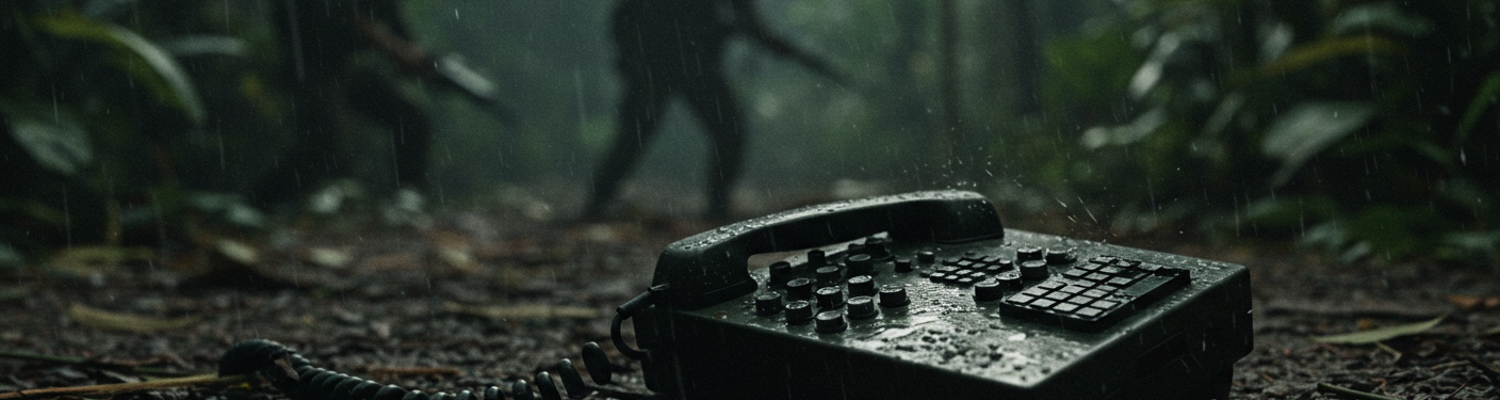
Operational logs for Dagger Thrust IV reveal the immediate failure of tactical communications once Battalion Landing Team 2/1 made its assault in November 1965. For the radio-telephone operator, the AN/PRC-25 was both a lifeline and a 25-pound burden. Its reliance on line-of-sight VHF transmission proved a major vulnerability in the dense jungles and rolling hills of Quang Ngai province. The moment platoons moved off the landing zones and into the vegetation, the company radio net began to degrade into static and broken signals. The humid, salt-heavy air of the coastal operation infiltrated the one known weak component of the radio: the handset. RTOs found their transmissions garbled. The terrain itself absorbed and scattered the low-power 1.5-watt output, reducing a five-kilometer range to less than a few hundred meters. For a platoon commander trying to report his position, his unit was electronically isolated.
This isolation had immediate tactical consequences, most significantly in the delay and prevention of supporting arms. The operational concept of a Battalion Landing Team was predicated on its ability to project firepower far beyond its organic weapons. Naval gunfire and close air support provided the decisive edge. Yet, this system depended on the man on the ground with the radio. With the tactical net degraded, forward observers attached to the rifle platoons were unable to transmit their calls for fire to the Battalion Fire Support Coordination Center. A platoon pinned down by a machine-gun nest and attempting to transmit a grid coordinate for an artillery strike would be met with nothing but static. The process became an exercise in futility. The inability to communicate meant that platoon and company commanders could not effectively coordinate their own movements, leading to units halting their advance or becoming separated. The speed of the amphibious assault dissipated into confusion.
This breakdown culminated in the isolation of the forward-most Marine units. An examination of after-action reports from the period repeatedly highlights the psychological impact of this severed connection. A platoon taking casualties was not just in a firefight; it was fighting alone. Standard operating procedure for casualty evacuation, the 9-Line MEDEVAC request, was impossible without a functioning radio. Wounded Marines could not be evacuated. The RTO, whose three-foot whip antenna already made him a priority target, would fight to get a signal out, climbing onto dikes or into open clearings, further exposing himself. Compounding this technical failure was the emerging threat of enemy electronic warfare. Viet Cong and NVA units had become adept at monitoring unencrypted US radio traffic, using the intelligence to set ambushes. They also employed jamming techniques, flooding frequencies with noise at critical moments. The loss of communications transformed technologically superior Marine units into isolated pockets of infantry, stripped of their support.
MEDEVAC Communication Breakdown
III MAF’s amphibious raids in late 1965 reveal a divergence between medical evacuation doctrine and the conditions faced by engaged Marine rifle companies. The doctrinal promise of helicopter evacuation, known as Dustoff, aimed to get a wounded man from the battlefield to a surgical facility within an hour. This process hinged on a clear and timely 9-Line MEDEVAC request sent over a tactical radio. For units like Battalion Landing Team 2/1 during the Dagger Thrust operations, this link was broken almost as soon as the assault began. The AN/PRC-25 radio had a handset vulnerable to the wet, saline conditions of coastal Vietnam, frequently garbling transmissions. More fundamentally, the radio’s low-power, line-of-sight FM signal was absorbed and scattered by the dense jungle and rolling terrain, shrinking its effective range from miles to hundreds of meters. A platoon pinned down and taking casualties found its requests for a UH-1 Huey helicopter lost in static. The doctrinal 40-minute response became a fiction. The wait stretched into hours.
After-action reports from the period point to a tactic employed by Viet Cong and NVA signal units: the use of captured American radios to sow chaos. These enemy operators would monitor Marine frequencies, learning call signs and procedures, and then inject themselves into the net at moments of crisis. A valid MEDEVAC call transmitted by a desperate RTO might be followed by a second, seemingly authentic transmission from a ghost station canceling the request or, more sinisterly, reporting the designated landing zone as under intense fire. This forced difficult decisions upon the helicopter crews and their commanders. An attempt to land in a hot LZ risked the loss of the aircraft and its crew, yet ignoring a call could mean condemning wounded Marines to death. This electronic deception created a layer of distrust. Pilots, unable to verify a call's authenticity, would be forced to circle, demanding authentication through smoke signals or other visual means, all while the clock ticked down for the casualties on the ground.
The direct result of these communication failures was the breakdown of field triage capacity. A Marine company’s medical section, typically led by a handful of Navy Corpsmen, was designed for immediate stabilization, not prolonged care. Their job was to stop bleeding, apply battle dressings, administer morphine, and get the patient onto a helicopter. When the helicopters did not come, the company command post or a secured clearing became an overflowing ward. A single Corpsman, intended to treat one casualty before evacuation, would suddenly find himself responsible for five, then ten wounded Marines, many with grievous injuries requiring urgent surgery. Supplies of plasma, bandages, and morphine dwindled. The triage system, which prioritized casualties based on the urgency of their need for evacuation, collapsed. Men designated as Urgent, who had a chance of survival only with immediate surgical intervention, were now left to wait. This backlog of casualties physically and psychologically paralyzed the combat unit, turning a command post into a static aid station and nullifying the mobility that was the basis of the Dagger Thrust doctrine.
Improvised Field Triage Conditions
Eyewitness testimony from November 1965 reveals the disintegration of doctrinal medical procedure. For the Navy Corpsmen attached to Battalion Landing Team 2/1, the company command post or any depression in the earth, a bomb crater, a drainage ditch, the lee side of a paddy dike, became a de facto surgical ward. These were casualty collection points, established under fire and staffed by one or two Corpsmen suddenly responsible for a dozen or more wounded Marines. The medical training these men received revolved around rapid stabilization for helicopter evacuation. They were equipped to stop bleeding, administer morphine from single-use Syrettes, and perhaps start an IV before the patient was lifted out. When medevac helicopters failed to arrive, this role inverted. Corpsmen were forced to perform prolonged care for which they were neither trained nor equipped, attempting to keep men with massive trauma alive for hours instead of minutes.
Conditions were appalling.
There were no sterile environments, no running water, and no protection from the elements or incoming fire. Wounded Marines lay on muddy ground or sodden ponchos, often close to the command group’s radios, which drew enemy mortar and machine-gun fire. The concept of a field hospital was a fiction for the rifle platoons in combat. Those facilities were miles away, inaccessible without the helicopters that could not be contacted. For the wounded, this meant a wait in the heat and mud, their initial field dressings becoming soaked with blood and dirt. The psychological effect was significant. Men with survivable wounds understood that their chances diminished with every passing hour, their fate tied not to the skill of the Corpsman beside them, but to a broken radio link. This turned a tactical operation into a vigil, with combat effectiveness decreasing as more men were pulled from the line to guard and assist the growing population of casualties.
This situation was made worse by the finite nature of medical supplies. A Navy Corpsman carried what he could fit into his M3 medical kit bag: a few dozen battle dressings, a limited supply of morphine, and perhaps two units of plasma. This was intended as a bridge to get a handful of casualties to a surgeon. When the number of wounded climbed past ten, these supplies were exhausted almost immediately. Accounts speak of Corpsmen running out of morphine Syrettes, leaving men to endure pain. Dressings were used up, forcing medics to apply ponchos or torn uniforms directly to wounds to control hemorrhage. The glass bottles used to hold plasma were fragile and often shattered during rough handling in a firefight. With no possibility of resupply due to the communications blackout, every spent bandage and used needle was a permanent loss.
Psychological Impact on Marines
After-action reports and personal accounts from November 1965 reveal the trauma inflicted upon the enlisted Marines of Battalion Landing Team 2/1, a trauma born not just from combat, but from the systemic collapse of the doctrine meant to protect them. The sensory experience of a firefight in Quang Ngai province was one of chaos. The world for the individual rifleman shrank to the mud in front of his face and the percussive blasts of automatic weapons and mortars. Visibility was often reduced to a few feet by dense foliage, meaning the enemy was an unseen source of fire. The noise was a disorienting wall of sound: the crack of AK-47s, the heavier thump of M-60 machine guns, and the screams of the wounded. This sensory overload created a state of extreme mental fatigue and anxiety. It was in this environment of fear and confusion that the technological lifelines failed.
For a Marine wounded during Dagger Thrust IV, the physical agony of his injury was compounded by a mental anguish: the loss of hope. The promise of a swift MEDEVAC was a core tenet of morale. The communications breakdown shattered that promise. As minutes turned into hours, the casualty collection points became scenes of desperation. Corpsmen, having exhausted their morphine and plasma, could do little more than offer comfort as they watched men with survivable injuries deteriorate. This spectacle had a severe effect on the unwounded Marines forced to stand guard over their dying friends. The inability to evacuate the wounded paralyzed units, pinning them in place and turning a dynamic assault into a static defense of a makeshift graveyard. This helplessness eroded the belief that the system would take care of them, replacing it with a cynical understanding that survival was a matter of luck. Studies of veterans would later confirm that a feeling of abandonment on the battlefield, when expected support never arrived, was a significant factor in long-term psychological distress.
This reality was captured with clarity by the civilian and military correspondents documenting the war. Photographers like Horst Faas of the Associated Press and Larry Burrows of LIFE magazine, both active in Vietnam during 1965, specialized in documenting the human cost of these operations. Their images did not focus on grand strategy but on the faces of the enlisted men. A photo essay by Burrows from March 1965, titled 'One Ride With Yankee Papa 13', chronicled a helicopter mission gone wrong, capturing the intensity of combat and the emotional toll on the crew. Though from a different operation, the scenes were identical to those in Dagger Thrust: young men, their faces etched with shock and grief, surrounded by the bloody aftermath of a firefight. Faas, who won a Pulitzer Prize in 1965 for his combat photography, made it his mission to record the suffering of both Americans and Vietnamese. These correspondents provided an external, documented witness to the terror and despair that after-action reports could only sanitize with clinical language.
Operational Lessons and Aftermath
Operational records following the Dagger Thrust raids reveal an immediate analysis of the communication failures that crippled Battalion Landing Team 2/1. The primary culprit was the AN/PRC-25 radio system. Its vulnerabilities were exposed by the environment of coastal Vietnam. The handset was susceptible to moisture, and the humid, salt-saturated air of the Quang Ngai operational area caused widespread malfunctions, garbling transmissions. This mechanical failure was compounded by the physical limitations of its low-power VHF signal, which required a direct line of sight. The dense jungle and rolling hills scattered and absorbed the radio waves, slashing the doctrinal five-kilometer range to less than a few hundred meters. For platoons that had moved inland from the beaches, the result was near-total electronic isolation. These failures directly led III MAF to identify a need for procedural and technical solutions. The immediate, informal response involved RTOs attempting to waterproof their handsets with plastic wrapping from battery packs, a field improvisation. The formal response began a slow process of doctrinal re-evaluation.
The experiences of late 1965 forced a confrontation with the threat of Viet Cong electronic warfare, compelling the Marine Corps to develop and implement counter-jamming and communications security strategies. Prior to this, a belief existed among some commanders that the enemy was too unsophisticated to exploit American radio traffic. Operations like Dagger Thrust IV shattered this assumption. In response, a greater emphasis was placed on radio discipline. Paper-based authentication tables and periodically changing call signs, which had often been ignored as too cumbersome, were enforced with new urgency. This was a stopgap measure. The true solution required new hardware. The U.S. military accelerated the development of voice encryption systems, most notably the NESTOR family of devices, such as the KY-38, which could be attached to the PRC-25 and its successor, the AN/PRC-77. These devices encrypted conversations, making it impossible for enemy listeners to understand the content of transmissions. However, these early encryption systems came with their own drawbacks; they were heavy, reduced the radio’s range, and required perfect signal clarity to function, a rarity in the jungle. It was a trade-off between security and functionality, a problem that would not be solved until the fielding of frequency-hopping radios like SINCGARS decades later.
The most significant long-term effect was a fundamental shift in combat doctrine regarding MEDEVAC. The promise of a rapid helicopter evacuation, the 'Golden Hour' that improved survival rates, was shown to be entirely dependent on the communications link. The triage ordeal during Dagger Thrust IV demonstrated that a unit’s medical capacity could collapse completely without reliable radio contact. This led to doctrinal changes that prioritized communications redundancy. Acknowledging that a single RTO could be killed or his radio disabled, procedures were developed to ensure multiple Marines in a unit were trained in basic radio operation and the 9-Line MEDEVAC request format. Planners also began to more seriously consider the need for dedicated command and control and relay aircraft to orbit above operational areas, acting as a bridge between ground units and offshore support elements when line-of-sight was obstructed. The policy of only landing in 'green' LZs, which had sometimes delayed evacuations, was also re-evaluated, leading to a greater acceptance of risk by MEDEVAC crews to retrieve urgent casualties under fire.