
Signals Intelligence Intercept Operations at Camp Duc Lap
Chinook transport helicopters rattled across the central highlands to deliver heavy ammunition pallets, towed artillery pieces, and sensitive electronic intercept consoles onto the red clay airstrip. Ground crews unhooked the cargo slings beneath hot turbine exhaust, manhandling metal-cased receivers, backup batteries, and gasoline generators into reinforced earthen bunkers before the aircraft lifted away. A three-man signals intelligence team from the 403rd Radio Research Special Operations Detachment deployed to Camp Duc Lap alongside 5th Special Forces Group Detachment A-239 to assemble these monitoring stations. Green Berets and indigenous Montagnard strike forces guarded the perimeter wire while the communications specialists unloaded heavy AN/PRD-1 direction-finding equipment and sensitive radio receivers into an underground bunker reinforced with sandbags and oak timbers. Exhaust fumes from the camp power generators drifted into the trench lines while technicians adjusted the tuning dials and tested line voltage on their monitoring consoles.
Headphones plugged directly into those monitoring consoles converted incoming high-frequency signals into steady Morse code rhythms and raspy voice transmissions. The listening post occupied an isolated frontier outpost situated fourteen kilometers from the Cambodian border to monitor high-volume regional North Vietnamese Army radio networks. Antennas strung between split bamboo poles picked up military traffic moving across border sanctuaries where enemy regiments staged supply convoys and infantry battalions. Humid jungle air corroded wire connections and caused vacuum tubes to overheat inside the heavy receiver housings, forcing the operators to clean contact points with dry rags and solvent brushes. Enlisted intercept operators logged every transmitter frequency, call sign, and signal bearing into paper logbooks while sweat dripped across their clipboards in the unventilated dugout.
Logbook entries on those clipboards rapidly filled with plotted coordinates showing North Vietnamese Army mortar units and infantry regiments closing the distance toward the camp. Operators tracked the sudden shift in enemy radio discipline, noting when routine administrative broadcasts dropped into complete radio silence or switched into short burst transmissions. Artillery crews on the surface fired registration rounds into the surrounding tree line based on these direction-finding coordinates, shaking dirt loose from the bunker ceiling onto the radio operators below. Red dust sifted into the cooling vents of the signal receivers, threatening to short out electrical circuits that required constant airflow to avoid total failure. Technicians took turns blowing debris from the chassis with hand pumps while listening to enemy field radios coordinate infantry movement along the perimeter.
Receiver dials spun under calloused fingers as the operators tracked these enemy signals reaching peak intensity just before darkness fell. Enlisted operators passed handwritten target grids directly to the Special Forces detachment commander, who ordered counter-battery mortar fire and directed Montagnard machine gunners to pre-sighted defensive sectors. Explosive concussions from nearby trench lines rattled the solder joints on the direction-finding antenna arrays, requiring the three-man radio research team to crawl through shallow trenches to repair severed copper leads under heavy darkness. Gunfire erupted across the barbed-wire barriers as North Vietnamese reconnaissance teams tested the outer fences, pinning the technicians in the mud beside the command bunker. Operators returned to their consoles, loaded fresh paper into their notebooks, and dialed their receivers to the enemy commander frequency to track the final assault coordinates.
Decryption Operations and the PAVN 95C Offensive
Earpieces clamped tight against sweaty heads allowed the technicians to intercept and decrypt low-level enemy tactical communications tracking staging movements along border infiltration corridors in mid-August 1968. Pencil tips snapped under heavy pressure as the enlisted operators transcribed raw numeric codes that came across the static from North Vietnamese transmitter sites. Manual codebooks spread out across the wooden workbench allowed the team to break down enemy routing codes, identifying supply movements and artillery displacements through the jungle cover. Decoded cipher strings gradually revealed that North Vietnamese reconnaissance teams were passing target data on the camp water points, runway approaches, and mortar pits. Grease pencils marked each decrypted coordinate directly onto acetate overlays pinned to the dirt wall, exposing converging routes of enemy march columns pressing steadily closer from the western sanctuaries.
Radio operators matched the intercepted traffic against regional call-sign registers, identifying an imminent multi-regiment assault spearheaded by the People Army of Vietnam 95C Regiment. Decrypted operational orders indicated that heavy mortar teams, recoilless rifle squads, and sapper units were already positioning themselves in the dense vegetation around the perimeter. Technicians tracked the regiment command frequency as staff officers issued final movement instructions to three separate assault battalions preparing for a coordinated night strike. Exhausted specialists checked signal bearings with their AN/PRD-1 direction-finding consoles, verifying that the main enemy element had slipped past the border screen and halted barely three kilometers from the runway. Paper carbons of the enemy order of battle were stamped urgent and handed immediately to armed couriers waiting at the bunker blast curtain.
Detachment A-239 officers received these early intelligence alerts inside the camp command bunker and immediately altered their defensive posture. Warning sirens sounded through the outpost, giving Detachment A-239 and over six hundred indigenous Montagnard CIDG strikers critical hours to fortify perimeter fighting positions prior to the initial bombardment. Montagnard strikers shouldered heavy wooden crates of fragmentation grenades, mortar rounds, and linked machine-gun belts, hauling the supplies through narrow communication trenches to the outer berms. Steel entrenching tools chopped into the hard red soil as strikers cleared fields of fire and reinforced low earthen parapets with fresh timber beams and double-stacked sandbags. Special Forces sergeants inspected machine-gun bunkers along the southern fence, resetting firing stakes to ensure continuous interlocking grazing fire across the predicted enemy approach paths.
Claymore mines clicked into place across the cleared buffer zones as strikers connected electrical firing wires to detonator boxes inside the sandbagged firing pits. Barbed-wire entanglements received fresh concertina coils and tin cans on tripwires to snag sapper infiltrators attempting to breach the outer revetments in the darkness. Artillery crews at the camp howitzer pits elevated their barrels and pre-loaded high-explosive shells, locking the guns onto the exact staging coordinates decrypted by the radio research team. Infantrymen clamped their steel helmets down and took cover against trench walls as the first enemy ranging rockets flew through the low clouds above the airfield. Heavy mortar detonations threw clods of red earth across the defensive perimeter, slamming against sandbags that the defenders had reinforced only hours before the assault began.
Perimeter Breaches and Close Quarters Bunker Defense
Shrapnel tore through these freshly reinforced sandbags on August 23, 1968, as massive PAVN artillery and mortar barrages preceded infantry wave assaults that breached the camp outer concertina wire entanglements. Incoming high-explosive rounds struck the red clay berms at a rate of dozens of impacts every minute, collapsing fortified firing steps, crushing wooden revetments, and severing field-telephone wires across the outpost. Shockwaves from the bombardment detonated defensive Claymore mines prematurely, stripping away the camp mechanical early-warning screens and blanketing the defensive perimeter in blinding red soil. North Vietnamese sappers exploited the dust and darkness to push long bangalore torpedoes into the tangled wire barriers, detonating heavy clearance charges that opened wide pathways into the forward defensive sectors. Automatic weapon fire erupted through the gaps as enemy assault squads rushed forward, firing assault rifles and pitching satchel charges directly into the outer trench network. Blast waves from these close-range explosions traveled down the earthen access tunnels, blowing open the reinforced blast curtains of the subterranean listening post and throwing choking dirt over the electronic receivers.
Smoke filled the underground listening post as 403rd Radio Research operators abandoned fixed intercept positions to reinforce perimeter defenses against infiltrating sapper units. Technicians shoved sensitive codebooks and frequency charts into fireproof containers, cut power switches to prevent electrical fires, grabbed their M16 rifles and canvas bandoliers, and scrambled up the timber ladder into the open fighting trenches. Infiltrating North Vietnamese soldiers were already moving inside the inner perimeter fence, firing shoulder-launched rockets into command bunkers and tossing fragmentation grenades down open communication trenches. Radio operators joined Green Beret sergeants and Montagnard strikers along a shattered secondary berm, leaning across torn sandbags to engage enemy skirmishers at point-blank range through dense clouds of burning cordite. Rifle barrels grew scalding hot under continuous fire as the defenders pinned down a sapper squad trying to place heavy demolition charges against the camp ammunition depot. Green Beret leaders shouted through the din for immediate heavy fire support to halt fresh enemy waves gathering at the severed wire, pointing the radio research soldiers toward an exposed mortar pit near the central bunker.
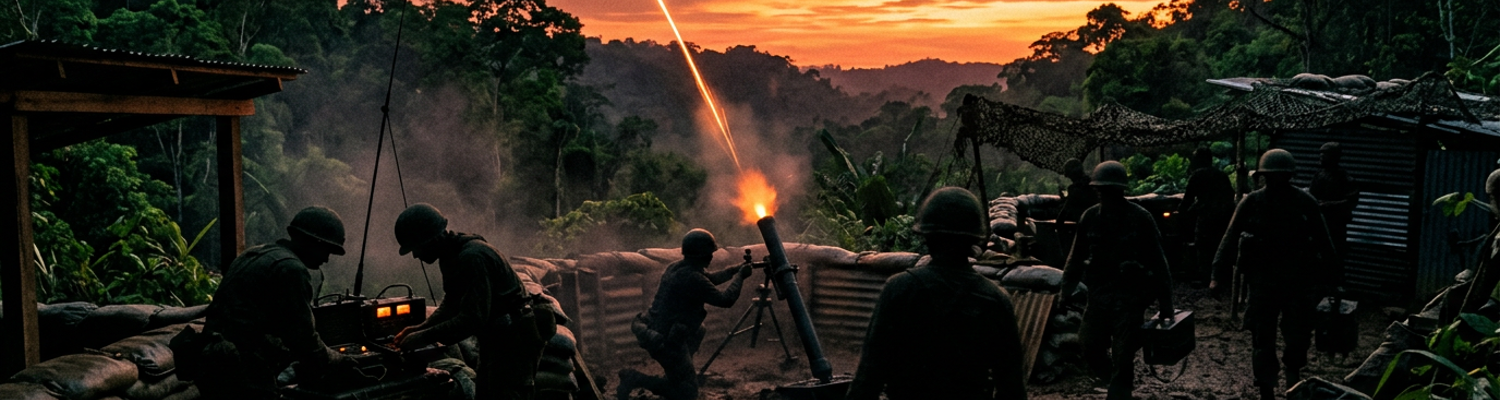
Infantry waves charged toward the inner gaps while SIGINT soldiers sustained rapid fire from an 81mm mortar tube, cooling the overheated weapon with canteen water to repel repeated assaults on the wire. High-explosive mortar shells slid down the smoking steel barrel with steady metallic clangs, detonating seconds later across the torn concertina fences where enemy riflemen were clustering for another push. Blistering heat scorched the hands of the loaders through their canvas work gloves, causing the olive-drab paint on the mortar casing to bubble and blister as canteen water splashed over the steel and hissed violently into thick clouds of white steam. Steam and sulfur fumes stung the eyes of the intelligence soldiers as they dropped round after round into the tube, maintaining maximum elevation to drop lethal fragmentation directly onto the enemy penetration points barely seventy meters away. Shrapnel from these continuous mortar bursts shredded the advancing assault squads, breaking up the momentum of the infiltration and driving surviving sappers back into the smoking craters outside the wire. Montagnard machine gunners poured interlocking grazing fire across the cleared kill zones to lock down the breach, allowing the surviving defenders to secure the inner trench line before daylight broke over the highlands.
Emergency Communications and Low Level Air Support Guidance
Detachment A-239 radio operators discovered that incoming explosive concussions severed fixed antenna masts and knocked out standard doctrinal very-high-frequency and high-frequency communication links across the outpost as soon as the inner trench line was secured. Heavy artillery shells had shattered the aluminum antenna towers, leaving severed coaxial lines whipping through the wind and dangling uselessly over the bunker walls. Detachment commanders had no way to alert rear headquarters at Ban Me Thuot about the massed battalions pressing against the southern fences. Static filled the underground shelter as operators flipped backup switches on the primary consoles, but the severed roof leads grounded the circuits and burned out several monitoring relays. Enlisted radio specialists immediately hauled coils of black WD-1 telephone wire from wooden storage bins to build an emergency antenna array before PAVN assault squads organized another push.
Operators exposed themselves to direct machine-gun fire to string improvised field wire antennas across sandbagged parapets along the camp highest defensive revetment. Enemy riflemen entrenched in the outer wire directed heavy bursts of automatic fire at the sandbag crests as soon as the soldiers pushed their heads above the berm. One communications technician used a heavy combat knife to strip the plastic sheathing from the copper strands, while two others crawled on their stomachs to lash the wire to splintered timber supports and empty ammunition crates. Ricocheting bullets tore open sandbags around their shoulders, spraying grit and red Highland soil into their faces as they spliced the makeshift feed lines together. The team secured forty yards of exposed wire horizontally across the earthen embankment, connected the stripped copper leads to an auxiliary adapter, and dropped back down the timber ladder into the command bunker.
Defenders relied on handheld tactical VHF radios and emergency signal mirrors to vector low-altitude airstrikes directly onto perimeter breaches after returning to the fortified command shelter. Forward air controllers flying low over the jungle canopy struggled to locate friendly positions through dense layers of burning cordite, red dust, and morning ground fog. Special Forces sergeants climbed back to the bunker roof, angled small glass emergency mirrors toward the aircraft engine sounds, and flashed rhythmic sunlight pulses through breaks in the smoke. Pilots in orbiting Douglas A-1 Skyraiders spotted the sharp flashes reflecting off the observation parapet and acknowledged the camp handheld VHF transmissions. Ground controllers radioed exact distance corrections from the flashing mirror position, guiding the attack planes to deliver ordnance fifty yards beyond the inner concertina wire where North Vietnamese infantry were massing for a fresh charge.
Skyraiders dove through the cloud ceiling in single-file runs, releasing napalm canisters and heavy fragmentation bombs directly into the occupied outer trenches. Burning liquid fuel spread across the collapsed barbed wire, igniting enemy weapon caches and closing the primary gap in the southern perimeter. Shockwaves from the close air support rattled the camp command post and showered the radio operators with loose dirt, but the field-wire connection held firm against the blasts. Forward observers used their handheld transceivers to direct twenty-millimeter cannon fire along the edge of the runway, driving surviving PAVN assault squads back into the bamboo thickets. Green Beret team leaders and Montagnard strikers advanced through the smoke to secure the outer parapet, setting up fresh machine-gun positions along the charred earthen berm.
Field Trauma Care and Subterranean Compound Defense
Litter teams carried dozens of wounded fighters down from the smoking parapet and into the underground complex as enemy mortar rounds continued to pound the interior runway. Sandbagged radio bunkers were converted into frontline casualty collection points to treat severe blast trauma and penetrating shrapnel wounds after artillery fire destroyed the outpost dispensary. Communications technicians swept classified codebooks and frequency charts into metal bins to clear flat workbench space for blood-soaked stretchers. Heavy canvas litters crowded the narrow earthen aisles between glowing receiver consoles, forcing soldiers to squeeze past racks of hot vacuum tubes as they delivered fresh supplies of field dressings. Battery-powered lamps threw harsh yellow light across torn flesh, exposed muscle tissue, and shattered limbs while medics applied tourniquets to stop arterial bleeding. Dust cascaded from overhead ceiling timbers with every incoming shell impact, coating open chest lacerations and puncture wounds in gritty red highland soil.
Saline bottles hung from splintered timber supports directly above the radio benches as the volume of casualties rapidly overwhelmed the two surviving Green Beret medics. Cross-trained signals personnel assisted Green Beret medical specialists in stabilizing wounded Montagnard strikers while simultaneously managing tactical defense nets. Technicians applied direct pressure to severed arteries and packed sucking chest wounds with petroleum gauze using their bare hands while clutching radio handset microphones under their chins. Operators shouted coordinates into their tactical transceivers, relaying urgent calls for medical evacuation and warning perimeter bunkers about enemy infiltrators between applications of intravenous fluids. Blood pooled across the dirt floorboards and spattered the dials of direction-finding receivers, but the intelligence specialists kept their headsets clamped down to coordinate defensive mortar strikes and track shifting PAVN assault columns. Gunship pilots received continuous firing adjustments directly from these underground consoles, placing twenty-millimeter cannon bursts and high-explosive rockets within throwing distance of the outer bunker revetments.
Sappers from surviving North Vietnamese assault squads took advantage of the smoke from these airstrikes to crawl into the communication trenches and reach the bunker exterior blast curtains. Infiltrating soldiers hurled heavy canvas demolition blocks into the stairwell, attempting to blast through the reinforced oak entry door. Enlisted technicians dropped their medical supplies, grabbed automatic rifles, and took up firing positions behind sandbag barricades at the bottom of the stairway. Concussion blasts from these point-blank explosions blew out the interior electric lamps, showered the wounded with dirt and timber splinters, and set fire to wooden storage crates in the entryway. Defenders returned fire through the dense cordite fumes, emptying rifle magazines up the access shaft and throwing fragmentation grenades to prevent sappers from tossing additional charges into the room. Rifle barrels burned hot as the operators and walking wounded held the narrow passage against repeated attempts by enemy squads to breach the doorway.
Personnel defended the subterranean communications bunker against point-blank satchel charges until relieving forces broke the siege. Counterattacking squads of American infantry and indigenous Mike Force reinforcements air-assaulted into landing zones outside the perimeter wire, fighting their way through the shattered southern trenches. Friendly heavy machine guns suppressed enemy firing pits along the runway, cutting off PAVN withdrawal routes and clearing sappers from the roofs of the command bunkers. Relieving troops reached the underground bunker entrance, cleared the smoking trench lines of remaining hostile riflemen, and secured the blast curtains. Radio operators inside the shelter unplugged tactical defense nets, laid down their weapons, and began carrying surviving casualties up the damaged stairway toward waiting evacuation helicopters on the airstrip. Flight medics loaded the wounded Montagnard fighters onto transport aircraft under the cover of orbiting gunships as ground commanders regrouped along the fortified perimeter.