
Chu Lai Operations and Marine Phantom Deployments
A Marine avionics technician knelt on the vibrating aluminum runway at Chu Lai. He steadied a torque wrench against the radar access panel of an F-4B Phantom II. Salt spray blew directly off the South China Sea. This wind coated his greasy knuckles and the exposed waveguide connectors of the AN/APQ-72 radar system with a fine paste of quartz sand. He cinched a stainless-steel safety wire through the housing bolts. He twisted it six times and snipped the excess with wire cutters. Any gap in the rubber environmental seal allowed the monsoon damp to seep directly into the high-voltage power supply of the radar receiver.
Dust infiltrated every hydraulic seal on the flight line.
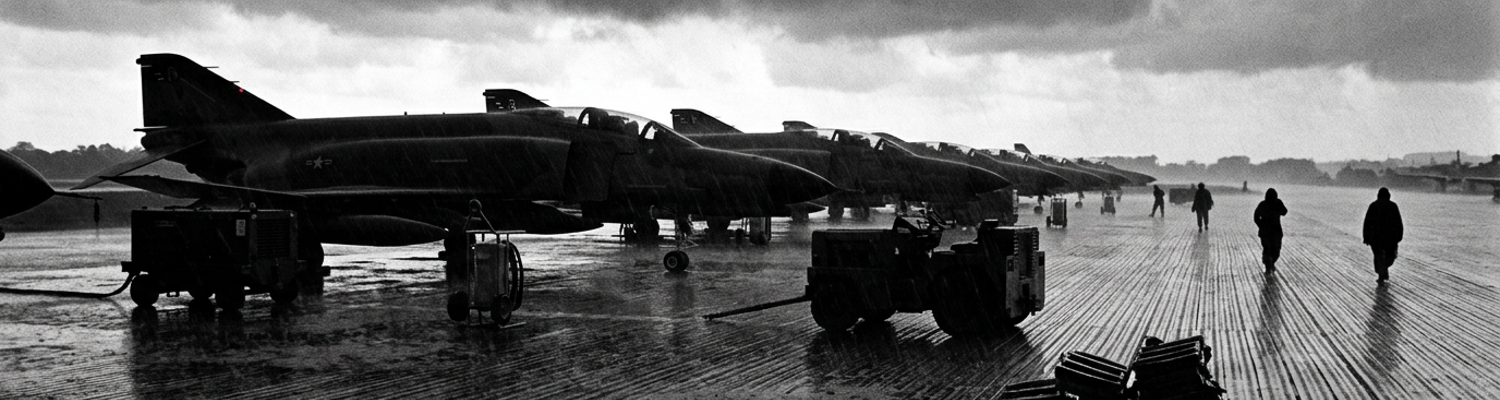
Archival evidence shows that in January 1967 Marine Fighter Attack Squadron 323 operated F-4B Phantom II aircraft from the expeditionary airfield at Chu Lai Air Base. Marine Aircraft Group 13 stationed the unit on a narrow coastal shelf in Quang Tin Province. Their assignment required providing dedicated air support across the northern sectors of South Vietnam. Chu Lai operated under the Short Airfield for Tactical Support concept. This facility utilized eight thousand feet of interlocking AM-2 aluminum matting laid over stabilized beach sand. Each twin-jet Phantom weighed over fifty-four thousand pounds when loaded with fuel and weapons. The aircraft pounded the corrugated planks during rollout. This caused individual aluminum locking tabs to buckle under the strain. Flight line crews from VMFA-323 worked out of unpaved revetted bays without hangars. They stripped and rebuilt General Electric J79-GE-8 engines while monsoon rains flooded the drainage ditches around the dispersal pads.
Supply ships failed to deliver replacement drop tanks for twelve consecutive days.
A close review of operational logs indicates that the VMFA-323 Death Rattlers flew combat air patrols and interdiction missions targeting logistics routes north of the Demilitarized Zone. Ordnance crews routinely loaded the aircraft with six 500-pound Mark 82 bombs on triple ejector racks. Four AIM-7D/E Sparrow radar-guided missiles nested within the fuselage wells. Pilots launched into low-overcast cloud decks to strike truck staging areas along Route 103 and the coastal highway Route 1A. They searched for North Vietnamese supply convoys moving south toward the DMZ. Defensive counter-air tasks ran day and night. Elements established barrier combat air patrols between Dong Hoi and Tiger Island. Their objective involved intercepting North Vietnamese MiG-17 and MiG-21 fighters staging out of southern North Vietnamese airfields. The squadron burned jet fuel at rates exceeding seven thousand pounds per hour per aircraft to sustain these northern sweeps.
Flight elements relied on short-field arresting gear and tactical air direction centers to maintain continuous combat air patrols over I Corps. The aluminum strip offered no safety margin for heavy jet operations. Every inbound F-4B dropped its tailhook to catch the cross-deck pendant of an M-21 arresting engine. Sometimes they caught the MOREST cable system stretched across the runway threshold. Snagging the wire jerked the thirty-ton airframe to a dead stop within several hundred feet. This exerted severe metal fatigue on the arresting hook attachment bulkheads. Overhead control belonged to the Tactical Air Direction Center at Da Nang and tactical air direction elements stationed with Marine Air Control Squadron 4 at Chu Lai. Operators tracking radar returns on AN/TPS-34 displays manually plotted Phantom positions. They radioed heading adjustments to guide pilots through poor weather. They vectored them toward unidentified contacts and monitored fuel states to cycle relief sections over the patrol sectors.
Corrosion inside the antenna waveguides altered the radar sweep frequencies before the pilots even reached their designated holding stacks.
Divided Datalinks Between Marine and Air Force Command
Archival evidence shows that Marine Tactical Data System installations at Chu Lai managed local tactical air control units independently of Seventh Air Force command structures. Marine Air Control Squadron 4 operated trailer-mounted AN/TYQ-2 systems equipped with CP-288 digital computers inside the air-conditioned shelter of the Tactical Air Operations Central. First Marine Aircraft Wing retained direct operational command over combat assets in I Corps. They refused to subordinate their interceptors to the Air Force Tactical Air Control Center at Tan Son Nhut. The Chu Lai installation processed raw signals directly from local AN/TPS-34 three-dimensional radars and coastal AN/TPS-22 sets. This fed target data into digital cathode-ray displays without routing tracks through the Air Force control post at Monkey Mountain. Marine intercept officers assigned combat air patrol positions along the 17th parallel based entirely on their own autonomous radar sweeps. Air Force planners under General William Momyer demanded a centralized single-manager system for all tactical aviation across South Vietnam. Marine command maintained physical firewalls between their communication lines and external Air Force switching centers.
Patch cables severed automated data sharing between the services.
A close review of operational logs indicates that Seventh Air Force EC-121 College Eye aircraft provided airborne radar tracking. These assets suffered recurring handoff latencies with ground-based Marine controllers. These converted Lockheed Super Constellations rotated out of Ubon Royal Thai Air Force Base and circled over the Gulf of Tonkin. They utilized belly-mounted AN/APS-95 search radars to detect low-flying North Vietnamese aircraft skimming over the karst ridges around Vinh. EC-121 radar crews tracked returns across high-frequency voice circuits. They manually read coordinates to ground listening posts. Atmospheric static over the South China Sea broke voice transmissions. This forced airborne radar operators to repeat phonetic coordinate blocks two or three times over open UHF channels. The lag between an EC-121 sweeping a target at twenty thousand feet and a Chu Lai Marine controller transcribing the latitude and longitude onto a manual plotting table frequently exceeded one hundred and twenty seconds. A MiG-21 cruising at Mach 1.4 covered nearly thirty miles in that two-minute window.
Coordinates arrived too late to warn outbound Marine sections.
Inter-service architectural differences in tactical display generation produced persistent track desynchronization and dual-track designations. Marine AN/TYQ-2 processors rendered radar tracks along local Cartesian X-Y grid coordinates centered directly on the Chu Lai radar antenna. Air Force control facilities and College Eye crews mapped targets according to the World Geographic Reference System. They converted positional data through alternate mathematical projections. Marine operators manually keyed incoming Air Force track reports into the CP-288 computer buffer. The software algorithms failed to correlate the external voice-reported coordinates with existing radar returns generated by local AN/TPS-34 sensors. The system registered the single physical aircraft twice. It painted two separate green blips traveling along divergent trajectories on the display scope. Marine intercept controllers at Chu Lai issued conflicting radio vectors to VMFA-323 sections. They sent Phantoms hunting an empty patch of sky while the real target slipped through an unmonitored radar corridor.
Track sixty-four split into two false vectors forty miles northeast of Dong Hoi.
North Vietnamese Ground-Controlled Intercept Threats
Archival evidence shows that North Vietnamese integrated air defense networks utilized Soviet-supplied radar stations north of the seventeenth parallel to track inbound Marine strike packages. The Vietnam People's Air Force operated P-12 Spoon Rest early warning radars operating in the VHF band deep within fortified bunker positions near Dong Hoi and Vinh Linh. They used these alongside P-35 Bar Lock microwave sets and PRV-11 Side Net height-finders. These sensors sat behind revetted earthworks along coastal bluffs at Cap Mui Lay just five miles north of the Ben Hai River. They swept southern airspaces across the Gulf of Tonkin. VMFA-323 F-4B Phantoms climbed through five thousand feet after takeoff from Chu Lai. Soviet-trained operators with the 290th Radar Regiment captured their radio emissions and skin returns. Technicians manually recorded Phantom headings, speeds, and altitudes onto back-lit transparent plexiglass plotting boards. They cross-referenced azimuth data from synchronized listening posts scattered along the Annamite Range. Landline telephone wires linked these radar bunkers directly to the central Air Defense Command headquarters outside Hanoi. This fed precise intercept coordinates down to regional command posts in Sector 4 within seconds of detection.
Soviet radar pulses swept the coastal approach corridors every six seconds.
A close review of operational logs indicates that Communist ground-controlled intercept operators cued MiG-17 and MiG-21 fighters using tracking gaps on the periphery of allied radar sweeps. Ground controllers attached to the 921st Sao Do and 923rd Yen The Fighter Regiments studied the line-of-sight limitations of the Marine AN/TPS-34 radar at Chu Lai and the Seventh Air Force installation atop Monkey Mountain. Heavy terrain masking generated by the karst topography west of Route 1 caused allied radar beams to diffract. This created expansive shadow corridors extending north toward Quang Khe. Ground-controlled intercept officers exploited these dead zones. They instructed MiG-21 pilots scrambling from Kep or Phuc Yen to stage forward into southern staging strips like Yen Bai and Dong Hoi under complete radio silence. Vietnamese interceptors stayed below radar sightlines until they reached the outer fringes of the allied sweep patterns. They were guided solely by discrete, high-frequency ground-vector signals broadcast over coded single-channel transceivers. American strike sections wandered into peripheral gaps where low-altitude radar returns dissolved into coastal sea clutter. North Vietnamese controllers directed their fighters into high-speed climbing turns behind the blind Marine formations.
Shadow zones in Allied radar coverage hid inbound interceptors until cannons fired.
Allied aircrews operating near the Demilitarized Zone faced increased surface-to-air missile guidance locks when wandering outside tactical radar coverage envelopes. The 367th Air Defense Division shifted multiple SA-2 Guideline missile battalions southward into disguised firing pits along the northern perimeter of the DMZ near Vinh Moc. North Vietnamese forces designated this the V-750 Dvina system. Each battery relied on an SNR-75 Fan Song radar trailer emitting pulse tracks at C-band and S-band frequencies to guide twenty-foot missiles toward incoming aircraft. Marine Phantoms drifted west of designated air safety corridors to avoid flak batteries near Tiger Island. They slipped completely out of real-time datalink contact with Chu Lai control shelters. Deprived of early warning vectoring from land-based radar operators, VMFA-323 crews received no tactical alert when Fan Song fire-direction radars transitioned from broad sector-acquisition searches into continuous-wave tracking locks. Cockpit APR-25 radar-warning receivers lit up solid azimuth warnings across all threat quadrants simultaneously. This indicated that a missile was already climbing off its launcher on an intercept trajectory.
Fan Song tracking beams locked onto Marine targets without generating warning coordinates at Chu Lai.
Tactical Recalibration of UHF Crypto and Transponders
Archival evidence shows that technicians with Marine Aircraft Group 13 initiated an emergency field modification of KY-28 secure voice equipment inside the avionics maintenance huts at Chu Lai during late January 1967. Signals intelligence reports from the Naval Security Group detachment at Danang confirmed that North Vietnamese communications intercept stations along the DMZ were intercepting open-channel UHF tactical air directives between VMFA-323 Phantoms and ground controllers. The KY-28 Nestor unit sat in the rear fuselage compartment behind the radar intercept officer's seat. It suffered from severe voice distortion and chronic overheating in the tropical heat of Quang Tin Province. Squadron radio specialists sought to deny intercept data to the 47th Communications Regiment of the People's Army of Vietnam. They bypassed factory-set frequency stepping relays inside the T-368 UHF transmitter integration harness. Technicians physically resoldered terminal boards to lock speech-security encryption matrices onto narrow band shifts. This altered the crypto key schedule across the squadron's tactical push-buttons. Ground mechanics swapped out internal crystal oscillators to prevent enemy radio direction-finding units at Hon La from tracking voice modulation anomalies. Flight crews were forced to toggle external encryption switches manually every fifteen minutes to stay inside the modified alignment patterns.
Resin fumes filled the corrugated tin work bays along the Chu Lai taxiway.
A close review of operational logs indicates that Chu Lai maintenance personnel simultaneously altered the timing pulse-spacing intervals of the airborne AN/APX-76 IFF interrogator sets. Under standard factory calibration, the APX-76 sent dual-pulse interrogation trains spaced precisely at three microseconds for Mode 1 and eight microseconds for Mode 2 through the radome antenna. Ground-based signal analysis units operated by the North Vietnamese 290th Radar Regiment near Dong Hoi utilized passive Soviet-built receiving equipment to isolate these fixed pulse gaps. They calculated the position and flight paths of American strike aircraft without ever radiating an active radar signal. Marine radar repairmen opened the RT-859 chassis on the avionics test benches to defeat this exploitation. They manually adjusted the internal delay-line potentiometers. Technicians widened the P1-to-P3 pulse-spacing intervals by fractions of a microsecond. They attempted to scramble the electronic footprint of the interrogator return before outbound Phantoms crossed north of the 17th parallel. This physical adjustment altered the pulse rise-time across the radio frequency modulator. It generated unstable side-lobe suppressions.
Every altered transmitter chassis returned directly to the flight line without diagnostic thermal cycling.
These hurried hardware alterations completely bypassed Naval Air Systems Command depot validation protocols across the Chu Lai workshops. Standard naval aviation operating instructions (NAVAIR Instruction 3120.1) required any modification of encrypted communication equipment or friend-or-foe avionics to clear engineering review at the Naval Air Technical Services Facility. This had to happen before depot technicians at Marine Corps Air Station Cherry Point or Naval Air Station Alameda issued authorized service bulletins. Marine Aircraft Group 13 ignored the mandatory six-month laboratory evaluation process to field an immediate tactical countermeasure. Squadron technicians lacked precision calibration signal generators. They relied instead on worn AN/USM-140 oscilloscopes and hand-cranked field test sets operating on fluctuating generator power inside makeshift plywood shelters. Impedance mismatches between the altered APX-76 interrogator units and the factory-standard AN/APX-72 transponders produced signal attenuation rates exceeding forty percent across the UHF spectrum. The improvised pin jumpers inside the KY-28 crypto enclosures created parasitic capacitance. This destabilized channel synchronization whenever the aircraft cockpit environmental control systems pumped cold air into the forward avionics bay.
Inspection stamps on the yellow maintenance tags recorded only the word field-modified.
Electronic Shadowing and Datalink Isolation
Archival evidence shows that the field-modified pulse intervals and altered crypto matrices immediately crippled transponder handshakes across the northern combat zone. VMFA-323 Phantoms climbed out of Chu Lai. Their AN/APX-72 transponders transmitted response trains featuring the widened microsecond delays introduced by squadron technicians. Ground-based AN/TPS-34 interrogators at Marine Air Control Squadron 4 and Navy shipboard radars aboard guided-missile cruisers in the Tonkin Gulf failed to match the incoming pulses against standard Mode 2 and Mode 3/A decoding gates. The receivers rejected the signals as atmospheric interference or unassigned electronic noise. Surveillance consoles displayed intermittent unverified blips that dropped off every third antenna rotation instead of rendering steady target tags with precise altitude and squawk data. The KY-28 voice-encryption shifts compounded the tracking failure. Pilots engaged the secure speech toggle on their communications control panels. The modified crystal arrays threw the transmitters out of phase with Seventh Air Force relay stations at Monkey Mountain. Radar sweeps at the Tactical Air Direction Center at Da Nang could not correlate the distorted transponder returns with flight plan tracks. This created wide transponder blind spots whenever Phantoms turned away from the coastal sensor line.
Radar screens across I Corps showed empty airspace where two Marine strike flights were flying north.
A close review of operational logs indicates that EC-121 College Eye radar aircraft circling over the Gulf of Tonkin suffered a total loss of datalink continuity with VMFA-323 elements crossing the Ben Hai River. The modified electronics severed the automated track-sharing loop precisely as the Phantoms descended below five thousand feet to avoid surface-to-air missile batteries. The Ben Hai River marked the center of the Demilitarized Zone. It cut through an irregular terrain of steep ridgelines, limestone karst outcrops, and dense river valleys near Vinh Linh. The Marine jets banked into these terrain channels. The physical ground barriers blocked direct line-of-sight UHF paths to the orbiting EC-121 Constellations. The altered APX-76 and APX-72 units lacked the signal power to pierce this topographical interference. The airborne controllers lost passive tracking telemetry. Airborne intercept directors aboard College Eye saw Marine track symbols freeze and then dissolve from their AN/APS-95 radar scopes. Radio operators attempted to re-establish manual contact across primary tactical frequencies. The desynchronized KY-28 crypto units produced only screeching static bursts across the flight crews' headsets.
Flight leaders received no warning when North Vietnamese radar stations at Cap Mui Lay acquired their heading.
Marine aviators operating north of the river suffered persistent radar return blackouts alongside the collapse of their onboard situational awareness systems. Cockpit crews flying the F-4B relied on the AN/APQ-72 radar system. A radar intercept officer operated this from the rear seat. The altered transponder harness leaked radio frequency noise back into the main radar receiver waveguides whenever the interrogator cycled. Ground reflection bouncing off the razor-sharp karst formations east of the Annamite Range flooded the analog radar scopes with heavy electronic clutter. Internal receiver gain circuits drifted out of calibration. Sweep traces on the cockpit radar displays flickered and washed out completely. This left the radar intercept officers with blank cathode-ray scopes during critical intercept phases. The degradation stripped crews of any visual display indicating hostile aircraft or wingman positions within contested airspace. Pilots were forced to clear their tails using visual scans through rain-streaked cockpit canopies. Their threat warning panels pulsed continuously from unlocated radar sweeps.
The strike package crossed into Sector 4 with dead radar scopes and broken radios.
Near-Strike Incident Along the Ben Hai River
A six-man patrol from the 3rd Reconnaissance Battalion lay concealed beneath triple-canopy jungle three hundred yards south of the muddy banks of the Ben Hai River.
Archival evidence shows that the breakdown in automated datalinks caused radar operators at Chu Lai to lose track of two VMFA-323 Phantoms. The aircraft descended below four thousand feet over the southern buffer of the Demilitarized Zone. Flying through low stratus clouds over the coordinates YD 152-714, the flight lead spotted movement along a tree line flanking the river. He assumed it was a North Vietnamese staging position. Their modified AN/APX-72 transponders failed to paint friendly interrogation codes on local ground scopes. Tactical air controllers plotted the aircraft five miles east of their actual geographic position. The flight leader armed six 500-pound Mark 82 low-drag bombs. He lined up along a thirty-degree dive angle and aligned the optical gunsight directly over the canopy patch shielding the reconnaissance team. The flight crew treated the sector as a free-fire zone without active transponder identification or a functioning KY-28 encrypted link to confirm coordinates with ground stations. Dense foliage muffled jet engine noise until the twin J79 engines pushed past three hundred and fifty knots on the final bomb run.
Arming solenoids engaged across the wing pylons of both Phantoms.
A close review of operational logs indicates that ground controllers inside the Marine Air Control Squadron 4 operations shelter recognized the positional error during a routine cross-check with manual paper plots. A plotting specialist noticed that a field report from the 3rd Marine Division placed friendly callsign Boxcar Six directly under the dive vector of the inbound strike flight. The altered KY-28 encryption units prevented direct secure communication on the primary UHF strike frequency. Technicians scrambled across the shelter floor to patches on unencrypted line-of-sight VHF emergency channels. Controllers routed manual voice overrides through a forward radio relay station on Dong Ha Mountain. They shouted abort coordinates across open guard frequencies. Airborne forward air controllers operating an O-1 Bird Dog over the Cam Lo river basin heard the open-band transmission. They immediately fired high-intensity smoke markers into adjacent rice paddies to disrupt the attack heading. The radio directive crackled inside the Phantom cockpits less than four seconds before the flight lead hit the weapons release button. Both pilots yanked back on their flight control sticks. They pulled six positive Gs to break out of the dive without releasing ordnance.
The strike package pulled up into heavy overcast as unguided bomb fins remained locked to their ejector racks.
This near-disaster forced Seventh Air Force and Marine air command into immediate coordinated administrative reforms. General William Momyer demanded total integration of radar monitoring. First Marine Aircraft Wing commanders conceded that uncoordinated electronic alterations threatened Allied survival. Technicians dismantled the improvised pulse-delay potentiometers inside the AN/APX-76 interrogators. They re-established depot-level factory specs across every chassis at Chu Lai. Joint communications directives mandated that Seventh Air Force controllers at Monkey Mountain and Marine radar teams at MACS-4 utilize uniform Mode 2 and Mode 3 IFF cryptographic matrices. This ended autonomous squadron-level key schedules. Staff officers drafted binding radar handoff protocols. These required positive verbal readbacks and dual-sensor target verification before any combat element received clearance to drop ordnance within ten kilometers of the Demilitarized Zone. Marine air liaison officers received permanent assignment to the Air Force Tactical Air Control Center at Tan Son Nhut. They established round-the-clock telephone and teleprinter links with the Chu Lai tactical shelters.
Commanders signed the unified radar directive on February 14, 1967.