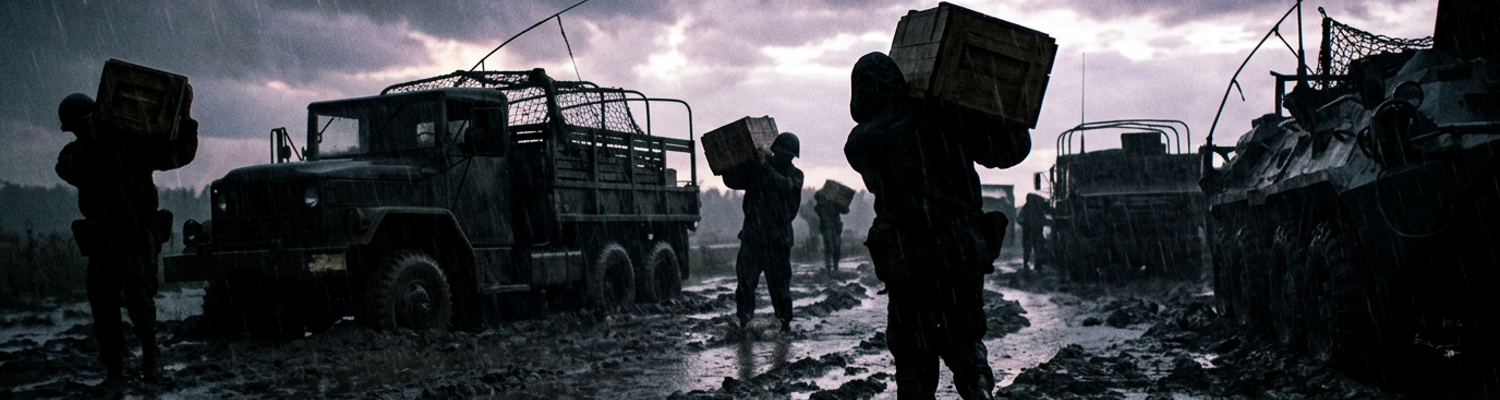

Fort Monmouth Doctrine and Topographical Disconnect
U.S. Army Field Manual 24-5 promised standard wire teams could lay, test, and secure five miles of communication line in under two hours. The manual assumed cleared, temperate combat sectors. On the eastern tip of Papua in late August 1942, four-man details from the 404th Signal Company required twelve grueling hours to drag a single copper loop through chest-deep mangrove silt. Japanese snipers watched the men sink.
The doctrine was written for New Jersey pastures.
Instructors at the Signal Corps School at Fort Monmouth constructed their curriculum around dry topography and predictable divisional movements. Doctrine required line crews to deploy W-110-B twisted-pair wire alongside established roads. They used motorized RL-31 cable reels mounted on the beds of standard quarter-ton trucks. Tactical guidelines set strict temporal quotas. Battalions had to tie into regiment-level switchboards within ninety minutes of establishing a defensive position. Circuits were anchored to fence posts, timber poles, or dry soil depressions. None of these mechanisms accounted for an absence of road networks between Gili Gili and the advance airstrip at No. 3 Strip. Monsoons deposited eighteen inches of rain across the bay in single forty-eight-hour windows. The clay paths disintegrated into impassable channels of brown mud. Transport trucks sank to their axles before offloading their reels. Signalmen had to shoulder forty-pound coils of heavy wire by hand. They waded through stagnant swamps where boots tore free from feet. Survey markers vanished under rising tidal water.
Dry ground did not exist.
Standard stateside defense layouts failed immediately against the Imperial Navy coastal thrust during the August 25 Japanese landing. Doctrine instructed signal sections to deploy linear trunk routes perpendicular to the shoreline. The assumption was that enemy forces would advance along surveyed inland avenues after conventional artillery preparations. Commander Shojiro Hayashi directed twelve hundred marines of the Kure 3rd Special Naval Landing Force directly into the bay aboard motorized barges. They struck the perimeter at Ahioma under heavy midnight squalls. Japanese Type 95 Ha-Go light tanks churned straight down the muddy coastal footpath. Heavy steel tracks severed the unburied American telephone lines strung along the track edge. Standard defensive protocol called for rapid line-repair patrols to retrace the severed wires under lantern light. Men moving out to splice the gaps walked straight into Japanese infantry wielding bayonets and submachine guns in the pitch darkness. By dawn on August 26, the Australian 61st Battalion and elements of the U.S. 43rd Engineer General Service Regiment found their communications completely severed. Forward observation posts went blind. Mortar rounds exploded across unmapped foxholes.
Every textbook wire splice became an ambush site.
Fort Monmouth classroom protocols completely ignored the chemical and mechanical destruction caused by continuous monsoonal saturation. Instructors trained technicians to service EE-8 field telephones and BD-71 six-line switchboards within clean staging tents. Standard canvas covers repelled ambient dust. At Milne Bay, the relative humidity hovered at ninety-eight percent. Mud infiltrated every latch and screw thread. The vulcanized rubber and braided cloth insulation wrapping the W-110-B field wire cracked. It absorbed standing swamp water. Massive electrical leakage bled voice signals into unintelligible static across distances as short as six hundred yards. Internal components of the SCR-284 radio sets fared no better. Moisture condensed inside the transmitter housings. Condensation corroded lead solder points. High-voltage capacitors detonated with sharp electrical cracks when operators engaged the hand-cranked generators. Technicians attempting emergency field repairs found their spare BA-30 dry-cell batteries bloated. The cells leaked corrosive potassium hydroxide. They were completely depleted of voltage before ever leaving their factory cartons. Frontline aid stations at Gili Gili treated wounded infantrymen under flickering kerosene lamps. Communication officers banged dead telephone receivers against sodden wooden crates.
W-110 Field Wire Failure in Silt
Standard U.S. Army W-110 field wire proved entirely unsuited for the tropical quagmire of eastern Papua. Between August 26 and August 29, torrential monsoonal downpours dumped more than twenty-two inches of rain across the narrow coastal shelf between Gili Gili and KB Mission. Established footpaths turned into channels of liquid mud. Signal detachments from the Australian 7th Brigade and the U.S. 404th Signal Company had strung miles of twisted-pair cable across low-lying coastal underbrush. They anchored lines to coconut trunks, saplings, and wooden pickets. The coastal flats flooded. The sheer weight of running water and shifting mud pulled these runs straight into the mire. Miles of deployed wire sank beneath two to four feet of corrosive, anaerobic alluvial silt. Rotting jungle peat and standing swamp water consumed the network. Mechanical drag from shifting silt deposits snapped improvised bamboo supports. Bren gun carriers and heavy supply trucks repeatedly churned through the submerged routes. They ground the wire deep into the clay subsoil.
The swamp buried the tactical network under tons of moving silt.
Standard W-110 wire possessed fatal structural vulnerabilities that rapid waterlogging instantly exposed (Signal Corps Technical Manual TM 11-333). Each conductor consisted of three strands of tinned copper for electrical conductivity twisted with four strands of galvanized steel for tensile strength. This core was wrapped in vulcanized rubber compound and encased in an asphaltum-impregnated cotton braid. Within forty-eight hours of full immersion in warm, acidic swamp water, the outer cotton braid rotted away. Silt grit abraded the softened rubber insulation. Ground water penetrated directly to the metal conductors. This saturation caused catastrophic dielectric breakdown and massive electrical leakage into the surrounding earth. Battery current from EE-8 field telephones drained directly into the mud before reaching forward positions. The conductive mud caused widespread signal cross-talk between parallel circuits laid along the coastal track. Artillery fire-direction lines bled into front-line infantry switchboards. Operators at Milne Force headquarters attempting to contact the 61st Battalion at Rabi heard only loud inductive hums. Overlapping distorted voices and unbroken static filled the receivers.
Every command circuit between the forward perimeter and rear artillery switchboards collapsed into dead ground loops.
The physical act of finding and repairing submerged breaks became a lethal assignment. Linemen could not locate severed wire breaks visually through three feet of opaque brown water. Two-man repair teams waded into chest-deep mangrove channels. They ran the submerged wire through bare hands to feel for tears in the casing. Troops from the Kure 3rd Special Naval Landing Force recognized the tactical value of these wire corridors. They used the cleared telephone tracks as primary axes of advance through the otherwise impenetrable sago swamps. Imperial snipers lashed themselves into the canopy of betel-nut and coconut palms directly above known line junctures. They shot linemen who stood upright to splice conductors with standard Western Union splices. At night, infiltration squads staked out severed lines. They waited in silence until repairmen clicked test handsets onto the bare copper. Japanese patrols struck these isolated repair parties with Type 96 light machine guns and bayonets in total darkness. Line crews died before they could report circuit status back to the switchboard at Gili Gili.
Repair details routinely discovered their predecessors dead in the mud.
They clutched half-soldered splices in stiff hands.
Atmospheric Ruin of SCR-284 Radios
Atmospheric exposure destroyed Allied radio systems long before enemy fire ever reached them. Signal detachments from the U.S. 404th Signal Company and the Australian 7th Brigade unloaded the SCR-284 radio system at No. 3 Strip. They expected reliable high-frequency voice and continuous-wave coverage across the coastal flats of Papua. Monsoonal squalls kept ambient humidity locked at a sustained one hundred percent between August 26 and August 31. The BC-654 transmitter-receiver units lacked hermetic rubber gaskets. Dense tropical vapor entered the sheet-metal chassis within minutes of uncrating. Condensation formed continuous films of conductive water across phenolic circuit boards. Terminal strips, bakelite transformer windings, and ceramic tube sockets soaked up the moisture. Radio technicians connected the 450-volt high-tension plate line from PE-103 dynamotors or GN-45 hand-cranks. This internal dampness triggered immediate dielectric breakdown. Electric arcs flashed across the pins of the 307A power amplifier tubes. The plate circuits burned out. The delicate filaments of the miniature 1T4 and 1R5 receiver tubes vaporized. Corrosion spread along bare copper wiring. Factory wax insulation broke down. Low-resistance short circuits grounded directly to the metal casing. Technicians burned through three complete replacement sets of vacuum tubes in seventy-two hours without transmitting an acknowledged signal.
Water shorted the circuits before operators could complete a frequency check.
Chemical degradation ruined the tactical power reserves. Operating elements deployed heavy lead-acid battery banks into open weapon pits to power vehicular dynamotors and portable receiver units. Standing groundwater quickly flooded these foxholes. Unsealed battery casings submerged in warm, acidic swamp runoff. Tropical fungi fed on the organic cellulose binders and animal glues sealing the hard-rubber battery cases. Thick fungal mats grew across the positive and negative posts. This biological growth created parasitic electrical bridges. Full charges drained within four hours. The inability to run gasoline-powered PE-210 charging units in waterlogged, fire-swept foxholes prevented routine recharges. Rapid chemical sulfation coated the lead plates with thick, non-conductive lead sulfate crystals. The electrochemical reaction became permanently inert. Infantrymen attempting to generate field emergency power with GN-45 hand-cranked generators found the crank housings flooded with coarse alluvial grit. Bronze reduction gears stripped as soon as two soldiers leaned onto the dual handles.
Submerged lead plates hardened into inert sulfur blocks within days.
The physical collapse of the SCR-284 sets produced total electronic silence along the tactical high-frequency spectrum. The entire frequency band between 3.8 and 5.8 megacycles went dead. Milne Force commander Major General Cyril Clowes sat isolated at his Gili Gili command post. He had no voice or continuous-wave telemetry from forward lines. Wet sago foliage physically grounded the whip antennas of the sets. Radio transmitters detuned. Radiated energy absorbed into the vegetation before signals could travel eight hundred yards. At Rabi and KB Mission, isolated companies of the 61st and 2/10th Battalions fought detached night engagements against the Kure 3rd Special Naval Landing Force without any electronic coordination. Forward observation officers could not establish link-ups with the 2/5th Field Regiment 25-pounder gun batteries situated along the shore. Calls for defensive barrages and emergency strafing runs from Royal Australian Air Force Kittyhawks had to be carried by frontline runners on foot. Waist-deep mud trails offered no cover from Japanese snipers. Radio crews simply sat beside silent, shorted equipment. Type 95 light tanks breached the forward perimeter at zero-four-hundred hours on August 27.
Coastwatcher and Papuan Scout Reconnaissance
By midday on August 27, the breakdown of high-frequency wireless communications and physical line cuts forced Major General Cyril Clowes to discard electronic transmission entirely at Milne Force headquarters. The command post at Gili Gili lost all contact with Brigadier John Field and his 7th Brigade headquarters near KB Mission. Facing complete tactical blindness, staff officers turned to local Papuan scouts attached to the Australian New Guinea Administrative Unit. These scouts operated without field gear, shoes, or firearms. They moved across unmapped sago swamps where Western infantry foundered. ANGAU officers dispatched scout pairs along the northern ridgeline above Rabi. They established visual contact with the advancing Kure 3rd Special Naval Landing Force. Working in four-hour continuous rotations through monsoonal cloudbursts, the scouts slipped through Japanese flank screens. They memorized enemy troop concentrations. They returned on foot to deliver verbal intelligence directly to Australian intelligence officers. Their physical observations provided the only accurate maps of Japanese mortar pits and supply dumps concealed beneath the coconut canopy along the coastal fringe.
Paper message slips replaced every tactical frequency across the bay.
Allied Coastwatcher networks filled the remaining void by coordinating native runner relays along the northern shoreline between East Cape and Taupota. Coastwatcher personnel hid in concealed observation posts along the Stirling Range. They tracked Japanese motorized landing craft and infantry patrols attempting to bypass Allied strongpoints through jungle footpaths. Battery acid failure and fungal exposure disabled their heavy teleradio sets. These watchers could not transmit reports over the air. They transcribed boat movements, troop counts, and landing coordinates onto grease-pencil message pads. They handed the slips to native relay teams stationed at five-mile intervals along the mountain trails. These runners crossed vertical razorback ridges and flooded river gorges on foot. They carried written intelligence packets from the northern coast down to the southern rim of the bay. The relay delivered tactical warnings of Japanese night reinforcements hours before enemy barges approached the shoreline at Wanadala. Allied anti-aircraft and artillery batteries at No. 3 Strip had time to reposition their gun tubes.
Runners covered twenty miles of vertical jungle in under eight hours.
Organic infantry runners suffered severe attrition while attempting to deliver physical battle orders through the swamps. Battalion commanders from the Australian 61st and 2/10th Battalions had no choice but to send runners with handwritten carbon-copy orders through the trackless mangrove morass separating KB Mission from Rabi. Soldiers selected for courier duty carried standard dispatch pouches wrapped in greaseproof canvas. They crawled through knee-deep alluvial mud under continuous sniper and light machine-gun fire. Japanese infiltration units from the Kure 3rd Special Naval Landing Force prioritized these trails. They established kill zones at natural choke points along the swollen banks of the Gama River and KB Creek. Couriers were picked off by concealed Type 96 gunners. Others drowned under the weight of their saturated web equipment when knocked into deep drainage channels. Operational records from the 61st Battalion indicate that certain forward platoons lost four consecutive runners over a single three-hundred-yard sector. Officers had to hold duplicate orders until nightfall. Dispatchers who survived the sniper fire often arrived at destination weapon pits with their paper orders reduced to illegible pulp by continuous rainwater immersion.
A duplicate order dispatch sent to the 2/10th Battalion rearguard on August 28 required five separate couriers.
Only one signature returned to headquarters.
Logistical Collapse of the 46th Engineers
By August 24, 1942, the 46th Engineer General Service Regiment faced total ground saturation while attempting to complete the dispersal aprons and taxiways at No. 1 Strip near Gili Gili. Standard heavy construction protocol dictated stripping away native topsoil, cutting deep lateral swales, and laying compacted crushed rock over the exposed subgrade (Engineer Field Manual FM 5-10). Milne Bay held no workable stone quarries. Company commanders instead ordered squads to clear acres of adjacent coconut plantations. They sawed felled palm trunks into uniform twelve-foot lengths to construct corduroy log foundations across the mud. Soldiers lashed these green logs together using half-inch manila rope and wire cable. They attempted to pin the buoyant timber deck directly into the waterlogged peat with split-wood stakes driven four feet deep. Above this corduroy base, details from Company A and Company B shoveled thin layers of river gravel dredged from the nearby Gurney River bed. They hoped the friction of the rough rock would lock the timber mats in place against the weight of heavy aircraft and fuel trailers. Drainage crews dug perimeter ditches five feet wide along the runway shoulders to channel runoff toward the mangrove swamplands bordering Milne Bay.
Raw coconut timber weighs less than displaced alluvial silt.
The monsoonal squalls of August 26 overwhelmed these drainage networks within six hours of continuous rainfall. Torrential downpours dumped up to five inches of water in a single afternoon. The narrow lateral channels backed up. High-velocity runoff from the Stirling Range foothills filled the excavated swales. Water levels overtopped the ditch banks. The runway shoulders submerged under three feet of brown water. Hydrostatic uplift ripped the corduroy logs straight out of their anchoring stakes. Miles of bundled palm trunks broke their rope lashings. They floated loose and drifted across the taxiways as chaotic rafts of rolling timber. Two-and-a-half-ton GMC CCKW 6x6 supply trucks (including chassis serial numbers recorded as lost in NARA Record Group 338) and heavy Caterpillars attempted to cross the aprons. Spinning dual tires shoved loose logs apart. The vehicles dropped chassis-deep into the liquid clay beneath. Drive shafts snapped as spinning wheels jammed against submerged timbers. Heavy D7 bulldozers sent to push the floating debris aside suffered cracked hydraulic lines and drowned magnetos. Their steel tracks threw after loose logs wedged into the drive sprockets.
Dozens of supply trucks remained buried to their wheel hubs across the apron.
This vehicular paralysis forced Allied commanders to alter tactical priorities across the perimeter during the night attacks near Rabi. Brigade orders had originally assigned the 46th Engineers to construct timber-revetted machine-gun bunkers, clear tactical fields of fire, and dig secondary antitank ditches to shield the No. 3 Strip against enemy armor. Staff officers pulled half of the regiment working companies off defensive engineering lines. They dispatched them directly into the flooded access tracks. Working parties armed only with shovels, tow chains, and pickaxes spent daylight hours wading waist-deep through the silt. They manually dug out immobilized supply convoys hauling small-arms ammunition and aviation fuel. Imperial Navy mortar squads from the Kure 3rd Special Naval Landing Force registered the stalled vehicle columns through openings in the palm canopy. Japanese gunners walked eighty-one-millimeter mortar patterns across the corduroy roadbeds. High-explosive fragments dropped into the mud where American soldiers worked exposed without overhead cover. Shrapnel punctured exposed vehicle radiators. It ignited drums of 100-octane avgas. Work details were shredded as men scrambled beneath half-submerged axles to secure winch cables to drowned frame rails.
Every recovered truck cost hours of shovel labor under indirect fire.
Operational casualty reports from August 28 confirm that Company B expended twenty-six hours freeing four stalled prime movers along the main runway road. Twelve hundred yards of the northern defensive perimeter remained without weapon pits when Japanese naval infantry launched their midnight assault.
Medical Triage in Waterlogged Canvas Stations
Operational casualty logs from the Australian 2/5th Field Ambulance recorded that frontline transport collapsed completely on August 27. Wheeled evacuation doctrine proved useless along the single dirt track running along the shoreline between KB Mission and Rabi. Standard Dodge WC-54 ambulances and converted three-ton Ford trucks assigned to medical detachments sank to their floorboards within twenty minutes of leaving Gili Gili. Clay slurry filled wheel wells. It locked brake drums and flooded engine exhaust pipes until starter motors burned out. Tracked Bren gun carriers sent to haul bogged ambulances snapped their steel tow cables when differential housings dragged over submerged tree roots. Wounded infantrymen from the 61st Battalion lay strapped to external stretcher racks for up to nine hours while drivers dug out axle assemblies with entrenching tools. These men suffered from arterial bleeding and chest perforations sustained during night attacks by the Kure 3rd Special Naval Landing Force. Evacuation details eventually abandoned the motor vehicles entirely. Four-man teams of Australian soldiers and native Papuan orderlies carried saturated canvas litters on their shoulders through waist-deep mangrove channels. It took six hours to transport a single casualty over two miles of flooded trail.
Litter bearers walked blind through chest-deep swamps under constant Japanese mortar fire.
Frontline surgical units established their receiving areas in flooded pyramidal canvas tents pitched directly over raw swamp soil near the Gili Gili coconut plantations. Water levels inside the aid stations rose fourteen inches above ground level. Liquid mud submerged tent pegs, wooden supply chests, and folded blanket stacks. Medical officers propped stretchers onto stacks of empty wooden 25-pounder shell boxes or notched coconut logs. This kept open wounds above the standing swamp runoff. Teams treated continuous streams of penetrating shrapnel wounds produced by Japanese Type 97 hand grenades and 81-millimeter mortar shells. Concussive blast injuries ruptured eardrums and collapsed lung tissue. Secondary infections appeared almost instantly. Pathogenic bacteria thriving in the saturated tropical environment entered open wounds within minutes of weapon impact. Gas gangrene and rampant tissue necrosis generated before casualties reached the operating tables. Soldiers brought in with minor abrasions or leech bites presented with severe tropical ulcers. These ulcers rotted through cutaneous tissue down to bare muscle and tibia periosteum within forty-eight hours of exposure to contaminated mud.
Field dressings turned black with mold within hours of being applied.
The physical sterilization of surgical tools failed as local drainage channels backed up into the medical perimeter. Monsoonal runoff pushed raw human waste from flooded field latrines backward through ditch lines. The waste flowed directly across the earthen floors of the operating enclosures. Field autoclaves broke down when rubber sealing gaskets perished in the tropical heat. Replacement valve fittings remained stranded aboard cargo freighters held offshore. Orderlies tried to boil surgical instruments over portable kerosene Primus burners. Silty floodwater contaminated fuel lines and clogged the burner orifices with carbon soot. Clean water did not exist within miles of the airstrip. Surgeons extracted jagged metal fragments and amputated shattered limbs using dull scalpel blades and bone saws dipped in lukewarm, untreated river water skimmed off the swamp surface. Assisting doctors washed their hands in declining rations of carbolic acid solution without rubber gloves. They moved between purulent wounds and open abdominal cavities. Grease-pencil triage markings dissolved off soaked paper tags.
A medic tossed a rusted bone saw into a bucket of brown river water.
The bucket overflowed with the next monsoon squall, washing the blood back into the swamp.