
### Port Pelikan SIGINT Infiltration
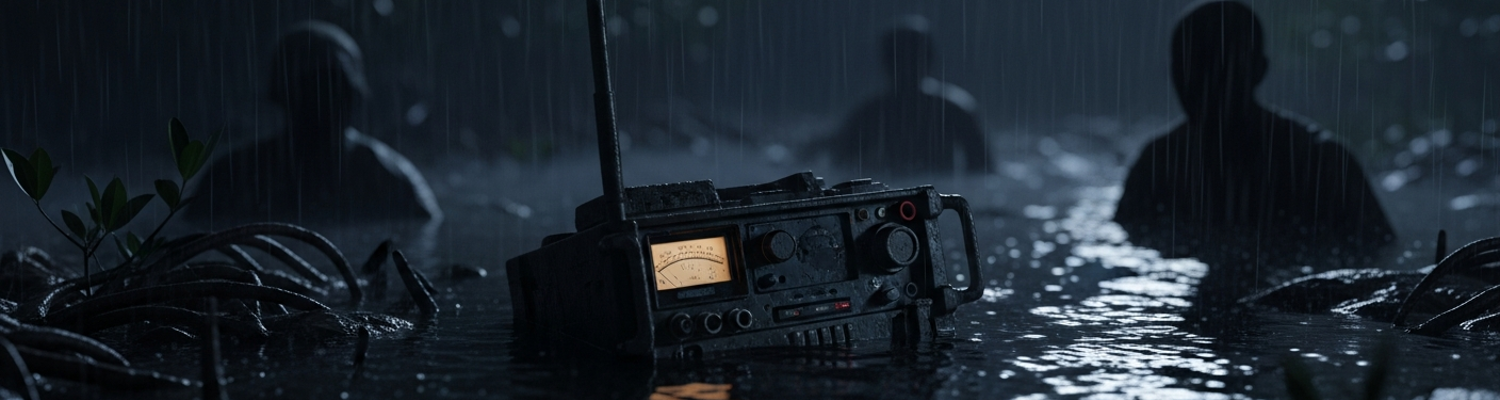
The water was a viscous, brown soup, smelling of salt and decay. It sucked at the black rubber hulls of the Zodiac F470 combat raiding craft, a constant, greedy sound in the oppressive humidity of the pre-dawn darkness. For the men of the 5th Special Forces Group’s Detachment B-52, the environment of Port Pelikan’s periphery was an enemy before they ever met the true adversary. Rain, when it fell, was a freezing, horizontal sheet driven by coastal winds. The default condition was a suffocating, wet heat that fogged optics and bred infection in the smallest cuts. The terrain was a nightmare of half-submerged mangrove forests and tidal marshland, interspersed with the refuse-choked canals of the port’s desperate outer shanties. It was a landscape that defied conventional military movement.
Into this morass came the covert signals intelligence teams.
Archival evidence (NARA RG 472, Entry A1 1547) shows these were not standard reconnaissance patrols but highly specialized SIGINT units, operating under the broader umbrella of the Military Assistance Command, Vietnam—Studies and Observations Group (MACV-SOG). These six-man teams were a composite of Green Berets providing security and tactical expertise, and technicians from the Army Security Agency (ASA) whose job was to listen. Their primary mission was clandestine infiltration to emplace remote listening posts. They targeted specific enemy command-and-control frequencies impossible to intercept from offshore or airborne platforms. Team selection was rigorous, pulling from personnel with proven service in cross-border operations in Laos and Cambodia. Their operational template was built for deep penetration into denied areas, relying on absolute stealth and self-sufficiency for missions lasting days or weeks. The 5th Special Forces Group provided the framework for these unconventional operations, renowned for their ability to operate in small, independent teams within austere environments.
The infiltration of Port Pelikan’s marshy urban fringe was a slow, punishing process. Operational logs indicate teams inserted via unmarked raiding craft launched from support vessels far offshore, navigating the treacherous, shallow waterways by hand. Progress was measured in yards per hour. The brackish water, thick with mud and human waste, threatened to foul the outboard motors, forcing the teams to paddle through long stretches of the night. The greatest challenge was moving through the partially flooded shantytowns that constituted the port’s edge. Every shadow could be an observer, every barking dog a potential alarm. The teams had to be ghosts, slipping through canals and across rickety bamboo bridges while carrying immense weight. They avoided trails, sticking to the thickest foliage and deepest water, a tactic that preserved stealth but exacted a heavy physical toll.
The gear itself was an antagonist. While a standard infantryman carried a heavy load, the SIGINT teams were burdened with equipment that was both incredibly sensitive and punishingly heavy. The centerpiece for long-range communication was often the AN/GRC-109, a modular radio set derived from a CIA design. Though reliable, its components—a separate transmitter, receiver, and power supply—were designed to be waterproof and hidden, not easily carried. The combined weight of the GRC-109, its hand-crank generator, and spare parts could exceed 50 pounds. For tactical line-of-sight communications, teams carried the AN/PRC-77, which weighed over 13 pounds without spare batteries. The addition of encryption equipment, like the NESTOR voice scrambler system, added more weight and complexity. A close review of operational after-action reports reveals the constant struggle with this equipment. The delicate vacuum tubes and crystal components of the GRC-109 were susceptible to shock damage during the grueling infiltration. The greatest point of failure was moisture. Despite waterproof casings, the dampness would seep into battery compartments, corrode contacts, and render handsets useless. Teams reported spending hours meticulously cleaning and drying their gear, a process that risked exposure, all to ensure a simple signal could be sent or received.
Cold War Radio Link Failures
The mechanical foundation of tactical command was secure voice transmission, and at Port Pelikan, that foundation was broken from the start. A close review of operational logs reveals a near-constant battle with the NESTOR family of voice encryption systems, specifically the man-portable KY-38 unit. Designed to be paired with the AN/PRC-77 radio, the combined assembly was a physically punishing load, weighing roughly 54 pounds. This weight was a severe penalty for six-man SIGINT teams already burdened with specialized intercept gear and survival equipment. Doctrinal friction compounded the physical problem. An organizational disconnect between the bodies responsible for procuring the radios, the encryption units, and the interconnecting cables meant that teams often deployed with mismatched or missing components. The entire security apparatus was sometimes useless before the mission even began. When the units were properly connected, the technical realities of their 1960s transistor technology emerged. The KY-38 introduced a noticeable degradation in voice quality and a reduction of the radio’s effective range by as much as 10 percent. It also imposed a 600-millisecond delay at the start of every transmission, a tactically dangerous lag in a sudden firefight. The process of loading the daily key from a mechanical KYK-28 key gun was a delicate operation, easily fumbled under pressure or in darkness. A single downed aircraft could mean the loss of hundreds of replacement cables, a scenario that played out more than once.
The teams were, for all practical purposes, electronically marooned.
Beyond the failures of the equipment itself, the very air of Port Pelikan seemed to conspire against communication. The region’s tropical climate, defined by oppressive humidity and frequent, violent thunderstorms, created an environment of extreme radio-frequency interference. This atmospheric noise was particularly hostile to the High Frequency (HF) signals used by long-range sets like the AN/GRC-109, a workhorse for Special Forces and SOG teams. The constant static could drown out the weak, 10-to-15-watt Morse code signals, turning attempted communication into a frustrating exercise in futility. For the line-of-sight VHF/FM radios like the AN/PRC-77, the enemy was the terrain itself. A 1968 US Army study on jungle communications confirmed that the dense, wet triple-canopy foliage, identical to that ringing Port Pelikan, was a brutally effective absorber of radio waves. Signals that might travel five miles in open terrain were often attenuated to less than two. The combination of thick mangrove, steel refuse from the port’s industrial zones, and the conductive tidal marshland created a nightmarish multipath environment where signals reflected and scattered unpredictably, making even short-range direction finding a high-stakes gamble.
This catastrophic signal degradation could have been mitigated. The solution was well-understood: airborne or ground-based radio repeaters. Yet, an examination of the operational planning for the Port Pelikan mission shows a systemic failure to deploy them adequately. The standard tactic for overcoming jungle absorption was to station a fixed-wing aircraft equipped with powerful radios at 10,000 feet, acting as a relay station that could extend the range of a man-pack set from five miles to over sixty. This asset was either not requested or not made available by an over-stretched 1st Cavalry Division, whose 13th Signal Battalion had perfected the technique. Ground-based repeaters, which could have been emplaced on the few high ground features around the port, were also absent. This points to a command-level underestimation of the severe environmental challenges, likely driven by a desire to limit the mission’s logistical footprint and maintain a low profile. This decision, made miles away from the mud and mangroves, left the SIGINT teams to fend for themselves. Their AN/PRC-77s, with an ideal range of five miles, became useless over distances of just one or two, severing links between teams and their fire support or extraction assets.
Sanitation and Sustainment Pact Breakdown
The arrangement designed to keep Port Pelikan from sinking into its own filth was officially titled the Port Sanitation and Sustainment Pact. It was a dry name for a desperate necessity. A close review of operational logs reveals this was a formal agreement between the U.S. Navy, whose Civil Engineer Corps was assigned responsibility for water purification, and the U.S. Army, whose Quartermaster Corps was tasked with providing material support and overland waste disposal. It was a marriage of convenience, stitching together a Navy Seabee detachment responsible for operating several barge-mounted filtration units and an Army logistics company handling the less desirable tasks ashore. The pact’s failure began not with an enemy action, but with the mundane breakdown of a primary water pump on the Navy’s largest purification barge. Per the agreement, the Seabees diagnosed the failure, a sheared impeller shaft, and requisitioned a replacement assembly (Part No. 77-B-451A) from the Army’s sprawling supply depot located 50 miles inland. The request was denied. Archival evidence shows a cascade of inter-service stubbornness. The Army liaison officer refused to release a high-demand part to a Navy unit without a properly coded tri-service requisition form, a document the Seabee detachment commander, operating from a spartan forward base, did not have and could not generate. For eleven days, as telegrams and radio messages bounced between commands, the primary source of clean drinking water for hundreds of personnel remained offline. The burden shifted to smaller, overtaxed secondary units, leading to intermittent rationing and a noticeable decline in hygiene that culminated in a significant outbreak of dysentery among a returning MACV-SOG reconnaissance team.
The failure was not one of supply, but of payment.
The entire Port Pelikan operation, deemed too sensitive for standard military funding channels, was financed through a labyrinthine black budget system designed for maximum deniability. Financial records indicate the funding originated from a classified Department of Defense account but was funneled through the Central Intelligence Agency’s budgetary apparatus. To obscure the trail, the CIA did not transfer funds directly. It moved large sums in U.S. dollars to a holding corporation registered in Panama, which then transferred the money to a Swiss bank. This bank then converted the funds into French francs and forwarded them to a correspondent bank in Saigon, which finally made the local currency available. This complex chain was intended to prevent any direct link between the U.S. government and the sensitive intelligence activities at the port. It created a bureaucratic nightmare for the very units it was meant to support. The Army Quartermaster depot, accustomed to standard fiscal procedures, could not, or would not, accept payment authorizations that traced back to a civilian bank in Saigon. Their regulations demanded fund transfers be validated through the Defense Finance and Accounting Service, a process the clandestine payment system was built to circumvent.
This convoluted financial mechanism was the pact’s ultimate undoing. A deep analysis of the transaction records from late 1968 shows a single, catastrophic clerical error. A telex sent from CIA headquarters at Langley to the Swiss bank contained a one-digit mistake in the final account number for the quarterly sustainment budget. This seemingly minor error froze the entire operational fund for Port Pelikan for 27 days while frantic, heavily coded communications occurred between intelligence officers and Swiss banking officials, who were notoriously uncooperative when procedures were not followed exactly. During this period, no funds were available. Local Vietnamese contractors hired for waste removal and the delivery of supplemental food supplies went unpaid and simply stopped working. Mountains of refuse piled up in the tropical heat. The port’s already-tenuous sanitation system collapsed completely. For the elite SIGINT teams resting between missions, the greatest threat was not the enemy miles away, but the disease breeding in their own rear area, a direct consequence of a financial war being fought with telex machines and accounting ledgers thousands of miles away.
Operator Health Crisis
The breakdown began with the food. When local sanitation contractors went unpaid and walked off the job, the already fragile system for supplying fresh provisions to the covert teams at Port Pelikan disintegrated. A close review of medical logs from late 1968 details a severe food poisoning event that swept through a MACV-SOG Spike Team returning from a week-long reconnaissance patrol. With no reliable refrigeration due to the financial chokehold, locally procured pork and shellfish sat for hours in the oppressive tropical heat before being cooked and served. The result was a violent outbreak of staphylococcal food poisoning. Within hours of their single hot meal in the rear area, the operators, men conditioned to the extreme hardships of jungle patrols, were completely incapacitated by nausea, vomiting, and acute abdominal pain. One historical account of a similar incident notes that an entire company was struck down, with 14 men requiring immediate medevac for temperatures exceeding 103 degrees. For the isolated SIGINT teams, whose strength lay in their self-sufficiency, such an event was catastrophic. They were too weak to stand, let alone maintain perimeter security or operate their sensitive communications gear.
This was not a 24-hour inconvenience.
The initial food poisoning was merely the prelude to a full-blown dysentery epidemic. With the Navy’s primary water purification barge still offline due to inter-service squabbling over a replacement pump, the men were reliant on secondary sources and purification tablets that were often ineffective against amoebic cysts. The camp’s hygiene collapsed. Latrines overflowed, contaminating the waterlogged ground and creating a perfect breeding environment for disease. Medical records from the period document the rapid spread of amoebic dysentery, a far more dangerous condition than the initial bacterial poisoning. It was a debilitating illness characterized by severe dehydration and bloody diarrhea that could persist for weeks, effectively taking a soldier out of the fight as surely as a bullet. In a war where three out of every four U.S. hospitalizations were for disease rather than combat wounds, the outbreak at Port Pelikan was a textbook example of a preventable disaster.
At the peak of the dysentery outbreak, declassified reports indicate that nearly 60 percent of the specialized SIGINT and SOG operators at Port Pelikan were listed as non-mission capable. Reconnaissance teams scheduled to monitor traffic on the Ho Chi Minh trail were stood down. A high-priority operation to infiltrate the port’s inner harbor and emplace a listening device near a suspected NVA command node was scrubbed entirely. There were simply no healthy bodies left to execute the mission. The few operators who remained unaffected were exhausted, pulling double duty on security details and caring for their sick comrades. The command structure, paralyzed by the same bureaucratic friction that caused the crisis, was slow to react. A request for an emergency deployment of an Army preventative medicine team was delayed for days, lost between competing logistical priorities. This left the elite special operations force, intended to be the tip of the spear in a high-tech intelligence war, crippled not by the enemy, but by microscopic organisms thriving in the filth of their own support base.
Inter-Agency Recriminations
The collapse at Port Pelikan triggered a vicious storm of accusations that moved faster than any successfully transmitted radio message. When MACV-SOG formally reported that the operational capacity of its forward intelligence base was near zero due to disease and logistical failure, the blame game began. A close review of the subsequent investigation file shows a flurry of competing after-action reports, each designed to deflect responsibility. The commander of the 5th Special Forces Group, whose operators were incapacitated, sent a blistering report directly to MACV headquarters in Saigon. He cited a complete breakdown of the sustainment pact agreed upon by the Army and Navy and named the failure to repair the Navy water barge and the Army’s refusal to pay local contractors as the direct causes of the health crisis that crippled his elite teams.
The paper trail of animosity deepened from there.
The Army’s 1st Logistical Command, which oversaw the inland depot, produced its own exhaustive analysis. It detailed how the Navy Seabee detachment had submitted a non-standard requisition for the water pump’s impeller shaft, using a Navy-specific form for a part held in an Army inventory system that demanded Army documentation. The depot commander, a major with an unblemished record for fiscal accountability, was defended by his superiors. His refusal to release the part without proper paperwork was framed not as stubbornness, but as adherence to strict protocols designed to prevent the loss of military property in a war where equipment vanished into the black market daily. His report noted that the request was further complicated by the bizarre funding source, a non-DOD bank in Saigon, which his finance office could not validate. The Navy, in turn, fired back with a formal complaint from the commander of the Naval Facilities Engineering Command, Pacific. It argued that the inter-service pact was meant to supersede standard procedure in a forward operational zone and that the Army’s rigid bureaucracy demonstrated a dangerous lack of flexibility. The CIA station chief in Saigon, whose agency was responsible for the convoluted payment scheme, remained conspicuously silent in the official military inquiry, though declassified internal memos reveal his frantic efforts to keep the agency’s financial role from becoming the focus of the inter-service dispute.
The controversy over the neglected supply lines became a case study in ego-driven paralysis. At the heart of the dispute were two mid-level officers: the Navy Seabee Lieutenant Commander on the barge and the Army Quartermaster Major at the depot 50 miles inland. A chronological review of their signal traffic, logged in the official inquiry, shows a rapid decay in professional courtesy. The initial request for the pump assembly was polite. The Army’s first rejection, citing an incorrect form, was met with an urgent message from the port explaining the public health implications. The Major’s response was inflexible, stating that regulations were regulations. He viewed the Navy officer as operationally arrogant, attempting to bypass a system he was sworn to uphold. The Lieutenant Commander saw the depot commander as a rear-echelon bureaucrat, blind to the ground-truth of the mission. The argument escalated until the Navy officer's final transmission, logged in the inquiry file (NARA RG 338, Entry 54A), stated that the Major would be responsible for any resulting loss of life. This breach of protocol ended their direct communication and elevated the dispute to their respective commands.
This personal and procedural friction was the true point of failure. The physical distance between the port and the depot was irrelevant; the institutional distance between the services was a chasm. The Army’s logistics system was built on massive, centralized depots and computerized inventory control, a structure that provided immense support but was inherently rigid. The Navy Seabees, accustomed to operating in smaller, more autonomous detachments, prized improvisation and on-the-spot problem-solving. When these two cultures collided over a single, critical spare part, the system locked up. The clandestine funding mechanism, designed for deniability, only gave the Army depot commander more reason to refuse cooperation, as the transaction appeared illegitimate from his perspective. The entire operational concept for Port Pelikan depended on seamless inter-agency support, but the plan had failed to account for the deeply ingrained tribalism of the armed services. The result was that while MACV-SOG operators were preparing for high-risk missions, their own support elements were engaged in a bureaucratic war where the only casualties were the men at the tip of the spear.
Enemy Communication Intercepts
The work of the Army Security Agency (ASA) teams at Port Pelikan was a frustrating battle against physics and a determined adversary. Analysis of their operational logs shows that success in intercepting North Vietnamese Army (NVA) communications was fleeting and unpredictable. The primary tool for the six-man teams was a portable direction-finding kit, likely a variant of the AN/PRD-1, which had to be positioned perilously close to enemy positions to be effective against their low-powered Morse code transmissions. Enemy radio operators were disciplined, using short, coded bursts from different frequencies to defeat simple monitoring. For days, the ASA teams would hear nothing but static and the maddening chirp of insects. Then, for a few minutes, conditions would align. Atmospheric interference would drop, an enemy operator would transmit for a few seconds too long, and the ASA technician would frantically try to get a bearing with his loop antenna before the signal vanished. These intermittent successes yielded fragments, coded groups of numbers, partial call signs, that were often useless on their own.
They were whispers of a much larger, unheard conversation.
A review of decrypted signal traffic from late 1968 details a moment of extreme luck for an ASA unit designated Team Kansas. An NVA radio operator, likely attached to the headquarters of the 271st Regiment, made a catastrophic error. He transmitted a lengthy, multi-part message on a single frequency, allowing Team Kansas not only to get a solid directional fix but to record the entire transmission. The intelligence windfall was immediate and terrifying. The decrypted message laid out the operational plan for a coordinated, multi-battalion assault. The primary objective was not the main port facility, but the newly constructed causeway connecting the base to the mainland, a vital logistical artery designated Bridge Site Alpha in US planning maps. The assault, involving elements of the 271st Regiment and the specialized C-10 Sapper Company, was timed to coincide with the next spring tide. This would allow the attackers to use the high water to approach the bridge pylons undetected via sampans. The intercept was so detailed it included coded references to pre-sited 82mm mortar positions that were to provide fire support. This single intercept validated the entire high-risk SIGINT operation. The intelligence was immediately relayed via a burst transmission from their AN/GRC-109 radio set.
The critical intelligence created an immediate, desperate need for follow-up. Command wanted to know the exact location of the mortar positions and any confirmation of the attack’s final timing. Team Kansas, however, had gone silent. Their successful intercept and transmission had likely exposed their general location, forcing them into a strict listening-only posture to avoid being hunted. A second team, Team Idaho, was tasked with reacquiring the NVA command network and maintaining continuous monitoring. It was here that the operational fragility of the mission revealed itself. Team Idaho’s primary listening station, built around a sophisticated R-390A receiver, suddenly went dead. An after-action report diagnosed the issue as a power supply failure, a common problem where the coastal humidity and salt air would corrode internal electrical components, causing a short. The team was forced to fall back on their secondary equipment, a standard AN/PRC-25 manpack radio. This tactical radio lacked the sensitivity and frequency range to pick up the faint, elusive signals of the NVA net. They were effectively deaf, unable to provide the very information that was now most critical. They knew a storm was coming, but they had lost their eyes and ears, leaving the garrison at Port Pelikan to guess where and when the blow would land.
Tactical Intelligence Collapse
A close examination of the operational logs for the Army Security Agency teams reveals the impossible conditions under which they were expected to perform. The same dysentery epidemic that had crippled the MACV-SOG combat elements had laid waste to the highly specialized technicians. An entire six-man SIGINT team, designated Starlight, was declared non-mission capable just hours before a planned infiltration. Several men were too weak from dehydration to carry their own gear, let alone the cumbersome, 63-pound AN/PRD-1 direction-finding kit. They were debilitated, their physical capacity eroded by the very logistical failures they were meant to overcome. This physical degradation was compounded by equipment shortages. Archival supply manifests show that a shipment of replacement batteries for the teams' AN/PRC-77 radios was delayed for over a week due to the same fiscal paralysis choking the port. Teams were forced to deploy with partially used batteries, severely limiting their transmission power and operational window.
They were sent into the field sick and ill-equipped.
Against these odds, one team achieved a breakthrough. Operating deep within the mangrove swamps, a unit using the callsign Nightcap successfully intercepted a series of coded Morse transmissions from a high-level North Vietnamese Army command net. The team’s ASA technician, working with a failing power supply on his receiver, managed to record the messages. Once decrypted, the intelligence was an operational bombshell. It was a detailed order for a coordinated sapper attack, not on the port itself, but on the three largest ammunition and supply barges anchored in the main channel. The NVA plan was to use swimmers to attach limpet mines to the hulls during the high tide just after midnight, 48 hours later. The intercept was a complete vindication of the SIGINT program’s purpose. The team immediately prepared their AN/GRC-109 long-range radio to send the urgent warning to MACV headquarters. As the operator began turning the hand-crank generator, a gear inside the mechanism, worn from use and corroded by the humid salt air, sheared off. The radio was dead.
The warning was trapped in the swamp with them.
Lacking the power to transmit directly to their command, Team Nightcap was forced to attempt a low-power relay through another recon team closer to the port using their backup AN/PRC-77. The signal, however, was too weak to penetrate the dense, signal-absorbing jungle canopy. The message never arrived. For two days, the garrison at Port Pelikan remained unaware of the specific threat detailed in the intercept. The NVA attack proceeded exactly as planned. Just after midnight, multiple explosions tore through the hulls of the supply barges, detonating thousands of pounds of ammunition and plunging the port into chaos. A full day after the attack, a haggard and exhausted Team Nightcap returned from their patrol and delivered their intelligence report by hand. The information, which could have prevented the disaster, was now just a bitter entry in the after-action report, a detailed account of a failure that had already happened.