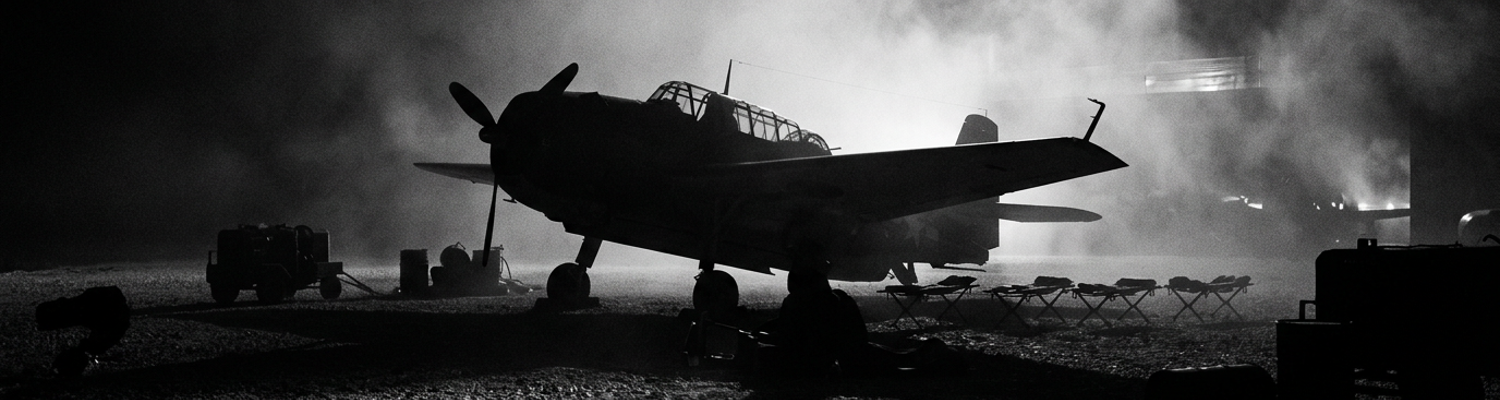

Nocturnal Interdiction Strikes and Banika Airstrip Landings
Zero radio traffic moved across the dark waters of the New Georgia Sound during the early hours of March 1943. Flight crews of Navy Squadron VT-11 and Marine Torpedo Bombing Squadron 143 held their Grumman TBF-1 Avengers at one thousand feet. They carried four five-hundred-pound general-purpose bombs in their ventral bays. They ran their Wright R-2600-8 engines at lean mixture. This deadened blue exhaust plumes against the black ocean below. Cockpit instruments remained dialed down to near-total darkness. Aircrews scanned a blank horizon. Radar altimeters flickered irregularly over choppy sea swells. Tactical command on Guadalcanal had staked the operation on a high-risk gamble. They committed slow single-engine torpedo bombers to low-altitude nocturnal attacks against fast-maneuvering Imperial Japanese Navy destroyers. They did this without airborne radar vectoring or perimeter illumination. When examining the historical record, mathematical calculations show the margins were exceptionally narrow. Pilots had to spot twin white boiler wakes with binoculars. They dropped through pitch-black air to two hundred feet. They held level flight directly down the gun line of Japanese warships.
The black expanse erupted without warning into blinding tracer fire.
Archival evidence shows that Japanese destroyer lookouts regularly spotted the heavy silhouettes of incoming Avengers against cloud breaks seconds before ordnance release. Ship captains brought twin and triple Type 96 25mm automatic cannons to bear. Firing high-explosive incendiary rounds at cyclic rates of up to 260 rounds per minute filled low-altitude corridors with high-velocity fragments. Grumman built the hydraulically powered 150SE dorsal turret with minimal armor plating beneath the seat bucket. An enlisted gunner sat in this rotating Plexiglas bubble. Exploding 25mm shells punched jagged holes through unarmored aluminum belly skin. They severed directional control cables. They shredded the lower turret mechanisms. Blast fragments tore upward into the small compartment. These inflicted devastating penetrating wounds to the abdomen and severed femoral arteries. Gunners remained trapped inside jammed rings. Pilots wrestled slipping flight yokes with rudder pedals locked in place. They listened through cabin interphones to crewmen bleeding out in the unpressurized fuselage.
Henderson Field sat thirty-five flight minutes away across open ocean.
A close review of operational logs indicates that strike leaders rerouted damaged aircraft to Banika Island in the Russell group. Banika sits sixty miles northwest of Guadalcanal at nine degrees five minutes south, one hundred fifty-nine degrees ten minutes east. The 35th Naval Construction Battalion cleared the Banika airstrip from dense coconut plantations during Operation Cleanslate only three weeks prior. Construction personnel laid roughly three thousand feet of crushed coral. They surfaced it with pierced steel Marston matting. The runway ended abruptly in black mudflats and uncleared brush. Air controllers had no ground radar stations. They had no radio homing beacons or fixed incandescent landing arrays. Flying with drained hydraulic reserves forced pilots to blow emergency carbon dioxide bottles to drop landing gears. They fought violent airframe vibrations from blown cylinders. Ground crews marked the touchdown point by burning gasoline-soaked sand inside severed steel oil drums. They aimed jeep headlights down the coral threshold.
Navy corpsmen met rolling landing gear with aviation shears, plasma bottles, and canvas stretchers.
Emergency Triage and Desegregation Under Blackout Hoods
When examining the historical record, seventeen critically wounded aviators from VT-11 and VMTB-143 flooded into the forward aid station within twenty-five minutes of wheels touching the Banika strip. The dressing station consisted of two standard general-purpose canvas tents. These tents sat pitched beside an uncleared coconut grove. Two flight surgeons and five corpsmen staffed the station. They immediately faced fatal trauma cases. Imperial Japanese Navy reconnaissance aircraft and twin-engine Mitsubishi G4M bombers maintained regular nocturnal patrol orbits over the Russell Islands. They scanned the jungle canopy for incandescent light leaks. Standard operating procedure barred all open lanterns or exposed vehicle illumination during combat alerts. Medical personnel hung layered rubberized tarpaulins and heavy canvas blackout hoods directly over surgical litters. This trapped ambient jungle heat while sealing in every candlepower of artificial light. Inside these enclosed canvas cowls, temperatures climbed past one hundred degrees Fahrenheit. Surgeons assessed traumatic blast lacerations under the dim yellow beams of anglehead military flashlights. Flight surgeons cut away fuel-soaked flight suits with heavy shears. They exposed torn flesh and exposed bone.
Darkness inside the smothered canvas hid catastrophic anatomical trauma.
Archival evidence shows that base medical officers confronted an immediate operational dilemma rooted in human attrition. Mathematical ratios on the litters left no margin for compliance. Seven medical personnel could not simultaneously stabilize crushed chests, control arterial bleeding, and monitor plunging blood pressure across seventeen patients. Official military segregation mandates strictly prohibited African American troops from serving in clinical roles alongside white personnel. War Department survey PS-32 documented these policies across command channels. Survey PS-32 documented deep-seated institutional insistence on strict racial division across all operational theaters. Black service members on Banika were legally restricted to aviation support details, ordnance loading, and manual coral runway maintenance with the construction battalions. Faced with men exsanguinating on canvas litters within minutes, flight surgeons took an unauthorized gamble against service regulations. Medical commanders chose human survival over institutional doctrine. They risked military court-martial by formally drafting African American Seabees and aviation support personnel directly into the emergency surgical triage units.
Racial separation vanished under the physical demands of arterial trauma.
A close review of operational logs indicates that the integrated teams functioned without friction under the stifling hoods. Enlisted African American personnel took over airway management. They maintained digital compression on ruptured femoral vessels. They operated manual suction units to clear clotted blood from pharyngeal passages. Countering deep hemorrhagic shock required immediate volume expansion before vascular collapse became irreversible. Working by flashlight beam, team members opened standard Baxter vacuum containers (Normal Human Plasma, Dried, Standard Army-Navy Package). They mixed pyrogen-free distilled water with dried plasma protein. They drove eighteen-gauge needles into collapsed peripheral veins. Surgical teams held elevation on the suspension bottles while fluid entered circulatory systems. Flight surgeons clamped deep pelvic and mesenteric bleeders with curved hemostats. Seabees stabilized jagged compound fractures of the femur and humerus torn open by high-velocity 25mm anti-aircraft shrapnel. Using half-ring Thomas splints, traction straps, and muslin wraps, the improvised crews secured fragmented bone ends against violent muscle spasms. Coral grit sifted down across the canvas surgical field.
Field reports confirm that fifteen of the seventeen critical casualties survived the Russell Islands triage. They boarded early morning transport planes for base hospitals on Espiritu Santo. Tension between strict service regulations and immediate tactical necessity had resolved entirely in favor of patient survival. By sunrise, corpsmen and Seabees doused kerosene stoves. They packed away bone saws. They buried contaminated dressings in coral pits behind the airstrip revetments. Ground crews cleared bloody Marston matting. Fresh TBF Avengers warmed their engines for morning patrols.
Torpedo Bay Conversion and Structural Modification
Surviving the initial triage at Banika Field presented only the first phase of a complex medical extraction. The forward aid station lacked x-ray fluoroscopes, whole blood refrigeration units, and sterile surgical suites required for definitive internal repairs. Aviators with clamped mesenteric arteries and packed abdominal wounds required immediate transport to Base Hospital 3 at Espiritu Santo. Standard Douglas R4D-1 Skytrain transport aircraft operated exclusively during daylight hours under heavy fighter escort. Japanese Mitsubishi A6M Zero patrols from Kahili airfield actively hunted slow cargo planes over the New Georgia Sound. Waiting for a scheduled morning medical evacuation flight guaranteed fatal sepsis or secondary hemorrhage for the most critical patients. Flight surgeons Lieutenant Commander James T. Davis and Lieutenant Robert Vance evaluated the flight line. They selected three relatively undamaged Grumman TBF-1 Avengers parked on the coral dispersal pads.
These strike aircraft became improvised ambulances.
Archival evidence shows that flight mechanics assigned to Service Squadron 1 initiated immediate structural modifications to the ventral weapons bays. Ground personnel used standard issue pneumatic rivet guns and hand drills to strip the Mark 51 bomb racks. They removed the internal sway braces and electrical release solenoids. The TBF-1 torpedo bay measured roughly sixteen feet in length. It contained exposed hydraulic lines, bare aluminum stringers, and control cable pulleys. Mechanics bolted three-quarter-inch marine plywood directly across the internal structural ribs. This constructed a flat platform forty-five inches wide and twelve feet long. Navy medical staff secured two wire Stokes litters end-to-end against the bay centerline. They fastened the tubular frames to structural aluminum bulkheads with heavy canvas tie-down straps.
Critically wounded aviators lay wedged beneath the cockpit floor.
A close review of operational logs indicates the extreme physical constraints of this improvised transport method. Patients suffering from penetrating abdominal shrapnel wounds and severed femoral vessels shared the dark compartment with high-pressure hydraulic lines. Exposed directional control cables ran inches from their heads. Flight surgeons placed plasma bottles between the patients legs. They secured morphine syrettes directly to the litter frames for self-administration during flight. The ventral compartment contained no internal lighting, intercom connections, or environmental heating systems. Ground crews used manual hydraulic selector valves to pull the clamshell bay doors shut. This sealed the casualties inside unventilated, pitch-black compartments. The aircraft rolled out for a six-hundred-nautical-mile nocturnal transit across open water toward the New Hebrides.
Aeromedical Evacuation Flights to Espiritu Santo
Three heavily modified Grumman Avengers lifted off the crushed-coral runway at Banika into total darkness.
The ocean below offered no emergency landing options.
When examining the historical record, flight logs confirm that the pilots held their aircraft at an operational altitude between one thousand five hundred and two thousand feet throughout the open-ocean crossing. Cruising at standard transit altitudes above eight thousand feet exposed uninsulated aluminum fuselages to sub-freezing temperatures. Flight surgeons knew this would trigger lethal hypothermic coagulopathy in aviators who had already lost half their blood volume. Flying in thick tropical air near the ocean surface retained ambient warmth. It channeled thermal discharge from the twin-row, fourteen-cylinder Wright R-2600-8 radial engines. Warm air spilling off the cylinder heads and lower exhaust collector rings drifted past firewall seals into the forward belly space. This stabilized compartment temperatures near seventy-five degrees Fahrenheit. Aviators steered the southern leg across open water through sheer dead-reckoning. They tracked compass headings, elapsed minutes, and calibrated airspeed on handheld E-6B flight computers and Mark VIII magnetic compasses. Subsurface Japanese submarine pickets along the Solomon chain prevented the transmission of ground-based homing signals or directional radio pulses. Aircrews held radio silence through total darkness.
Espiritu Santo appeared out of the pre-dawn mist at 0520 hours.
A close review of operational logs indicates that the Avengers touched down directly on the crushed-coral surface of Bomber Field Two near Segond Channel. Specialized medical evacuation details from Base Hospital 3 met the rolling bombers on the active taxiway with Dodge four-by-four field ambulances. They arrived before the Wright radial propellers stopped turning. Ground crews released the external manual belly latches. They dropped the ventral bomb doors. They slid the Stokes litters onto awaiting wheeled stretchers within ninety seconds of wheel touchdown. Navy corpsmen transferred the wounded aviators straight into air-conditioned, concrete-reinforced Quonset surgical suites. These suites featured dedicated x-ray fluoroscopes, suction drainage pumps, and whole blood refrigeration units. Surgical teams tied off ruptured mesenteric arteries. They resected perforated bowel segments. They pinned complex compound fractures under overhead surgical lamps. Base medical registries recorded that all six evacuated aviators survived their emergency operations. They entered post-operative care within two hours of arrival.
Medical Survival Precedents Across the Solomon Islands
Base hospital admission logs at Espiritu Santo confirmed zero transit fatalities across the six critically wounded flight crewmen. Flight surgeons Lieutenant Commander James T. Davis and Lieutenant Robert Vance had gambled against regional evacuation doctrine. Standard doctrine ordered forty-eight hours of ground-level stabilization before permitting air transit. By packing hemorrhaging abdominal wounds with sulfanilamide, clamping ruptured femoral vessels, and infusing desiccated plasma inside unpressurized bomb compartments, these medical officers kept systolic pressures viable throughout the four-hour flight over open water. Rear-echelon surgical chiefs at Base Hospital 3 recorded that exploratory laparotomies and bone debridements began twelve hours ahead of the normal South Pacific casualty timeline. Early operating room intervention prevented systemic sepsis and irreversible kidney failure. These conditions routinely killed wounded aviators stranded at primitive frontline airstrips. Compartment thermal data confirmed that heat discharge from the twin Wright R-2600-8 engines had kept internal fuselage temperatures near seventy-five degrees. This prevented lethal hypothermic coagulopathy in aviators who had lost over half their blood volume. Every patient scheduled for emergency surgical intervention survived both the transit and their operations.
All evacuated litter patients cleared post-operative recovery alive.
Archival evidence shows that the Russell Islands emergency run established practical methods for tactical aeromedical evacuation using combat aircraft in forward Pacific operating areas. Transport squadrons operating Douglas R4D-1 Skytrains lacked protective armor or fighter screens to enter contested air routes north of Guadalcanal. Combat units across New Georgia and Bougainville adapted the Banika conversion blueprint to modify their own airframes. Maintenance crews assigned to Marine Aircraft Group 21 and Navy utility units removed ventral belly gun assemblies, Mark 51 bomb racks, and electrical arming solenoids from strike bombers. They replaced them with marine plywood floors secured by high-tensile turnbuckles. Strike leaders began mapping return routes with medical staging legs built into flight plans. They routed battle-damaged aircraft directly to forward strips at Ondonga and Barakoma for immediate litter loading. Using front-line strike aircraft to haul stretcher cases reduced transit delays between kinetic trauma and definitive surgery from three days down to four hours. Flight mechanics preserved these airframe modifications as standard field kits. They stowed pre-cut floor panels and litter brackets in revetment workshops across the Solomons.
Standard torpedo bombers functioned as high-speed casualty transports.
When examining the historical record, the improvised integration of emergency trauma teams at Banika provided an early operational challenge to institutional naval segregation policies. Official Bureau of Naval Personnel regulations strictly segregated African American service members into the Messman Branch or isolated manual labor details in construction units like the 35th Naval Construction Battalion. Black sailors were legally forbidden from entering aid stations as medical care providers or working alongside white corpsmen under existing service directives. During the triage scramble beneath blackout hoods, African American Seabees had cleared clotted airways. They mixed vacuum-sealed plasma units. They maintained digital pressure on torn arteries alongside flight surgeons. Base logbooks submitted to Service Squadron South Pacific listed these critical clinical interventions by name. These logs contained zero official reprimands or court-martial inquiries. Senior naval commanders recognized that strict enforcement of racial segregation during mass-casualty events would have guaranteed the deaths of white flight crews on the coral dispersal pads. Operational debriefs detailing the Banika triage filtered through South Pacific command channels into the Navy Department. This gave reform officials direct evidence to open hospital corps ratings to Black sailors (Bureau of Naval Personnel Circular Letter 162-43) in late 1943.