
Establishment of the 1917 Defensive Sea Areas
Steam hissed violently from the fractured cylinder head of the cutter port boiler feed pump, spraying scalding water across the lower engine grating. Machinists scrambled through the hot vapor to wrench the emergency bypass valve shut before pressure loss could stall the main propulsion plant. Sweat poured into my eyes as I balanced on the vibrating steel deck plates of the 15th Naval District patrol boat, smelling scorched cylinder oil and salt water while our engine crew hammered a temporary lead gasket into the cracked housing. The sudden loss of boiler pressure dropped our speed to three knots just as the vessel rolled into the Pacific swells outside the canal entrance channel. Engineers tightened the valve studs with heavy brass wrenches, restoring water flow to the boilers and stopping the pressure drop before our screws stopped turning completely.
Boilers maintained steady pressure as our crew resumed enforcing the wartime shipping boundaries established by President Woodrow Wilson under Executive Order 2692 in August 1917. This mandate created heavily regulated Defensive Sea Areas across the maritime approaches to Colon and Balboa. These executive orders compelled every incoming merchant ship to accept compulsory government pilotage before crossing into the inner channels. Naval regulations enforced daylight navigation across the entire sector, forcing any transport arriving after sunset to anchor in open water until morning. Commercial vessels receiving permission to enter had to observe a strict six-knot speed ceiling, allowing our armed cutters to pull alongside and inspect their papers before they drew near the lock chambers. Sailors spent twelve hours at a stretch monitoring these slow-moving convoys under the tropical sun, checking cargo manifests and searching holds for concealed explosives.
Patrolmen shifted their boarding positions when President Wilson issued Executive Order 2737 in October 1917, amending the geographic boundaries to rectify perimeter coordinates along the Pacific entrance near Taboguilla Island. Army coastal artillery garrisons at Fort Amador and Fort Grant manned heavy batteries overlooking this revised boundary line, tracking every ship crossing into their field of fire. Artillery officers demanded absolute authority over the approaches, warning naval commanders that coastal gunners would open fire on any vessel deviating from the swept channel without clearance. Naval boat crews resented these threats because our small cutters operated directly in the line of battery fire while intercepting merchant ships in choppy water. Radio operators constantly exchanged heated warning messages between our cutter wheelhouse and the Army fire control stations, trying to prevent coastal gun crews from targeting allied ships during routine boardings.
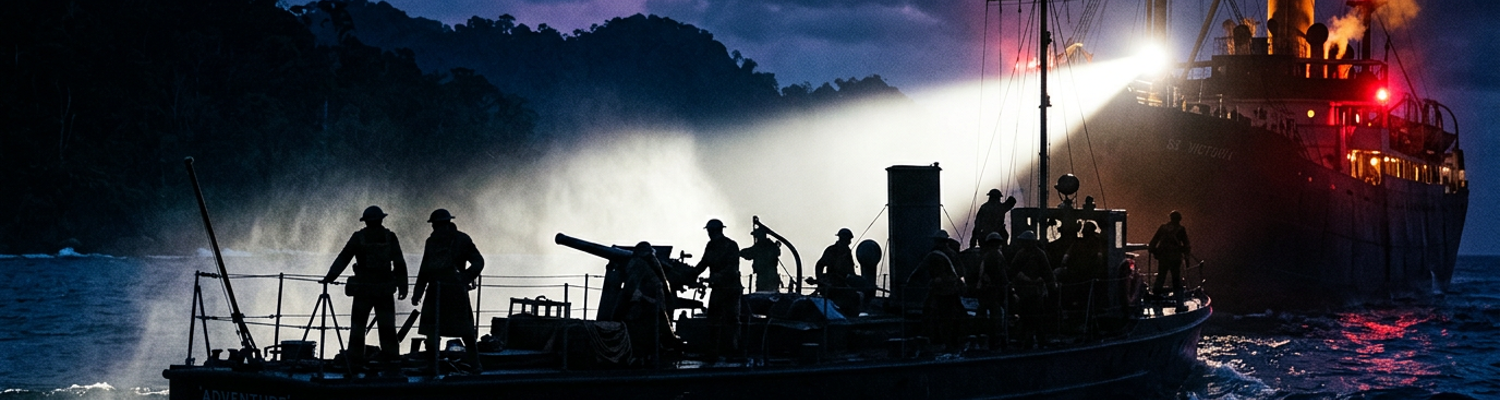
Lookouts on our bow interrupted those radio arguments with an urgent shout as twilight settled over the water, pointing toward an unidentified black-hulled steamer breaching the outer boundary line off Taboguilla Island without showing navigation lights. Exhaustion and heat rash drained our crew after weeks of continuous sea watches, and the sighting caused immediate alarm across the bridge as signalmen rushed to uncover the carbon-arc searchlight. Army battery commanders at Fort Grant instantly telephoned our shore base, demanding permission to train their fourteen-inch rifles on the intruder and fire across its bows. I grabbed the radio handset and shouted down the Army battery commander, insisting that our cutter intercept and board the ship rather than risk an artillery barrage shattering our wooden hull in the crossfire. Helmsmen spun our steering wheel hard over, surging our cutter forward through the darkened swells to place our vessel directly between the advancing stranger and the loaded Army shore guns.
Patrol Operations of the Fifteenth Naval District
Cables connected to the rudder groaned under heavy strain as the cutter sliced across the black swells, positioning our wooden hull straight into the firing lane of the Fort Grant batteries. Signalmen rushed forward to hoist our required night identification markers onto the mast rigging before coastal gunners could loose an artillery shell across our bow. Patrol vessels flew the Union Jack at the jackstaff by day and displayed three vertically stacked lights by night to signal their authority to merchant traffic. Lantern tenders hauled the halyards taut, locking three glowing white and red lanterns into place along the masthead so the foreign bridge watch could recognize our command to halt. Deck gunners powered up the carbon-arc searchlight and pinned the stranger wheelhouse in a blinding beam of light, demanding an immediate shutdown of her propulsion. Steam vented from the intruder exhaust stacks with a heavy clatter, signaling that her engine crew had finally cut their forward speed to obey our visual signals.
Machinery vibrations shuddered through our deck plates while our sister patrol craft converged on the drifting steamer to seal off any escape. The 15th Naval District organized harbor entrance patrol squadrons using armed tugs, converted motor yachts, and naval cutters to police outer terminal waters day and night. Converted private motor yachts commandeered from wealthy owners carried three-pounder rapid-fire guns on their forward decks, operating alongside commercial harbor tugs fitted with boiler-plate armor around their pilot houses. District commanders organized these mixed craft into continuous picket lines stretching across the outer Pacific terminal zone between Taboguilla Island and the mainland shallows. Our cutter took the lead interception position along the merchantman starboard side while an armed harbor tug pulled within fifty yards of her stern to keep heavy machine guns trained on her crew. Deckhands tossed heavy canvas fenders over our side and secured grappling lines as our wooden hull slammed against the steel plates of the foreign freighter.
Sailors in our boarding party climbed the swinging rope ladder toward the freighter iron deck, clutching loaded sidearms and watertight inspection satchels. Officers marched directly into the captain cabin to scrutinize the bill of lading, cargo manifests, and crew lists, searching for false declarations or concealed sabotage materials. Armed sentries took control of the wheelhouse and engine room telegraph, keeping watch over the foreign crew while inspectors checked registry papers to confirm the ship genuinely belonged to a neutral Chilean shipping line. Stifling heat inside the iron superstructure rose past one hundred degrees, soaking our uniforms in sweat and making the tedious paperwork search an exhausting physical trial. Petty officers finished searching the lower holds with electric lanterns, checking behind sacks of nitrates to ensure no scuttling charges were wired to the bilge valves. Chief inspectors stamped the master manifest with official clearance marks and handed him safe-conduct charts for the swept channel, clearing our boarding crew to drop back down to the cutter deck.
The Taboguilla Island Perimeter Breach
Sailors swung down the Manila rope ladder onto our vibrating deck plates just as the forward lookout shouted a fresh contact report into the voice pipe. An unidentified commercial steamer breached the Pacific Defensive Sea Area boundary line off Taboguilla Island at twilight without displaying required recognition signals. The black silhouette drove through the choppy swell past the rocky island reefs, showing no national ensign and refusing to burn the colored masthead lanterns mandated for wartime entry. Lookout watches through our binoculars revealed high iron bulwarks and a heavy deck cargo of lumber obscuring her upper superstructure. Operational procedures required emergency interdiction to counter covert scuttling attacks designed to block the deep-water channel leading to the Balboa locks. Engine telegraph bells clanged through our engine spaces as I shoved our throttle levers hard forward, pushing our small craft directly into the path of the oncoming freighter.
Headsets crackled with furious static as the coastal artillery command post at Fort Grant broke in on our tactical frequency to demand an open firing lane. Naval patrol commanders faced immediate tactical uncertainty over whether to dispatch an armed boarding party or clear the trajectory for Army shore guns. Heavy fourteen-inch coastal rifles on the island forts tracked the intruder through their optical rangefinders, but an artillery shell hitting the freighter could easily detonate cargo in her holds and sink her directly in the navigation channel. Coastal gunners cared only about destroying any target crossing their perimeter line, while our naval squadron had to keep the entrance fairway clear of sunken wreckage. Sending our own wooden motor launch alongside presented an equally deadly gamble, since our boarding party would be caught directly in the crossfire if the Army battery loosed a salvo without waiting for our signal. Gunners on our forward deck cranked the bronze elevation wheels of our three-pounder rapid-fire gun, keeping the muzzle trained on the stranger steering gear while I wrestled with the choice between an armed boarding assault and an artillery barrage.
Coxswains steered our cutter across the steamer foaming bow wake, choosing a close boarding approach rather than giving the Army gunners permission to open fire. Searchlight tenders threw the knife switch on our carbon-arc lamp, splashing a blinding white beam across the freighter rust-streaked wheelhouse and bridge wings to warn her crew to stop. Armed sailors cocked their Colt service pistols and unslung canvas-wrapped grappling irons along our starboard rail, bracing their feet against the rolling deck as our hull scraped alongside the towering steel plates. Deckhands threw heavy hemp fenders between the two hulls to absorb the crushing impact, filling the air with the smell of scorched rope and friction heat. Whistle blasts shrieked from our steam pipe while our executive officer bellowed instructions through a brass megaphone, ordering the stranger to reverse her screws and drop anchor immediately outside the dredged entrance. Steam geysered from the merchantman escape valves as her engine room finally answered the wheelhouse telegraph, slowing the giant hull just fifty yards away from the minefield boundary markers.
Coast Artillery Corps Defenses and Shore Batteries
Steel cables held buoyant mine casings beneath the surface right along that perimeter line, anchoring explosive charges to heavy concrete sinkers on the seafloor. Army artillerymen maintained electrical firing control over underwater minefields planted to seal harbor choke points against unauthorized incursions. Soldiers in concrete mining casemates monitored galvanometer dials and multi-pin switchboards, ready to route electric current through armored subsea cables to detonate targeted mine groups if an unverified hull drifted across the channel line. Telephone operators in the harbor defense command room monitored our cutter progress, warning me over the crackling radio link that any forward surge by the merchant ship would trigger an instant group detonation. Signalmen on our wheelhouse roof clicked our signal shutter rapidly, sending urgent Morse code flashes toward the shore towers to confirm that our naval party had secured the freighter deck and ordered her anchor dropped into the mud.
Fort Amador recorded our Morse flashes through brass spotting scopes, but gun crews along the concrete parapets remained locked at their action stations. The United States Army Coast Artillery Corps garrisoned strategic strongpoints flanking canal entrances, including Fort Sherman, Fort Randolph, and Fort Amador. Soldiers at Fort Sherman and Fort Randolph guarded the Atlantic approaches off Colon with coastal guns and mortar batteries, while the Pacific strongpoints protected Balboa with massive batteries built into the volcanic rock. Coast artillery officers operated under constant pressure to stop surprise naval attacks, treating any merchant vessel without cleared paperwork as a potential raider intending to bombard the locks. Battery commanders kept their fire control officers glued to depression position finders, tracking our cutter and the Chilean steamer while awaiting orders to open fire.
Gunners at Fort Amador trained their elevation wheels onto the coordinates calculated by those fire control officers, keeping their weapons laid on the freighter silhouette. Fort Amador mounted fourteen-inch disappearing rifles sighted over the Bay of Panama to engage long-range naval surface raiders. Massive counterweights rested in deep pits beneath the concrete gun emplacements, designed to heave each multi-ton barrel upward into firing position over the parapet before the recoil slammed the breech back down into safety for reloading. Soldiers hauled fifteen-hundred-pound projectiles on mechanical handcarts and loaded silk powder bags into the yawning chambers, working inside stifling underground magazines that smelled of damp concrete and cordite. A single accidental discharge across our patrol sector would have vaporized our wooden launch and blown the Chilean freighter apart, scattering debris across the main fairway. Lookouts on our bridge watched through their binoculars as the dark gun tubes remained tucked down behind the earthworks, confirming that the battery commander had paused his countdown.
Sailors from our boarding party scrambled onto the steamer iron deck plates the instant the shore guns paused their countdown, drawing their sidearms to secure the vessel before she could drift any closer to the minefield. Armed petty officers took control of the steering engine and ordered the merchant captain to reverse his screws and drop both bower anchors into thirty fathoms of water. Chief machinists climbed down iron rungs into the engine room, checking sea valves and boiler lines to confirm that no scuttling valves had been cracked open by the panicked crew. Our naval telegraphist tapped out a clear message to the 15th Naval District headquarters, announcing that the vessel was safely anchored, her engines were dead, and the approach channel remained completely open. Coastal artillery spotters finally lowered their rangefinder hoods on the distant bluffs, returning their batteries to standby status as our cutter tied off along the steamer quarter.
Inter-Service Friction and Communication Failures
Hemp mooring lines groaned against our bronze deck cleats as the cutter surged alongside the freighter rust-streaked iron plating, but this uneasy lull brought no relief from administrative hostility. Navy harbor patrol officers and Army artillery observers clashed over jurisdictional boarding authority and final target clearance procedures across both canal terminal zones. Coast Artillery commanders on the mainland insisted that their battery defense mandates gave them supreme command over every vessel entering the defensive area, while our naval district regulations assigned boarding inspections and entry clearance solely to patrol craft captains. Army officers repeatedly telephoned our naval base to demand that my crew stand down and let their spotters inspect merchant shipping with shore-based searchlights, claiming our small wooden launches obstructed their lines of fire. Shouting matches echoed across the radio sets and dockside headquarters buildings as senior colonels accused naval lieutenants of compromising canal defense, while we accused the artillerymen of ignorance regarding basic maritime law and boarding safety. I maintained our armed sailors on the freighter bridge and engine spaces, refusing to yield our legal inspection authority to gunners stationed miles away behind concrete parapets.
Signalmen on our wheelhouse roof hammered out rapid Morse code flashes toward the observation towers on Flamenco Island to report our boarding progress, but the shore command posts consistently failed to read our lights. Communication breakdowns between naval patrol craft using blinker signals and Army battery spotters using telephone lines created severe friendly fire risks throughout night operations. Naval signalmen depended on visual shutter lamps penetrating only short distances through tropical rain squalls, while Army spotters relied on copper telephone lines running across damp jungle terrain between observation posts and gun casemates. Heavy tropical downpours and lightning strikes frequently grounded the landline circuits, leaving battery officers without direct telephone contact when our cutters sent critical clearance messages. Army spotters misread our shutter pulses or failed to receive telephone verification from their command bunkers, causing anxious artillery crews to aim loaded fourteen-inch guns at our wooden cutter. Signalmen on our bridge had to fire emergency red flares and aim high-powered searchlights directly into the gun positions to halt artillery countdowns before shore batteries opened fire on our inspection team.
Sentries in the coastal spotting towers panicked at the slightest movement across the water, shattering whatever fragile discipline our warning flares had restored. False-alarm submarine sightings routinely prompted coastal battery crews to initiate combat alert sequences while naval cutters were still conducting vessel inspections. Drifting mahogany logs, porpoise pods, and bioluminescent ocean waves constantly tricked nervous Army observers into believing German submarines were penetrating the swept fairway. Battery sirens shrieked across the bay as coastal gunners sprang to their guns, ringing alarm gongs and traversing massive artillery mounts while my sailors were deep inside merchant holds inspecting bilge pumps. Artillerymen in the disappearing rifle pits shoved fifteen-hundred-pound projectiles into open breeches and aimed their sights at the merchant ship, treating our tethered cutter as an enemy vessel providing cover for a torpedo run. Inspectors had to abandon their paperwork searches, scramble up iron ladders into the open air, and fire wave after wave of green identification pyrotechnics to stop coastal gunners from blasting the anchored steamer to pieces.
Minefield Navigation and Gatun Lake Security
Sulfur smoke from those green pyrotechnics drifted across the freighter iron deck plates while coastal gunners swung their heavy artillery tubes away from our hull. Relief lasted only until daybreak when our patrol division received urgent orders to shepherd the cleared convoy toward the Atlantic entrance. Navy sweepers marked designated narrow transit channels through the controlled minefields protecting Limon Bay and the Toro Point breakwater. Converted steam tugs and shallow-draft motor launches dragged heavy wire sweeps across the sea floor every morning, dislodging floating debris and confirming that moored explosive canisters had not broken loose from their concrete sinkers. Salt crust caked on our windshields while high Caribbean swells hammered against the Toro Point masonry, throwing white spray fifty feet into the air and shoving incoming vessels toward the submerged cables. Signalmen on our wheelhouse roof kept their kerosene lanterns trimmed to show the boundary stakes, shouting through brass megaphones to hold the merchant column in single file.
Helmsmen monitored rudder angles relentlessly from our bridge watch because naval navigation officers enforced tight helm discipline to prevent inbound neutral shipping from drifting into armed Army mine belts. Tired foreign helmsmen on rust-streaked tramp steamers struggled against violent crosscurrents and heavy river runoff surging through the channel entrance. Merchant captains regularly attempted to cut corners across the channel buoys to shave minutes off their voyage, forcing our armed boarding officers on their bridge wings to physically grab the wooden steering spokes. Army mining casemates along the shoreline kept electrical circuits connected to their underwater detonation groups, meaning a single steering mistake would trigger high explosives directly beneath an errant hull. Boarding crews stationed at the engine telegraphs kept their revolvers drawn, ready to throw the levers to emergency reverse if a ship began sliding toward the wire-strung mine lines. Patrol cutters escorted each cleared hull all the way to the concrete guide walls of Gatun Locks, where massive electric locomotives hooked onto the towing bitts to lift the ships into the lake.
Cutters guarded Gatun Lake interior anchorages and dam facilities against potential sabotaged merchant vessels carrying concealed explosives. German operatives or sympathizers aboard neutral freighters could easily pack lower cargo holds with dynamite and scuttle their vessels directly across the spillway gates. Any massive breach in the earthen wall of Gatun Dam would release millions of gallons of impounded fresh water into the Chagres River valley, emptying the inland basin and shutting down all canal transits for over a year. Our launches patrolled the vast freshwater anchorages at all hours of the day and night, running slow loops around every anchored merchantman while sailors swept electric searchlights across the water to spot swimmers or tethered limpet mines. Gunners stood behind canvas-shielded three-pounder deck guns and Colt machine guns, keeping their sights trained directly on the foreign wheelhouses to prevent unauthorized engine starts. Engine heat and swamp humidity inside our small cabins reached past one hundred degrees, soaking our canvas uniforms in sweat while lookouts strained their eyes through the black drizzle.
Inspectors climbed into the rain to conduct mandatory searches on every vessel riding at anchor in the lake basin. Navy machinists clambered down oily iron ladders into the bottom bilges of each merchant ship, tapping hull plates with brass hammers to uncover concealed detonators or opened scuttling valves. Armed petty officers watched the foreign crews assemble on the open deck under guard, verifying that no crewmen slipped into the cargo holds with fuses or blasting caps. Our cutter coxswain kept our steam engine idling alongside the merchantman iron quarter, ready to tow the vessel away from the dam spillway if smoke or explosions erupted from her hatches. Signal searchlights on our mast clicked out green status flashes to the Army garrison towers on the shore, confirming that each interior vessel was secure and dead in the water.
Psychological Toll of Tropical Wartime Alert
Shutters on our carbon-arc searchlights clattered closed as our signalmen collapsed onto the damp deckhouse benches, their hands trembling from the strain of another ten-hour watch. Intense tropical humidity and endemic mosquito-borne illnesses steadily degraded the physical endurance of 15th Naval District boat crews. Stagnant air inside our cramped crew quarters hovered above ninety-five degrees day and night, turning thin canvas bunks into damp breeding grounds for skin rot and fungal infections. Heavy rain squalls swept across Gatun Lake every afternoon, drenching our watches to the skin before the equatorial sun baked the wet salt and steam back into our woolen undershirts. Malaria and dengue fever struck our small patrol division with relentless force, driving body temperatures over one hundred and three degrees while men stood shivering over their helm stations. Shipboard corpsmen distributed daily rations of liquid quinine from brown glass bottles, but the bitter medicine could not stop the steady drain of feverish sailors being carried down the gangways to the naval dispensary at Balboa.
Replacements rarely arrived to fill those empty bunks, leaving our remaining watchstanders to double their hours at the wheel and lookout stations. Months of ceaseless vigilance against unseen German submarines and surface raiders generated chronic operational fatigue among isolated patrol units. Men stared through salt-crusted binoculars into the black ocean for twelve hours at a stretch, their eyes burning from wind and visual strain until dark ocean swells began to resemble the conning towers of enemy submarines. Every floating palm frond, bioluminescent wave crest, or startled manta ray triggered frantic calls to battle stations, forcing tired gunners to train their weapons into the dark night after night. Sleep deprivation eroded basic judgment across our bridge, making simple navigation orders and channel checks feel like overwhelming mental hurdles. Jumpy boat captains gripped their helm spokes with white knuckles, constantly dreading that a single split-second delay in spotting a wake would allow a German torpedo to cripple the canal locks.
Officers at Canal Zone headquarters recognized that this collective exhaustion and jittery hair-trigger readiness pushed the harbor defenses toward an accidental disaster. The wartime coordination crisis of 1917 forced Army and Navy leadership to implement permanent joint command protocols across the Canal Zone. Senior coastal artillery commanders from Fort Amador met directly with 15th Naval District officers in the administrative offices at Quarry Heights to dismantle the chaotic divided reporting channels plaguing night operations. Military planners drafted unified signal directives establishing identical pyrotechnic codes and mandatory challenge procedures for all patrol craft and shore batteries. Technical crews ran direct armored telephone trunks between naval harbor entrance control posts and coastal artillery fire control casemates, eliminating the uncoordinated civilian switchboards and unreliable blinker lamps. Watch officers on both sides of the service divide received standardized dispatch ledgers and synchronized clocks, requiring battery gunners to verify vessel identities directly with patrol commanders before loading live armor-piercing rounds into their coastal rifles.