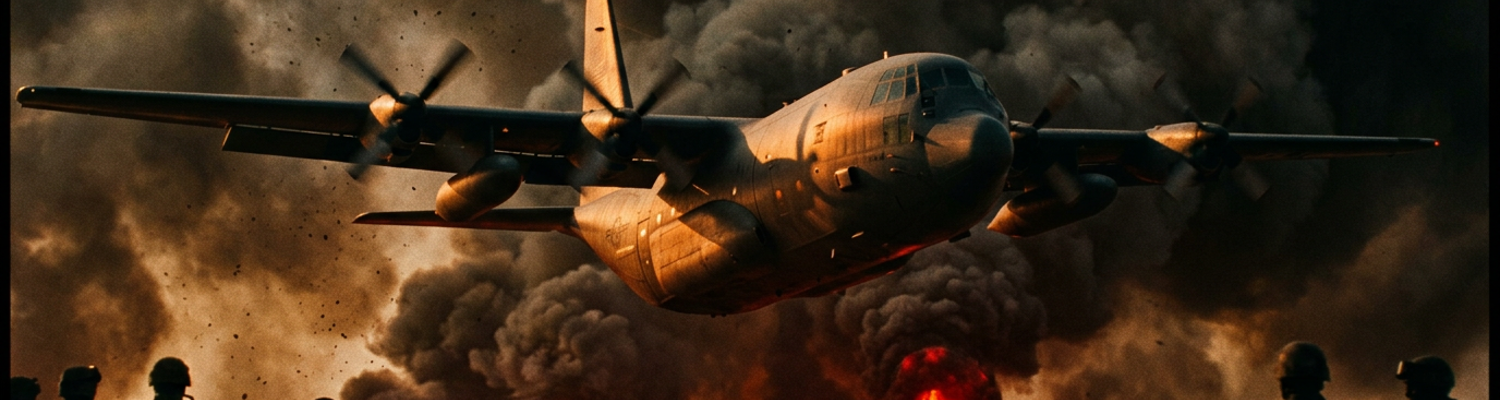

EC-130E Sorties Beneath Kuwaiti Oil Smoke
Radio operators detected the first surge of fractured Iraqi military chatter across high-frequency bands and immediately called the aircraft commander on the flight deck. Intercepted transmissions revealed frantic voices shouting conflicting coordinates without the standard operational call signs or authentication codes required by Iraqi command doctrine. Airborne signal operators listened to these erratic transmissions as isolated units broadcast plain-language distress calls across open frequencies. Regional officers pleaded for transport fuel while artillery batteries abandoned fortified berms without waiting for defensive orders. Mission commanders reviewed these panicked reports, verified that organized resistance was disintegrating across southern Kuwait, and sent an urgent secure transmission to the ground station in Riyadh. Flight coordinators responded by ordering the crew to keep the four-engine turboprop aloft on an extended electronic reconnaissance track rather than returning to base.
Aircrews of the 193rd Special Operations Wing flew EC-130E Volant Solo aircraft along this extended track into midday darkness caused by over six hundred burning Kuwaiti wellheads following the February 28 ceasefire. Dense smoke from the sabotaged petroleum fields blocked all sunlight across the operational zone and forced the pilots to transition immediately to instrument flight rules. Large sheets of flame rose hundreds of feet into the air from ruptured wellheads, casting dull red glares against the black sky and illuminating the heavy soot coating the airframe. Engine air scoops drew in sulfurous fumes and suspended carbon particulates, forcing the flight engineer to monitor turbine temperatures and oil pressure gauges for signs of internal fouling. Technicians inside the pressurized cargo compartment adjusted their receiver dials to cut through the heavy atmospheric electrical noise generated by the burning fields.
Flight crews navigated dense hydrocarbon soot plumes and severe thermal updrafts while maintaining continuous orbit tracks along designated tactical sectors to keep their receiver antennas pointed toward Iraqi retreat corridors. Hot gases venting from the burning wells generated violent thermal drafts that lifted the heavy aircraft hundreds of feet in seconds, followed by abrupt sinking air that rattled the cabin structure and strained the airframe. Pilots wrestled the flight controls and adjusted engine throttles constantly to stabilize their airspeed, fighting turbulence to stay within assigned altitude blocks. Airborne soot particles scratched the cockpit windshield panels and reduced forward visibility to zero, requiring constant coordination with tactical air controllers to maintain separation from other coalition aircraft. Navigators verified every turn using onboard radar systems and radio beacons to keep the aircraft firmly inside its designated orbit box above the desert.
Officers inside the mission cabin matched these steady radar fixes with incoming audio logs and pinned red wax markers onto laminated sector maps to track retreating Iraqi units. Electronic warfare specialists rewound magnetic tape reels to log the exact times and frequencies where Iraqi division networks stopped transmitting. Mission supervisors assembled the handwritten log sheets into an urgent intelligence summary that converted raw audio intercepts into an organized timeline of the enemy retreat. Radio technicians transmitted the finished summary over secure high-frequency teletype channels directly to central command headquarters in Riyadh. Duty officers in Riyadh used these real-time Volant Solo intercepts to draft immediate retasking orders for allied reconnaissance aircraft across the northern gulf.
Surrender Instructions Across Disrupted Broadcast Bands
Teletype terminals inside the EC-130E mission cabin printed these new retasking orders, directing the crew to transition from passive electronic reconnaissance to active tactical broadcasting across southern Kuwait. Technicians immediately engaged modified high-frequency, very-high-frequency, and ultra-high-frequency transmitters to broadcast standardized surrender protocols across civilian and military frequencies. Mission specialists patched pre-recorded audio tapes and live linguist microphones into high-output amplifier racks, sending clear Arabic instructions over the exact radio nets Iraqi units had used before their command structure fractured. Standardized surrender protocols instructed Iraqi soldiers to drop their weapons, step fifty paces away from armored fighting vehicles, and display white flags or clothing from vehicle antennas to guarantee humane treatment. Trailing-wire antennas beneath the turboprop pumped thousands of watts of radio frequency energy into the soot-filled atmosphere, cutting through heavy electrical static from the burning oil fields to reach distant desert outposts. These repetitive broadcast loops saturated company and platoon frequencies across the combat zone, leaving isolated commanders with clear instructions on how to safely yield their positions.
Volant Solo operators systematically overrode regional AM and FM channels to beam geographic assembly coordinates directly to cut-off Iraqi units. Iraqi infantrymen had carried battery-operated commercial transistor radios into their defensive bunkers to listen to civilian broadcasts from Baghdad and Kuwait City, making commercial bands the most reliable way to reach rank-and-file soldiers. Crew linguists repeated specific highway numbers, pipeline junctions, and desert road markers in clear regional dialects, cross-checking the terrain features against aerial charts to ensure safe passage away from minefields and burning trenches. Flight engineers monitored cabin power distribution panels as the broadcasting equipment drew heavy electrical currents, ensuring transmitter output remained strong enough to drown out local Iraqi relay towers. Ground units throughout the burning desert heard these overriding broadcast coordinates, abandoned their dugouts, and began walking in disciplined columns toward the designated rally sectors. Columns of surrendering soldiers left only isolated clusters of hardline forces scattered across the northern perimeter of the Kuwaiti theater.
Loyalists from Baathist security organizations attempted to halt this exodus by deploying mobile radio vans to broadcast harsh counter-orders threatening execution for unauthorized retreats. Real-time spectrum analysis allowed mission personnel to detect and suppress these sporadic attempts by Baathist loyalists to broadcast counter-orders. Electronic warfare officers spotted each rogue carrier frequency the moment it spiked across their cathode-ray displays, measuring the signal characteristics and calculating the approximate ground location of the transmitting antenna. Transmitters aboard the EC-130E quickly matched the enemy frequencies, washing out the Baathist voice transmissions with electronic noise and looping surrender instructions that completely overwhelmed the local signals. Navigators simultaneously passed the coordinates of the loyalist broadcast vehicles down to tactical air command networks, directing armed observation aircraft to pinpoint the trucks along the northern highway. Tactical flight crews tracked the silenced loyalist transmitters until ground patrols advanced to secure the remaining desert sectors and sealed off the last operational radio networks of the Iraqi army.
Rapid Disintegration of Frontline Iraqi Morale
Patrols sweeping through these silenced desert sectors discovered miles of vacant defensive trenches, bulldozed sand berms, and unmanned artillery pits standing completely empty beneath the heavy smoke. Signals intelligence confirmed that frontline Iraqi infantry divisions abandoned defensive earthworks en masse after losing signal contact with Baghdad. Intercept monitors logged an abrupt drop in signal traffic across regional high-frequency nets the moment allied precision air strikes severed the underground coaxial cables and microwave relay dishes connecting southern command posts to the capital. Deprived of hardwire landlines and dispatch networks, field officers had no way to verify whether neighboring brigades were holding their defensive sectors or retreating northward. Unsupervised battalion commanders faced total tactical blindness, prompting them to order their men out of reinforced concrete dugouts to discard their heavy weapons and march westward in ragged columns.
Conscripts trudging along these open tracks carried empty canteens and canvas pouches, having endured weeks of physical deprivation in waterlogged holes. Deserting Iraqi conscripts suffered from severe supply starvation following relentless coalition interdiction of supply lines and tactical communications nodes. Coalition strike wings had methodically cratered desert supply highways, shattered fuel tanker convoys, and demolished forward food warehouses, cutting frontline rations down to occasional crusts of moldy bread and brackish water drawn from agricultural ditches. Precision bombs also obliterated forward logistics vans and generator sets, leaving isolated infantry companies without fresh dry-cell batteries to operate their short-range field transceivers. Exhausted by chronic dysentery and hunger, thousands of drafted farmhands threw down their assault rifles and waved white undershirts at approaching scout vehicles to obtain clean water and medical assistance.
Central Command intelligence analysts processing these massive surrender tallies observed that defensive resistance collapsed in hours rather than the multi-week attritional timeframe anticipated by war plans. Planners in Riyadh had designed the initial ground offensive around expectations of brutal trench-by-trench slugfests through complex minefields and fortified wire barriers, calculating that clearing operations would demand weeks of heavy artillery barrages and infantry attrition. Allied armored task forces instead breached primary defensive lines within sixty minutes of departure, encountering unmanned tank revetments and silent howitzer batteries whose crews had walked away before firing a single ranging shell. Staff officers inside the joint operations center worked frantically to redraw tactical boundaries as advancing tank columns covered dozens of desert miles in single shifts, outpacing their own forward communications links. Logistics managers immediately retasked flatbed supply trucks from hauling artillery shells to transporting thousands of plastic water jugs and boxed combat rations to frontline prisoner intake points.
Interrogators questioning these captured officers inside temporary holding pens gathered handwritten unit rosters, destroyed signal logbooks, and field diaries to verify the exact timeline of the frontline collapse. Senior Iraqi prisoners confirmed that severed communications links, combined with round-the-clock radio surrender broadcasts and empty supply trucks, convinced company and battalion commanders that higher authority had completely dissolved. Technical intelligence specialists correlated these physical documents with audio recordings and electronic intercept files from the Volant Solo aircraft to map out the failure points in the enemy command chain. Duty officers compiled the resulting data into thick binder packets and loaded them aboard transport planes bound for military headquarters in Riyadh. Transport crews secured the heavy document crates onto cargo pallets and flew them directly to the coalition air operations center for immediate analysis.
PSYOP Coordination and Mass Surrender Corridors
Couriers unloaded these thick binder packets at the coalition air operations center in Riyadh, delivering the flight logs directly onto the planning tables of theater broadcast directors. Tactical psychological operations teams synchronized airborne broadcasts with massive leaflet drops to establish designated safe-passage corridors across southern Iraq and Kuwait. Special operations aircrews packed fiberglass bomb casings with millions of illustrated paper leaflets and released them from transport aircraft and strike jets over frontline defensive zones. Ground broadcast teams and Volant Solo radio operators continuously repeated matching Arabic scripts that directed isolated units toward specific desert highways, pipeline junctions, and open border tracks where coalition forces waited to receive them. Leaflets carried simple diagrams and Arabic text that instructed Iraqi soldiers to strip off their load-bearing web gear, sling their rifles barrel-down over their left shoulders, and raise both hands above their heads. Iraqi soldiers collected the paper sheets from the sand, folded them into safe-conduct passes, and marched in long files along the designated corridors toward allied security checkpoints.
Checkpoints along the frontier buckled almost immediately under the sheer volume of soldiers marching out of the desert. Over eighty thousand Iraqi soldiers surrendered within days of the declared ceasefire, severely exceeding planned coalition prisoner-of-war logistics. Coalition planners had based their intake formulas on an estimated total of twenty to thirty thousand captives spread across several weeks of grinding combat. Surrendering Iraqi units instead abandoned intact tanks, trucks, and artillery batteries across entire sectors, walking forward in company- and battalion-sized formations that overwhelmed forward handling teams. Exhausted military police detachments rapidly ran out of plastic flex-cuffs, search pens, and Arabic registration forms as thousands of men sat in dense rows along the desert asphalt. Frontline supply officers realized that existing food crates and five-gallon water cans could not support the immense crowd gathered at the roadside collection points.
Engineers from heavy combat battalions rushed to resolve this severe supply crisis as headquarters scrambled to regain control of the transit routes. Coalition ground commanders redirected logistical convoys and field engineering units to construct makeshift holding pens along primary desert transit routes. Bulldozers and road graders scraped flat perimeter boundaries and open intake lanes into the hard desert gravel, working through the night under blackout driving lights. Troops drove thousands of steel fence pickets into the compacted sand and unrolled endless coils of concertina wire to partition the enclosures into manageable battalion-sized cells. Supply trucks originally loaded with artillery shells and tank ammunition turned around at forward depots, trading their combat cargo for pallets of bottled water, prepackaged rations, and field medical dressings. Tanker trucks pumped drinking water into collapsible rubber bladders set up outside the wire, allowing medical personnel to distribute fluids and treat dehydrated Iraqi soldiers before transferring them to rear internment facilities.
Drivers lined up commercial buses and five-ton cargo trucks along the desert shoulder to evacuate these treated prisoners south toward permanent internment facilities at Rafha and Hafar al-Batin. Navigators guided each convoy through dense oil smoke and desert dust storms along main supply routes, maintaining steady intervals between the wire enclosures and the rear camps. Intelligence specialists moved between the temporary pens to collect discarded unit rosters, signal codebooks, and tactical maps left behind by surrendering brigade staffs. Logistics officers logged every inbound prisoner shipment on paper manifests, updating theater counts that continued to outstrip transport capacity throughout the first week of the ceasefire. Engineering crews remained at the roadside pens to expand the wire enclosures and install additional trench latrines as new columns of Iraqi soldiers kept arriving from the northern desert.
Theater Signal Bottlenecks and Ad-Hoc Downlinks
Watch officers monitoring these endless prisoner columns funneled continuous position reports and real-time electronic intercepts directly into theater networks. The sudden surge in tactical data transfer between airborne platforms and Central Command in Riyadh saturated theater satellite communications bandwidth within the first forty-eight hours of the ceasefire. Ultra-high-frequency transceivers and Defense Satellite Communications System channels overloaded under hundreds of simultaneous voice transmissions, teletype feeds, and digitized telemetry files transmitted from the Kuwaiti border. Ground operators in Saudi Arabia watched data queues back up for hours on their terminals because the allocated military satellites lacked the throughput to process the massive volume of intelligence reports. Flight crews orbiting over the oil fires had to hold urgent radio intercept files on reel-to-reel magnetic tapes because downlink queues had completely halted. Mission directors realized that routine status messages and low-priority logs were blocking the passage of critical real-time tactical warnings.
Air Force communications specialists scrambled into forward desert staging areas to bypass these overloaded orbital channels. Technicians deployed improvised commercial satellite dishes and tactical line-of-sight relays to transmit intercepted audio to intelligence units waiting at tactical air control centers. Signal teams bolted civilian parabolic dishes onto heavy wooden packing crates, aligned the transceivers with commercial telecommunications satellites, and ran thick coaxial cables straight into mobile processing shelters. Microwave relay vans climbed onto desert escarpments to establish multi-stage radio links that bypassed congested orbital paths entirely. Radio technicians used these terrestrial links to push raw voice intercepts of Iraqi troop movements directly to brigade combat teams along the border. Field technicians patched bare copper wiring and manual switchboards together day and night to keep recorded audio tapes moving out of the crowded staging bases.
Hardware mismatches between the field switchboards and aircraft avionics exposed deeper flaws across the entire theater network. Incompatible terminal standards between ground stations and special operations aircraft highlighted major doctrinal friction in real-time tactical dissemination. Special operations EC-130E crews used specialized cryptographic gear and non-standard data modems that could not link directly to standard Army corps receivers or tactical air control posts. Ground intelligence teams had to transcribe incoming audio transmissions by hand and read the text over secondary tactical radios, causing severe delays in passing information between aircrews and ground units. Joint staff planners had built wartime communications around separate service architectures, assuming air operations and ground maneuvers would handle their own internal data flows without needing rapid cross-service sharing. Field officers filed urgent discrepancy reports documenting how these incompatible systems forced technicians to carry magnetic tapes between separate communication tents on foot.
Communications officers in Riyadh gathered these physical courier logs and network diagnostic printouts to map the exact bottlenecks across the theater architecture. Staff sergeants stacked thick binders of recorded transmission failures and degraded voice files on briefing tables inside Central Command headquarters. Senior directors ordered forward signal battalions to maintain their commercial dish networks and improvised microwave towers until permanent fiber-optic lines reached isolated desert garrisons. Signal engineers marked regional connection maps with red grease pencil to show where tactical data links had severed between airborne platforms and frontline combat units. Operations teams archived the raw audio recordings and transmission delay logs for formal post-campaign doctrine reviews. Technicians delivered the completed communication fault files to command staff sections preparing the final theater electronic warfare assessment.
Post-Cold War Drawdown and the Base Force Plan
Officers stacked the diagnostic folders across steel conference tables in Riyadh, comparing recorded equipment breakdowns directly against sweeping personnel reduction orders radioed from the Pentagon. President George H.W. Bush implemented the Base Force plan immediately following hostilities, targeting a twenty-five percent reduction in overall military personnel. Defense officials in Washington designed the policy to shrink the armed forces from their massive Cold War posture down to a leaner regional contingency force. Budget analysts seized upon the lopsided ground and air victory in Kuwait as proof that active-duty ranks, carrier battle groups, and tactical air wings could be dismantled rapidly without compromising American security interests. Theater commanders who had just spent weeks relying on non-stop electronic warfare sorties suddenly faced strict manpower caps and early retirement mandates that threatened to dissolve specialized flight sections. Command staff struggled to compile urgent technical requests for improved tactical data links while simultaneously drawing up mandatory separation lists for experienced communications officers.
Pilots and signal technicians felt the immediate impact of these contradictory directives inside their forward staging hangars. Specialized electronic warfare squadrons faced accelerated demobilization and budget reviews while still conducting operational support sorties in the Persian Gulf. Aircrews continued to orbit along the Kuwaiti border to monitor unorganized Iraqi army remnants, broadcast humanitarian notices, and track potential ceasefire violations through dense industrial soot. Ground personnel worked double shifts on exposed flight lines in Saudi Arabia and Turkey to replace burned-out transmitter tubes and recalibrate antenna arrays, even as supply clerks stamped incoming shipping crates with return tags for stateside depots. Flight surgeons and squadron leaders scrambled to manage crew fatigue across shrinking rosters as experienced technicians boarded transport planes for early civilian separation. Auditors from military financial boards arrived at base operations tents to inspect flight hour ledgers, questioning the necessity of daily broadcast fuel consumption while combat operations were officially over.
Air National Guard units operating specialized airframes prepared for swift demobilization despite lingering theater stabilization requirements. Aviators of the 193rd Special Operations Wing still had to broadcast clear instructions to hundreds of thousands of displaced refugees and isolated Iraqi garrisons across southern Iraq. Joint commanders in Riyadh warned that withdrawing the EC-130E Volant Solo aircraft too early would leave allied ground divisions without an airborne voice to manage regional surrender points and calm civil unrest. Headquarters staff and home-station air wings nevertheless received orders to begin processing return paperwork for citizen airmen who had families and civilian careers waiting back in Pennsylvania. Supply sergeants collected desert camouflage gear and inventoried chemical defense suits, while operations clerks prepared separation physicals and flight clearance forms inside makeshift plywood administrative shacks. Flight leaders divided their remaining duty rosters between maintaining twenty-four-hour broadcast tracks over the burning oil fields and preparing deployment packs for the transatlantic flight back to the United States.
Mechanics stripped portable diagnostic gear from desert shelters and loaded heavy flight-line toolboxes into the cargo bays of transport aircraft. Avionics technicians carefully packed specialized magnetic tape consoles, radio frequency analyzers, and spare amplifier modules into wooden transit containers labeled for long-term depot storage. Radio specialists detached trailing-wire antennas and sealed high-voltage transmitter racks to protect sensitive internal components from fine sand and corrosive oil soot during the ocean crossing. Wing staff officers locked completed flight logs and mission recording tapes into secure green metal footlockers, preserving the physical proof of their electronic broadcasts for congressional committees and Pentagon study groups. Ground crews in grease-stained coveralls marshaled the first demobilizing turboprops out of their parking revetments and pointed them toward the runway, readying the airframes for their return flight while ongoing surveillance flights continued to climb into the smoky desert sky.
Congressional Inquiries into Electronic Warfare Doctrine
Navigators carried the sealed metal footlockers containing mission tapes, frequency logs, and flight-line diagnostic sheets straight from those demobilizing transport planes to hearing rooms on Capitol Hill. House and Senate Armed Services Committees convened inquiries into the coalition military reliance on ad-hoc broadcast systems and jury-rigged data networks. Congressional investigators spread out hand-drawn wiring schematics and desert courier logs showing how flight crews had relied on commercial satellite dishes bolted to wooden crates and unshielded copper wires to send critical audio intercepts back to command posts. Committee members questioned senior defense officials about why the most technologically advanced military coalition in history had to improvise local relay systems to move basic operational intelligence across the Kuwaiti border. Witnesses acknowledged that these communications bottlenecks forced forward tactical units to transcribe radio intercepts by hand and pass recordings on foot between separate service command tents.
Officers presented classified after-action briefings that revealed that established Air Force electronic combat doctrine had lagged behind the operational reality of airborne psychological operations. Existing tactical manuals had focused almost entirely on suppressing Soviet-built surface-to-air radars and jamming military communication nets during high-intensity conventional combat. Planners had never designed electronic combat squadrons to manage mass surrenders, broadcast psychological messages over civilian frequencies, or direct humanitarian movements across hundreds of miles of open desert. Airborne crews had to write their own operational rules inside the cabin while flying through Kuwaiti oil smoke, retasking broadcast antennas to beam Arabic surrender instructions without formal joint coordination procedures. Department officials admitted to the panels that standard service doctrines had treated psychological operations as an afterthought rather than a core electronic combat mission.
Commanders challenged lawmakers to fix these conceptual shortcomings instead of using the victory in Kuwait to justify dismantling specialized air units. Congressional testimony emphasized the strategic danger of prematurely retiring electronic warfare assets amid sweeping post-Cold War defense budget reductions. Veteran pilots and electronic warfare directors warned the committees that deep spending cuts under the Base Force plan would gut specialized flying units before their wartime lessons could be integrated into new joint doctrine. Testifying officers stressed that highly trained flight technicians, linguists, and airborne broadcast specialists took years to train and could not be reconstituted quickly during a sudden regional crisis. Skeptical lawmakers pressed defense budget directors to explain why vital modernization programs for tactical transmitters and secure airborne modems were being canceled while frontline crews were still conducting stabilization sorties in the Persian Gulf.
Lawmakers demanded that the Pentagon halt premature divestment plans until joint staff leaders produced a comprehensive review of theater electronic warfare requirements. Budget analysts and joint staff officers returned to their Pentagon workbenches to adjust force-structure spreadsheets and draft new training programs for airborne information warfare. Staff directors impounded flight logs, audio reels, and transmission fault reports from the Persian Gulf deployment, archiving them inside defense research facilities to guide future modifications for electronic warfare aircraft. Technical evaluators began drafting joint architecture guidelines to guarantee that airborne broadcast transmitters and ground-based tactical radios could share digitized intelligence across service boundaries without relying on emergency commercial equipment. Technicians shipped the original magnetic tape logs to military laboratories in Ohio and Maryland, where avionics engineers began analyzing transmitter power levels and frequency stability under combat conditions.