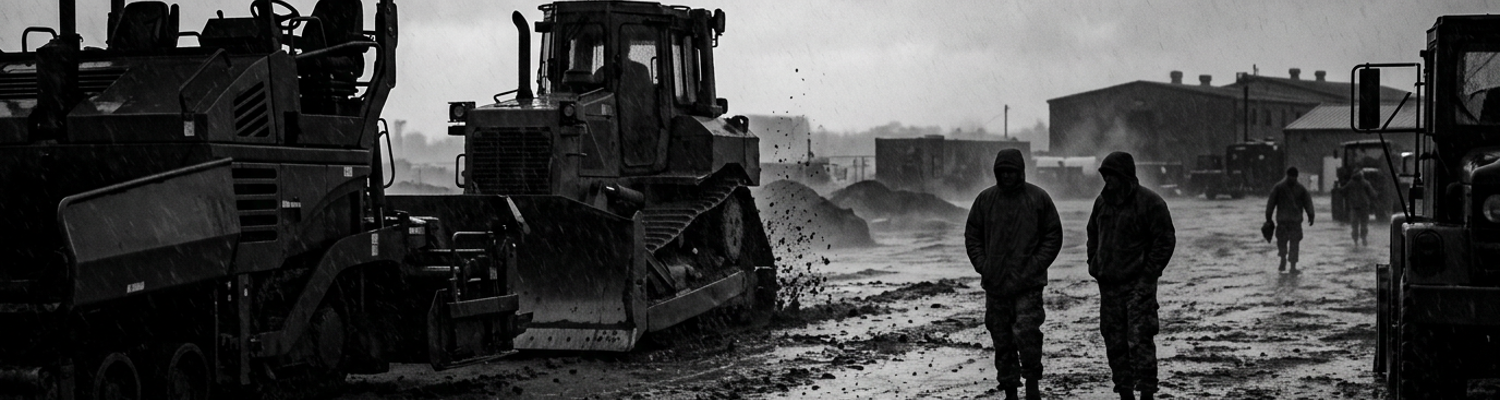

Civilian Origins of the Model 879-A
By late June 1948, the Soviet Group of Forces in Germany ringed the perimeter of Berlin with thirty-two combat divisions. They massed roughly 300,000 frontline infantry and armored personnel against an isolated Western garrison of barely 22,600 soldiers. Soviet Marshal Vasily Sokolovsky locked down all road, rail, and barge corridors running across the 110 miles of Soviet-controlled territory separating the Western sectors from the Allied zones of western Germany.
A complete blockade.
Across the airfields surrounding the city, including Werneuchen, Schonwalde, and Rangsdorf, the 16th Air Army held forward-deployed fighter regiments. These units flew hundreds of Yakovlev Yak-3s and Lavochkin La-9s. They could easily sweep the narrow flight corridors if ordered. Inside the cordoned enclave, the Western powers faced an immediate collapse of basic supplies for 2.1 million civilians. The city survived on a daily food inventory of barely thirty-six days and coal stocks calculated to last forty-five days. General Lucius D. Clay calculated that the two operational landing zones inside West Berlin lacked the runway acreage to receive the necessary minimum of 4,500 daily tons of food, medicine, and solid fuel. Those zones were Tempelhof in the American sector and Gatow in the British sector.
The tactical arithmetic pointed toward surrender within weeks.
When examining the historical record of highway mechanization, the instrument destined to break this tonnage barrier had never been intended for combat airbases. Industrial designer Harry H. Barber and his Aurora, Illinois manufacturing company originally conceived the Model 879 asphalt finisher in the late 1930s. They formalized its design as the upgraded Model 879-A in 1940. Blueprints preserved from the Aurora plant demonstrate that Barber sought to eliminate the labor-intensive wooden form rails previously required to lay uniform asphalt roads. Instead of dragging a dead blade behind a tractor, the Model 879-A introduced a self-leveling floating screed assembly. This assembly was suspended on two heavy draft arms pinned far forward on the crawler tracks.
American municipal planners bought hundreds of them for New Deal parkways.
This structural geometry allowed the screed to seek its own equilibrium. It rode atop hot asphalt mix while floating over small subgrade depressions without transferring roadbed bumps into the finished mat. Operating directly in front of this floating plate, an eccentric-driven tamping bar struck downward at 1,200 strokes per minute. This compressed the bituminous aggregate and bitumen binder against the base before the heated screed plate passed overhead to impart a dense, sealed surface.
A close review of operational logs and maintenance manuals reveals that the machine was structurally incompatible with emergency airlift operations. Barber-Greene engineered the Model 879-A exclusively for domestic road projects. They cast the gear casings, transmission housings, differential housings, and track idler brackets out of dense grey iron. Cast iron absorbed the violent mechanical chatter of internal combustion engines and aggregate tampers. It possessed near-zero tensile tolerance against sudden point impacts and resisted field welding once cracked. Feeder slats and propulsion systems relied on commercial steel pintle chains and standard agricultural roller chains. Factory crews designed these to run exposed to street dirt rather than stripped down for transport in narrow fuselages.
In full working trim, the machine weighed approximately 18,500 pounds.
It measured over eight feet across its receiving hopper and rested on continuous tracks driven by a low-speed LeRoi or Buda gasoline engine. Factory technicians assembled the entire frame with permanent hot rivets and thick bead welds on structural steel channels. No mechanic could separate the chassis into pieces small enough to clear the standard six-foot by seven-foot side cargo hatch of a Douglas C-47 transport plane.
Terrain Hazards at the Tegel Artillery Grounds
A close review of operational logs indicates that on August 5, 1948, advance survey parties entered the Hermann Goring artillery training grounds in Berlin northern French sector. French commandant Brigadier General Jean Ganeval had formally allocated the overgrown, four-square-kilometer reservation in the Reinickendorf district for emergency airfield construction. Transit teams from the 739th Engineer Heavy Equipment Company moved onto the firing ranges alongside surveying detachments from the 862nd Engineer Aviation Battalion. They cut through thick pine scrub and stagnant drainage swales to stake out a proposed 5,500-foot runway alignment. Transit instruments quickly documented severe elevation drops across the site. The location sat in an ancient post-glacial hollow east of Lake Tegel. It had spent decades serving as a proving ground for Reich military weapons. This left the acreage pitted with craters, concrete firing aprons, and collapsed target buttresses.
The subsoil could not support the deadweight of an empty army truck.
Archival core samples taken by the 739th during the second week of August revealed that dense layers of waterlogged peat and decomposing vegetable muck extended sixteen feet below the surface. Subsurface water tables sat barely twenty-four inches beneath the forest floor. Caterpillar D8 crawler tractors and heavy towed scrapers made preliminary passes to clear the topsoil. The machinery churned the fragile root mat into a black slurry. Steel tracks spun helplessly against underlying blue clay. Several seventy-thousand-pound bulldozers broke through the crust and sank to their belly pans. Their hulls rested directly on buried pine logs.
Recovery crews burnt out master clutches.
They snapped two-inch steel winch cables attempting to drag bogged tractors backward out of the mire. Thick fibrous peat packed into track roller frames. This bent track tension adjustment bolts and stripped propulsion sprockets before operators could establish a level baseline.
Excavation teams hit live munitions with every hundred yards of forward progress.
When examining the historical record of the Berlin clearance operations, survey detachments reported that the terrain was saturated with unexploded war materiel. The grounds had sustained heavy Allied bombardment during attacks on the adjacent Borsig locomotive and armaments works. Close-range Red Army heavy artillery bombardments followed this during the April 1945 encirclement of Berlin. Unexploded 250-pound general-purpose demolition bombs rested just beneath the waterline. Buried 152mm Soviet high-explosive artillery shells and unfired German 88mm anti-aircraft projectiles sat in the mud. Bulldozer blades constantly threatened to strike sensitive impact fuzes. French sector officers assigned teams of German bomb-disposal personnel to search the strip. Workers walked abreast with non-magnetic bronze probing rods and mine detectors through waist-deep muck. Technicians uncovered and neutralized over two hundred tons of live ordnance before grading equipment could safely cycle through the area.
Target flight operational dates left no time for natural soil drainage.
Command records from mid-August show that engineering officers abandoned conventional drainage ditches in favor of total subgrade replacement. Dump truck teams excavated roughly 1.3 million cubic yards of peat and mud. They hauled the soupy waste to spoil piles along the northern perimeter. Fleets of three-axle commercial trucks then hauled hundreds of thousands of tons of rough building rubble from bombed city blocks into the depression. Heavy tractors shoved piles of broken brick, pulverized plaster, and cracked foundation stones into the saturated cuts. They relied on ten-ton three-wheel steel rollers to force the debris deep into the peat until the subbase stopped shifting under dynamic load tests.
Oxyacetylene Sectioning for C-82 Transport
A close review of operational logs from the Hanau engineer depot indicates that on August 18, 1948, maintenance officers confronted the severe dimensional constraints of the Fairchild C-82 Packet. The twin-boom transport featured rear clamshell doors designed for vehicle roll-on loading. The internal cross-section narrowed sharply at the cargo floor. This imposed a strict sixty-inch width clearance for rolling industrial chassis. The Barber-Greene Model 879-A measured eight feet, eight inches across its crawler tracks and aggregate hopper. To bypass the 60-inch cargo hatch limit of C-82 Packets, combat engineers cut the civilian-pattern pavers into modular halves using oxyacetylene torches.
Specialists from the 739th Engineer Heavy Equipment Company attacked the structural steel frame.
They targeted designated transverse cross-sections behind the primary drive transmission. Blue and white oxyacetylene jets melted through half-inch structural steel channel stringers. The flames severed solid-drawn propulsion driveshafts and cut high-tensile pintle chain linkages. They bisected the heavy-gauge sheet steel of the aggregate receiving hopper. Burning slag pooled across the concrete apron as mechanics freed the engine block, clutch pack, and LeRoi four-cylinder powerplant from the rear crawler track assemblies. Torches cleaved the heavy cast-iron bracket seats supporting the dual tamper eccentric shafts. Each clean cut compromised the factory-trued structural geometry established by Barber-Greene assembly jigs in Aurora.
Civilian manufacturing tolerances were surrendered to the cutting flame.
Archival evidence shows that on August 24, loadmasters balanced the sliced machinery sections aboard transport airframes assigned to the 60th Troop Carrier Group at Rhein-Main Air Base. Severed chassis assemblies and screed components were flown into Berlin through restricted Soviet air corridors without structural blueprints for reassembly. Pilots hauled the five-ton severed halves along the narrow twenty-mile-wide southern corridor at five thousand feet. They flew under constant monitoring by Soviet radar tracking stations situated at Doberitz. Inside the vibrating C-82 cargo bays, tie-down chains strained against the raw, jagged edges of unbraced steel channels as aircraft encountered severe turbulence over the Thuringian Forest.
Barber-Greene had never drawn or issued depot maintenance schematics detailing field bisection.
This left army engineering units with zero manufacturer data regarding allowable frame deflection, re-welding tolerances, or cast-iron thermal preheat specifications. Flight crews operated under standing orders to jettison heavy cargo over the Soviet zone if an engine failed during transit. Mechanics in Berlin received only crates of loose fasteners, flame-scorched hydraulic pipes, severed control rods, and crates of jagged structural metal.
Field survival depended entirely on manual trial and error.
When examining the historical record of the 862nd Engineer Aviation Battalion, maintenance records show that mobile repair trucks established a makeshift reconstruction pad under canvas shelters at the Tegel artillery grounds. German civilian welders worked alongside military mechanics around the clock. They used twenty-ton hydraulic bottle jacks and heavy screw clamps to force distorted chassis channels back into baseline alignment. Flame-cutting had warped the structural channels by several tenths of an inch. This caused the main crawler drive sprockets to bind against the primary transmission output shafts. Mechanics veed out the severed frame members with handheld pneumatic grinders. They inserted fabricated carbon-steel splice plates across the sliced webs and ran multipass electric arc welds using Lincoln 300-amp portable diesel welding sets. The Aurora plant built the screed draft arms to operate within tolerances of one-thirty-second of an inch to prevent washboarding on asphalt surfaces. Engineers had to true the screed pivot brackets by eye using taut piano wire and plumb bobs. By September 2, mechanics had successfully rejoined two modified Model 879-A units and filled their crankcases with 30-weight engine oil.
Field Reassembly and Improvised Thermal Shrouds
A close review of operational logs from the 862nd Engineer Aviation Battalion indicates that field reassembly began directly on the exposed, wind-scoured concrete aprons of the French sector during the first week of September 1948. Mechanics from the 739th Engineer Heavy Equipment Company worked without overhead gantry cranes or permanent shop walls. They jacked the sliced Model 879-A chassis sections onto rough railroad ties set over waterlogged clay. When torch crews had sliced the machines in Hanau, the intense cutting heat had relieved built-in manufacturing stresses. This caused the 10-inch structural steel channel stringers to twist up to three-eighths of an inch out of true.
Aligning the main drive shafts and crawler track roller frames required four-man crews.
They swung 16-pound sledgehammers against drift pins while portable hydraulic jacks forced the severed halves together. Baseline tram measurements eventually matched original factory wheelbases. Military welders then burned through hundreds of pounds of AWS E6010 cellulosic arc electrodes. They laid multiple root and filler passes across the severed webs and flanges. To prevent the vibration of the eccentric tamping bars from cracking these raw butt welds under full operational loads, maintenance officers ordered heavy structural gussets fabricated on site. Mechanics sheared half-inch-thick mild steel scrap plates into triangular fishplates and rectangular scab patches. They clamped them directly across the exterior seams of the spliced side frames. Electricians then ran continuous fillet welds around each perimeter. This doubled the wall thickness along the critical mid-chassis flex points where dynamic stresses from the seven-ton aggregate hopper met the oscillating loads of the screed draft arms.
The modified structural frames held.
Weather conditions soon threatened the thermal core of the machine. By late October, temperatures across northern Berlin plunged below freezing. Relentless sleet, freezing rain, and biting continental winds blew from the eastern steppes across the exposed clearing. Barber-Greene had designed the Model 879-A screed heater to maintain bottom-plate temperatures near 300 degrees Fahrenheit. The system used open kerosene pressure burners positioned directly above the floating iron screed to soften incoming asphalt and prevent sticky bitumen binder from adhering to cold metal. In the open conditions of the Tegel flightline, freezing gusts constantly stripped heat from the uninsulated iron castings and blew out the exposed burner flames. Whenever the screed plate dipped below 200 degrees, raw asphalt mixture cooled into unworkable, stiff clumps inside the auger chamber. This caused the eccentric tamping bars to jam and tore wide, jagged furrows into the fresh runway mat.
Archival evidence shows that field maintenance shops operating out of corrugated steel huts behind the Borsig locomotive complex began fabricating improvised sheet-metal burner shrouds.
These shielded the combustion chambers. Metalworkers salvaged twenty-gauge steel sheets from discarded aircraft shipping containers and fuel drum walls. They cut the metal with hand shears and bent it over truck bumpers into deep protective cowlings. These custom cowls were bolted directly over the twin kerosene burner assemblies. They formed an enclosed plenum chamber that channeled forced air across the combustion nozzles while blocking freezing sleet and lateral wind gusts. Mechanics drilled adjustable air-intake baffles into the shroud side panels. This allowed equipment operators to fine-tune fuel-air ratios as ambient temperatures fluctuated between sub-zero nights and daylight thaws. By trapping burner exhaust gases against the upper surface of the screed box, the shrouds turned the entire floating assembly into a heat exchanger. This kept bottom-plate steel temperatures consistently above 275 degrees despite sustained sub-freezing winds. On November 17, 1948, the modified pavers laid down 1,200 tons of hot-mix asphalt in twenty-four hours over frozen sub-base rubble without a single burner flameout.
Subbase Preparation from Hand-Crushed Urban Rubble
A close review of operational logs from the French military administration indicates that by late August 1948, municipal labor bureaus mobilized more than 17,000 German civilian laborers to supply base material for the Tegel runway. Roughly sixty percent of this workforce consisted of local women. They organized into structured clearance brigades across the ruined residential blocks of Wedding, Reinickendorf, and Mitte. The blockaded sectors faced a total absence of mechanical rock-crushing plants. Workers attacked the masonry mountains left by Allied carpet bombing using handheld sledgehammers, short iron prybars, and crude wire sieves. Crews broke dense Reich-format red clinker bricks and concrete lintels down into rough three-inch ballast chunks. They sorted out scorched plaster, timber framing, and twisted rebar by hand. French and American authorities paid these laborers standard paper wages supplemented by daily allocations of Category II ration cards. This granted each worker an extra theoretical intake of two thousand calories consisting primarily of dried legumes, canned luncheon meat, and dark bread.
Human muscle met the tonnage demands that machinery could not.
Archival evidence shows that local transport detachments moved approximately 15,000 cubic yards of this hand-hammered brick debris into the Tegel reservation each week. Fleets of wood-sided three-ton Opel Blitz commercial trucks dumped thousands of tons of rubble directly into the excavated peat trenches. Dozens of horse-drawn flatbeds and salvaged narrow-gauge field carts joined the effort. Bulldozers pushed the jagged brick fragments into layers eighteen inches thick across the 5,500-foot runway strip. Three-wheel ten-ton Buffalo-Springfield road rollers followed immediately. They ground the top surface into an interlocking stone matrix. Under this repeated crushing, the masonry fractured into a jagged, uneven bed laced with sharp quartz inclusions and powdered lime mortar.
The resulting surface functioned as an industrial abrasive against moving steel.
When examining the historical record of the 862nd Engineer Aviation Battalion, maintenance sheets indicate that this abrasive brick subbase caused accelerated track wear on the crawler mechanisms of the reconstructed Barber-Greene units. The Model 879-A was built for uniform stone aggregates and clean, graded macadam. It was not designed for shards of shattered vitreous tile and abrasive brick dust. As the twenty-thousand-pound pavers crawled across the unpaved fill, pulverizing brick dust worked deep into the exposed track roller bearings and drive chains. Factory-cast grey iron sprockets suffered acute erosion. Their drive teeth ground down to razor-sharp points that slipped against propulsion links under full five-ton hopper loads. High-tensile steel track pins and track bushings experienced severe metal-to-metal galling. Each track assembly lengthened by several inches after barely forty operating hours.
Sprockets skipped links under the load of incoming asphalt batches.
Field reports from the 739th Engineer Heavy Equipment Company document that mechanics had to pull each Model 879-A off the active mat every three days to rebuild crawler assemblies. The frame modifications made during C-82 transport had already weakened alignment tolerances. The loose, grit-scoured track chains frequently jumped the front idler guides. Civilian machinists working in field sheds along the French perimeter cut away damaged track links with oxyacetylene torches. They drilled out frozen steel pins using bench-mounted radial presses and replaced destroyed idler bearings with components salvaged from immobilized Wehrmacht halftracks. Maintenance officers established a strict requirement for daily kerosene pressure washdowns and high-pressure greasing every four operating hours. This flushed crushed brick silt from the lower track carriages.
Continuous Cold-Weather Operations at Tegel
A close review of operational logs from the 862nd Engineer Aviation Battalion indicates that by the first week of November 1948, meteorologists attached to the French sector forecast sustained subsurface soil freezing within twenty days. Ground frost penetrating the porous, waterlogged peat of the Hermann Goring firing grounds would expand the unsealed subgrade. This would crack the newly rolled brick matrix and halt all heavy construction until the spring thaw of 1949. Major General Curtis LeMay demanded an operational strip before winter locked the corridor. To beat this hard environmental deadline, military engineers ran the spliced Model 879-A pavers continuously day and night. They determined to lay the entire 5,500-foot asphalt runway before deep frost set into the terrain. Operators refueled the four-cylinder LeRoi engines while running at full governor RPM. They poured low-octane gasoline directly into the vibration-shaken fuel tanks through canvas filters while dump trucks backed up to the receiving hoppers. Mechanics crawled alongside the moving tracks with hand-pumped Alemite grease guns. They forced high-viscosity chassis grease into overheating idler bushings every ninety minutes without cutting power.
A hard ground freeze would terminate the entire strategic project.
Archival evidence shows that halting a paver for even twenty minutes turned the unheated hopper aggregate into an immovable, solid black mass. Asphalt mix hauled six miles from batch plants across the ruined city arrived at the strip in wood-sided three-ton Opel Blitz trucks. Coarse burlap tarpaulins covered the loads, bleeding thermal energy into the November drizzle. If a machine stopped crawling, incoming asphalt cooled below 200 degrees Fahrenheit. It congealed into thick bitumen slag that jammed the twin internal delivery augers and snapped the cast-iron drive sprockets. Flightline maintenance officers instituted three rotating eight-hour military shifts. Hundreds of local German civilian shovelers backed them up, working beneath trailer-mounted carbon-arc floodlights. As one team stepped down, replacement operators grabbed the vibrating steering clutches. The pavers crept forward at fourteen feet per minute. They laid a uniform two-inch binder course over the crushed brick base without leaving transverse cold joints across the width of the runway.
The machines never shut off.
When examining the historical record of runway paving detachments, the waterlogged soil beneath the runway created an acute thermodynamic hazard at the point of contact. Deep subterranean water sat within two feet of the hand-hammered brick subbase. This kept the excavated foundation perpetually soaked with muddy seepage. As the modified pavers laid down 300-degree hot-mix asphalt, the floating vibratory screeds compacted the steaming petroleum matrix directly onto the damp, cold rubble bed. Eccentric-driven tamping bars hammered downward at 1,200 vibrations per minute. They drove the heated bitumen into the jagged voids of crushed Reich-format brick while the weighted screed plates smoothed the crown. Superheated moisture trapped inside the saturated foundation flashed instantly into steam. It erupted through the uncured asphalt mat as pressurized blisters that threatened to blow voids through the pavement. Rolling crews followed thirty feet behind the screed shoes on ten-ton steel-wheel rollers. They systematically sealed these steam blisters before cold air could chill the binder below its compaction threshold.
Mud boiled beneath the screed plates.
A close review of mechanical inspection logs from late November reveals that this continuous dynamic pounding sheared the re-welded draft arm brackets on an almost daily basis. High-frequency vibration from the tamping bars, combined with the uneven resistance of water-saturated peat beneath the crushed stone, stressed the repaired structural welds far beyond civilian factory ratings. Spliced joint plates cracked their mounting bolts. This threw the floating screed out of parallel alignment and scored deep longitudinal ridges into the cooling runway surface. Maintenance specialists from the 739th Engineer Heavy Equipment Company ran alongside the active equipment with portable torches and pneumatic impact wrenches. They tightened loose draft pivot bolts and welded cracked gussets while the machines laid hot mix at 2.5 miles per hour. On November 28, 1948, paver number two completed the final forty-foot transverse pass at the eastern threshold. This secured a continuous 5,500-foot landing strip fifty-six days after ground survey teams first entered the swamp.
Mechanical Exhaustion and Final Equipment Obsolescence
A close review of operational logs from the 739th Engineer Heavy Equipment Company indicates that by January 1949, the structural consequences of emergency field welding began destroying the internal mechanics of the Model 879-A fleet. When mechanics in Hanau sliced through the ten-inch steel channel stringers and rewelded them over frozen ground at Tegel, the rebuilt chassis retained a persistent five-millimeter twist along the main longitudinal axis. This continuous structural torsion forced the primary driveshafts to rotate out of true alignment with the cast-iron transmission housings. Continuous passes over millions of square yards of pulverized brick subgrade kicked up clouds of microscopic silicate and calcium oxide particles. The abrasive masonry dust penetrated every unsealed orifice of the machines. It bypassed felt grease retainers and settled directly into the open drive chains, crawler track pins, and final-drive reduction gearboxes. Inside the gearboxes, the brick dust mixed with standard 90-weight gear oil to form a grinding compound. This ground hardened steel gear teeth down to thin blades within sixty operating hours.
Cast-iron differential housings cracked along their original factory casting seams.
Archival evidence shows that by March 1949, maintenance detachments were stripping every third paver down to its structural frame to harvest functioning drivetrain components for the surviving units. Mechanics noted that the secondary transmission countershafts on paver unit number three had sheared their bronze sleeve bushings. This caused the input pinions to jam against the bevel gears and violently stall the LeRoi four-cylinder engine under full hopper load. Because the warpage of the rewelded side frames prevented proper gear meshing, vibration from the 1,200-cycle eccentric tamping bars transmitted directly into the drive assembly rather than dissipating into the floating screed. Thermal stress fractures propagated across the patched splice plates. High-tensile pintle chains snapped under the strain of pulling heavily loaded tracks through thick lime dust. By the time the machines completed the auxiliary taxiways and parking aprons in April, the fleet suffered an uncorrectable eighty percent degradation in propulsion efficiency. Operators had to keep steering clutches permanently engaged to maintain a straight course.
The strategic equation shifted decisively on May 12, 1949.
When examining the historical record of the European Command Engineer Division, Soviet authorities officially lifted the ground blockade and reopened the Helmstedt-Berlin rail corridor on that date. Freight trains and highway convoys restored terrestrial supply routes. This rendered the extreme measures of the aerial construction program obsolete. Command inspection teams from Rhein-Main Air Base surveyed the surviving Model 879-A units parked along the Tegel perimeter. They calculated that the cost to dismantle, transport, and rebuild the battered pavers exceeded their commercial value by four hundred percent. Engineers determined that repeated oxyacetylene cutting, field re-welding, and deep structural metal fatigue made the machines unsafe for standard domestic roadworks. Combat engineers received orders to strip the radiators, electrical dynamos, and battery sets. They left the twisted iron hulls in open revetments near the Borsig works. Cutting teams from local German disposal firms reduced the frames to scrap metal with handheld gas torches. They fed the cast iron into open-hearth furnaces at Berlin steel mills. Concurrently, the Department of the Army cancelled further procurement of civilian-pattern pavers for forward aviation engineering. They redirected funds into newly developed military specifications for air-transportable, modular earthmovers with factory-engineered quick-disconnect frame pins and sealed planetary drives manufactured by Clark, Caterpillar, and LeTourneau.
The final operational Model 879-A at Tegel was broken up for foundry furnace feed on June 28, 1949.