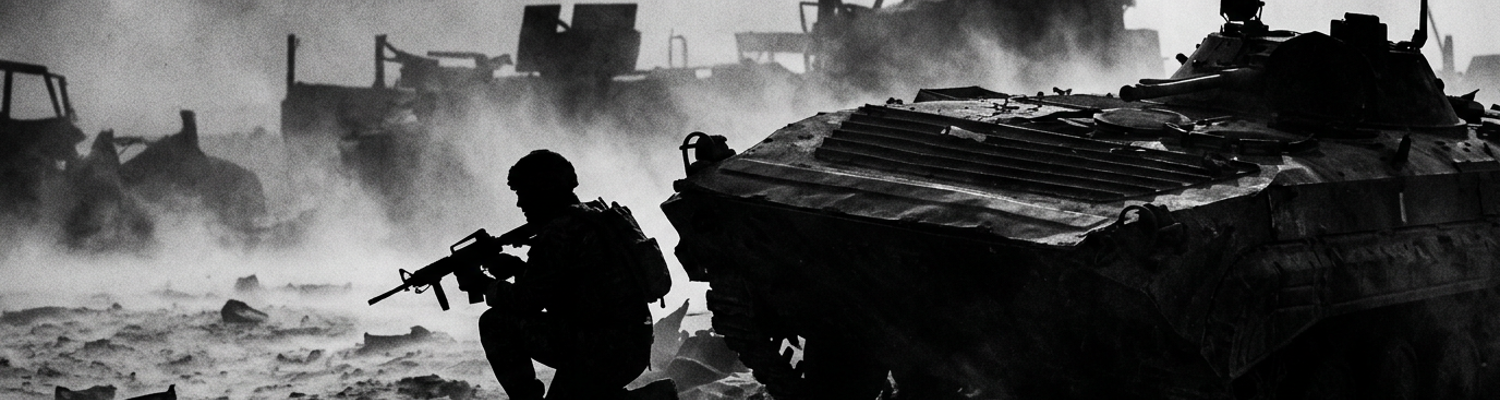

Mechanized Advance Across Southern Iraq
Before dawn on February 24, 1991, thousands of idling combat vehicles lined the Saudi border berms across an eighty-kilometer frontage. Tank crews from the 1st Infantry Division sat inside sealed M1A1 Abrams turrets. The 1500 horsepower Honeywell AGT1500 gas turbine engines idled at high RPMs. Thermal sights scanned north into complete pitch black. Exhaust from muffled turbine engines dissipated into the freezing desert air. Radios stayed on strict listening silence.
Nothing moved.
Field Manual 100-5 AirLand Battle doctrine envisioned rapid mechanized thrusts sustained by textbook replenishment cycles. Ground conditions in the stony Wadi al-Batin corridor dismantled those diagrams within thirty-six hours. Lieutenant General Frederick Franks Jr. directed the main body of VII Corps to wheel east into the southern Iraqi interior following initial breach operations. This maneuver included the 1st Armored Division and the 3rd Armored Division. Visibility dropped to near zero as sandstorms swept across the flat gravel plains. Fine gypsum powder seized turbine filtration assemblies on M1A1 tanks. Mechanics had to pull and clean V-pack air induction filters every four hours instead of every twenty-four.
Heavy Equipment Transporters carrying JP-8 fuel sank to their wheel hubs in wet sabkha salt flats.
Track pads delaminated across flint outcroppings. Combat elements pushed over one hundred kilometers north into Iraqi territory by February 25. They burned through four hundred thousand gallons of fuel per division each day. A close review of operational logs indicates that supply columns fell miles behind the lead cavalry screens.
Doctrine promised continuous resupply.
The terrain delivered broken suspension arms and empty fuel bladders.
Al Busayyah Logistics Depot Discovery
Archival evidence shows that this rapid armored sweep placed VII Corps directly on an intercept vector toward the fortified crossroads village of Al Busayyah. The location sat near latitude 30 14 N and longitude 46 07 E. The settlement functioned as the central supply hub and forward logistical depot for the Iraqi 26th Infantry Division. It also supplied operational reserves of the Iraqi VII Corps. Iraqi military engineers had transformed the village into an entrenched supply redoubt. They packed dried mud-brick compounds and concrete bunkers with reserves of munitions and drummed diesel.
Supply routes branching out from Al Busayyah fed forward defensive lines along the Saudi frontier.
Without the diesel drums and artillery shells stored in these reinforced depots, Iraqi frontline artillery regiments faced complete exhaustion of Class V ammunition within forty-eight hours. Scout platoons from the 2nd Armored Cavalry Regiment discovered Al Busayyah was not an abandoned staging area. Initial satellite intelligence summaries had been incorrect. Iraqi logistical elements had fortified perimeter trenches with D-30 122mm howitzers. Dug-in Type 69 tanks served as static firing platforms. Combat engineers had seeded surrounding approaches with Italian-made VS-1.6 anti-tank mines.
Theoretical field manuals instructed attacking formations to bypass non-essential population centers. Franks could not permit an active enemy supply node to sit directly across his primary supply route. This route was designated Main Supply Route Sultan. By midday on February 25, scout Bradley crews and AH-64 Apache gunships from the 11th Aviation Brigade began trading direct fire with Iraqi security detachments.
The 1st Armored Division received orders to level the logistics base by morning.
Signal Cache Exploitation and Cryptographic Recovery
Elements of the 1st Armored Division penetrated the northern perimeter of the Al Busayyah complex at 0700 on February 26. Thermal-equipped infantry squads cleared fortified earthen revetments and hardened subterranean shelters. Task Force 1-37 Armor pushed through burning vehicle hulks toward reinforced concrete structures built four meters below grade. Inside these dugouts, infantrymen from Company C discovered a centralized Iraqi military communications hub. Tactical maps had labeled these structures as routine supply sheds.
Iraqi signals officers from the 26th Infantry Division had abandoned the underground rooms minutes earlier.
Technicians from the 501st Military Intelligence Brigade immediately cordoned off three primary command bunkers. This prevented the destruction of physical intelligence materials. Operational charts pinned to the bunker walls revealed the exact deployment grids for Iraqi reserve units across the theater.
Intact enemy cryptographic networks lay exposed on steel folding tables.
Intelligence exploitation teams documented dozens of Soviet-manufactured R-140 and R-161 high-frequency radio sets. These were paired directly with French Thomson-CSF tactical frequency-hopping VHF transceivers. These specific units were capable of shifting transmission frequencies up to three hundred times per second. Technical specialists recovered intact Cyrillic cipher drums and current division-level signal operating instructions. These documents mapped the radio nets connecting Iraqi VII Corps headquarters to frontline artillery regiments. Cable harnesses connected these systems directly into commercial-grade landline switchboards buried under sandbags.
Heavy lead-acid battery banks had sustained chemical leaks across the floorboards.
The acid corroded cabling insulation. It created short circuits that risked frying internal solid-state memory modules before exploitation teams could photograph the circuit architectures. Technical analysts worked in ten-minute shifts using chemical-resistant gloves. They extracted volatile lithium backup batteries from the cryptographic units without wiping the encryption keys.
The capture of functional cipher materials bypassed months of theoretical radio-intercept analysis.
Doctrinal Render-Safe Procedures Failure
Explosive ordnance disposal specialists from the 54th Engineer Battalion encountered an acute tactical crisis within the surrounding munitions storage bays. Sustained preparatory bombardments from American multiple-launch rocket systems had breached dozens of corrugated-steel supply sheds. The strikes shattered crates of Soviet-made 122mm and 152mm high-explosive artillery shells. Corrosive propellant from damaged artillery casing bags had spilled across floorboards. It liquefied into volatile nitrocellulose puddles that reacted with gypsum dust. Temperatures rose rapidly past ninety degrees Fahrenheit.
Mixed among this chemical slurry were live M77 dual-purpose improved conventional munition bomblets.
These submunitions sat balanced on buckled storage racks. Armed ribbon stabilizers were caught in razor wire. Movement inside the bunkers posed an immediate risk of friction-induced detonation. Leaking white phosphorus marking rounds had begun fuming alongside stacks of unstable naval-fused demolition charges. Hand-grenade crates lay splintered under fallen overhead I-beams. Raw picric acid deposits were exposed to leaking sulfuric battery acid.
Every footstep risked triggering a sympathetic explosion across the supply bays.
Combat engineers halted mechanical clearance operations at 1130. Stabilizing chemical readings identified toxic propellant vapor concentrations reaching explosive thresholds inside Storage Bunker 14. EOD technicians from the 75th Ordnance Detachment established exclusion zones along the perimeter. They used sandbag baffles to contain volatile cordite cook-offs. They marked unexploded submunitions with engineer tape.
Standard doctrine dictated the recovery and transport of captured munitions to division collection points. Physical degradation rendered bulk handling impossible. Ordnance handlers faced an environment where a single dropped wrench could ignite secondary blasts large enough to crater an entire supply quadrant. Demolition teams began laying M112 composition C-4 charges with electric blasting caps directly onto the destabilized shell stacks.
Severe Environmental Limits and Sandstorms
Standard explosive ordnance disposal doctrine disintegrated against the physical conditions of Al Busayyah.
Technical specialists operating under Technical Manual 9-1385-series procedures had trained to neutralize captured munitions through precision mechanical isolation. Technicians carried specialized brass de-arming tools and fuze extractors designed to thread cleanly into fuze wells. At the Al Busayyah supply perimeter, fine silica dust welded the steel-on-steel threads of Soviet V-429 point-detonating fuzes. When clearance crews applied manual torque with strap wrenches, grit packed within the booster threads generated severe rotational friction against internal lead azide primers.
Grounding cables meant to dissipate static electricity failed across dry surface sands.
This transformed technicians into walking electrical conductors carrying electrostatic potentials upward of twenty thousand volts. Touching an aluminum casing could deliver an electrical arc sufficient to initiate low-voltage primers. Field teams from the 75th Ordnance Detachment found that doctrinal directives specifying controlled fuze removal could not be executed.
The classroom drill had ended.
Environmental conditions deteriorated drastically between the afternoon of February 26 and the morning of February 27. A winter shamal swept across the open gravel flats south of the Euphrates. It brought driving rain mixed with forty-knot gusts of abrasive gypsum dust. Microscopic particles scratched polycarbonate eye shields to opaque frosts within thirty minutes of exposure. Technicians lost functional depth perception. Torrential downpours churned the dry topsoil into thick mud that coated munition bodies in sticky paste.
Moisture seeped past deteriorated neoprene seals on exposed Iraqi submunitions.
It wetted delayed-action powder trains and swelled cardboard internal liners against sensitive firing pins. Saturated mud caused unexploded ordnance perched along trench embankments to slide into unstable angles. This exerted lateral pressure on cocked mechanical firing pins held back only by corroded spring tension. Technicians crawling through knee-deep slurry could not distinguish between buried anti-personnel pressure plates and scattered packing straps.
Every manual maneuver in the mud risked an unheralded detonation.
Allied Cluster Submunition Dud Hazards
American preparatory fires across the Al Busayyah approaches generated an immediate tactical crisis for follow-on elements. Field manuals for the M26 Multiple Launch Rocket System and 155mm M483A1 artillery projectiles had predicted a baseline submunition dud rate between two and five percent. Ground saturation around the depot revealed a failure rate exceeding twenty percent. Specific impact sectors logged dud frequencies as high as thirty percent. Heavy artillery units attached to the 42nd Field Artillery Brigade had saturated the three-kilometer perimeter surrounding the supply hub with tens of thousands of dual-purpose improved conventional munition bomblets.
The mechanical M223 fuze assemblies built into the M77 submunitions relied on high-velocity rotational spin.
They required uniform ground impact against hard earth to drive their inertia weights forward into sensitive M55 detonators. Impact angles across soft windblown drift sand failed to generate the required deceleration force. Thousands of live bomblets buried themselves unexploded into the topsoil instead of detonating on contact.
Pre-mission firing tables had understated physical dud totals by several orders of magnitude.
Clearing officers discovered that the eastern approach to Al Busayyah was practically impassable for soft-skinned logistical transports on the morning of February 26. Over two square kilometers of open ground outside the depot revetments were carpeted with intact M77 bomblets. High-explosive shaped charges designed to burn through steel armor plates lay half-buried under five centimeters of pale sand. Tactical drivers in five-ton supply trucks hauling fuel bladders refused to leave existing armored vehicle tracks. A single rolling tire crushing an armed submunition would instantly detonate its thirty-gram composition A-5 main charge. This charge drove a shaped copper cone liner downward while scattering a scored steel fragmentation matrix outward.
General purpose combat boots provided zero protection against the upward-directed copper liner jets.
Tracked recovery vehicles attempting to bypass choked movement corridors ground unexploded bomblets directly into the gravel. This occasionally set off dual secondary explosions that severed track pins and immobilized heavy support equipment.
The division had fouled its own logistical corridor.
Supply Deficits and Ordnance Disposal Equipment Shortages
VII Corps logistics planners in Riyadh and tactical command nodes prioritized Class III bulk fuel and Class V armor munitions to the total exclusion of ordnance clearance units. Corps planners pushed over four hundred thousand gallons of JP-8 per division each day to sustain the eastern armored wheel across the desert. Transportation officers directed every available M915 line-haul tractor along Main Supply Route Sultan toward hauling 120mm depleted uranium sabot rounds. Combat service support doctrine dictated that ordnance companies receive dedicated transport for specialized tool sets. Movement priority matrices classified explosive ordnance disposal detachments as non-combat-essential assets.
Disposal units attached to the 54th Engineer Battalion sat marooned at the absolute bottom of the movement priority manifest.
Clearance teams waited behind empty flatbeds.
Tactical movement authorizations across the Saudi border required explicit clearance stamps from VII Corps movement control centers. Coordinators at Forward Logistics Base Bastogne routinely bumped ordnance disposal equipment vehicles from scheduled convoy packets. They made space for mobile fuel tank farms and water tankers. Disposal detachments lacked dedicated organic heavy transport. The 144th Ordnance Detachment possessed only four aging M1028 utility trucks and two cargo trucks. These suffered blown head gaskets and fractured transfer case assemblies thirty miles south of the Al Busayyah grid coordinates.
Supply convoys rolled past these stranded maintenance trucks without stopping to transfer loads.
EOD personnel hitched rides on forward ammunition flatbeds. They carried only what mechanical hand tools they could cram into rucksacks and lash to vehicle fenders. Forward teams faced an acute exhaustion of basic energetic materials within twenty-four hours of breaching the perimeter. Clearing thousands of scattered submunitions required continuous counter-charging. Doctrinal consumption charts allocated sixty M112 composition C-4 blocks and four five-hundred-foot spools of M456 detonating cord per detachment.
Technicians burned through that baseline allowance in a single afternoon blowing surface cluster duds across Storage Bunker 14.
Demolition specialists ran out of factory M51 blasting cap test sets. Soldiers tested circuit continuity with commercial volt-ohm meters salvaged from damaged communications shelters. Standard firing wire reels were completely depleted by midday on February 27. Teams spliced together hundreds of meters of discarded WD-1 field telephone wire to maintain the required three-hundred-meter safety standoff distances between blast pits and firing switches.
The detachment possessed four blasting caps for fifty identified dud concentrations.
Specialized render-safe apparatus failed to reach the depot perimeter before clearance commenced. Standard MK 2 Mod 0 explosive disposal toolkits sat backlogged at the port of Jubail. Forward teams worked without remote mechanical grippers or radiographic x-ray equipment. Body armor sets worn by clearance personnel lacked groin or neck ballistic inserts. Troops lacked sandbags to build blast containment walls around armed bomblets resting against volatile propellant stacks. Technicians shoveled loose desert gypsum into empty canvas meal-ration boxes with entrenching tools. When electric cap inventories dropped to zero at 1600 on February 27, demolition teams resorted to crimping non-electric M7 caps directly onto lengths of slow-burning M700 time fuse using mechanic pliers. They calculated burn times with wristwatches while crouching behind the unarmored beds of five-ton trucks.
Supply records documented that zero replacement demolition blocks reached the depot prior to the formal suspension of offensive operations.