
Postwar Espionage Myths and Industrial Archival Realities
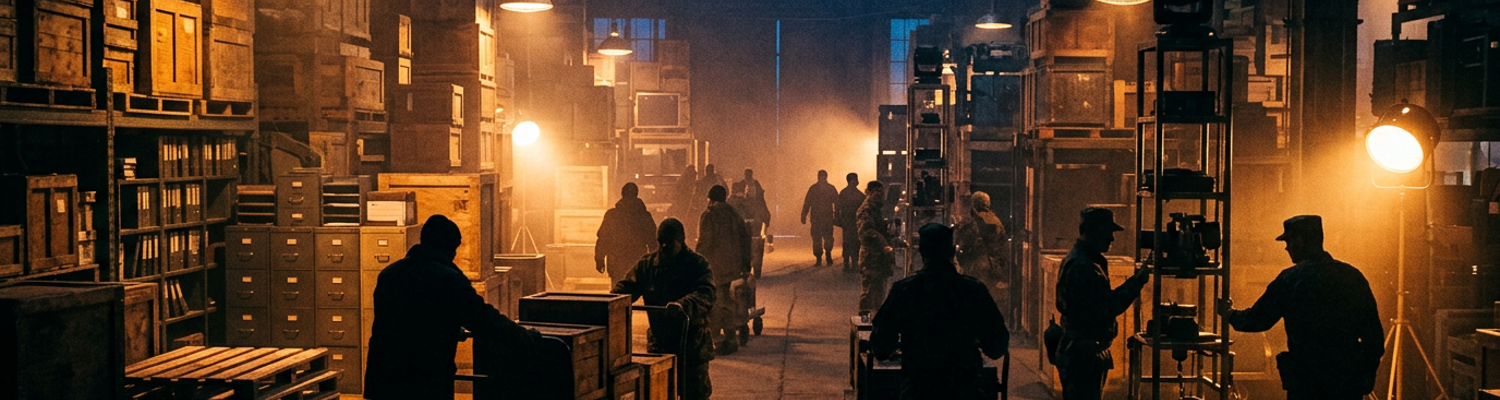
Soldiers of the records processing detachment dragged crates of captured enemy files past rusted torpedo mounts. Crews wrestled five hundred pound wooden crates across cracked pavement and struggled to clear narrow aisles blocked by incoming shipments. Popular postwar spy fiction reimagined the Alexandria facility as an active operational espionage hub, but the physical reality involved broken hand trucks, peeling lead paint, and stifling summer heat. Water dripped from leaking overhead pipe joints onto stack after stack of fragile wartime folders while warehouse workers constantly shuffled tarps to protect the salvageable pages. Handlers hauled heavy bundles away from flooded floor drains as clerks examined waterlogged boxes to assess document losses. Supervisors scrambled to keep the crumbling pulp dry as tons of paper threatened to rot before cameras could photograph a single page.
Pages required immediate stabilization before technicians could mount high reduction cameras over makeshift plywood tables, forcing workers to pull twelve hour shifts to capture the delicate German military paperwork before humidity destroyed the ink. The 1958 General Services Administration report established the physical footprint of seized foreign documents across repurposed naval ordnance warehouses, covering hundreds of thousands of square feet jammed with wooden footlockers and metal file cabinets. Floor loads in the former munitions shops routinely exceeded standard structural safety limits, forcing military handlers to disperse the heaviest filing cabinets across reinforced concrete bays. Heavy machinery vibrations from nearby industrial cranes shook the work tables and caused early microfilm exposures to blur until workers placed thick rubber isolation pads under each camera leg. Dust from dried cardstock coated every surface and clogged mechanical feed rollers, requiring teams to repeatedly wipe down camera lenses with lint free cloths. Handlers used wooden shims to level wobbly machinery on the sloping factory floors where workers had once rolled heavy naval torpedoes toward the Potomac River.
Potomac River humidity seeped directly into the uninsulated munitions assembly bays and warped cardboard storage boxes. Civilian clerks and enlisted technicians formed hand to hand lines to move overstuffed binders away from drafty cargo doors. Damp air softened the paper fibers and caused brittle report pages to curl and tear whenever personnel lifted them out of storage tubs. Stacks of personnel rosters, technical blueprints, and operational diaries required painstaking manual sorting as clerks separated brittle carbon sheets from heavy bond paper. Every individual folder required manual inspection to remove rusted staples, corroded metal clips, and rotting string ties that could snag camera feeder trays. Clerks used dull bone folders and small brass spatulas to pry stuck pages apart without tearing historical text.
Text fragments required careful repair before conservators smoothed torn margins across wooden workbenches and applied archival mending tissue to keep damaged sheets intact for the camera run. Photographic operators loaded the repaired pages into feeder trays and checked focal alignments under hot incandescent lamps that drove warehouse temperatures past ninety degrees. Supervisors tracked daily progress with chalkboards tallying feet of exposed microfilm and pounds of cataloged paper. Completed reels went into tin canisters labeled with simple stamped index numbers before clerks packed the canisters into steel cabinets destined for permanent federal repositories. Field officers signed off on daily shipping manifests as flatbed trucks backed up to the loading docks. Drivers threw heavy canvas tarps over the cargo, strapped down the wooden crates, and hauled the bulk paper toward long term storage facilities.
Administrative Custody Transfer of Seized Axis Records
Storage facilities received the bulk paper while military administrators remained inside the torpedo plant to finish the transfer records. The Department of the Army Adjutant General Office transferred jurisdiction of over one hundred thousand cubic feet of Axis documents to the National Archives and Records Service in 1958. This transfer stripped the intelligence detachment of direct control over the captured paperwork, forcing military leaders to concede administrative control because the Army lacked the permanent staff and specialized facilities required to manage such a massive volume of fragile paper. Enlisted clerks stood beside the rows of wooden storage racks with metal clipboards. They stamped handover logs and cross checked shipping numbers against civilian inventory manifests.
Manifests guided civilian archivists as they checked each line item against the rows of damp cardboard cartons and took over physical supervision of the bays room by room. The institutional chartering of the World War II Records Division formally transitioned the military intelligence cache to civilian archival stewardship. Government officials created this dedicated division within the National Archives to establish systematic control over the vast foreign holdings. Archival directors discarded temporary military intelligence sorting codes and instituted standard federal cataloging systems. Staff members traded khaki uniforms for gray cotton work coats and moved through the unheated concrete plant with dust masks and flashlights. Technical teams pried open neglected crates stored beneath rusted ceiling beams and discovered overlooked German naval records and army corps command files that required immediate stabilization.
Stabilization teams scraped mold from the newly opened wooden crates and carried the brittle sheets to flat sorting benches. Civilian technicians dismantled old military security barricades and turned armed guard posts into routine sorting stations. Teams replaced rotting wartime wrappers with acid neutral folders while clerks carefully transcribed original German field post numbers and division markings onto standardized index tabs. Supervisors ordered the immediate disposal of water damaged shipping crates, sending crews to shovel decaying wood chips and splintered slats into heavy steel scrap bins outside the loading doors. Workers loaded hundreds of freshly labeled document containers onto wheeled metal carts. They wheeled the carts along the concrete corridors toward the central microfilming laboratories.
Laboratories received the loaded carts as camera operators swung open the heavy steel doors of the microfilming bays. Technicians immediately inspected each tray of prepared paper for missing pages before operators clamped the original operational logs flat beneath glass pressure plates. They snapped high resolution negatives frame by frame to complete master reproduction reels. Civilian administrators verified each finished photographic spool against the master inventory lists before packers boxed the film reels for shipment to the main National Archives building in downtown Washington. Warehouse crews loaded the original photographed paper collections back into dry storage bays. Guards locked the perimeter gates and secured the building against Potomac River dampness. Security personnel signed off on the final shift change at the warehouse gates, pocketed the heavy brass keys, and left the decommissioned torpedo factory under quiet administrative management.
Diplomatic Restitution Schedules and Repatriation Mandates
Management personnel faced urgent diplomatic restitution deadlines as soon as morning shifts unlocked the administrative offices. State Department diplomatic protocols set strict deadlines to repatriate original Wehrmacht, High Command, and Luftwaffe documentation to the West German federal archives. Officials in Bonn pressed the United States government to return sovereign military records so the new West German state could administer veteran pensions, settle civil claims, and establish its national archives. Army intelligence officers could not retain the captured files as permanent operational property because international agreements recognized the Federal Republic of Germany as the ultimate owner of the paper. Warehouse managers tacked repatriation schedules onto wooden support posts beside the storage aisles. They marked exact shipping dates for each army corps and division collection.
Collections faced intense scrutiny as inspectors enforced strict legal mandates governing the transfer. Interagency agreements required full preservation capture before physical crates were loaded for transatlantic sea transport. Representatives from the National Archives, the State Department, and the Department of the Army agreed that not a single operational logbook or situation map could leave American soil without a complete photographic copy on master film reels. Civilian researchers and defense planners recognized that American agencies would lose physical custody of the enemy command records once the original files returned to West Germany. Officers refused to sign shipping releases for any wooden shipping container until laboratory personnel verified every reel of microfilm against the original folder contents.
Contents verification required technicians to examine each developed spool on illuminated light tables to hunt for blurry margins, skipped pages, and overlapping carbon sheets. Camera operators hurried back to the warehouse aisles whenever inspectors flagged an illegible frame, pulling the specific Wehrmacht folder back off the staging shelf to reshoot the damaged document. Heat from the heavy photography lamps caused pages to curl during these retakes while mechanical feed jams snapped brittle paper and forced operators to mend torn sheets with archival tape. Clerks logged each approved spool into bound registry books and stamped the corresponding paper files with formal clearance markings. Handlers transferred the cleared folders directly to the packing lines.
Packing lines received the cleared files as laborers lowered the folders into heavy wooden crates lined with waterproof tar paper to protect the records from salt air. Laborers hammered steel banding around the pine boxes and stenciled shipping codes across the lids. Forklift drivers moved the sealed crates onto the concrete loading docks and stacked the shipments into designated holding bays beside the railway tracks. Port marshals checked the crate manifests against federal export declarations to clear the cargo for movement to Atlantic docks and transatlantic sea transport to West Germany. Riggers secured heavy tie down chains over the loaded pallets as the first transport trucks backed into the dock bays.
Industrial Microfilming Operations Across Munitions Warehouses
Trucks idled outside the open dock bays while Army technical intelligence personnel and civilian historians operated planetary cameras across four waterfront munitions buildings. Workers set up heavy photographic towers directly on the concrete floors where naval machinists had once assembled torpedo casings. Each workstation centered on a tall vertical steel column holding a movable lens carriage, flanked by high intensity incandescent lamps that poured heat over flat wooden copyboards. Specialists positioned brittle wartime documents by hand under glass pressure plates, smoothing down folded edges and checking focus marks through calibrated viewfinders. Civilian historians scrutinized the sequence of every command folder to ensure strict chronological order. Operators pressed electrical foot pedals to trip the mechanical shutters and advanced unexposed film through the camera heads with steady rhythmic clacks.
Clacks echoed through the bays as crews created high density master security rolls containing millions of pages of captured operational war diaries. These master rolls captured fragile paper records generated by field armies, corps headquarters, and supreme staff offices across every European battlefront. Historians and technical personnel scrutinized carbon copy sheets printed on low grade pulp, adjusting exposure timers so faint blue inks and smeared pencil annotations remained legible against the yellowed backgrounds. Operators changed reduction ratios on the fly and repositioned the camera heads along the steel vertical columns whenever oversize daily situation maps or folded artillery plots arrived in the document batches. Each completed hundred foot reel of film preserved up to one thousand individual document pages. Darkroom technicians collected the exposed film magazines at regular intervals and carried them through light tight revolving doors to the wet processing sinks.
Sinks sloshed with chemical solutions as technicians guided the long strips of safety film through continuous wash loops. High heat from rows of overhead floodlamps routinely spiked ambient temperatures inside the unventilated munitions bays, softening film emulsions and threatening to warp delicate negatives during chemical processing. Technicians monitored water temperatures with glass immersion thermometers and fed blocks of ice into cooling jackets to maintain precise chemical development speeds. Rotating motorized drums dried the washed negatives before quality control clerks examined every frame on lighted inspection benches. Inspectors examined resolution targets and flagged light flares caused by reflective glass surfaces. Clerks stamped verification marks onto reel leader strips for every batch that met federal photographic standards.
Standards verification allowed inspectors to clear approved master rolls from the lighted tables for immediate cataloging. Technicians routed the processed negatives to metal winding tables for secondary duplication, running the approved camera negatives through contact printers to strike working reference reels while reserving the master copies for deep security storage in federal vaults. Soldiers loaded the finished master rolls into airtight metal canisters and sealed each lid with moisture resistant tape. Civilian catalogers cross referenced the can numbers against original army group and division registers. Clerks stacked the sealed canisters into heavy steel transport cabinets and secured the drawers against Potomac River humidity. Warehouse runners hauled empty document carts back to the staging bays to collect the next batch of files.
Declassification Panels and Signals Intelligence Purges
Files reached the camera tables just as inspectors pushed through the aisles to seize the clamped folders. Army intelligence vetting boards screened the operational records to redact Allied signals intelligence methods derived from wartime cryptanalysis. Reviewers examined German communications reports, corps telephone logs, and daily battle assessments to ensure that enemy entries did not reveal how Anglo American codebreakers had intercepted and decrypted top secret Axis radio traffic. Officers scrutinized every margin where German staff commanders noted suspicions regarding compromised Enigma machines or broken teleprinter links. Examiners pulled any sensitive leaf showing successful Allied interception techniques out of the document sequence. Vetting officers set the flagged pages aside in designated cardboard holding trays.
Trays filled rapidly across the inspection tables as vetting officers began physical redactions on the flagged signals intelligence records. Reviewers placed thick stencil masks and opaque black grease pencils over individual sentences that described Allied radio direction finding, physically blacking out the text before cameras could capture the sheets. Censors cut heavy paper shields to cover entire paragraphs whenever an enemy intelligence evaluation discussed Allied traffic analysis patterns. Military examiners cross referenced every redacted line against joint declassification directives from the Department of Defense. Clerks stamped formal redaction control numbers along the margins of each blacked out page and logged the altered sheets into administrative ledgers before passing the remaining division folders to secondary review lines. Secondary review teams opened wooden crates containing captured counterintelligence files staged across the concrete warehouse floor.
Floor staging areas yielded thousands of counterintelligence dockets that required an entirely different set of security restrictions. Censors purged counterintelligence files referencing active Cold War sources and sensitive Western intelligence networks. Intelligence personnel recognized that wartime German security dossiers and informant rosters named hundreds of undercover assets actively gathering intelligence for Western services behind the Iron Curtain. Reviewers extracted complete personal dossiers, source payment receipts, and operational network maps. Staff members inserted stiff red cardboard withdrawal sheets into the vacant folder slots, recording archival withdrawal numbers so researchers knew pages were missing without revealing the identities of protected field agents. Clerks gathered the pulled counterintelligence dossiers into heavy steel footlockers and secured the latches with heavy brass padlocks.
Padlocks clinked against the metal hasps as armed military police loaded the sealed footlockers onto canvas covered transport trucks. Drivers secured the cargo under heavy ratchet straps and hauled the purged counterintelligence files directly to classified vaults in the Pentagon. Vetting officers inside the warehouse completed their final clearance tallies on the surviving operational records and applied declassification stamps in purple ink across each approved folder cover. Archival aides wheeled the vetted folders back to the planetary camera stations on rubber tired handcarts. Photographers adjusted their vertical camera carriages over the stamped sheets and flipped on the overhead incandescent lamps. Operators pressed their foot pedals to resume continuous microfilming of the cleared documents.
Publication of the Alexandria Finding Aids
Documents translated into microfilm rolls that accumulated on sorting tables as processing teams struggled to build an accessible reference collection. Clerks sat beside hand cranked film readers in windowless rooms and squinted at yellowed German typescript to record folder titles, operational dates, and military unit designations. Indexers drafted concise folder descriptions on paper cards for every divisional war diary, staff conference report, and artillery logbook captured on the film reels. Typists transferred these handwritten index entries onto mimeograph stencils and organized the sheets by record group and negative roll number. Carbon ribbons hammered out endless lines of inventory descriptions. The typists cross indexed original German folder headings with newly assigned reel numbers.
Numbers organized the inaugural series of Guides to German Records Microfilmed at Alexandria in 1958. The National Archives published these typed inventories as official reference booklets, gathering the loose mimeographed pages into structured volumes that documented the precise contents of each film spool. These printed volumes allowed researchers to locate specific operational reports without ever searching through physical paper crates. Warehouse personnel proofread the printed pages against original card files and corrected mislabeled division numbers. They verified reel counts before running the sheets through print shop collators. Heavy metal staples bound the thick booklets along cardstock spines to produce durable catalogs ready for public use.
Catalogs served as systematic guides tracking tactical field commands, Reich ministries, and party organizations for independent researchers. Scholars consulted the entries to track the movements of field armies across the Eastern Front, examine policy memos from the Reich Chancellery, and inspect local party membership rolls. Each printed entry listed the roll number, frame sequence, and general description of the filmed documents. Researchers used these listings to order duplicate microfilm rolls through the mail, directing their requests to specific reel numbers rather than waiting for intelligence clearances. Clerks checked incoming request slips against the guide tables and pulled the corresponding film canisters from row after row of steel storage cabinets.
Cabinets emptied as packers loaded stacks of finished guidebooks into cardboard cartons for delivery to academic libraries. Delivery trucks moved the boxed publications out of the Alexandria gates and distributed the reference volumes to civilian institutions. Readers in university research rooms used the printed guides to navigate thousands of microfilm rolls, bypassing Cold War intelligence channels to reconstruct wartime campaigns directly from staff records. Warehouse workers rolled empty document carts back to the microfilming bays and swept loose paper trimmings off the mimeograph tables. They stacked fresh boxes of index cards beside the manual typewriters. Supervisors locked the master inventory ledgers inside metal filing cabinets and marked off another completed distribution target on the warehouse chalkboards.
Documentary Deconstruction of the Clean Wehrmacht Myth
Chalkboards tracked the distribution as civilian historians and military researchers unspooled the newly cataloged microfilm reels under bright reading lamps. Civilian scholars and intelligence evaluators began cross checking the microfilmed German records against popular postwar memoirs written by surviving field marshals. These bestselling memoirs insisted that regular German army formations had stayed untainted by the criminal policies of the Nazi regime. Raw unit war diaries directly refuted postwar officer memoirs that deflected operational responsibility away from standard military formations. Analysts cranked film viewers through routine morning situation reports, radio intercepts, and quartermaster receipts to uncover an uninterrupted record of field commands executing radical orders on the ground. Researchers paused the film reels over typed combat journals that matched specific battle groups to brutal reprisal actions against civilian populations.
Populations suffered as glass lenses exposed operational dispatches where division staff officers coordinated directly with mobile killing squads. Popular military histories had long repeated officer claims that frontline troops fought a strictly conventional conflict. Captured war diaries destroyed that defense by recording regular army units establishing security cordons, supplying transport trucks, and providing guard details around execution sites. Staff logs from army corps, motorized divisions, and rear area security commands recorded daily operational cooperation with security police detachments. Field commanders signed daily ammunition disbursement slips for firing squads and logged civilian executions alongside bridge repairs and fuel deliveries in their standard ledger columns. Clerks entered these actions into the daily journals as routine military business managed by regular soldiers in combat uniform.
Uniforms provided no shield as archivists duplicated the incriminating pages for public circulation. The systematic release of original day to day logs provided undeniable proof of Wehrmacht complicity in ideological atrocities on the Eastern Front. The filmed documents detailed how combat formations enforced the Commissar Order and executed captured political officers immediately upon capture. Tactical logs showed field armies deliberately starving hundreds of thousands of Soviet prisoners of war in open pens. Other daily records described frontline troops burning rural settlements and shooting hostages during anti partisan sweeps. These military files carried original hand drawn operational maps, rubber unit stamps, and signature blocks of senior field commanders, leaving no room for postwar apologists to dismiss the accounts as hostile propaganda or wartime rumor.
Rumors dissolved as couriers loaded crates of duplicate microfilm reels containing these verified logs onto delivery vans at the Alexandria docks. The vans sent the evidence to university libraries and public archives across the country. Independent researchers and civilian scholars combed through the photographed logbooks frame by frame, comparing the unit entries against published autobiographies that had dominated Cold War military literature. Scholars used the stamped dates, route maps, and combat strength returns to build chronological campaign studies that dismantled the myth of an honorable, detached Wehrmacht once and for all. Warehouse personnel in Alexandria cleared their processing benches of the vetted divisional folders and prepared the camera tables for the next intake of captured foreign records. Workers wheeled another wooden cart loaded with German army files into the center aisle and unlatched the metal storage bins to keep the documentation line moving.