
Ignored Armor Intelligence Across the Laotian Border
Fog covered the jagged limestone ridges along Route 9, blocking visibility from observation posts and soaking the steep Laotian borderland in relentless moisture. Thick elephant grass and tangled bamboo filled every ravine, forcing reconnaissance patrols to cut through dense vegetation under heavy heat before afternoon downpours washed the red topsoil into slick mud. Special Forces soldiers from Detachment A-101 constructed their fortified camp at Lang Vei directly into this unstable clay, contending daily with collapsing trench walls, flooded fighting pits, and eroded perimeter berms. American operators and indigenous troops struggled continuously to keep weapons clean, communication wires operational, and perimeter minefields anchored against the shifting hillsides. These punishing environmental conditions severely limited vehicle travel on the few primitive trails, convincing conventional planners in rear headquarters that the surrounding wilderness formed an impassable barrier against any enemy armored vehicles.
Patrols from the clandestine MACV-SOG organization tracked diesel engine rumbles and wide track impressions across the Laotian border prior to February 1968, finding physical evidence that directly challenged this official assessment. Defense Intelligence Agency advisories soon matched these field reports, circulating urgent warnings that North Vietnamese Army PT-76 amphibious light tanks had marshaled in hidden staging areas along the Ho Chi Minh Trail. Captain Frank Willoughby recognized the catastrophic danger of these armored units and began requesting heavier anti-tank weapons, including anti-tank mines and dedicated heavy artillery support for his Lang Vei garrison. Willoughby instructed his Green Berets to inspect dead zones along the dry riverbeds, test every available light anti-tank rocket, and rehearse defensive reactions against moving vehicles. Radio operators sent every verified reconnaissance report detailing tank engines, tread marks, and diesel fuel storage caches directly up the military chain of command to alert senior commanders.
Officers at conventional MACV headquarters and within the 26th Marine Regiment at Khe Sanh routinely dismissed these tank sightings as logistically unfeasible for the surrounding jungle terrain. Marine leaders believed that the swollen rivers, steep ravines, and total lack of paved highways made heavy vehicle travel impossible across the plateau. Bureaucratic analysts at higher headquarters argued that the North Vietnamese Army could never move the massive amounts of diesel fuel, spare parts, and heavy maintenance equipment needed to keep armor operational in such remote mountains. This professional disagreement produced sharp friction between the frontline Green Berets and conventional commanders stationed just six miles to the northeast. Colonel David Lownds commanded the 26th Marines at the Khe Sanh combat base and refused to promise ground relief or dedicate his heavy artillery batteries to Lang Vei, viewing the isolated Special Forces outpost as an expendable forward screening position.
Detachment A-101 soldiers reinforced their underground bunkers with extra layers of heavy logs, sandbags, and red clay after learning that no conventional ground relief would march from Khe Sanh. Special Forces sergeants trained their local Bru and Montagnard strike force soldiers to fire M72 light anti-tank weapons, showing them how to aim at the thinner side armor, engine grates, and road wheels of the Soviet-built tanks. Green Beret operators dug deeper fighting pits, laid additional concertina wire across probable approach routes, and listened to the distant grinding of heavy machinery vibrating through the earth at night. Outpost observers noted that the enemy armor possessed superior night-vision equipment and amphibious capabilities, allowing the tanks to cross streams and maneuver through ground that conventional doctrine labeled impassable. Captain Willoughby ordered his men to sleep beside their loaded rocket launchers, maintain continuous perimeter watches, and prepare to defend the base without outside assistance.
Detachment A-101 Fortifications and Defensive Architecture
Captain Frank Willoughby directed twenty-four Green Berets alongside hundreds of Montagnard, CIDG, and Royal Laotian irregulars across the fortified compound to maintain these continuous fighting watches. The American detachment divided the base into designated company sectors, assigning indigenous Bru and Montagnard strike force companies to hold the forward trench lines while Laotian irregulars guarded the administrative camp and southern approach. Willoughby stationed small teams of two or three Green Berets inside each indigenous company area to supervise weapons maintenance, coordinate defensive fire plans, and prevent panic among the non-English-speaking troops. Cultural differences and language barriers created daily friction among the allied units, forcing the Green Berets to use hand signals, local interpreters, and repetitive combat drills to keep everyone prepared for ground assaults. These diverse combat units worked in alternating twelve-hour shifts to clear jungle brush, fill sandbags, and mount heavy machine guns overlooking the highway approach.
Steel concertina wire belts encircled these forward machine gun positions in deep concentric bands to stop enemy infantry and sappers before they could reach the trenches. The camp defensive layout relied on concentric concertina wire belts, claymore minefields, and reinforced timber bunkers centered on a subterranean concrete Tactical Operations Center. Green Beret demolition specialists rigged hundreds of M18A1 Claymore mines throughout the cleared fields of fire, pointing directional fragmentation charges toward every dry stream bed and natural ravine around the base. Indigenous troops drove sharpened bamboo stakes between the wire barriers and strung tripwires connected to white phosphorus flares to expose night infiltrators. Timber fighting bunkers stood at regular intervals along the inner trench line, built from heavy jungle logs and covered by red clay berms thick enough to deflect direct mortar strikes and small-arms fire.
Concrete walls anchored this bunker network at the center of the camp, housing the subterranean Tactical Operations Center beneath heavy timber overhead cover and deep red clay. This command bunker functioned as the nerve center for all base communications, containing map tables, telephone switchboards, and long-range radios tuned to American air support frequencies and Khe Sanh command nets. Willoughby and his communication specialists ran heavy-gauge field wire through shallow trenches out to each company command post, though incoming mortar rounds regularly threatened to cut these landlines. Special Forces technicians placed backup generators inside blast-protected side chambers to keep the tactical radios powered if artillery severed the exterior utility lines. Radio operators tested their signal equipment every hour to monitor their tenuous link with the 26th Marines at Khe Sanh, though Marine staff officers continued to treat requests from Lang Vei as low-priority interruptions.
Willoughby responded to this official indifference by placing two 106mm recoilless rifles and a pair of 57mm guns directly into reinforced revetments along the primary vehicle approach routes. Weapons crews stacked high-explosive anti-tank rounds inside timber-lined ready boxes beside each gun, ensuring gunners could fire multiple shots within seconds of spotting enemy armor. Mortar teams sighted their 81mm and 4.2-inch tubes onto pre-registered target markers across the perimeter wire to drop high-angle defensive barrages on advancing enemy infantry. Green Beret weapons sergeants distributed M72 light anti-tank rockets to indigenous squad leaders, instructing each rifleman to keep the weapon slung across their chest during every watch. Willoughby inspected each perimeter bunker before nightfall, checking that gunners kept their rocket launchers primed and their firing pins cleared of red mud.
Midnight Assault of the 198th NVA Armored Battalion
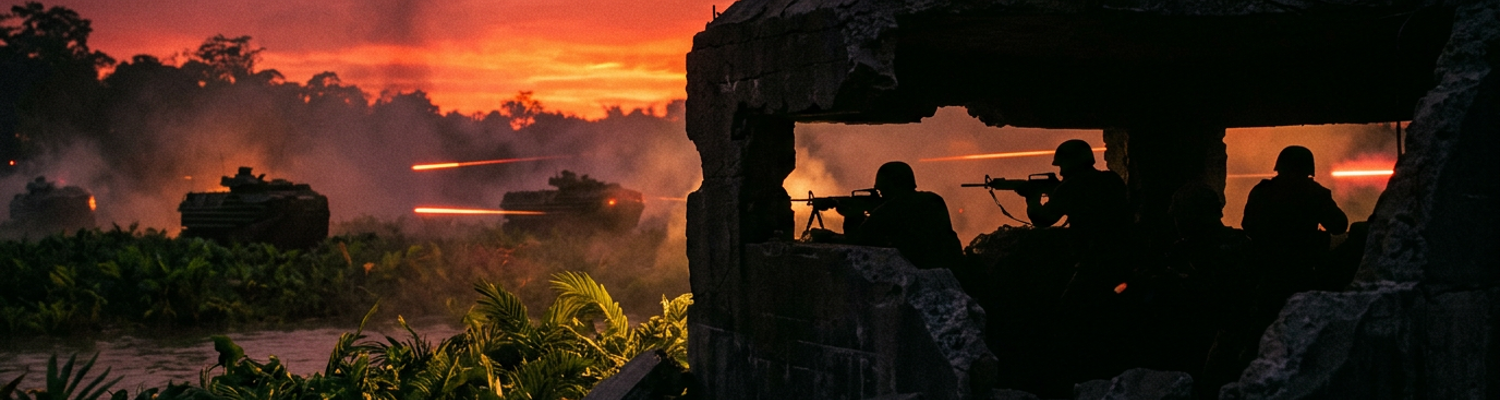
Gunners gripped their primed launchers inside the forward bunkers as heavy artillery salvos pounded the camp on the night of February 6, 1968, when the NVA 198th Armored Battalion and 24th Infantry Regiment launched a coordinated assault against the Lang Vei perimeter. Screeching metal tracks and roaring diesel engines echoed through the dense fog along Route 9, confirming the armored threat that conventional command had insisted could never cross the Laotian border. North Vietnamese combat engineers blew gaps through the outer defensive belts with satchel charges and bangalore torpedoes, creating clear lanes for advancing infantry squads. North Vietnamese soldiers moved behind the sappers under high-explosive mortar cover, firing automatic rifles into the forward observation posts. Special Forces radio operators shouted into their tactical handsets that Soviet-built vehicles were overrunning the camp, but Khe Sanh staff officers hesitated to commit heavy artillery without visual Marine confirmation.
PT-76 light amphibious tanks breached the outer defensive wire during this lethal delay, crushing defensive fighting positions and directly shelling forward trench networks. Steel treads flattened sandbags and collapsed log overhead covers, burying indigenous riflemen alive inside their fighting holes. North Vietnamese tank commanders stood exposed in open turrets, firing coaxial machine guns into the communication trenches while their main 76mm guns blasted bunker embrasures at point-blank range. Green Beret weapons specialists rushed into the open trench lines with M72 light anti-tank weapons, aiming directly at the rear engine decks and exposed bogie wheels of the lead vehicles. Several rocket warheads failed to penetrate the Soviet armor, glancing off curved hulls or detonating without piercing the internal crew compartments. Surviving defenders scrambled through the smoke toward secondary fighting positions, dragging wounded Montagnard soldiers away from the churning tank tracks.
Specialist Five James Holt manned a 106mm recoilless rifle beside the secondary perimeter, loading high-explosive anti-tank rounds to halt the vehicles pursuing his retreating comrades. His first high-explosive shot struck the lead PT-76 in the turret ring, igniting its internal ammunition stores and blowing the armored hatch off the vehicle. Holt reloaded swiftly and disabled a second advancing tank before an enemy 76mm high-explosive shell destroyed his firing revetment. Hostile infantry from the 24th Regiment advanced through the smoking breach, spraying submachine gun fire across the supply depot and tossing satchel charges into company command bunkers. Strike force irregulars broke under the overwhelming firepower, leaving isolated teams of Green Berets to fight hand-to-hand from scattered weapon pits.
Captain Willoughby ordered all surviving Green Berets and loyal irregulars to fall back into the concrete Tactical Operations Center as enemy armor rolled across the central compound. North Vietnamese armor crews drove their tanks directly atop the reinforced bunker roof, firing machine guns through ventilation pipes and attempting to collapse the overhead logs. Radio operators inside the subterranean room pleaded with the 26th Marines at Khe Sanh for ground reinforcement or air strikes directly on their own coordinates. Marine officers at Khe Sanh refused to send ground troops into the nighttime jungle, arguing that their own combat base remained under imminent threat of assault. Willoughby bolted the heavy blast doors, distributed the remaining hand grenades among his wounded operators, and prepared to defend the underground command room to the last man.
Catastrophic M72 LAW Failures Against Soviet Armor
Steel blast doors sealed Willoughby and his radio operators below ground while isolated Green Berets fought desperately in the open trenches to stop the advancing PT-76 armor. Green Beret defenders discovered that pervasive jungle humidity had degraded the percussion firing mechanisms and shaped charges of their shoulder-fired M72 Light Anti-Tank Weapons. Damp mountain fog and heavy monsoon rains had seeped through the rubber seals of the disposable launch tubes during weeks of storage inside wet dirt revetments. Operators extended the telescoping tubes and pressed the rubber trigger bars, only to hear useless mechanical clicks as damaged linkages and dampened primers failed to ignite the rocket propellant. Dozens of these unserviceable launchers failed to fire completely, leaving riflemen defenseless in exposed fighting pits while diesel exhaust filled the air.
Rockets that actually fired provided little protection across the compound, because defective LAW munitions failed to detonate or bounced off PT-76 hulls, forcing operators to attempt close-range ambushes with 106mm recoilless rifles and thermite grenades. Point-blank impacts against the curved cast turrets and sloped glacis plates repeatedly failed to crush the nose fuses at the required ninety-degree angle, deflecting intact projectiles harmlessly away into the darkness. Warheads that struck the thin side armor of the amphibious tanks detonated with weak surface pops because moisture had decomposed the explosive compound, preventing the shaped charges from burning through the hull plates. North Vietnamese tank commanders observed these harmless deflections and pressed forward aggressively, using their coaxial guns and 76mm cannons to blast apart every sandbag position that produced a rocket backblast. Shrapnel from exploding artillery and direct cannon rounds tore through the inner communication trenches, slaughtering indigenous troops and driving surviving American sergeants out of their overrun fighting positions.
Gunners converged on the camp remaining heavy weapons pits to mount sudden flank ambushes against the advancing armor. Special Forces operators loaded heavy high-explosive anti-tank shells into the surviving 106mm recoilless rifle and targeted a PT-76 moving past the burning mess hall. Direct 106mm cannon fire slammed into the side flank of the Soviet vehicle, ripping through the tracks and detonating the onboard ammunition storage in a violent explosion. North Vietnamese infantry swarmed the gun revetment immediately after the shot, raking the open position with machine-gun fire and knocking out the recoilless rifle before the crew could reload. Surviving operators grabbed cans of thermite grenades from an adjacent ammunition bunker, resolving to hunt the remaining vehicles on foot through the burning camp.
Thermite canisters hissed violently as daring soldiers leaped onto the flat rear decks of the maneuvering PT-76s to drop burning incendiaries directly over the engine grates. Blinding chemical fires generated temperatures exceeding four thousand degrees, melting through thin steel access covers and pouring liquid iron into the engine compartments. Dense smoke and burning oil filled the vehicle cabins, disabling the drive mechanisms and forcing enemy crewmen to bail out into the open trenches. Hostile infantry supporting the armored column quickly surrounded the isolated Americans, firing Kalashnikov rifles point-blank to clear the tanks and drive the defenders into secondary drainage ditches. Sergeants dragged their wounded comrades through the mud toward the outer perimeter wire, leaving the smoking hulls behind as fresh enemy tanks took control of the central compound.
Subterranean Siege Inside the Tactical Operations Center
Special Forces soldiers and indigenous troops withdrew into the reinforced underground Tactical Operations Center bunker beneath mounting structural rubble after enemy armor sealed off the surrounding trenches. Captain Willoughby secured the steel blast hatch from within, gathering ten American Green Berets, several South Vietnamese interpreters, and dozens of terrified Bru strike force fighters inside the cramped shelter. Heavy tank treads churned directly across the timber and earth roof above their heads, crushing the ventilation shafts and collapsing heavy ceiling beams into the crowded subterranean corridor. Choking clouds of red clay dust, battery acid fumes, and engine exhaust settled over the trapped occupants as emergency lantern filaments shattered under the continuous vibrations. Radio operators huddled over their PRC-25 sets in the dim emergency light, reporting that North Vietnamese troops had occupied the surface completely and were hunting for bunker access points.
North Vietnamese sappers scrambled across the fractured bunker roof with pickaxes, crowbars, and explosive charges to breach the concrete ceiling. Sappers peeled away splintered logs and sandbags, exposing the concrete slab before blasting jagged breach holes through the overhead roof to drop satchel charges directly onto the men below. Medical personnel treated severe fragmentation wounds, third-degree burns, and asphyxiation in total darkness while enemy engineers blasted holes in the ceiling to lower explosives on wire cables and ropes. Medic Kenneth Beeson and fellow Green Berets tore field dressings with their teeth, binding shredded limbs by touch and administering morphine while shrapnel caromed off the concrete walls. Smoldering tear gas and explosive residue filled the pitch-black lower room, forcing the wounded defenders to cover their faces with urine-soaked bandages to draw breath.
Carbine barrels thrust upward through the smoking ceiling breaches as Green Beret sergeants fired blind bursts into the daylight to drive the enemy sappers away from the openings. Enemy troops answered by shoving automatic rifles through the gaps, raking the dirt floor with bursts of submachine-gun fire and dropping fragmentation grenades down the open blast shafts. Special Forces sergeant Peter Serrano caught falling grenades and kicked them into corners or smothered them under dead equipment packs to shield the wounded irregulars lying along the walls. Thermite grenades dropped down the shafts burned white-hot across the metal radio consoles, melting circuit boards and filling the sealed chamber with toxic fumes that threatened to suffocate everyone inside. Lieutenant Colonel Daniel Schungel gathered the uninjured operators to form an interior defense perimeter facing the main entryway.
Steel blast doors groaned under the impact of shaped charges detonated against the exterior stairwell by demolition teams attempting to force the entrance. Shockwaves from these breaches buckled the metal frame and blew heavy debris across the tactical operations floor, burying several Montagnard fighters under cracked masonry blocks. Willoughby kept his remaining men in a tight firing arc behind overturned tables and ammunition crates, directing shotgun and rifle fire down the narrow concrete stairway whenever enemy soldiers attempted to crawl inside. North Vietnamese voices shouted down through the breached ceiling vents, demanding immediate surrender and warning that flamethrowers were being moved into position over the bunker. American operators loaded their final magazines, fixed bayonets to their rifles, and trained their muzzles on the shattered doorway to repel the impending breach.
Command Reluctance and Khe Sanh Relief Column Refusal
Radio operators inside the battered Tactical Operations Center shouted urgent distress calls into their transceivers while Green Beret riflemen aimed at the shattered doorway. Captain Frank Willoughby pleaded over the radio network for the 26th Marine Regiment to dispatch the planned armored relief force from Khe Sanh Combat Base, located nine kilometers to the northeast along Route 9. North Vietnamese infantry and PT-76 tanks occupied the ground directly above the subterranean bunker, leaving the defenders with no escape route unless outside mechanized forces broke the perimeter encirclement. Marine operations officers at Khe Sanh received these desperate pleas but declined to commit their mechanized assets to the dark highway. Colonel David Lownds listened to the static-filled transmissions in his regimental command post and refused to order his tanks and infantry into the night, stripping the defenders at Lang Vei of immediate ground support while enemy demolition teams detonated satchel charges across the roof.
Colonel Lownds prioritized the defense of the main combat base above all external missions, viewing Lang Vei as an exposed outpost that sat too close to the Laotian border. The clandestine status of the 5th Special Forces Group exacerbated operational friction with conventional Marine command, leaving the besieged garrison isolated without direct ground support. Marine officers had long expressed skepticism regarding the autonomous authority granted to Green Beret detachments, which operated independently with irregular CIDG strike forces and Laotian border fighters outside the standard chain of command. Conventional headquarters in Da Nang and Saigon had repeatedly issued conflicting directives regarding whether Khe Sanh was formally obligated to protect civilian irregular defense camps. Bureaucratic communication breakdowns between Army special operations channels and Marine regimental staff prevented coordinated defensive planning before the battle began, allowing inter-service disagreement and administrative hesitation to dictate tactical responses under fire.
Marine leadership at Khe Sanh Combat Base repeatedly denied requests to deploy a mechanized armor relief column along Route 9 due to ambush risks. Marine reconnaissance patrols reported that the North Vietnamese 304th Division had established prepared ambush positions with heavy machine guns, B-40 rockets, and artillery observers along the dense vegetation bordering the unpaved highway. Officers on the regimental staff remembered the total destruction of French Mobile Group 100 on an identical stretch of road in 1954 and refused to repeat that tactical disaster in the dark. Lownds pointed out that sending M48 tanks and tracked landing vehicles down the single mud road without infantry security on the ridges would trap the relief force in direct crossfire. Thick cloud cover and low-hanging fog also prevented attack aircraft from dropping ordnance close enough to suppress enemy gunners along the embankments, leading Marine commanders to conclude that an attempted breakout would sacrifice hundreds of additional men without reaching the trapped Green Berets.
Captain Frank Willoughby received this final refusal over the subterranean radio network as fresh explosions shook the concrete bunker walls. Lieutenant Colonel Daniel Schungel set the microphone down and told the surviving operators that Khe Sanh would send no ground reinforcements to save the camp. Green Beret sergeants inside the dark operations room accepted that they were completely surrounded and had to hold the bunker alone. Defenders dragged heavy equipment chests and crushed timber beams against the buckled steel blast door to slow down enemy sappers. Willoughby positioned his uninjured men in a defensive perimeter behind overturned steel desks with their weapons aimed at the stairway. Soldiers chambered their remaining rounds and waited in silence for the final North Vietnamese assault against their subterranean position.
Morning Counterattack and Improvised Survivor Breakout
Gunfire erupted across the surface as First Lieutenant Paul Longgrear and Sergeant First Class Eugene Ashley Jr. coordinated repeated counterassaults with Laotian irregulars to suppress enemy perimeter positions and draw North Vietnamese troops away from the bunker. Sergeant Ashley gathered over one hundred armed Laotians and led them forward against reinforced North Vietnamese machine-gun nests operating out of the old base camp down Route 9. Marine command at Khe Sanh maintained its refusal to send ground reinforcements, which forced Ashley to direct emergency artillery missions and air support over his hand-held radio while running between exposed fighting pits. Ashley drove his irregular force through four separate frontal charges into heavy automatic fire, knocking out several enemy positions along the trench lines before artillery shrapnel struck him down during a fifth assault. The fierce counterattacks disrupted North Vietnamese consolidation efforts and forced enemy gunners to swing their heavy weapons toward the perimeter, granting the trapped men inside the underground bunker a fleeting chance to escape.
Captain Frank Willoughby seized this opportunity and ordered the underground survivors to unblock the shattered blast hatch and prepare for immediate evacuation. Trapped survivors executed a desperate morning breakout through rubble and remaining trench networks under emergency close air support to link up with rescue helicopters. Lieutenant Colonel Daniel Schungel kicked through the smoldering debris at the entrance, firing his carbine into enemy sniper nests while Green Beret sergeants carried severely burned and mangled comrades up the concrete steps. Air Force A-1 Skyraiders and Marine jet pilots repeatedly dropped napalm and five-hundred-pound bombs directly on the camp perimeter, creating curtains of fire and thick smoke that blinded North Vietnamese machine-gun crews. The survivors scrambled along half-collapsed drainage ditches and shattered timber bunkers, keeping their bodies low to avoid friendly bomb fragments and hostile small-arms fire that churned the red clay around them.
Machine guns fired continuously from the tree line as the fleeing column pushed through this hostile fire toward the southern perimeter wire and the open fields of the old camp. Green Beret operators fired their last carbine magazines into enemy rifle squads that pursued them through the shattered barbed-wire barriers. Bru and Montagnard fighters who survived the nighttime armor onslaught carried wounded Americans on improvised ponchos, navigating around unexploded ordnance and burning PT-76 hulls. Forward air controllers flying light observation planes noticed the ragged group emerging into the open and directed attack aircraft to strafe enemy positions along Route 9. Airstrikes and suppressive gun runs forced North Vietnamese infantry to pull back into the jungle tree line, clearing a narrow corridor for the exhausted soldiers to reach the landing area.
Helicopters from the United States Marine Corps and the 119th Assault Helicopter Company touched down through intense anti-aircraft fire in this cleared corridor near the old camp. Door gunners laid down steady machine-gun fire into the surrounding woodline while crew chiefs jumped into the mud to pull wounded Green Berets and indigenous fighters into the cargo bays. Lieutenant Longgrear and the remaining operational soldiers formed an outward security perimeter around the landing skids, guarding the loading process against approaching enemy skirmishers. Flight crews loaded the casualties aboard, pulled in the surviving defenders, and lifted off through heavy automatic-weapons fire toward the safety of Khe Sanh. Pilots accelerated their turbine engines and banked hard to the east, carrying sixty wounded survivors away from the smoking perimeter while enemy rounds pinged against the aluminum fuselages.