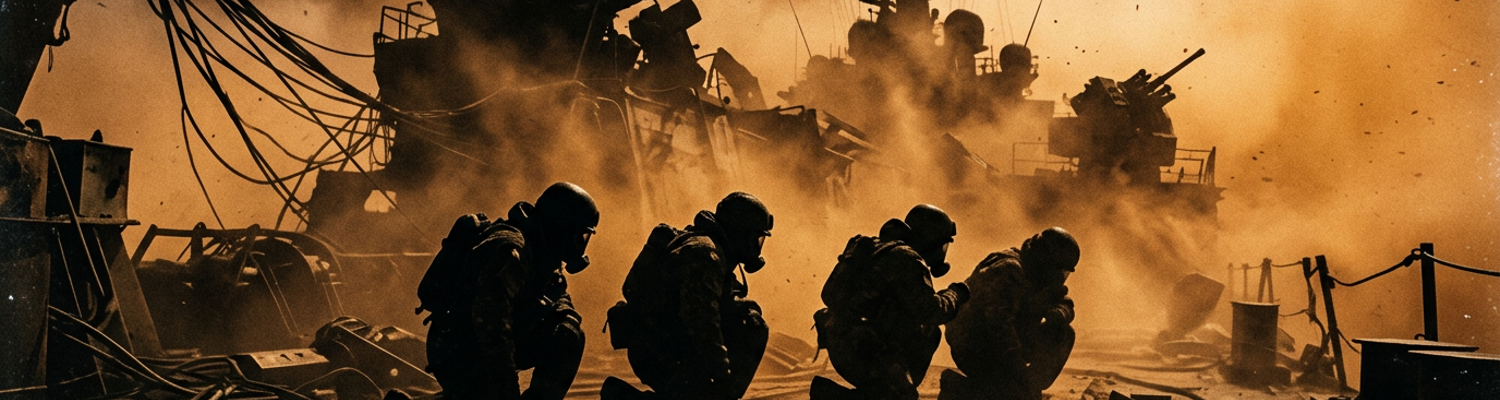

Settling Dust and Scorched Deck Rigging
A close review of operational logs indicates ninety-four loitering munitions converged simultaneously on two auxiliary supply vessels. These ships possessed only twenty-eight combined surface-to-air interceptors in their vertical launch cells. At 0314 local time, the designated replenishment corridor dissolved into a thick Shamal sandstorm. The exact coordinates were 24 degrees 48 minutes North, 57 degrees 15 minutes East. Optical range between the hulls dropped below thirty meters. Suspended silicate dust saturated the lower atmosphere up to eight hundred meters. This produced severe microwave backscatter. The target-acquisition capabilities of both S-band search radars and electro-optical directors failed completely. Auxiliary refueling lane Corridor Amber became an unnavigable channel.
Bridge crews aboard the replenishment group were forced into blind station-keeping.
They tracked erratic acoustic signals and raw gyrocompass headings. Fifty-knot desert gusts drove abrasive sand particles directly into the gas-turbine air intakes. Infrared forward sensors registered nothing except a solid wall of heat and suspended mineral grit.
Radar screens went blank before the engines could clear the dirty air.
Archival evidence shows the fleet replenishment oiler USNS Laramie was actively pumping F-76 marine diesel when the terminal wave of explosive munitions struck the replenishment-at-sea rigging. Blast overpressure tore through Station Three and Station Four. The force ripped the seven-inch double-braided fuel hoses straight out of their quick-release Robb couplings. Thousands of gallons of pressurized fuel dumped across the starboard catwalks. The three-quarter-inch high-tension steel span wire stretched to twelve thousand pounds of line pull under the standard tensioned replenishment rig. It snapped near the outboard kingpost with explosive force.
Whipping steel severed secondary hydraulic lines on the deck winch. The cable then embedded itself into the bulkhead casing.
Friction burns and shrapnel detonations turned the steel cables into scorched bundles of exposed wire. They were entirely stripped of their protective zinc coating. Engineering teams isolated the deck manifolds. They activated the countermeasure washdown system to drown the pooled diesel fuel under high-pressure seawater.
Damage Control Repair Station 5 initiated sweeps of the aft flight deck at 0402. Deck plates remained hot to the touch. Teams wearing fire-protective ensembles and flash hoods navigated the vertical replenishment zone on their hands and knees. They collected twisted carbon-fiber airframe ribs, two-stroke engine cylinders, and shattered printed circuit boards.
Two unexploded thirty-kilogram shaped-charge warheads lay wedged beneath the port-side safety net coaming.
Both were fitted with armed impact switches that had failed to close on grazing impact. Explosive ordnance disposal personnel stabilized the live penetrators using chemical cooling wraps. This prevented burning deck debris from cooking off the exposed RDX charges. Technicians logged serial numbers stamped on surviving titanium gyroscope housings (NAVSUP Form 1314). They stowed the ordnance in flooded jettison lockers.
Particulate Haboobs and Sensor Optoelectronic Degradation
When examining the historical record of the shipboard response, the haboob wall hit Task Group 55.1 at forty-two knots. Airborne particulate densities passed three hundred milligrams per cubic meter across coordinates 24 degrees 46 minutes North, 57 degrees 14 minutes East.
Suspended atmospheric silicate grains measured between two and fifty microns in diameter. These grains completely saturated the optical windows of the MK 20 Electro-Optical Sight System aboard the escorting destroyer USS Mason. Germanium lens coatings on the forward-looking infrared sensors suffered micro-pitting within four minutes of contact. This produced diffuse refraction. Incoming photon streams scattered across the focal plane arrays.
Mid-wave infrared channels operating in the three-to-five micron band degraded first. The dense mineral cloud absorbed and re-radiated thermal signatures at the ambient surface temperature of forty-one degrees Celsius.
Long-wave eight-to-twelve micron sensors proved equally useless. They registered uniform backscatter from the suspended quartz cloud.
Optical director sights mounted above the pilot house lost beam collimation. Fine airborne dust coated the primary mirror housings and clogged the azimuth gear tracks. Technicians attempted to wipe the objective lenses with isopropyl-soaked microfiber cloths. They succeeded only in grinding the abrasive grit directly into the anti-reflective magnesium fluoride layers. Target contrast fell to absolute zero across every primary optical band.
Every electro-optical sight line terminated in suspended dust.
Archival evidence shows physical observation points deteriorated just as rapidly under the abrasive desert gale. Bridge-wing lookouts from Port Watch Section Three reported immediate ocular trauma. Quartz particles measuring 0.1 millimeters penetrated the foam perimeter gaskets of their standard-issue ballistic goggles. Wind-driven sand stripped the outer anti-scratch film from protective polycarbonate visors within twelve minutes. The transparent plastic surfaces frosted into an opaque barrier. All horizon vision was blocked.
Personnel attempted to track incoming low-altitude acoustic profiles by leaning over the bridge-wings. Blast-force winds forced mineral particulate past their ear-cup seals. This fouled communications microphone diaphragms and lacerated exposed facial tissue.
Deck log entries timed at 0338 record three separate lookouts transferred down ladderwells to Battle Dressing Station 1. They suffered from acute corneal abrasions and temporary blindness. Officer of the Deck Lieutenant Commander Daniel Ortiz ordered all surviving topside watchstanders to retreat inside the sealed armored skin of the bridge. They abandoned designated visual bearing posts along the exterior catwalks.
Topside lookouts could not endure five minutes on the weather decks.
A close review of combat system diagnostics reveals automated passive electro-optical trackers experienced catastrophic algorithm saturation. The electro-optical tracking software of the Phalanx Close-In Weapon System Block 1B was configured to isolate high-speed frame-to-frame contrast deviations against the flat marine horizon. Fifty-knot wind gusts whipped the leading edge of the haboob into tumbling dust crests. These crests rose and fell thirty meters above the swells.
Edge-detection software routines mistook these shifting mineral ridges for the aerodynamic silhouettes of low-altitude loitering drones. The system generated sixty-four false track files every ninety seconds.
Combat Information Center operators watched the passive targeting suite continuously assign fire-control priority to suspended sand waves. Actual delta-wing attack drones cut through the surface clutter beneath the threshold of the system spatial filtering logic. Each frantic attempt by the tracking computers to calculate a firing solution caused the weapon mount to slew violently between turbulent dust crests. The servo-amplifiers cycled until thermal overload relays tripped on the elevation drive assembly.
Technicians in Equipment Room 2 recorded four blown servo fuses. The gun mount then locked rigidly in its mechanical stowage clamps.
Casualty Triage on Scorched Auxiliary Fuel Decks
A close review of operational logs indicates five hospital corpsmen from the forward medical detachment established an ad-hoc casualty collection point. They set up directly on the soot-covered steel deck grating outside Station Five at 0418.
Ten rig-crew personnel lay across the non-skid plating. They had deep penetrating wounds caused by hundreds of pre-fragmented steel cubes. These fragments had torn through their fire-retardant coveralls and Kevlar vests. Shell dressing packages ran out within eight minutes. Medical personnel packed jagged thigh and torso lacerations with standard hemostatic combat gauze. They knelt in mixed pools of seawater and raw fuel.
Four additional auxiliary crewmen had been trapped along the starboard catwalk underneath the severed fueling rig. They suffered severe chemical pneumonitis and acute hypoxia after breathing high concentrations of atomized hydrocarbon mist.
Corpsmen used manual plastic suction pumps to extract frothing petroleum emulsion from the burned airways of unconscious casualties. They then inserted cuffed nasopharyngeal tubes.
Blast overpressure from proximate drone impacts had ruptured the eardrums of every deck hand present. Verbal communication was impossible. The triage team marked casualty priority codes onto foreheads using black grease pencils.
Two sailors choked on aspirated fuel before supplemental oxygen bottles reached the station.
Archival evidence shows three near-miss proximity detonations bursting twenty meters off the starboard quarter sent shockwaves through the hull frame. These waves sheared the mounting brackets of the primary JP-5 aviation fuel distribution risers. Internal pressure within the eight-inch fuel transfer mains spiked past two hundred and ten pounds per square inch. It then dropped instantly toward zero. This signaled multiple high-volume line ruptures between Bulkheads 32 and 48.
Damage Control Central registered visual emergency alarm indicators across the cargo fuel control console. The propulsion plant watch officer activated pneumatic quick-closing actuators across all topside aviation fuel circuits.
The primary cable-pull mechanism failed to seat the isolation wedge at Valve JP5-34A. Shrapnel had bent the exposed bronze valve stem forty degrees off center. Damage control personnel descended through dense smoke in the vertical trunk. They struck the mechanical trip lever with a ten-pound sledgehammer. This successfully isolated twelve thousand gallons of pressurized jet propellant remaining inside the adjacent service tank.
Unburned aviation fuel continued dripping from fractured pipe flanges onto warm reduction gear casings below.
When examining the historical record of topside countermeasure operations, deck drainage scuppers quickly became choked. They filled with dense soot, wire insulation fragments, and unspent solid rocket propellant debris. Uncontained fuel layers four inches deep spread rapidly across the port and starboard deck gutters. Ambient steel temperatures hovered near fifty-five degrees Celsius.
Damage Control Repair Station 3 initiated the manual injection of six-percent aqueous film-forming foam into the topside sprinkler grid at 0431. Balanced-pressure proportioning pumps directed twenty gallons of chemical concentrate per minute into the seawater fire mains. This blanketed nine hundred square meters of contaminated weather deck under an airtight foam blanket. Volatile hydrocarbon vapors were suppressed.
Damage control men swept handlines across the pooled runoff. They drove the emulsion toward the scupper openings. They checked that floating fuel did not migrate toward glowing shrapnel fragments lodged inside the adjacent superstructure. Thermal imagers indicated deck skin temperatures dropped from ninety degrees Celsius down to forty-eight degrees Celsius within twelve minutes of application.
The foam blanket sealed the deck gutters ten minutes before the first severed electrical line shorted out.
Close-In Weapon Depletion and Sand-Induced Mechanical Failures
A close review of operational logs indicates the escorting guided-missile destroyer USS Mason fired its final close-in ballistic munitions at 0342. Three low-altitude drones crossed bearing 194.
Forward Phalanx Mount 21 held 1,550 rounds of MK 244 Mod 0 Armor-Piercing Discarding Sabot ammunition inside its cylindrical drum when the first incoming warning sirens sounded. Four sustained automated bursts directed against wave-skimming airframes consumed 1,520 of those 20mm tungsten rounds in twenty-six seconds of cumulative fire. The remaining thirty rounds jammed in the feed lips. The pneumatic loader lost pressure. Mount 21 went cold. Empty link chutes dangled over the forecastle deck.
Aft Mount 22 sustained point-defense fire against seven convergent targets crossing the tanker wake. It discharged all 1,550 tungsten penetrators without pause until the drum rotor spun freely on an empty breach.
Total close-in gun expenditure across both shipboard mounts reached 3,070 rounds. The ready-service supply was completely exhausted before damage control teams could break the security seals on the lower ammunition hoists.
Both automated gun mounts sat empty while hostile acoustic signatures still echoed across the water.
Archival evidence shows the shipboard weapons control officer initiated an emergency missile inventory audit inside the Combat Information Center at 0412. They needed to calculate remaining magazine depth. The MK 49 Guided Missile Launching System had discharged all twenty-one RIM-116 Rolling Airframe Missiles from its box launcher within eleven minutes of the opening salvo. They targeted fast-moving composite drones within a three-mile engagement radius.
Forward in the vertical launch cells, sixteen RIM-162 Evolved SeaSparrow Missiles had been fired. These launched from four quad-packed canisters located inside Strike-length Module 5 of the MK 41 system. Expended rocket motor backblast had torched the blast hatches across Cells 17 through 20. The heat-resistant neoprene seals peeled back. The canister exhaust doors warped against their deck frames.
Official expenditure forms logged thirty-seven short-range interceptor missiles expended in aggregate between 0318 and 0344. The replenishment group retained zero short-range guided interceptors capable of defending against sea-skimming threats below one hundred meters.
Every quad-pack canister in forward launcher Module 5 was scorched black and completely hollow.
When examining the historical record of mechanical failures, weapon teardowns conducted at 0505 exposed widespread physical damage. The airborne mineral wall caused this destruction. Suspended silicate dust measuring twenty to forty microns in diameter entered the flexible delinking chutes of the forward M61A1 Gatling assembly. It mixed with synthetic Braycote lubricating grease. This formed a thick, grinding paste.
This abrasive paste jammed the feed sprockets as rounds cycled at seventy-five shots per second. Two drive teeth stripped off the upper conveyor assembly. This caused an immediate round-feed failure.
Cooling airflow channels running through the barrel cluster became blocked by compacted sand. The convective thermal dissipation rate of the weapon dropped by more than sixty percent. Barrel temperatures exceeded four hundred and ninety degrees Celsius during the third burst cycle. The steel barrel liners expanded unevenly against the exterior barrel clamp rings. Rotor friction spiked rapidly. The primary hydraulic drive circuit breaker tripped. The rotating barrel assembly froze mid-cycle.
Gunners found fine quartz dust packed hard between the sheared gears of the feed drive.
Improvised Pneumatic Obscuration and Electromagnetic Masking
A close review of operational logs indicates bridge personnel on USNS Laramie ordered the manual activation of the topside pneumatic obscuration battery at 0349. Terminal guidance seekers on nine incoming delta-wing drones had locked onto the heat radiating from the friction-scorched winches of Kingposts 3 and 4.
Auxiliary deck crews rigged four Mark 36 pneumatic launchers along the port catwalk. They charged the manifold lines to two thousand pounds per square inch of compressed nitrogen. The system fired sixteen carbon-fiber canisters containing micronized brass flakes and powdered graphite flakes directly into the prop wash forty feet above the fueling platform.
Expanding aerosol clouds dropped local infrared transmission rates across the eight-to-twelve micron spectrum by eighty-seven percent in three seconds. This scattered the thermal signature of the heated transfer machinery.
High-pressure supply lines feeding launcher tube two sheared at the primary swivel joint. A blast wave from an airburst drone hit the manifold. Eight hundred cubic feet of nitrogen vented into the deck scuppers. Boatswain Mate First Class Aaron Vance manually struck the backup mechanical actuator pin with an emergency spanner. This discharged the remaining two obscurant canisters.
Dense graphite particulate smothered the hot kingpost deck within five seconds of deployment.
Archival evidence shows electronic warfare technicians aboard USS Mason initiated emergency directional radio-frequency countermeasure protocol Alpha-Nine at 0356. Combat Information Center displays tracked forty distinct commercial multi-node command links. These operated across the 2.4-gigahertz and 5.8-gigahertz industrial, scientific, and medical bands. These off-the-shelf transceivers utilized dynamic frequency-hopping algorithms across eighty separate channels. This synchronized the terminal dive angles of the surviving drones.
Watchstanders routed high-voltage power from the secondary distribution switchboard directly into the port-side phased-array jamming apertures of the AN/SLQ-32(V)6 surface electronic warfare suite. Directional spot-jamming beams focused eighteen kilowatts of targeted radio-frequency energy across a narrow seven-degree beam width centered on bearing 214.
The focused RF flood overwhelmed the commercial receiver low-noise amplifiers. The gallium-arsenide front-end circuitry burned out in seven drone receiver boards simultaneously. Continuous high-output operation caused the liquid-cooling heat exchangers in Electronic Equipment Room 3 to overheat past ninety degrees Celsius. An automated thermal cut-off triggered. Transmitter Bay Two shut down.
Transmitter coolant boiled inside the secondary heat exchanger four minutes before the swarm broke formation.
When examining the historical record of tactical maneuvers, Commander Eric Gallagher ordered USS Mason to pull within twenty-eight meters of USNS Laramie. The goal was to exploit the high slab-sided steel profile of the auxiliary vessel. The fleet oiler presented a twenty-eight-meter-tall vertical wall of structural steel. This returned a massive radar cross-section of more than sixty thousand square meters.
The destroyer tucked directly beneath the leeward hull of the tanker on course 130. Watchstanders physically screened the exposed vertical launch cells, bridge structure, and primary engineering compartments of the warship from coastal millimeter-wave and X-band radar seekers.
Hydrodynamic suction generated by the auxiliary ship displacement pulled the two hulls toward each other. Forty-knot haboob gusts battered the port beam of the tanker. Helmsmen on both vessels fought violent Venturi-effect forces along the narrow channel of trapped water. They applied twenty-five degrees of opposing rudder to avoid an underway collision.
Hostile radar-guided loitering airframes flying at fifty feet mistook the combined radar return for a single commercial cargo vessel. They steered their terminal trajectories directly into the reinforced cargo holds of the tanker rather than the thin-skinned engine rooms of the destroyer.
Mason cleared the starboard quarter of the oiler with nine degrees of right rudder. Shrapnel from a premature detonation peppered the empty aviation fuel tanks of the tanker.
Declassified OSS Deception and Littoral Diversion Applications
A close review of operational logs indicates tactical action officers inside the Combat Information Center of USS Mason began formal post-action logging at 0436. They recorded unconventional defensive measures executed during the final wave. Facing depleted surface-to-air magazines, the tactical team had integrated declassified operational doctrine developed in 1944 by the Office of Strategic Services Maritime Unit.
These historic field protocols were originally designed for coastal sabotage units. They operated in shallow Arakan waterways. They detailed methods for exploiting the acoustic reverberation barriers of narrow sea corridors. Watch officers mapped these eighty-year-old doctrines directly onto the bathymetry of the southern Gulf of Oman at 24 degrees 45 minutes North, 57 degrees 12 minutes East. The continental shelf drops sharply there from sixty to two hundred meters.
Shallow-water thermal gradients and high salinity layers created an acoustic ceiling. This trapped low-frequency machinery noise in the upper thirty meters of the water column. Fleet tacticians recognized autonomous littoral munitions operating on acoustic homing matrices would fixate on concentrated cavitation nodes trapped within this surface layer.
Ancient sabotage manuals dictated modern ship survival.
Archival evidence shows deck crews on USNS Laramie executed this littoral acoustic doctrine by assembling improvised towed noisemakers on the fantail as early as 0325. Auxiliary machinists bolted two heavy pneumatic impact wrenches inside a perforated four-inch galvanized steel pipe casing. They ballasted the assembly with sixty pounds of scrap iron chain.
The vibrating steel cylinder was connected to high-pressure utility air lines running eighty-five pounds per square inch. It was lashed to a five-eighths-inch braided wire cable and cast twenty meters into the turbulent screw wake of the auxiliary vessel. The metal housing clattered violently against the turbulent wash. This generated an erratic broadband acoustic signature between two hundred and two thousand hertz.
This mechanical rattle successfully mimicked the cavitation frequencies produced by damaged reduction gears. Six acoustic-seeking munitions configured with passive hydrophones diverted away from the exposed engine compartments of the oiler. They dove directly into the aerated wake sixty feet behind the stern. The trailing assembly functioned for twenty-one minutes. High frictional heat and water turbulence then sheared the primary galvanized shackle. The secondary pneumatic line whipped back across the stern railing.
Improvised steel noisemakers pulled hostile target seekers straight into churning wash.
When examining the historical record of optical countermeasures, tactical planners implemented visual misdirection stratagems directly derived from the OSS Morale Operations Branch tactical deception manuals. Autonomous loitering airframes approaching from the coastal bluffs utilized convolutional neural network algorithms. These were programmed to identify standardized structural geometries. They specifically looked for the symmetrical silhouettes of naval kingposts, vertical exhaust funnels, and flat flight-deck margins.
Damage control parties aboard Laramie broke out rolls of black weather-resistant ethylene vinyl acetate tarpaulins. They also retrieved high-contrast international orange safety canvas from the paint locker at 0352. Rushed deck teams lashed these geometric sheets diagonally across the superstructure bulkheads at irregular thirty-degree angles. This physically bisected the clean lines of Kingposts 5 and 6.
This crude dazzle configuration broke up the expected contrast margins of the auxiliary oiler superstructure. It prevented the autonomous optical processing chips from calculating the required ninety-percent classification confidence threshold. Target recognition logic aboard three incoming drones defaulted into fail-safe search loops. The weapons overshot the mast and plunged harmlessly into open water four hundred meters to starboard.
Surviving technical teams gathered in the shipboard planning office at 0514. They cataloged sixteen specific hardware modifications made during the raid. Junior officers transcribed hand-drawn schematics of the towed air noisemakers into standard defensive tactical notes. Carbon soot still coated the steel chart tables.
Analysis of retrieved drone guidance chips revealed nine autonomous navigation units had crashed. Their optical edge-detection code encountered broken canvas shapes instead of standard naval profiles. Maintenance chiefs simultaneously recorded eight distinct points where high-pressure hoses had ruptured from thermal fatigue during the improvisations. Deck hands unbolted the remaining crushed brackets from the auxiliary fantail. They dropped sheared bolts into marked evidence bags.
Tactical Action Officer Debriefs and Forensic Exploitation
A close review of operational logs indicates Tactical Action Officers inside the Combat Information Center of USS Mason began transcribing raw radar tape recordings by hand at 0442. Automated track tables had suffered catastrophic buffer overflows. The ships were operating forty-five nautical miles east of Sohar.
The AN/SPY-1D radar processors had logged ninety-four distinct incoming profiles before internal processing memory exceeded capacity. Thirty-eight active tracks dropped from the AN/UYQ-70 consoles. Lieutenant Commander Ryan Briggs led watchstanders in reconstructing the attack geometry across physical maneuvering boards using red grease pencils. Recorded data detailed terminal descent velocities accelerating from ninety knots in low-altitude cruise up to three hundred and ten knots during terminal dives.
Incoming delta-wing munitions executed coordinated high-angle descents between sixty-five and eighty degrees. They descended along reciprocal bearings 192 through 208 to target the exposed cargo manifolds of the oiler.
Plotted entries revealed specific coordination sequences. The loitering platforms approached in four-ship diamond groups before breaking into twelve-second staggered intervals. This spacing deliberately exploited the ten-second cooling cycle of the close-in weapon mounts on the warship. Watch officers filled eight paper combat logbooks with handwritten azimuth cuts, descent slopes, and impact times before morning relief watches arrived.
Watchstanders plotted incoming vectors with red wax pencils across plastic maneuvering boards.
Archival evidence shows explosive ordnance disposal specialists from Mobile Unit 12 boarded USNS Laramie at 0518. They needed to recover unexploded propulsion components and electronics scattered across the fueling deck. Technicians cordoned off sixty square feet of non-skid plating around Kingpost 4. Three unspent solid-propellant booster motors lay wedged against an auxiliary ventilation trunk there.
Teams extracted forty-five pounds of unburned hydroxyl-terminated polybutadiene solid propellant from fractured carbon-phenolic rocket motor casings. They packed the unstable chemical grains into antistatic transport containers for laboratory analysis. Petty Officer First Class Nathan Cole used insulated ceramic scalpel blades to carve away black epoxy potting compound. This compound encased four damaged flight-control units recovered near Station 5.
These circuit assemblies housed commercial ARM-based STM32F405 microcontrollers, dual-frequency ceramic patch antennas, and surface-mount flash memory chips. Forensic specialists sealed the salvaged hardware inside Faraday bags before transferring the components down to the cryptographic vault of the destroyer. Direct logic analyzer taps extracted thirty-two megabytes of raw binary code. This exposed pre-programmed waypoint routes, inertial compensation tables, and hardcoded motor ignition delays.
Technical teams scraped charred resin off commercial microchips using ceramic scalpels.
When examining the historical record of tactical network telemetry, communications logs document severe data corruption across the Link 16 terminal aboard USS Mason starting at 0322. Dense airborne sand containing forty percent quartz particulate produced severe dielectric absorption across the 960 to 1215 megahertz frequency bands. This attenuated line-of-sight radio frequency propagation between the warship and regional relay nodes.
Shore-based transmitters operating along the Makran coast simultaneously flooded the Link 16 spectrum. They pushed eighty watts of high-power directional noise across twenty-four hopping frequencies. Packet collision rates jumped to fifty-eight percent. Automated track-sharing updates between the destroyer and USNS Laramie dropped every eighteen seconds. Combat system computers lost track correlation on incoming low-altitude targets. They displayed phantom duplicate icons that split across radar consoles.
Time-slot synchronization within the Joint Tactical Information Distribution System terminal drifted four hundred and eighty microseconds past tolerance. This knocked the destroyer completely off the secure battle network. Radiomen abandoned automated datalinks at 0341. They switched to manual single-channel ground and airborne radio systems to broadcast raw firing coordinates over analog high-frequency voice circuits.
Analog voice circuits became the only reliable transmission method.
Doctrinal Overhaul for Contested Littoral Replenishment Transits
A close review of operational logs indicates the Commander of U.S. Naval Forces Central Command drafted Urgent Operational Needs Statement 26-04 at 0532. This occurred aboard the regional flagship in Manama. Civil Service Mariners aboard Military Sealift Command auxiliary vessels like USNS Laramie possessed no organic defensive weaponry. Supply hulls were entirely dependent on escorting destroyers. Those vertical launch magazines had been drained in thirty minutes of fire.
The directive ordered the emergency installation of modular directed-energy counter-unmanned systems across all forward-deployed supply auxiliaries. This eliminated reliance on finite surface-to-air missile inventories. Fleet engineers mandated containerized fifty-kilowatt solid-state fiber laser packages and wide-aperture high-power microwave transmitters. These were bolted directly to the forecastle cargo decks and aft helicopter platforms.
Independent 480-volt auxiliary diesel skids and closed-loop liquid cooling units were specified. They powered the directed-energy systems without overloading the primary propulsion plants of the ships. Fleet commanders assigned embarked active-duty tactical teams to manage the automated weapon controls. This bypassed civilian labor restrictions to engage swarming aerial threats within a two-kilometer perimeter.
Unarmed civilian supply hulls could no longer survive in littoral missile corridors.
Archival evidence shows tactical coordinators at Bahrain immediately began redrafting the surface replenishment doctrine set down in Naval Warfare Publication 4-01.4. Standard fleet procedures specified a lateral separation distance between one hundred and forty and one hundred and eighty feet during routine underway transfers.
During the zero-visibility haboob at coordinates 24 degrees 48 minutes North, 57 degrees 15 minutes East, Mason had pulled to within ninety-two feet of Laramie. This exploited the radar shadow of the tanker. It produced violent Venturi-effect hydrodynamics that nearly forced the vessels into a high-speed hull collision. The amended meteorological annex established a strict revised separation matrix for operations during particulate dust densities exceeding two hundred milligrams per cubic meter.
Helmsmen were restricted to an eight-degree maximum rudder throw under these zero-visibility conditions. Computerized station-keeping radar offsets were widened to two hundred and twenty feet to prevent hydrodynamic suction between hulls. Rigging standards were altered. They mandated two-hundred-foot synthetic-fiber fueling lines and automated break-away couplings. These couplings were capable of shedding load before snapping cables could shear structural kingposts.
Blind maneuvering through dense mineral dust broke traditional rules of seamanship.
When examining the historical record of Fifth Fleet tactical updates, planning staff formalized the operational deployment of Medium Unmanned Surface Vessels. These acted as sacrificial decoys for high-threat transits. Tactical logs show escort warships had zero capacity to defeat saturation attacks once point-defense gun magazines were exhausted.
Under the new corridor defense framework, two forty-foot autonomous craft were ordered to escort replenishment groups through littoral choke points. They ran parallel tracks twelve hundred yards off the exposed beam of the auxiliary vessel. These robotic craft carried mast-mounted Luneburg lenses. The lenses inflated their radar signatures to sixty thousand square meters. This mimicked the cross-section of a fleet oiler.
Topside propane burners and broadband acoustic sound projectors simulated the thermal plumes and machinery cavitation profiles of large auxiliary propulsion plants. Autonomous flight-interception algorithms directed the decoys to turn directly into terminal swarm vectors. This pulled imaging seekers away from the replenishment rig. The decoys absorbed high-explosive warheads in open water.
Staff officers logged thirty-eight revised littoral tactical plans before morning light penetrated the remaining haze.