
Intelligence Estimate 11-14-68 and Forward Soviet Posture
Granite ridges along the Bavarian frontier trapped bitter winter storms that glazed the steep slopes of the Oberpfalz in sheets of jagged carbide ice. Subzero winds froze deep mud ruts into solid ice, shearing road-wheel pins on heavy recovery vehicles and cracking rubber track pads into brittle fragments. Dense pine forests crowded right to the edge of narrow logging tracks, leaving armored crews almost no room to traverse their turrets or maneuver off the slush-slicked roads. Standard field manuals had taught tank commanders to expect broad, gently rolling firing lanes across West Germany, but the reality of the Bavarian border confronted them with blind turns, sheer drops, and boggy creek beds concealed under thin crusts of snow. American tank drivers found their heavy vehicles sliding uncontrollably toward ravine edges whenever the ice gave way beneath their steel grousers, forcing mechanics to spend freezing nights pulling battered hulls out of frozen ditches.
Ditches along the Bavarian border represented the exact terrain where a new strategic crisis would unfold, as detailed in National Intelligence Estimate 11-14-68. The United States Intelligence Board issued this document in December 1968 to detail the massive relocation of Warsaw Pact troop positioning following the invasion of Czechoslovakia the previous August. Soviet and allied divisions that had previously stayed deep within Eastern Europe were now parked right alongside the Bavarian frontier. Western intelligence officers discovered that these combat formations were not returning to their home garrisons inside the Soviet Union, but were instead establishing permanent logistical hubs, ammunition depots, and air defense batteries throughout Western Bohemia.
Bohemia now hosted T-62 tanks of the newly created Soviet Central Group of Forces, pushing five fully equipped combat divisions into positions that overlooked NATO border markers. This forward stationing drastically compressed NATO early-warning timelines from several weeks down to a matter of mere hours. Older tactical doctrines had assumed that Allied commanders would receive days of political warnings and long rail transport movements to mobilize their reserves and set up defensive screens along the border. Soviet commanders in Czechoslovakia could now roll straight out of their newly built barracks and strike Western positions before tank units in Bavaria could even finish warming up their engines. Border observation posts operated by the 2nd Armored Cavalry Regiment had to maintain continuous visual watch across the tree line through binoculars and radar sets.
Radar sets and binoculars proved useless when rapid-deployment timelines demanded movement across frozen, mountainous ground. Official defense manuals dictated that armor companies should disperse rapidly along secondary roads to block Soviet armored columns in narrow valley choke points, but freezing rain and carbide ice turned those mountain trails into impassable sheets of ice. Heavy M88 recovery vehicles slid off steep forestry switchbacks while trying to reach stranded tanks, snapping steel winch cables and blocking the very supply routes they needed to clear. Company commanders realized that the smooth timelines envisioned in theoretical staff studies proved completely unworkable in the face of Soviet proximity and brutal winter terrain. Mechanics worked through the night with open-flame heaters and hand wrenches to thaw frozen hydraulic valves and unfreeze seized track assemblies, struggling to keep enough armor running to hold the frontier line.
Exercise REFORGER I and POMCUS Site Mobilization
Frontier line defense required immediate reinforcement to counter this forward Soviet threat. Lockheed C-141 Starlifter transport planes descended through freezing fog over West Germany in January 1969 to initiate Exercise REFORGER I. This operation tested the strategic plan of flying light infantrymen rapidly across the Atlantic Ocean to link up with prepositioned heavy combat gear. Official Pentagon plans assumed that these troops would step off the planes, travel straight to heated depot buildings, draw their tanks, and roll into defensive sectors within a matter of hours. The actual winter weather in West Germany disrupted that orderly schedule the moment the transport doors opened into the subzero air. Shivering soldiers dressed in standard canvas field uniforms climbed down onto snow-slicked tarmac and waited in long lines for cargo trucks.
Cargo trucks finally hauled the Kansas soldiers out to Prepositioning of Materiel Configured to Unit Sets storage depots scattered across West Germany. These POMCUS sites held thousands of preserved tanks, armored personnel carriers, and artillery pieces packed away in grease and sealed inside unheated metal warehouses. Theoretical training manuals assumed that crews would simply break the moisture seals, start the engines, and drive directly into combat formations. Troops entering the dark depots found the heavy steel hulls coated in stiff layers of Cosmoline rust-inhibitor that had hardened into solid crusts under the severe winter cold. Drivers scraped the thick wax compound from periscope glass, vision blocks, and battery terminals using handheld putty knives and scrapers while their bare skin stuck to the freezing iron plates. Cold-cracking engine seals and dead twenty-four-volt batteries stalled hundreds of vehicles on warehouse floors, forcing crews to pull heavy jumper cables through the snow to start each engine one at a time.
Engines roared to life inside the mobilization sheds, filling the unheated metal warehouses with thick diesel exhaust. Tankers discovered that grease inside the turret gear rings had frozen solid, locking the gun tubes forward and preventing the turrets from rotating until soldiers used blowtorches to heat the metal joints. Radios and fire control electronics, preserved for years in storage, short-circuited when moist cabin air condensed on cold vacuum tubes and circuit boards as the heaters fired up. Ground crews worked around the clock in the unheated warehouses to replace cracked rubber hoses, bleed air out of sluggish brake lines, and top off frozen transmission fluid. Officers had to sign paper forms for missing tool kits, dead radios, and cracked vision blocks while standing in subzero draft corridors illuminated by portable generator lights. The frantic push to activate POMCUS materiel left entire tank platoons rolling out of the depot gates days behind their doctrine timelines, heading straight toward the icy assembly areas in the Oberpfalz.
Assembly areas in the Oberpfalz hills required the newly activated armored columns to navigate snowbound autobahns and icy secondary roads. American crews who had trained on the dry, flat plains of Kansas struggled to keep fifty-ton tanks from spinning sideways down banked German highways and narrow Bavarian village streets. Doctrinal road-march speeds of twenty-five miles per hour dropped to a crawling three miles per hour as drivers fought for traction on black ice without enough steel grousers installed on their track shoes. Military police units had to establish emergency recovery checkpoints at every steep incline, winching jackknifed supply trucks and ditch-bound armored personnel carriers back onto the roadway. Unit commanders abandoned their theoretical march schedules and ordered every available tank to halt in dispersed staging areas to install ice cleats and rig steel tow cables.
Carbide Ice Maneuvers in the Oberpfalz Corridor
Steel tow cables and ice cleats bolted directly into the rubber track shoes allowed the armored columns of the 24th Infantry Division to lurch forward into the rugged terrain separating Grafenwoehr and Hohenfels. Blinding winter snowstorms swept across the Oberpfalz corridor within hours of the advance, reducing forward visibility to less than twenty yards and burying visual road markers under drifting snowbanks. Standard army doctrine assumed that mechanized units could execute rapid cross-country movements along mapped ridge corridors, but the steep Bavarian grades and hidden boulder fields forced heavy armor back onto single-lane timber tracks. Drivers peered through frozen periscopes and iced windshields while their tracks churned through waist-deep snowdrifts, kicking up loose gravel and frozen topsoil as engines strained against the climb. Each slide toward the edge of an embankment threatened to roll a fifty-ton hull into the ravines below, compelling tank commanders to stand upright in their open cupolas to direct their drivers by physical boot taps on their shoulders. These open-hatch operations exposed vehicle commanders to subzero wind chills that quickly coated their goggles and radio helmets in thick frost.
Frost and heavy static plagued the radio headsets as 24th Infantry Division advance guards attempted to coordinate their movement with the 2nd Armored Cavalry Regiment screening the border sector. The 2nd Armored Cavalry Regiment maintained active reconnaissance lines along the frontier, tracking simulated Warsaw Pact incursions while simultaneously trying to guide the arriving Kansas division through the blizzard. Doctrinal planning called for a seamless passage of lines, where screening cavalry forces would smoothly hand off defensive sectors to incoming heavy brigades at designated map coordinates. Heavy snowdrifts and frozen radio batteries disrupted contact points, forcing cavalry scouts in light M114 reconnaissance vehicles to drive directly into blinding squalls to locate lost infantry battalions. Scouts burned chemical signal flares at unmapped forest crossroads to guide disoriented tank columns toward designated rally points near Hohenfels. Cavalry officers stood in the snow with hand-drawn route sketches, physically briefing tank commanders whose paper maps failed to reflect logging trail washouts and impassable mountain grades.
Mountain grades required bulldozer blades to cut into the frozen embankments and carve bypass tracks around the washed-out trails identified by the cavalry scouts. The brutal field deployment across the rugged, frozen terrain between Grafenwoehr and Hohenfels pushed vehicle power trains to their mechanical limits. Armored personnel carriers lost traction on ice-glazed granite shelves, sliding backward into tree trunks and snapping their final drive sprockets under sudden reverse shock loads. Crews worked in freezing sleet with heavy sledgehammers and replacement track pins, swapping shattered track shoes on thirty-degree slopes while holding their vehicles in place with steel chocks and cable winches. Theoretical doctrine demanded continuous tactical dispersion to survive simulated tactical nuclear strikes and air raids, but the unforgiving Oberpfalz landscape compressed entire battalions into single-file columns pinned between granite bluffs and dense fir thickets. Tank drivers kept their diesel engines idling at high revolutions throughout the night to prevent cold-seized fuel injectors, burning through critical fuel reserves twice as fast as operational planning tables projected, requiring constant resupply from fuel tanker trucks.
Fuel tanker trucks struggled to climb the ice-coated logging roads to replenish the draining combat vehicles before morning maneuvers began. Supply sergeants rigged heavy tire chains and doubled up winch lines to haul five-thousand-gallon tankers through snowdrifts that had swallowed smaller transport trucks. Exhausted tank crews used rubber siphon hoses and gravity-fed jerry cans to distribute fuel along the dispersed treelines, working in pitch darkness to avoid violating blackout light discipline. Joint command posts operated by the 24th Infantry Division and the 2nd Armored Cavalry Regiment scrambled to redraw defensive phase lines as blizzards continued to dump fresh snow over the training corridors. Cavalry scouts deployed radar-equipped outposts on exposed high ground above Hohenfels, establishing acoustic and visual links to monitor mock enemy armor pushing through the valley passes. Frontline commanders directed their lead tank platoons to dig hull-down fighting positions into the frozen soil, anchoring the defensive perimeter against the simulated invasion corridor using demolition charges and shovels.
Armor Attrition and Mechanical Failure Rates
Shovels and entrenching tools proved useless when M60 main battle tanks maneuvering into those blasted hull-down pits slid sideways across hidden ice shelves. Snapping road-wheel torsion bars echoed through the valleys as fifty tons of armor slammed against the frozen rock. Standard field manuals had assured armor officers that the tank suspension system could absorb rough cross-country travel at steady combat speeds. Deep tractor ruts in the Oberpfalz dirt had frozen into solid ridges of rock-hard soil, and when the heavy steel tracks struck those ruts at an angle, the lateral force ripped the rubber road-wheel tires and sheared the guide horns off the track shoes. Thrown tracks repeatedly immobilized combat vehicles on exposed ridgelines, leaving tanks tilted at dangerous angles on thirty-degree slopes where a single slip meant a rollover into the timber below. Crewmen had to dismount into subzero wind gusts with heavy steel pry bars, hydraulic track jacks, and sledgehammers to wrestle several tons of frozen track links back into alignment, hammering replacement track pins into place with bare or lightly gloved hands until their fingers lost feeling.
Fingers and hands suffered equally as M113 armored personnel carriers attempting to detour around those blocked ridgelines sank up to their lower hull plates in deep mud bogs concealed beneath thin crusts of frozen snow. Theoretical deployment charts assumed that mechanized infantry carriers could maintain pace with front-line armor across broken ground, but the brutal cold immediately crippled their fuel systems. Subzero temperatures caused diesel fuel inside the external fuel tanks and lines to separate into thick paraffin wax that choked fuel filters and starved the two-stroke diesel engines of power. Drivers pulled clogged fuel filters out of the cramped engine bays to scrape away the thick wax buildup with pocket knives while freezing winds blew directly into the open access hatches. Fuel lines that cleared for a few minutes soon iced over again as condensation inside the fuel cells froze into solid ice chips, shutting down the carrier engines in the middle of steep timber tracks.
Timber tracks trapped the stalled carriers, and their lead-acid batteries lost electrical charge within minutes of the engines cutting out in the freezing cold. Official operations doctrine relied on twenty-four-volt vehicle power to run personnel compartment heaters and tactical radios continuously during winter holds, but dead battery banks killed all interior heat immediately. Aluminum armor plates on the carrier hulls conducted heat out of the troop compartment and lowered the interior temperature to match the subzero air outside. Soldiers sitting inside the unheated aluminum hulls began shivering violently as their damp combat boots and sweat-soaked fatigue jackets froze stiff against their skin. Platoon sergeants recognized the initial stages of hypothermia among their riflemen as soldiers grew lethargic, slurred their words, and lost sensation in their feet and fingers. Squad leaders ordered troops to dismount into the deep snow, chopping pine boughs and stomping their feet on the frozen ice simply to keep their blood circulating while mechanics scrambled for power sources.
Ice covering the ground provided no warmth as mechanics from the forward support battalions dragged heavy slave cables and gasoline-powered blowtorches through the knee-deep mud to jump-start the dead carrier batteries. Sparking jumper cables ignited lingering diesel vapors around open engine bays twice during the night, forcing soldiers to smother small engine fires with shovel loads of freezing slush. Battalion commanders watching their combat readiness rates plummet below forty percent halted the mechanized advance toward Hohenfels and ordered every mobile M88 recovery vehicle to pull the dead carriers into consolidated maintenance collection points. Wounded and hypothermic infantrymen were loaded into the heated cabs of five-ton cargo trucks for emergency evacuation back to base aid stations at Grafenwoehr. Armor officers redrew their operational timelines on map tables illuminated by red flashlights, writing off entire tank platoons that remained immobilized by thrown tracks and broken suspension arms along the dark Bavarian ridges.
Salvage Operations and Doctrinal Reassessment
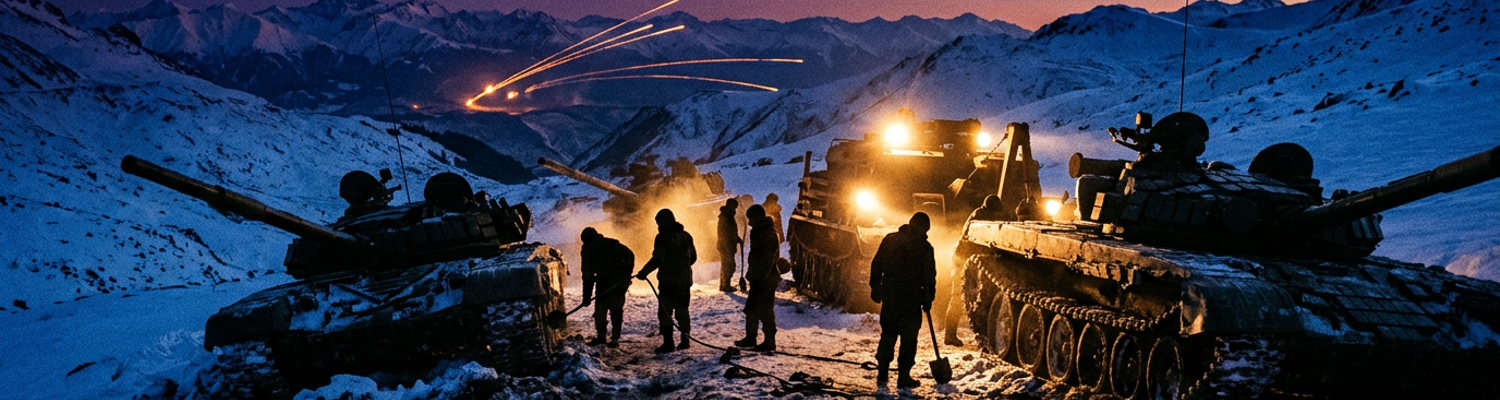
Ridges across the Bavarian frontier became salvage zones as M88 recovery vehicles deployed into the blizzard to winch and extract those immobilized tank platoons. Whiteout conditions blinded the recovery crews as heavy snow blew across the logging trails, forcing drivers to navigate forward by watching crewmen who walked on foot directly in front of the tracks. Riggers unspooled two-hundred-foot steel cables and dragged the heavy lines through deep snowdrifts to clamp onto the towing shackles of sunken M60 hulls. Hydraulic spades mounted on the rear of the recovery vehicles drove deep into the frozen dirt to anchor the hulls against the massive weight of fifty-ton tanks trapped in frozen mud. Winches strained under maximum mechanical load as diesel engines ran at full power, snapping frozen cables under excessive tension and flinging frayed wire across the snow. Recovery crews spent more than four continuous hours extracting each crippled tank, falling far behind the twenty-minute recovery schedule established in standard operations manuals and struggling to pull the vehicles onto level ground.
Ground conditions offered little relief, completely destroying the expectations set by field manuals that assumed a single recovery platoon could easily maintain the advance of an entire mechanized brigade across European terrain. Subzero temperatures and ice-covered rock faces destroyed those expectations as mud froze around road wheels and welded steel track links together. Mechanics had to swing heavy pickaxes and sledgehammers to clear frozen soil out of suspension assemblies before the winch lines could pull the vehicles free. Engines on the M88s consumed diesel at three times the normal rate while idling on steep inclines to keep hydraulic lines from freezing solid during winching operations. Transmission packs inside three recovery vehicles burned out completely under the strain of dragging bogged tanks up thirty-degree slopes near Hohenfels. Battalion leaders halted recovery missions across two critical sectors because every available wrecker had suffered mechanical breakdown or run out of fuel.
Fuel shortages and mechanical breakdowns forced officers inspecting the stalled columns to document severe doctrinal failures regarding the mismatch between theoretical rapid-reinforcement timetables and winter battlefield salvage constraints. Strategic mobilization models had assumed that combat divisions flown in from the United States could draw equipment from depot sites and enter combat positions within seventy-two hours. Oberpfalz weather conditions proved that mechanical breakdowns and recovery delays stripped arriving armored battalions of forty percent of their combat vehicles before reaching defensive lines. Prewar doctrines had treated battlefield recovery as a secondary maintenance task rather than an essential combat operation requiring specialized winter equipment. Commanders observed that a single disabled tank on a narrow forest trail blocked entire companies, creating traffic jams that simulated enemy air strikes would have destroyed. Staff officers at Seventh Army headquarters acknowledged that rapid reinforcement was impossible without doubling the number of recovery vehicles and rewriting movement timetables for winter weather.
Winter weather forced planners to direct maintenance units to implement emergency field changes across the training corridor to salvage the remaining immobilized tanks. Mechanics distributed heavy steel tow bars and spare track pins directly to combat tank platoons so crews could tow one another instead of waiting for scarce M88 wreckers. Tank drivers received orders to attach steel grousers to every track shoe before departing staging areas, regardless of the delays this imposed on road marches. Supply sergeants loaded five-ton cargo trucks with extra drums of winter-grade hydraulic fluid and preheated fuel filters to keep recovery systems functional in subzero air. Crews built open timber ramps over frozen ditches and pulled the last stranded M60 tanks back onto the main logging roads leading toward Hohenfels. Armor battalions consolidated their surviving vehicles into reduced company formations and dug defensive positions along the valley roads as night temperatures fell toward zero.