
OPPLAN 25-58 and the Nuclear Alert Posture
Chinese Communist forces concentrated hundreds of artillery pieces across the narrow three-mile gap separating Kinmen Island from mainland Fujian. The defending Nationalist garrison was outmatched by four to one in heavy guns and rocket batteries. A close review of operational logs indicates that the People's Liberation Army assembled over four hundred batteries across the Tateng, Amoy, and Lienho sectors. They trained 152mm howitzers and 130mm coastal guns onto an island complex smaller than Staten Island.
Between August 23 and early October 1958, Chinese Communist forces fired over 400,000 artillery shells onto Kinmen.
Explosive detonations tore apart field triage stations. They leveled military infrastructure in Jincheng and collapsed granite tunnels along the western ridges of Mount Taiwu. Field manuals issued to Nationalist medical officers instructed surgical staff to establish triage points fifty yards behind front trenches. Incoming salvos arrived at a rate of several thousand shells per hour. This volume of fire eliminated any distinct rear boundary.
Surgical staff operated inside humid cave complexes lit by failing gasoline generators.
They treated traumatic amputations while fractured ceilings dropped granite dust directly into open surgical incisions. Casualty collection points filled past capacity as artillery fire severed forward telephone lines and blasted supply roads into impassable rubble.
Kinmen had no operational depth left.
Archival evidence shows that Seventh Fleet war planners addressed this artillery mass with strategic atomic escalation. Seventh Fleet carrier strike groups maintained tactical nuclear strike aircraft on fifteen-minute alert under OPPLAN 25-58. Aboard the carriers USS Lexington and USS Midway cruising in the Philippine Sea, Douglas A4D-2 Skyhawks sat pre-positioned on catapults. Mark 7 and Mark 90 atomic weapons were clamped to their centerline pylons. Flight crews slept in flight gear inside ready rooms beside the hangar bays. They awaited coded flash authorizations to strike mainland Chinese air bases at Longxi and Shantou.
Saltwater spray and tropical heat constantly corroded the sensitive internal wiring of weapon arming plugs.
Ordnance handlers ran continuous circuit continuity tests on open flight decks. Naval operational doctrine assumed these atomic-capable strike packages would deter mainland aggression. Seventh Fleet medical planners were left without any practical procedures for treating non-nuclear shrapnel trauma on isolated beachheads.
Atomic payloads waited on ocean swells.
Soldiers on the beaches died from conventional artillery.
Shoreline resupply collapsed into direct combat within hours of launch. Amphibious crews from Task Force 76 received orders to penetrate Liao Lu Bay under active bombardment. They attempted to ferry surgical kits, plasma bottles, and artillery ammunition directly across exposed tidal flats. Landing ships arrived at coordinate 24 degrees 24 minutes North, 118 degrees 24 minutes East. The coastal shelf was bracketed by mainland coastal batteries.
Incoming Chinese artillery salvos hit Landing Craft Tanks as vehicle bow ramps dropped into six feet of breaking surf.
Waterlogged beach sand entered the intake tracks of Landing Vehicles Tracked. The sand seized their drive sprockets while high-explosive fragments penetrated the thin aluminum hulls. Navy corpsmen crawled across open beach gravel to extract wounded Taiwanese soldiers from disabled landing craft. They wrapped burn trauma in salt-crusted field bandages while mortar fragments destroyed canvas aid shelters. Diesel fuel from ruptured fuel tanks ignited along the surf line.
Casualty evacuation operations along the tideline ceased entirely.
Postwar Amphibious Doctrine and Beachhead Assumptions
Operational records from Commander Amphibious Force, Pacific Fleet in 1958 reveal that logistical directives were lifted directly from amphibious doctrine formed during the 1945 Okinawa and Iwo Jima assaults. Naval planners based beachhead turnaround times on wide, surveyed coral shelves. Tracked landing vehicles crawled over fringing reefs to establish fixed logistics depots within six hours of H-Hour.
At Liao Lu Bay, the granite coast presented shifting sand spits and a dynamic twenty-foot tidal drop.
This exposed soft silt beds instead of hard, load-bearing coral limestone. Heavy 32-ton Landing Craft Utility hulls grounded two hundred yards offshore on falling tides. Tracked sprockets on Republic of China Marine Corps LVT-4 amphibians churned through granite-derived quartz sand. Abrasive granules pulled into axle bearings and jammed bilge water pumps. Manual NWIP 22-1 dictated that forward logistics echelons maintain dry-ramp offloading zones.
Kinmen forced landing craft to drop ramps into churning ocean swells.
Cargo bays loaded with crated Ringer's lactate, penicillin vials, and surgical dressings swamped immediately.
Fleet doctrine mandated a rigid, mechanized evacuation pipeline connecting forward casualty collection points to offshore hospital ships within forty-five minutes. Standardized Bureau of Medicine and Surgery procedures directed Landing Craft Personnel Large and Higgins boats to dock alongside beachhead evacuation stations. They were to load litter cases directly into designated amidships wells and execute continuous transit cycles to hospital ships like the USS Haven (AH-12).
Stokes wire-basket stretchers were designed to be hoisted by deck-mounted boom winches aboard transports idling three thousand yards out to sea.
These mechanized transfer cycles required clear navigation corridors and calm swells under two feet. They also required uninterrupted beach access where vehicle engines could run continuously without thermal lockup. Off Kinmen, thirty-knot monsoons pushed waves over five feet high against Liao Lu Bay. Small landing craft could not hold station alongside casualty sorting barges without crushing hull plates against steel pilings. Injured soldiers strapped to metal Stokes frames suffered secondary spinal trauma. Landing craft heaved ten feet vertically on coastal swells.
The litter baskets smashed against wet cargo coamings before winches could take up wire tension.
A close review of operational logs indicates that Seventh Fleet casualty handling manuals rested entirely on an untested baseline assumption. Planners expected absolute air and surface gunfire supremacy to neutralize all hostile coastal batteries before casualty collection began. Naval Warfare Information Publication 11-1 outlined beachhead triage on the premise that fleet destroyers and carrier-based F4D-1 Skyray interceptors from Task Force 77 would silence shore installations prior to landing ship approaches.
At Kinmen, this suppression never occurred.
Rules of engagement strictly restricted American destroyers from firing on mainland Chinese batteries located along the Amoy and Tateng peninsulas. Washington wanted to avoid starting a direct war with Beijing. Unmolested People's Liberation Army coastal artillery positions maintained uninhibited line of sight across the entire maritime evacuation route. These included 152mm Model 1937 howitzers and 130mm B-13 naval coastal guns bunkered inside reinforced granite revetments at Amoy.
Soviet-supplied SON-9 fire control radars tracked landing ships moving past coordinate 24 degrees 20 minutes North.
Evacuation craft and floating aid stations absorbed high-explosive airbursts from guns that Seventh Fleet warships were legally forbidden to target. Shrapnel sliced through unarmored auxiliary vessels. It shredded canvas litter stretchers, punctured rubber plasma bags, and killed naval medical corpsmen as they attempted to secure arterial tourniquets on exposed sandbars.
By late September, shrapnel had destroyed eighty percent of the medical gear landed on the open beachhead at Liao Lu.
Liao Lu Bay Hydrography and Tidal Obstacles
Coastal hydrography created an operating environment that paralyzed naval landing craft. Kinmen presented an extreme ten-foot tidal drop that exposed vast mud flats at low water. Semi-diurnal tides driven through the Formosa Strait forced sea levels downward at rates exceeding two vertical feet per hour during the ebb phase.
As the water retreated, the shoreline vanished.
An eight-hundred-yard expanse of gray, decomposed granite silt mixed with thick terrestrial runoff was uncovered. This sediment lacked the compression strength of Pacific coral shelves or coarse volcanic beach sand. Human weight punched through the crust. Foot soldiers plunged eighteen inches deep into an anaerobic mire that pulled boots from ankles. Wheeled litters carrying traumatic amputees could not traverse the saturated mud.
Republic of China Army logistics personnel attempting to plant route-marking buoys found that iron mooring sinkers sank into six feet of fluid mud without reaching hard bedrock.
Tidal currents sweeping past the southern coast reached velocities of four knots. They sheared away soft silt banks and constantly shifted the underwater topography between morning and evening low tides.
Ten vertical feet of seawater drained from the bay twice every twenty-four hours.
Archival evidence shows that Republic of China Navy landing craft grounded continuously along this shelf. Landing Ship Tank (LST) and Landing Craft Utility (LCU) hulls grounded hundreds of yards short of firm beachheads. A fully loaded 375-ton LCU-1466 class vessel drew six feet of water at the bow and nearly eight feet at the stern. The 4,000-ton LSTs like the ROCS Chung Hai (LST-201) required over seven feet forward to drop their ramps onto dry terrain.
Skippers attempting to breach the shoreline at half-tide struck the submerged silt banks four hundred yards seaward of the high-water berm.
Keels ground directly into the dense mud. Twin diesel screws spun through thick sludge, pulling suspended sediment into sea chest strainers. General Motors 12-567 engines starved of raw cooling water within three minutes of contact. Engineers shut down propulsion plants to prevent block cracking as engine manifolds overheated past safe operating limits. Bow ramps slammed open into churning surf and waist-deep mud rather than packed beach gravel.
Medical orderlies had to haul Stokes baskets through five hundred yards of liquid silt under 152mm artillery airbursts.
Pre-mission intelligence surveys failed to calculate how coastal mud flats altered vessel turn-around times. Hydrographic charts distributed by the US Navy Hydrographic Office relied on high-altitude photographic sorties flown over Kinmen during high-water intervals. Photo interpreters mistook the smooth, dark reflectance of water-covered mudflats for firm, hard-packed sand capable of bearing heavy wheel loads. Standard doctrine manuals established that a landing craft utility should touch down, discharge twenty tons of plasma and ordnance, embark thirty litter patients, and retract seaward within twenty-five minutes.
The mud flats destroyed this planning baseline.
Once a displacement hull touched the falling bottom, the retreating tide deposited the ship's full deadweight into the clay suction. The vessel was cemented in place for an entire tidal sequence. Task Force 76 planners in Taipei calculated beach throughput using mathematical models that assumed uninterrupted vessel cycling around the clock. Each landing craft completed a single mission every twelve to fourteen hours instead of executing six supply runs per day.
Evacuation schedules broke down entirely.
Critical surgical casualties remained pinned on the sandbars until nightfall. Grounded landing craft became stationary artillery targets for People's Liberation Army forward observers on the mainland. Battery crews positioned across the Amoy peninsula registered impact coordinates on immobilized LST hulls with Soviet SON-9 radar sets. They landed 130mm coastal gun salvos directly on open cargo decks while ships waited for flood tides to float their keels.
Mechanical Breakdown of Automated Casualty Systems
Mechanized casualty handling collapsed the moment heavy coastal artillery pulverized the Kinmen shoreline.
High-explosive detonations across the granite cliffs of Mount Taiwu threw tons of pulverized rock dust into the lower atmosphere over Liao Lu Bay. Thirty-knot autumn monsoons drove this airborne quartz powder seaward. The dust mixed immediately with churning saltwater spray. It settled as an abrasive slurry onto the open decks of auxiliary vessels and amphibious transports idling offshore. Welin-type motorized boat davits and deck-mounted casualty hoist winches possessed exposed open-spur gears, cable drums, and unsealed bronze bushings.
The quartz-and-brine mixture penetrated the grease housings within twenty minutes of exposure.
Drive cables jumped their sheaves when the grinding paste packed the grooved winch drums. Drive pins sheared and electric motor gearboxes stripped aboard transports like the USS Catamount (LSD-17). Technicians attempting to flush the assemblies with freshwater ran out of potable boiler feed water. Deck crews had to use dry rag wiping that pushed the microscopic granite grit deeper into roller bearings.
Winch motors overheated and threw circuit breakers.
Stokes wire stretchers were left suspended forty feet above water level while artillery bracketed the ship hulls.
The primary mechanical bottleneck occurred directly at the vessel waterline. Republic of China Navy landing ships and American-supplied LCU-1466 craft relied on dual hydraulic rams powered by high-pressure Vickers pumps. These operated at fifteen hundred pounds per square inch to raise and lower their multi-ton steel bow ramps. Breaking surf pushed dense plumes of suspended granite mud across the bow aprons when landing craft beached at coordinate 24 degrees 23 minutes North.
Particulate grit lodged against the exposed chrome piston shafts.
Neoprene rod wiper seals wore away under the constant abrasion. Quartz sediment slipped past the cylinder glands and entered the pressurized hydraulic reservoirs. Fluid return lines choked on sludge. Control valves jammed in partial-travel positions, causing system pressure to drop to zero within seconds.
Bow ramps froze in place.
They hung half-lowered at forty-five-degree angles into four feet of breaking surf. The mechanical failure prevented the ramp lips from resting flush on the sandbars. Wheeled casualty litters could not traverse the threshold. Medical corpsmen had to step down into waist-deep water under active shrapnel fire. They physically hoisted stretcher-borne patients over the jammed hydraulic hinges to get them inside the cargo decks.
Commander Amphibious Force, Pacific Fleet directives had explicitly mandated modern automated vertical casualty lift systems aboard modified landing ships.
Bureau of Medicine and Surgery specifications called for continuous-loop chain conveyors and pneumatic platform hoists installed inside vertical trunk shafts. These were engineered to lift litter cases from the lower tank deck directly into surgical sorting flats in under sixty seconds. The machinery failed completely under combat conditions at Kinmen. Concussive shockwaves from mainland 152mm artillery airbursts warped the internal aluminum guide rails inside the lift shafts.
Saltwater flooding in through unsealed ramp doors shorted out electrical limit switches.
The lower motor sumps flooded with conductive seawater. Automated lift cages jammed midway between decks. Severely wounded soldiers were trapped inside unventilated steel elevator trunks while ships maneuvered under shellfire. Maintenance crews lacked replacement switchgear and had to use manual crowbars to pry open elevator safety gates. Shipboard medical officers discarded Pacific Fleet directives entirely and organized human bucket brigades.
Sailors hauled canvas litters up forty-five-degree shipboard access ladders using hemp mooring lines.
Evacuation Across the Exposed Mud Flats
Standard medical transport equipment disintegrated within meters of leaving the concrete loading aprons at Liao Lu.
US Navy Bureau of Medicine and Surgery field inventories had supplied wheeled mechanical gurneys fitted with four-inch solid rubber casters and tubular steel frames. These were engineered specifically for paved dry docks and level hospital corridors. On the exposed flats at coordinate 24 degrees 23 minutes North, the narrow wheel rims sank six inches into the saturated silt within seconds of rollout. Rolling resistance increased until the wheel assemblies locked. The immobilized metal pushed mud forward, creating a physical barrier.
Thick granite clay packed the swivel housings.
Axle bolts sheared under forty-pound lateral drag loads. Medical personnel abandoned the immobilized wheeled carts along the high-water berm. Maintenance crews and corpsmen stripped corrugated zinc roof panels from destroyed fish-packing sheds near the shoreline. They punched holes through the metal corrugations to thread half-inch Manila rope tow lines.
ROC Marine Corps logistics personnel split fifty-five-gallon steel fuel drums lengthwise with cutting torches.
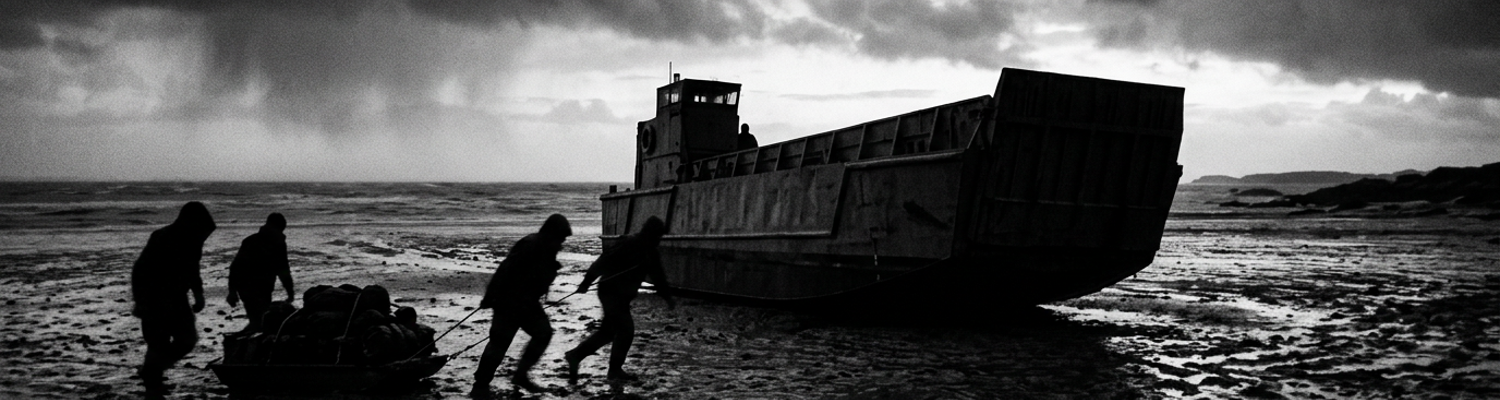
They hammered the curved steel barrels flat against granite boulders to assemble low-profile drag sleds. These improvised sheet-metal skids distributed a casualty's weight across four square feet of surface area. They slid across the fluid upper silt where mechanical gurneys bogged down completely.
People's Liberation Army gunners deliberately exploited the open flats to maximize fragmentation patterns across the intertidal evacuation lanes.
Battery emplacements on the Amoy peninsula integrated Soviet-manufactured radio proximity fuzes into their coastal bombardment tables. Standard contact fuzes buried their explosive payloads three feet into the soft silt. This absorbed shockwaves and smothered high-explosive fragments within deep mud craters. Radio proximity fuzes eliminated this terrain dampening.
The incoming 152mm steel casings contained radar transducers set to trigger electrical detonators ten to fifteen meters above the ground. They burst before the rounds made contact with the wet sediment.
Downward-directed fragmentation cones sprayed jagged shrapnel across circular kill zones forty yards wide. The intertidal zone offered zero physical defilade. Digging defensive slit trenches was impossible because rising groundwater flooded any excavation within ninety seconds. High-velocity shrapnel shredded canvas stretcher covers and punctured rubber intravenous tubing when airburst salvos detonated over the intertidal route.
Wounded personnel strapped to the metal drag sleds were struck repeatedly.
The physical burden of moving patients fell entirely onto four-man stretcher teams working without vehicle support. Navy corpsmen attached to Task Force 76 landing units operated alongside Republic of China Army litter bearers. They carried M1945 folding canvas litters and wire Stokes baskets across twelve hundred yards of exposed tidal sludge to reach grounded amphibious craft. Every step required lifting against thirty pounds of sediment suction that pulled boots straight off feet.
Bearers abandoned their footwear within sixty yards of the surf line.
They marched across fractured clam shells and sharp shell splinters in bare feet or heavy woolen socks bound with field telephone wire. A standard evacuation required four men to transport a single two-hundred-pound casualty and gear load. Forward movement slowed to less than half a mile per hour. Exhausted corpsmen suffered quadriceps muscle tears and severe physical exhaustion under sixty-pound wet utility uniforms.
Pulse rates exceeded one hundred and eighty beats per minute during active fire missions.
Incoming artillery salvos forced teams to drop litters directly into twelve inches of liquid mud. The bearers threw their own bodies over open chest wounds and compound fractures to absorb low-angle shrapnel. By midnight on September 24, litter teams had carried seventy-two critical surgical cases across nine miles of open silt under continuous shellfire.
Triage Breakdown on Damaged Amphibious Hulls
Standard medical protocols collapsed the moment casualty loads crossed the threshold of Task Force 76 amphibious hulls.
Aboard vessels like the USS Catamount (LSD-17) and Republic of China LSTs idling three miles off Liao Lu Bay, shipboard sickbays containing four to six bunks could not physically accommodate the incoming waves of wounded men. Medical officers directed walking wounded and litter cases straight onto the open, waterlogged tank decks. Saltwater swirled four inches deep across the non-skid steel plating. Heavy sea swells drove the water inward through damaged bow seals and open well decks.
Bilge pumps choked repeatedly on granite grit.
Surgeons stood in a mixture of brackish foam, diesel fuel, and human blood. With interior surgical compartments overwhelmed, doctors lashed folding canvas litters across metal oil drums and jeep bonnets to create emergency operating tables. Illumination came from hand-held battle lanterns and 24-volt vehicle headlamps clamped to overhead structural ribs. Surgeons conducted emergency laparotomies, debridements, and traumatic limb amputations.
Thirty-knot monsoonal winds drove cold spray across open peritoneal cavities.
Wrenching hull vibrations from twin diesel engines constantly shifted surgical blades during delicate arterial repairs. Severe physiological trauma was aggravated by sea immersion and hours spent pinned in the intertidal mire. Evacuees pulled from the tidal mud flats of Liao Lu Bay arrived aboard the amphibious ships encrusted with gray granite silt. That saturated mud pulled thermal energy directly from bare skin through conductive cooling.
Immersion in seventy-degree coastal water dropped core body temperatures into critical hypothermic ranges between ninety and ninety-two degrees Fahrenheit.
Blood vessels in the extremities constricted aggressively. Peripheral vascular collapse prevented corpsmen from locating viable veins for intravenous access. Doctors cut directly into saphenous veins with unsterilized scalpel blades just to insert cannula lines. Severe metabolic acidosis set in quickly. Shivering reflexes ceased as intravascular volume fell from blast trauma.
Patients went into profound shock before surgical intervention could stabilize internal bleeding.
Wet wool blankets soaked by breaking surf during transit offered zero insulation against the wind. Naval transport sickbays exhausted their stored whole-blood and plasma reserves within the initial hours of evacuation. Fleet supply manuals had provisioned Task Force 76 assault transports with baselines of forty to sixty vacuum-sealed bottles of type-O whole blood and twenty units of dried plasma. The severity of fragmentation wounds inflicted by Soviet-supplied 152mm high-explosive artillery destroyed these supply estimates immediately.
A single traumatic bilateral amputation consumed six to eight blood units within forty minutes to maintain baseline systolic pressure.
By late afternoon on September 24, medical lockers aboard the evacuation transports were empty. Corpsmen substituted normal saline and dextran volume expanders. The clear fluids diluted remaining red blood cells and washed away clotting factors. This accelerated fatal coagulopathy in mangled limbs. Medical officers activated emergency walking donor rosters over shipboard 1MC public address systems.
They drew fresh blood directly from off-watch boiler technicians and deck division gunners while the vessels remained within range of mainland coastal batteries.
Unscreened direct transfusions ran from living donors to dying soldiers through rubber tubing held steady by orderlies on the shaking steel deck.
The Doctrine Disconnect in Littoral Evacuation
High-level strategic planning inside Commander in Chief, Pacific Fleet (CINCPAC) headquarters focused on massive nuclear deterrence while front-line landing elements lacked basic littoral survival equipment.
Admiral Harry D. Felt directed staff officers to refine atomic strike targets against thirty-two mainland Chinese airfields under OPPLAN 25-58. He prioritized megaton-yield weapons systems over frontline beach gear. In forward staging areas, Republic of China Marines and US Navy support details lacked waterproof casualty wrapping, rubberized survival suits, and mud-shoe flotation gear. Troops tasked with wading through the intertidal zone wore standard M1951 cotton uniforms and heavy leather combat boots.
These boots absorbed ten pounds of seawater within sixty seconds.
Supply officers at Subic Bay stocked carriers with Mark 7 nuclear bomb casings and radar guidance packages. They sent no waterproof bags for Ringer's lactate containers or vulcanized rubber covers for surgical instruments. Salt spray corroded standard aluminum litter handles before medics reached the surf line. Non-commissioned officers requested pneumatic life vests and buoyant litter floats to prevent wounded soldiers from drowning in two-foot surf breaks.
Naval supply depots reported zero inventory across the western Pacific theater.
Standard fleet medical manuals offered no alternate protocols for hostile intertidal extractions under sustained indirect fire. Publications such as NAVMED P-117 and the Amphibious Medical Support manual NWIP 11-1 established evacuation sequences on the assumption that beachheads were fully secured and dry. These manuals directed casualty clearing teams to establish sheltered aid posts on flat ground forty yards inland. They required sorting tents and marked evacuation lanes.
At Liao Lu Bay, no such dry sanctuary existed.
Incoming Chinese Communist 152mm howitzer and 130mm coastal gun airbursts exploded over bare silt beds where natural defilade did not exist. Fleet directives ordered corpsmen to apply tourniquets and splints to immobilized patients on elevated stretchers. Elevating a patient ten inches above the mud exposed their torso to supersonic fragmentation cones. Medical guidelines contained zero guidance for performing vein cutdowns, establishing chest drainage, or administering whole-blood transfusions while corpsmen and casualties lay half-submerged in twelve inches of freezing tidal silt.
Navy physicians were trained for sterile operating rooms aboard hospital ships.
Kinmen forced them into exposed intertidal shell craters where rising tides threatened to drown immobilized litter cases before shock could kill them. Command authorities initially delayed operational adaptations due to rigid compliance with pre-crisis logistical doctrine. Vice Admiral Roland N. Smoot and Seventh Fleet amphibious task commanders insisted on following peacetime supply requisition procedures and standardized ship loading configurations. Front-line officers from Task Force 76 requested the immediate dispatch of shallow-draft civilian sampans, tracked M29C Weasels, and local wooden sledges to replace grounded thirty-ton landing craft.
Fleet logistical staff in Yokosuka rejected these field requests.
Non-standard indigenous craft violated Navy safety regulations and maintenance accountability tables. Depots refused to split pre-packed assault supply blocks to extract emergency medical materials. They demanded that field commanders requisition entire sixty-ton logistical modules through normal peacetime supply channels. Administrative desks held up requisitions for waterproofed field radios and canvas litter tarpaulins for weeks while supply clerks checked stock catalog numbers against Pacific Fleet allowance lists.
Field units attempting to weld skid plates onto landing craft ramps were ordered to halt until naval engineering bureaus issued formal technical change directives.
By the end of the third week of September, requisition forms for thirty-six tracked amphibious cargo carriers sat unapproved in naval supply offices in Yokosuka.
Operational Revisions to Naval Beachhead Triage
Equipment casualties at the water's edge forced emergency engineering revisions across western Pacific naval shipyards.
By October 1958, maintenance units aboard the repair ship USS Jason (AR-8) and depot facilities at Subic Bay initiated mandatory modifications across Task Force 76 amphibious hulls. Seventh Fleet technical teams redesigned hydraulic seals and winch enclosures to withstand fine granite grit. Airborne quartz dust kicked up by artillery salvos on Mount Taiwu had eroded the factory-installed neoprene wiper packings on Vickers ramp-hoist cylinders. Abrasive sludge entered high-pressure fluid reservoirs.
Machinists cut split-ring brass scrapers and fitted them directly forward of the cylinder packing glands.
These metal scrapers physically peeled dry mineral residue from exposed chrome piston rods before the shafts could retract through the seals. For open-spur deck machinery, technicians constructed welded ten-gauge sheet-steel housings around Welin boat davits and deck-mounted cargo winches aboard assault transports. Gasketed access doors sealed with synthetic Buna-N rubber kept airborne sediment off the grooved hoist drums. Maintenance crews added pressurized lubrication ports.
Sailors injected heavy water-resistant grease directly into internal roller bearings without exposing the gears to open sea air.
Commander Amphibious Force, Pacific Fleet formally suspended NWIP 11-1 beach evacuation timetables during post-deployment reviews in early 1959. Post-crisis naval evaluations forced the rewriting of Pacific Fleet littoral casualty evacuation directives. Tactical analysis boards convened at Pearl Harbor determined that rigid forty-five-minute mechanized evacuation cycles between exposed tidal berms and offshore hospital transports failed under artillery fire. Naval authorities eliminated assumptions of uninhibited beach access from fleet casualty publications.
New operational instructions directed landing forces to abandon centralized, high-density shoreline aid depots.
They favored dispersed intertidal collection points established inside natural defilade. Amphibious assault ships received updated blueprints requiring shipfitters to relocate primary triage sorting spaces out of upper-deck sickbays. Spaces moved down into lower vehicle decks shielded behind three-quarter-inch armor plating. Revised directives instituted mandatory walking-donor collection procedures directly into standard general quarters bills on tank landing ships.
This countered the rapid depletion of fragile glass-bottled whole blood stores during sustained littoral operations.
Planners abandoned their exclusive reliance on deep-draft displacement landing craft along shallow coastal shelves. Subsequent Taiwan Strait defense planning integrated manual, low-draft extraction contingencies into amphibious operational doctrine. Joint contingency plans produced in Taipei incorporated civilian wooden sampans, modified flat-bottomed skiffs, and shallow-draft junks drawing less than twelve inches of water into frontline casualty evacuation corridors. Field commands trained Republic of China Marine Corps litter bearers to drag wounded personnel across saturated mud flats on improvised sheet-steel sleds.
They stopped waiting for grounded landing craft to refloat on flood tides.
Pacific Fleet logistics authorities amended landing force equipment tables. They added man-portable rope-and-pulley tackle sets, canvas-bottomed skids, and folding field litters to standard beachmaster supply blocks. Tactics shifted toward running dispersed groups of unpowered and low-horsepower indigenous boats beneath coastal radar coverage during night operations.
The amended equipment tables assigned thirty flat-bottomed extraction sleds to every forward beachmaster unit.