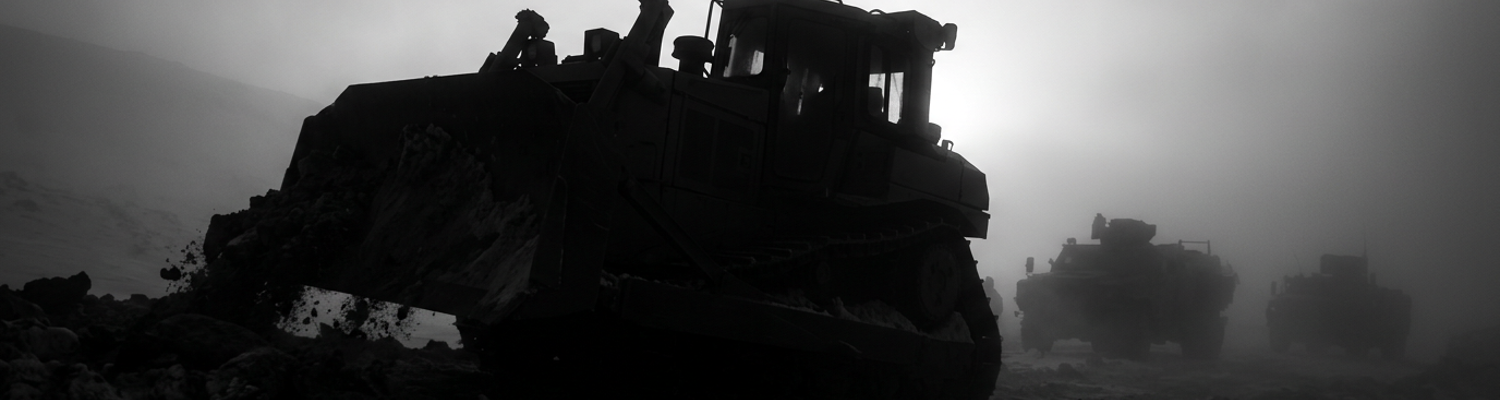

Origins of the Military Caterpillar D7 Bulldozer
Along the narrow shelf of Route Texas in the Chorwon Valley, the predawn air sat motionless. Mist clung to the base of Hill 255. The guns of the Chinese People's Volunteer Army 73rd Division remained quiet across the valley floor. Three hundred yards out, an engineer team lay prone in the dirt. They listened for the scrape of trench spades or the metallic click of mortar bipods. Sound disappeared entirely across the barren sector. Every man in the defile understood that the silence signaled incoming registration fire.
Industrial diesel exhaust broke the stillness.
Archival evidence shows that this tractor began its service far from the Korean peninsula in commercial earthmoving fields. Caterpillar Tractor Company in Peoria, Illinois finalized the base civilian D7 design in the late 1930s. They designated the early production run as the 7M series before transitioning to the modernized 3T series in 1944. Military procurement boards recognized that mechanized ground armies required heavy civil engineering capabilities. The War Department adopted the civilian tractor without redesigning its mechanical core. Output originated from a four-cylinder D8800 diesel engine displacing 831 cubic inches. It rated at approximately eighty horsepower at the drawbar.
Civilian contractors originally used this engine to clear farm acreage.
Army engineers mated the power plant to heavy-duty LeTourneau model R7 or Caterpillar No. 24 front cable control units. Technicians fitted front-mounted push frames and ten-foot straight dozer blades directly to the track roller frames. Starting the main block in freezing weather required an auxiliary two-cylinder vertical gasoline engine. Troops called this a pony motor. Allied logistics commands distributed more than ten thousand D7 platforms during the Second World War. They cleared Pacific airfield strips and carved European bridge approaches. Engineers pushed the twenty-four-thousand-pound tracked chassis through deep mud using heavy steel grousers driven by a five-speed sliding-gear transmission.
None of those engineering specifications accounted for incoming small-arms fire.
A close review of operational logs indicates that American tactical doctrine categorized engineering tractors strictly as rear-echelon equipment. The Eighth United States Army scrambled to hold the Pusan Perimeter in the summer of 1950. Engineer units like the 2nd Engineer Combat Battalion and the 73rd Engineer Combat Battalion unloaded standard open-cab D7s onto Korean docks. Factory floor configurations dominated the forward areas. The tractor operator sat on an unsprung open-bench seat positioned six feet above ground level. This seat rested directly on top of the main diesel fuel reservoir. Ballistic steel was entirely absent from the steering clutch levers, the throttle assembly, and the driver's torso.
Chinese and North Korean infantry recognized the tactical value of stopping earthmoving operations. They targeted these drivers with high-angle mortar rounds and 7.62mm Mosin-Nagant rifle fire. Shrapnel routinely severed exposed hydraulic lines. It pierced engine crankcases and shredded the fuel lines feeding the D8800 block. Operating a four-mile-per-hour tractor under direct visual contact produced high casualty rates among engineer personnel. Combat formations lacked modular cab kits. Frontline maintenance detachments operated without standard options for armored conversions.
American depots entered the third year of the Korean War with these bare commercial platforms still clearing primary combat supply routes under direct fire.
Route Texas and the Yokkok Sector Corridor
Winter froze the clay bed of the Yokkok River valley solid.
When examining the historical record, Eighth Army headquarters (NARA Record Group 338) assigned the 73rd Engineer Combat Battalion the direct responsibility for maintaining Main Supply Route Texas in January 1953. Operating under I Corps in support of the 7th Infantry Division, Company B of the 73rd deployed its Caterpillar D7s into an eighty-foot-wide defile flanking the frozen Yokkok tributary. Daily operational logs record that sub-zero temperatures regularly thickened standard military 30-weight engine oil to the viscosity of grease inside the D8800 blocks. This snapped pony-motor starter cords and stripped the internal bendix drives. Technicians kept blowtorches roaring against the oil pans for forty minutes before the primary diesel blocks turned over. Ground temperatures hovering near ten degrees below zero froze the track shoes to the earth each night. Mechanics pried the track assemblies loose with pickaxes and timber balks before engaging the master clutch.
Once rolling, the D7s scraped frozen ruts. They cleared debris from artillery cratering and stabilized ditch banks. Sleet storms and brief thaw cycles turned the graded earth into an abrasive paste. This jammed track rollers and placed excessive friction on the final drive pinions.
Every supply truck moving toward the front lines depended on these cleared tracks.
Archival evidence shows that Route Texas was the sole vehicular artery feeding the forward defensive ring around Hill 255. Tactical maps designated this feature as Pork Chop Hill. Forward outposts occupied by elements of the 31st and 17th Infantry Regiments sat directly across a barren depression. They were completely isolated except for the narrow gravel track cut into the southern slope of the Yokkok corridor. Artillery forward observers of the Chinese People's Volunteer Army held uninterrupted sightlines onto this roadbed from positions along Old Baldy and the Hasakkol ridges. Any vehicle raising dust or exhaust along the five-mile corridor immediately drew pre-registered fire from concealed 76mm field guns and 120mm heavy mortars.
The 7th Infantry Division consumed approximately sixty tons of ammunition, water cans, concertina wire, and rations each night across this specific lane.
If Chinese interdiction fire severed the dirt surface, tank-led supply convoys carrying 76mm and 90mm rounds stalled within the primary kill zone. This stripped the hill outposts of defensive firepower during night assaults.
Chinese gunners zeroed their sights directly on the exposed road curves.
A close review of operational logs indicates the unarmored D7 became the focal point of defensive engineering along the Yokkok approach. Headquarters ordered the tractors to push earth berms three to six feet high along the exposed northern edge of Route Texas. This masked moving two-and-a-half-ton cargo trucks from direct visual tracking. Carrying out this engineering mandate meant driving a D7 directly onto the forward crest of the grade at three miles per hour. The machines silhouetted against the open snow. Shrapnel from airburst artillery consistently punctured the thin steel cowlings of the tractors. It severed radiator cores and sprayed boiling coolant into the open driver compartments. Company B mechanics spent the final weeks of January 1953 stripping damaged D7 chassis in forward maintenance sheds at Chepyong-ni. They scavenged replacement track links, fuel filters, and steering clutch bands from knocked-out vehicles. Maintenance logs recorded four separate bulldozers rendered inoperable in a single seventy-two-hour period due to shattered sprockets and severed hydraulic lines.
Field Armor Modifications and Structural Chassis Strain
Archival evidence shows that in February 1953, the 73rd Engineer Combat Battalion motor pool at Chepyong-ni began converting bare Caterpillar D7 chassis into improvised gunboxes. Facing relentless PVA sniper fire and mortar fragmentation along Route Texas, maintenance personnel scavenged half-inch structural boiler plate. They took this steel from damaged railway gondolas and ruined bridge trusses near Uijeongbu. Welders burned through hundreds of mild-steel electrodes using truck-mounted Hobart generators. They fused the heavy slabs directly to the tractor operator station. Shop crews erected four solid steel walls surrounding the seat. These plates extended forty inches upward from the floorboards to cover the driver's head.
Access required climbing over a solid rear wall or squeezing through a narrow hatch cut into the roof.
Welded seams held against standard 7.62x54mmR lead-core ammunition fired from Chinese Type 53 carbines at ranges exceeding fifty yards. Jagged fragments from 82mm and 120mm mortar bursts gouged deep divots into the exterior without penetrating the steel core.
Vision shrank to narrow slits.
When examining the historical record, welders cut two-by-six-inch horizontal apertures into the front and lateral plates. This left operators with roughly twelve degrees of forward visibility. Heat from the underlying transmission combined with poor ventilation turned the enclosed cab into a suffocating chamber. Minor exhaust leaks filled the space with carbon monoxide. Operating levers required extended mechanical linkages. The added half-inch plate crowded the foot pedals and jammed the master clutch travel. Despite these limitations, Company B reported an immediate drop in operator casualties. Bullets that previously decapitated drivers ricocheted off the angled front faceplate. They scattered hot copper jackets across the fuel tank shroud while the D8800 engine pushed steadily through frozen mud.
The protection carried a severe mechanical penalty.
A close review of operational logs indicates the boiler plate assembly added nearly 3,500 pounds of deadweight directly over the rear half of the tractor. This top-heavy ballast raised the center of gravity by more than fourteen inches. It shifted the operational load completely out of alignment with the factory track balance. Caterpillar engineered the D7 to balance front-mounted cable blades through a heavy transverse leaf spring bolted to the front cross-member. This relied on uniform ground contact along the six-roller track frames. Excess rearward weight bias compressed the track recoil springs to their absolute limits. It left zero suspension travel when the steel grousers climbed over frozen boulders along the Yokkok defile. Equalizer bars bent upward under the localized load. This caused the front idler wheels to toe inward and wedge the track chains against the roller flanges.
Worse structural damage accumulated inside the final drive housings.
Turning a 32,000-pound armored D7 required the operator to disengage one steering clutch and stomp down hard on the corresponding band brake. This forced the single opposing drive sprocket to absorb the full kinetic load of the chassis. Cast-iron final drive housings cracked laterally across their mounting flanges under this repeated torsional shock. Maintenance reports from early March 1953 document eight catastrophic drive shaft shears and twelve stripped bull gear assemblies across Company B. The drive pinions chewed themselves into metal shavings inside the contaminated gear oil. Mechanics lacked replacement gear sets. Field teams welded cracked cast-iron housings in freezing mud using nickel-alloy rod.
Caterpillar D7 chassis number 3T-11422 cracked its left bull gear off its splines on March 18. It sat abandoned in the ditch beside marker post seven.
Winter Operational Hazards and Mechanical Subsystem Failures
Archival evidence shows that by late January 1953, ambient temperatures across the Chorwon Valley plunged past twenty-two degrees below zero Fahrenheit. This overwhelmed the basic fluid dynamic thresholds of the Caterpillar D7 mechanical systems. Company B of the 73rd Engineer Combat Battalion attempted to operate forward bulldozers along the Yokkok approach. The petroleum-based OE-10 hydraulic oil inside the reservoir tanks thickened into an unworkable gelatinous paste. Paraffin waxes suspended in the standard-issue oil crystallized within the return lines. This choked the intake screens of the front-mounted gear-type pumps. Cold-thickened fluid starved the rotating pump assemblies of lubrication. It generated vacuum cavitations that gouged the inner pump housings and scored the steel impellers within minutes of engagement. Blade lift controls failed to maintain pressure. Operators who yanked the four-way control valve levers found the ten-foot cutting blades responding with a lag of eight to twelve seconds. Sometimes they refused to drop altogether against the frozen grade.
The hydraulics simply locked solid.
When examining the historical record, Company B maintenance officers authorized an emergency field modification to keep the blades operational. Mechanics drained half of the OE-10 hydraulic stock from each machine. They refilled the reservoirs with pressurized mixtures of standard diesel fuel and low-octane gasoline to thin the fluid. This field adjustment thinned the viscosity sufficiently to restore line flow. It also stripped the lubrication from the internal spool valves and decomposed the synthetic rubber packings inside the hydraulic lift cylinders. Fluid blew past the degraded rod seals under four hundred pounds per square inch of operating pressure. It sprayed atomized diesel across the hot engine manifolds and set two tractors on fire near Outpost Eerie. Drivers kept blowlamps roaring directly against the cylinder jackets between supply runs. This prevented the internal fluid columns from freezing into rigid plugs while parked.
Frozen soil presented an equally destructive mechanical barrier.
A close review of operational logs indicates the alluvial sediment along the river flats froze to a depth of nearly three feet. This solidified wet clay into dense permafrost. Caterpillar D7s equipped with rear-mounted Caterpillar No. 25 and front-mounted LeTourneau model R7 cable-control units faced sudden violent resistance whenever the hardened cutting edges snagged this earth. Standard operational procedure dictated that the tractor hit the frozen pack in first gear to fracture the crust. The steel cutting bits stopped cold against the ground. They transferred tons of kinetic shock directly backward through the multiple-part wire rope reeving and into the cable-control winches. Soft-steel shear pins designed to protect the winch drive shafts sheared clean off under the sudden torque spikes. Operational records from the 73rd Engineer Combat Battalion indicate that Company B tractors sheared an average of six winch drive pins per eight-hour shift during ditching operations south of Hill 255.
Deprived of replacement high-tensile pins, motor pool mechanics cut down structural iron framing bolts with hand saws. These unhardened field pins either stripped their threads instantly or deformed into the keyways. This locked the winch drums into permanent gear engagement. Under continuous drive power, the half-inch wire ropes wound past their drum stops. Tension spiked until the steel strands frayed and snapped with lethal force. Whipping metal cables sliced through the unarmored operator stations and severed hydraulic return tubes. Even when the drive pins held, the dry-disc brake and clutch linings inside the cable units glazed over from the extreme friction and sub-zero condensation. They lost grip entirely. Bulldozer blades dropped without warning under their own deadweight into the roadway. This high-centered the tractors on their belly pans and stranded them directly in the crosshairs of Chinese artillery observers on Old Baldy.
On February 4, 1953, Company B recorded five cable control units burned out. Forty feet of severed wire rope tangled in the sprockets of chassis 3T-8819.
Chinese Artillery Interdiction Along Frontline Supply Routes
Archival evidence shows that Chinese People's Volunteer Army artillery groups across the Chorwon sector did not require optical line-of-sight to locate bulldozers operating along Route Texas. Stationed on the reverse slopes of Hill 266 and the Hasakkol ridges, forward observers of the PVA 73rd Division used sound-ranging techniques. They tracked the acoustic profile of the Caterpillar D8800 engine. Displacing 831 cubic inches, this slow-turning four-cylinder diesel block operated at an unvarying governor-controlled tempo of one thousand revolutions per minute. It produced a rhythmic low-frequency mechanical thrum that bounced off the basalt canyon walls of the Yokkok River. Night operations offered zero acoustic concealment. Cold dense winter air acted as an efficient conductor. It carried the engine valve clatter and exhaust bark through the gorge across distances exceeding three miles. Mortar crews from the PVA 218th Regiment relied on listening posts dug into no-man's-land to establish intersecting azimuths toward the noise. They calculated firing solutions on the narrow roadbed with mathematical precision. Blackout regulations required tractor drivers to run without headlamps. The iron exhaust stack glowed a dull cherry-red under continuous load. It vented six-hundred-degree exhaust gases that produced a thermal plume against the zero-degree snowpack. Forward artillery spotters equipped with basic night optics or bare vision followed this rising heat signature through the gloom. They registered their battery strikes on the moving hot spot.
Sound alone gave away the exact map coordinates.
When examining the historical record, PVA artillery doctrine relied on sudden concentrated mortar and field gun volleys. They aimed to destroy the tractors before engineer crews could reverse out of the impact area. Soviet-supplied 120mm Type 43 heavy mortars and 76mm divisional guns fired pre-fragmented high-explosive ordnance. These rounds were timed to detonate ten to fifteen feet above the roadbed or on immediate contact with the shale soil. The field armor modifications fabricated at Chepyong-ni protected only the operator cab. The front half of the Caterpillar D7 sat entirely defenseless against incoming fire. Factory sheet metal enclosing the D8800 engine consisted of thin sixteen-gauge commercial steel stampings. These were designed to keep rain and dust off the fuel injection pump rather than stop high-velocity shrapnel.
Sheet steel offered no protection against ballistic shock.
A close review of operational logs indicates that during the operations of March 1953, jagged casing fragments from near-miss artillery bursts routinely shredded these sheet metal side panels down to the structural framing. Splinters traveling at four thousand feet per second sheared through the unarmored louvers. They tore directly into the forward cooling assembly. Caterpillar engineered the D7 radiator with a deep exposed tube-and-fin core positioned directly behind an open cast-iron grille. This maximized airflow during heavy earthmoving work. High-explosive shell fragments tore wide gouges through the soft copper water tubes. They severed the upper collector tank fittings and flattened the brass cooling fins. Within ninety seconds of a shrapnel strike, all nineteen gallons of water-antifreeze coolant drained out onto the frozen grade. This left the water jackets completely empty while the machine ran under full throttle.
Deprived of cooling liquid, internal combustion temperatures inside the uncooled D8800 cylinders surged beyond eight hundred degrees. Operators trapped inside heavy boiler-plate cabs watched cylinder head temperature gauges peg against the stops. The engine fought to push the frozen dirt slides clearing Route Texas. Piston skirts expanded rapidly against the cast-iron cylinder liners. They wiped away the oil film and galled the metal surfaces with deep friction gouges. Crankshaft babbit bearings melted into liquid slag under the thermal load. They seized the connecting rods against the crank journals with a violent jolt. This stalled the entire thirty-thousand-pound tractor directly in the roadway. Company B maintenance reports dated March 22, 1953, recorded three separate D7 chassis abandoned south of Pork Chop Hill. They suffered blown radiator cores, seized blocks, and shattered oil pans caused by PVA 76mm fragmentation.
Rear Echelon Tonnage Divergence and Resource Competition
Two hundred miles south of the Chorwon trenches, the port cranes at Busan never stopped swinging.
Archival evidence shows that during January and February 1953, the Korean Base Section of the 2nd Logistics Command processed hundreds of thousands of measurement tons of dry cargo through Pier 1 and Pier 2 at Busan Harbor. Deep-draft cargo hulls operated by the Military Sea Transportation Service disgorged heavy industrial manifests. Military supply coordinators directed primary structural steel shipments straight into rear-echelon infrastructure. Millions of pounds of rolled structural steel I-beams, eight-inch channel sections, and corrugated iron sheeting bypassed combat railheads entirely. Base construction detachments consumed these materials while building permanent administrative compounds, concrete-floored barracks, and vehicle staging depots around the southern perimeter. Frontline combat engineering companies operated under a starkly different distribution formula. Up along Route Texas, Company B of the 73rd Engineer Combat Battalion received zero factory-new replacement track groups for its Caterpillar D7 fleet throughout the entire mid-winter operational cycle. Supply sergeants rationed heat-treated track pins and link assemblies like precision ammunition. They released only single replacement shoes when existing links fractured completely off the rails. Motor pool welders at Chepyong-ni had to scrounge worn scrap rail from destroyed narrow-gauge rail lines. They used low-amperage stick electrodes to build up flattened track rails and eroded sprocket teeth. These field-welded metal buildups lacked proper surface case-hardening. The improvised steel overlays chipped off under forty-eight hours of friction against frozen Yokkok mud.
Tonnage allocations followed administrative priorities rather than mechanical wear.
When examining the historical record of Eighth Army logistics in early 1953, Department of the Army fiscal audit teams dispatched to Tokyo and Busan uncovered severe resource distortions within the theater procurement system. Special audit boards from the Office of the Comptroller of the Army scrutinized thousands of Class IV and non-standard requisition manifests. They discovered that rear-area command groups had classified vast shipments of premium construction materials under Morale, Welfare, and Recreation accounts. Ship space aboard cargo carriers sailing out of the San Francisco Port of Embarkation had been systematically reserved for recreation center frames, interior timber, bowling alley components, and athletic facility hardware. This displaced critical Class IX tracked-vehicle spare assemblies. The audits revealed that forward Caterpillar D7 tractors worked until their bottom rollers wore down to the retaining flanges. Shipping manifests listed hundreds of tons of structural angle iron and commercial electrical cable funneled into recreational clubs and personnel service annexes across Daegu and Busan. Bureaucrats shielded these service allocations under special recreational funding codes. These codes bypassed the standard combat priority requisition matrix utilized by I Corps engineers.
Frontline mechanics paid for that paper trail in sheared steel.
A close review of operational logs indicates that Company B went through March 1953 without receiving a single crate of factory-matched track-roller bearings or manganese steel cutting edges. Mechanics had to burn open seized track chains with oxyacetylene torches. They rotated cracked track pins one hundred and eighty degrees before driving them back into wallowed-out bushings with sixteen-pound sledgehammers. This inverted pin placement left the track chain thirty percent loose. It caused the thirty-six-link track assemblies to jump the front idler wheels whenever an operator attempted a zero-radius turn to clear an artillery crater. Without genuine Caterpillar heavy-duty belly pans or replacement bottom rollers, the unshielded oil pans on three separate D7 tractors cracked open on frozen river boulders near Outpost Harry between March 14 and March 19. The dry engines seized solid within six minutes of crankcase evacuation.
Field Maintenance Ingenuity and Heavy Equipment Cannibalization
Archival evidence shows that by April 1953, the narrow ditches flanking Route Texas between checkpoint Victor and the base of Hill 255 contained five burned-out or structurally shattered Caterpillar D7 carcasses. Facing complete Class IX component starvation from Busan depots, Company B commander Captain Robert Miller authorized maintenance teams from the 73rd Engineer Combat Battalion to strip these disabled hulls where they sat. Recovery crews drove open Dodge M37 three-quarter-ton trucks out to chassis 3T-11422. This machine had thrown its left bull gear three weeks earlier. They stripped usable hardware before Chinese artillery pulverization destroyed the assemblies. Mechanics utilized heavy impact wrenches and four-foot cheater pipes to unscrew 5/8-inch heat-treated track shoe bolts from frozen assemblies. They soaked corroded threads in gasoline to break rust welds. Teams pulled thirty-six intact manganese-steel track shoes off knocked-out machines. They pried individual track pads loose with crowbars to replace shattered grousers on operational tractors. When a near-miss mortar detonation fractured the front idler bracket on chassis 3T-9401 near the Yokkok crossing, mechanics unbolted a complete thirty-inch cast-steel front idler wheel along with its guide plates and tension coil from an abandoned D7 half-submerged in roadside mud. They hauled the four-hundred-pound component onto a steel drag sled.
Metal scrounged from destroyed tractors kept the supply route open.
When examining the historical record, Company B mechanics performed these heavy extractions directly within sight of Chinese People's Volunteer Army forward observers stationed on Hill 266. PVA mortar batteries targeted any stationary vehicle along Route Texas. Recovery crews worked in twenty-minute shifts under sporadic 82mm and 120mm interdiction fire. Splicing severed track chains required mechanics to crawl directly beneath five-ton armored hulls resting on oak cribbing blocks. High-explosive fragments pinged off the track skirts. Combat engineers used forty-pound portable hydraulic porta-power rams and wire rope come-alongs to draw broken track ends together after anti-personnel mines or shrapnel ruptured the connecting links. When standard master pins could not be seated because of deformed rail bushings, repair teams burned away warped metal with oxyacetylene cutting torches. They heated the outer link ears until cherry red before ramming oversized field-turned steel pins into place with fourteen-pound double-faced sledgehammers. Shell splinters from mortar bursts frequently cut the rubber oxyacetylene hoses. Welders snuffed out torch nozzles in the dirt and dropped flat behind the bulldozer lower roller frames until artillery salvos ceased.
Tractors could not be moved back to rear workshops for track repairs.
A close review of operational logs indicates that during the defense of Outpost Pork Chop, field mechanics completed eleven emergency track splices while lying flat in deep mud along exposed stretches of Route Texas. Track separation left a bulldozer completely defenseless. It high-centered the machine on its steel belly pan within direct visual range of Chinese 76mm gun emplacements across the valley. Operating without mechanical cranes or overhead hoists, engineer crews drove heavy oak wedges between the lower track rollers and the chain rails. They used the tractor's own D8800 engine power to roll the track chain back over the top carrier rollers. If the master clutch linkage jammed from concussive blast pressure, two mechanics worked under the chassis with drift pins and cold chisels. They cut away twisted sheet iron to manually free the release bearing. Field teams discarded shattered bottom track rollers. They bolted scavenged track shoes directly across severed gaps to create three-link splice patches. They torqued the salvaged bolts to three hundred foot-pounds using pipe extensions. Company B maintenance reports show that by April 16, chassis 3T-8819 operated on Route Texas with twenty-two scavenged track shoes from three separate knocked-out tractors and an idler wheel taken from chassis 3T-11422.
Postwar Obsolescence and Purpose-Built Armored Earthmovers
Archival evidence shows that immediately following the signing of the Korean Armistice Agreement on July 27, 1953, the Department of the Army ordered an absolute freeze on further field modifications of civilian construction machinery. Within forty-eight hours of the ceasefire, Eighth Army logistics inspectors swept through the motor pools of the 73rd Engineer Combat Battalion and the 2nd Engineer Combat Battalion along the 38th parallel. Survey teams condemned nearly every field-armored Caterpillar D7 in the I Corps sector. Scorched boiler-plate slabs warped by hundreds of hours of engine heat and crude weld seams were cut off with torches at the Ascom City salvage depot outside Incheon. Mechanics stripped the surviving 3T chassis of usable drawbars, winch spools, and cable assemblies before consigning the hulls to open scrap fields. The structural toll exacted by 3,500 pounds of non-standard steel had destroyed the underlying engineering tolerances. Inspectors found that seventy percent of the modified D7 chassis suffered from hair-line fractures across the cast-iron final drive housings. They found wallowed-out dead axle shafts and permanently bowed equalizer bars that prevented factory-spec track alignment.
The improvised iron modifications were scrapped at Bupyeong.
When examining the historical record, the Army Corps of Engineers recognized field improvisation as an untenable doctrine. Technical reports forwarded from the Chorwon Valley to the Engineer Research and Development Laboratories at Fort Belvoir, Virginia, detailed how piecemeal welding failed to address basic mechanical survivability. Unshielded copper radiator cores, fragile hydraulic hoses, and unarmored belly pans had repeatedly paralyzed Company B bulldozers under PVA mortar and 76mm fragmentation. Fort Belvoir engineers discarded the concept of bolting structural steel onto commercial farm tractors. Ordnance designers drafted specifications for dedicated factory-built combat earthmovers featuring integrated ballistic envelopes. The new doctrine mandated all-welded high-hardness homogeneous steel hulls that doubled as structural load-bearing chassis. This eliminated the failure-prone bolted tractor frames. Early prototypes including the T118 entrenching machine and the Barnes and Reinecke armored tractor testbeds integrated protected radiator ducting. They routed armored hydraulic conduits through internal hull bulkheads. They installed heavy belly plates capable of withstanding mine blasts that previously ruptured the D7 crankcase.
Ballistic protection shifted from an afterthought to the foundational core of the vehicle.
A close review of operational logs indicates that crew ergonomics and survivability cells received direct structural overhauls. Instead of trapping an operator inside a suffocating boiler-plate enclosure with six-inch slit viewports, Fort Belvoir engineered hermetically sealed crew compartments built deep within the center of the armored hull. These purpose-built survivability capsules featured M17 periscopes offering 360-degree vision. They contained positive-pressure air filtration units to purge carbon monoxide and dust. Floor suspensions were isolated from the bottom hull to mitigate concussive blast shock from anti-tank mines. Forward power plants were repositioned behind heavy sloped armor plate and protected by ballistic louvers engineered to deflect incoming shell splinters away from the radiator tanks. This engineering trajectory laid the institutional baseline for the Universal Engineer Tractor program. Army doctrine shifted permanently away from the Caterpillar D7 commercial lineage toward fully armored, amphibious, and air-transportable platforms like the T108 and its operational descendant, the M9 Armored Combat Earthmover.