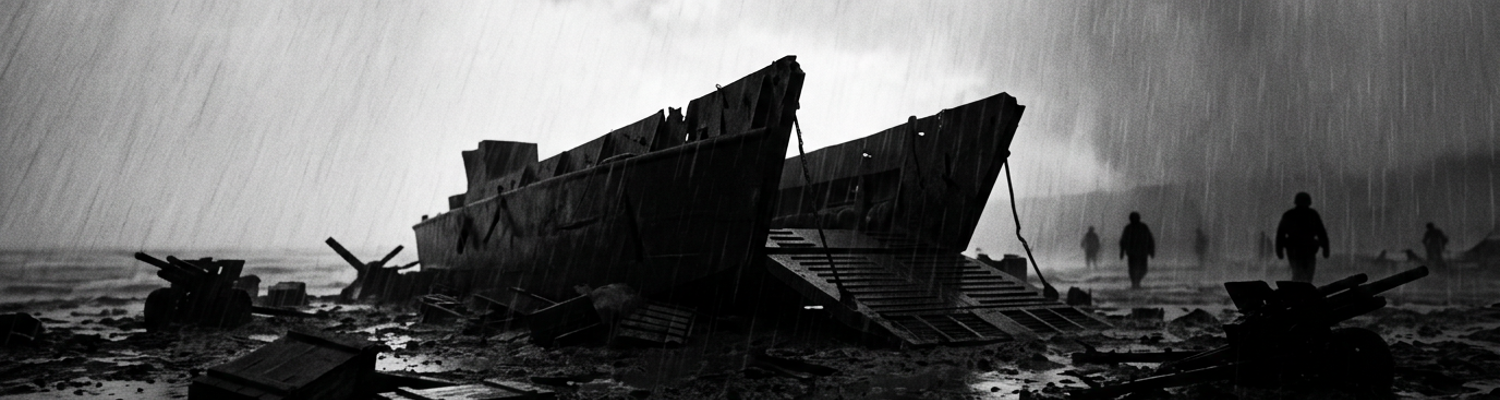

Seventh Fleet Landings at Dulag and Tacloban
Archival evidence shows that Seventh Amphibious Force planners completely misjudged the physical shoreline of Leyte Gulf. Kneeling in six inches of brackish water on White Beach near Tacloban, Motor Machinist Mate Third Class Ray Miller scraped gray volcanic grit from the oil cooler fins of an Allis-Chalmers HD-10 bulldozer. He used a rusted trench knife. Rain fell uninterrupted for forty-eight hours. Seawater and churned mud blended until the two were indistinguishable. The diesel exhaust of idling Landing Craft Mechanized hung thick in the stagnant tropical air. It mixed with the smell of scorched clutch plates. Miller attempted to clear a clogged intake line before the tractor engine seized entirely. A seized engine would leave the beach party without a means to drag broached pontoon barges out of the surf line. An unspotted Japanese Type 41 mountain gun fired from the ridge at Cataisan Point. The shell exploded forty yards to the east. Shrapnel peppered the tractor steel cowling. The winch cable snapped instantly.
The beachhead choked on its own equipment.
A close review of operational logs indicates that Task Force 78 at Tacloban and Task Force 79 down at Dulag handled an unmanageable volume of watercraft along narrow strips of sand. Impenetrable swamp backed these beaches. Underwater Demolition Teams 3, 4, and 5 cleared offshore wooden pilings. They reported the absence of heavy barrier reefs. Their initial hydrographic charts failed to anticipate the extreme shallow gradient of the gulf. Landing craft approached the Tacloban sector on October 20. Landing Ships, Tank grounded nearly one hundred yards out on submerged sandbars. Seventh Fleet beach parties worked alongside the 592nd Engineer Boat and Shore Regiment. Ramps dropped directly into six feet of water. Dozens of Dodge three-quarter-ton weapon carriers and GMC 6x6 trucks swamped before their tires touched solid ground. On the southern flank at Dulag, the 75th Naval Construction Battalion struggled to pin down steel Marston matting across Yellow Beach. The soil beneath the perforated steel was not firm sand. It was decayed organic silt. Thirty-ton Sherman tanks liquified the silt. Inland tracks turned into impassable mud.
Bulldozers sank until their cooling fans threw mud.
The onset of the seasonal northeast monsoon rapidly degraded these engineering failures. Between October 21 and October 24, torrential downpours dumped inches of water across the coastal plain. Every local irrigation canal overflowed. Makeshift dirt causeways built by the Seabees washed out completely. At Dulag, the 96th Infantry Division moved ashore on Blue and Orange beaches. The Daguitan and Calbasag rivers spilled their banks. Rear staging zones converted into standing lakes of runoff. Amphibious scouts pushed inland toward the Dulag airstrip. They discovered that local dirt paths were incapable of supporting tracked prime movers. Heavy artillery batteries stranded at the high-water mark. Salvage winches snapped repeatedly under the strain of pulling mired vehicles from the tidal flats. Beachmasters halted outbound traffic. Hundreds of fully loaded supply barges drifted offshore. Japanese mortar crews registered fire on them without opposition.
When examining the historical record of Task Force 79, the breakdown of shore operations came down to basic mechanical failure rather than defensive brilliance. Salt spray destroyed the electrical harnesses on radio command jeeps. Communication between the Dulag control vessels and the beachmasters ashore cut out for intervals of up to five hours. Mechanics belonging to the 88th Naval Construction Battalion resorted to stripping parts from submerged tractors. They needed to keep a single road open toward San Jose. By the evening of October 24, the southern sector stacked over twenty thousand tons of ammunition and dry rations in unorganized mounds directly inside the high-tide zone. Salt water destroyed fifty percent of the crated medical stores and small-arms ammunition.
Schistosoma Japonicum Exposure in Stagnant Marshlands
Archival evidence shows that naval and ground commanders sent landing elements directly into an intense endemic parasitic zone without functional preventative gear. Behind Red Beach and White Beach, the coastal flatlands around the Binahaan and Palo rivers were webbed with unmaintained rice paddies. Stagnant drainage canals choked with vegetation. These shallow, slow-moving waters housed dense colonies of Oncomelania quadrasi. This amphibious freshwater snail measured less than five millimeters in length. Personnel from the Seventh Fleet Naval Advance Base units and the 592nd Engineer Boat and Shore Regiment waded through knee-deep muck. They strung shore-to-ship fuel lines and established inland radio relay posts. Fork-tailed microscopic larvae called cercariae emerged from the snails. The parasites penetrated intact human skin within minutes. South West Pacific Area medical circulars distributed in late September identified Leyte as an active transmission zone for snail fever. Sixth Army and Seventh Fleet beach masters failed to issue protective rubber boots or chemical repellents to support echelons. More than 1,700 service personnel developed acute Katayama syndrome from this initial contact.
Men collapsed with violent abdominal cramps while stringing telephone lines through irrigation ditches.
A close review of operational logs indicates that the acute systemic reaction incapacitated shore support groups during the precise operational window when Japanese air raids intensified over Leyte Gulf. Within three to four weeks of wading across the marshlands near San Joaquin and Tanauan, engineers, repair specialists, and signalmen experienced sudden rigors. Body temperatures spiked to 104 degrees. Severe urticaria spread across their torsos. Laboratory staff from mobile field units recorded eosinophil levels exceeding seventy percent in infected naval mechanics. These violent immune reactions mimicked typhoid. Seventh Fleet pontoon assembly crews lost twenty-five percent of their effective work shifts. Technicians could not stand for more than two hours without severe hepatic tenderness and prostrating dry coughs. Clinical diagnosis required identifying microscopic ova in stool specimens. Medical officers initially misdiagnosed the outbreak as malaria or scrub typhus. They dosed incapacitated shore operators with unnecessary atabrine. Viable larvae migrated through their circulatory systems to mature in the mesenteric veins.
Sanitation broke down completely along the four-mile supply corridor between San Jose and Palo.
Simultaneously, an uncontrolled outbreak of bacillary dysentery devastated the physical readiness of naval supply depots across the Tacloban and Dulag sectors. Heavy rainfall kept the local water table level with the surface of the soil. Flooded slit trenches overflowed directly into the shallow, muddy pools that Seabees used for vehicle washing and emergency sponge baths. Pathogenic Shigella flexneri bacteria swept through the 75th and 105th Naval Construction Battalions with extreme speed. The problem turned catastrophic when medical detachments discovered that salt water had ruined crate after crate of sulfaguanidine and sulfadiazine tablets. These crates were stacked on open beachheads during the initial amphibious assault. Technicians running Northwest 25 crawler cranes and Cletrac high-speed prime movers suffered tenesmus and bloody diarrhea while seated at their control levers. Ammunition movements from the high-water mark to forward artillery positions halted.
By the second week of November, dispensary field wards attached to Navy Base Hospital 13 held over eight hundred dysentery cases alongside deteriorating schistosomiasis patients. Shore parties lacked replacement water-purification equipment. They operated mobile distilling units with brackish ditchwater. Silt fouled evaporator tubes every twelve hours. Clean drinking water output dropped to 1.8 gallons per man per day across Task Force 78 shore installations.
MacArthur GHQ Censorship and Script Delays
Archival evidence shows that operational autonomy for naval intelligence detachments on Leyte was systematically dismantled by General Douglas MacArthur and his General Headquarters. Commander Arthur H. McCollum directed Seventh Fleet intelligence under Vice Admiral Thomas C. Kinkaid. McCollum found his staff placed in direct administrative subordination to Assistant Chief of Staff for Intelligence, Major General Charles A. Willoughby. Southwest Pacific Area command directives stripped all tactical deception, prisoner interrogations, and psychological warfare assets from Seventh Fleet discretion. These assets were consolidated under the Psychological Warfare Branch. Brigadier General Bonner Fellers commanded this civilian and army hybrid organization. Fellers answered exclusively to GHQ rather than forward naval task groups. Navy communications officers attached to Task Group 77.1 on the amphibious command ship USS Wasatch possessed no independent authority to draft, broadcast, or air-drop frontline tactical appeals. Field intelligence personnel attached to the Seventh Amphibious Force were strictly forbidden from executing localized loudspeaker missions from patrol craft. They could not mount Davidson dual-duplicator presses on beachheads without explicit prior review from Willoughby and his G-2 censorship echelon.
Navy broadcast teams waited by their transmitters while the ground fighting moved out of range.
When examining the historical record of Task Force 77, the mechanical procedure for script authorization created an unsustainable procedural lag. Field teams drafting tactical surrender messages at Tacloban could not produce materials locally without formal political clearance. Clearance had to come from the main Psychological Warfare Branch office stationed at Hollandia. Hollandia was twelve hundred miles away in Dutch New Guinea. Communication back to the rear base relied on fragile, low-priority radio teletype channels routed through Sixth Army signal centers. Physical transport aboard courier aircraft was the only alternative. Staff officers under Willoughby scrutinized every Japanese-language text. They guaranteed absolute ideological conformity with MacArthur and his personal pronouncements. Censors struck any operational phrasing that offered tactical surrenders without citing Allied headquarters authority. Signal corps operators running SCR-399 radio trucks regularly faced transmission backlogs exceeding forty-eight hours. Simple two-paragraph surrender passes aimed at isolated Japanese platoons stalled in administrative holding patterns. MacArthur and his personal staff reviewed the draft line by line. Atmospheric disturbances frequently severed high-frequency radio connections. Mimeograph drafts sat in leather courier pouches awaiting transport aboard Douglas C-47 flights operated by the 322nd Troop Carrier Wing.
The vetting pipeline turned urgent combat messaging into stagnant administrative paperwork.
A close review of operational logs indicates that this centralized vetting structure crippled operations during the drive toward Dagami and Burauen. Between October 23 and November 4, mobile field printing presses belonging to the 592nd Engineer Boat and Shore Regiment sat idle on the muddy verges of Tanauan. They lacked authorization to produce five designated leaflet series. These leaflets targeted trapped elements of the Japanese 16th Division and the 33rd Infantry Regiment. Approved text clearances returned to the beachhead via Consolidated PBY Catalina flying boats from Hollandia on November 6. By that time, the targeted Japanese strongpoints had been overrun by artillery fire from the 24th Infantry Division. Surviving defenders had retreated into the trackless jungle of the Leyte Central Cordillera. Seventh Fleet PB4Y-1 Liberator patrol aircraft executed the delayed drops. They discharged over three million paper slips over empty terrain. Tactical instructions fell over abandoned defenses along the Guinarona River where Japanese lines no longer existed.
LCI Loudspeaker Operations and Coastal Artillery Strikes
Archival evidence shows that Seventh Amphibious Force technicians turned to experimental, improvised deck mountings when conventional distribution channels collapsed on the beachheads. In late October 1944, naval ordnance crews operating under Task Group 77.2 at Leyte Gulf converted three Landing Craft Infantry hulls into broadcast platforms. Machinists welded structural steel framing to the upper pilot house superstructures of LCI(G)-365 and LCI(L)-439. They anchored clusters of Western Electric nine-cell directional horn speakers driven by naval announcing system amplifiers. These public address rigs required independent, constant electrical current. Technicians bolted auxiliary Detroit Diesel 2-71 generator sets onto the open forecastle deck directly forward of the 40mm Bofors mountings. Cables running to the five-hundred-watt vacuum tube audio amplifiers were wrapped in rubber friction tape. Electricians threaded them through open watertight hatches. Psychological Warfare Branch teams intended to maneuver these shallow-draft vessels inside the surf zone along the Leyte coast. They planned to project recorded Japanese surrender messages across the low-lying palm groves between Tanauan and San Jose.
The top-heavy sound arrays reduced the craft to sluggish, conspicuous targets in the shallows.
When examining the historical record of Task Group 77.2, the mechanical limitations of the sound equipment instantly ruined the tactical plan. High-frequency surf noise, engine rumble from the twin General Motors 6-71 diesels, and acoustic dampening from mangrove shorelines degraded the broadcast range. Expected ranges of three thousand yards dropped to less than five hundred. Coastal ambient sound drowned out the speakers at standard standoff ranges. Seventh Fleet boat captains received direct orders to close the shoreline off Labiranan Head to point-blank distances of four hundred yards. The vessels drifted along the four-fathom line at a speed of four knots. They presented broadside profiles to the heights overlooking Leyte Gulf.
Japanese forward observers on Catmon Hill tracked the vessels through open gun sights for forty minutes without firing.
A close review of operational logs indicates that coastal artillery units of the Imperial Japanese Army 22nd Field Artillery Regiment exploited these close approaches with lethal precision. Japanese gunners operated Type 38 75mm field guns concealed inside log-reinforced revetments on the seaward bluffs of Catmon Hill. They waited until the modified LCIs cut their engines to reduce audio interference. At 0915 on October 27, four 75mm guns opened synchronized counter-battery fire on LCI(L)-439 from an elevation of three hundred feet. The second salvo straddled the craft. High-explosive fragmentation shells burst directly across the open superstructure. Steel slivers severed unshielded lead wires and riddled the Western Electric horn bells. An airburst detonated twenty feet above the bridge deck. Concussion shattered the glass envelopes of the 866A mercury-vapor rectifier tubes inside the amplifier cabinet. The signal extinguished mid-sentence.
Splinters from the third shell severed the auxiliary generator fuel lines and ignited diesel pooling across the forecastle.
Shrapnel punctured the unarmored 3/16-inch mild steel deck plating around the pilot house. The primary steering gear control linkage was destroyed. Six naval crewmen were wounded alongside two Army linguists from the Allied Translator and Interpreter Section. The auxiliary generators burned. Electrical fires spread along the main cable trunk. The vessel lost directional control fifty yards off the fringing sandbar. Japanese battery crews shifted to rapid traversing fire. Four consecutive high-explosive rounds slammed through the unarmored hull plates along the water line. The escorting destroyer USS Conyngham laid down a chemical white phosphorus smoke screen. Navy salvage teams from the fleet tug USS Sonoma managed to grapple the flooded broadcast craft. They towed it south toward Dulag. Inspection confirmed that every external speaker horn had been torn from its welded mounting brackets by shrapnel.
Communique Narratives Versus Frontline Attrition
Archival evidence shows that Psychological Warfare Branch tactical loudspeaker units deployed along the coast between Tolosa and Tanauan achieved zero mass surrenders among front-line Japanese formations. AN/UIQ-1 sound systems were mounted on the flatbeds of GMC CCKW three-quarter-ton weapon carriers and M29 Weasels. Operators attempted to broadcast direct appeals across the low-lying dunes to the log-and-earth bunkers of the Japanese 16th Division. Second Lieutenant Raymond Akimoto and Nisei interpreters from the Allied Translator and Interpreter Section read standardized scripts. They urged Japanese soldiers of the 9th and 20th Infantry Regiments to throw down weapons and crawl toward American pickets along Highway 1. Acoustic conditions along the surf line instantly disrupted transmissions. Continuous eighty-decibel wave action combined with 25-knot trade winds distorted vocal frequencies. Japanese phonemes turned into unintelligible static at distances beyond one hundred and fifty yards. Operators increased power to push through coastal surf noise. Paper-cone drivers on the University Laboratories 25-watt trumpet speakers tore. Secondary windings on the step-up audio transformers burned out after fifteen minutes of sustained transmission in the 90-degree heat.
Japanese defenders responded to the broadcasts with synchronized 81mm mortar salvos.
A close review of operational logs indicates that the frontline Japanese response completely contradicted staff projections formulated at Hollandia. Gunners belonging to the 16th Division Independent Mortar Battalion did not discard equipment or abandon defensive earthworks. They used sound origin points to register precise coordinates on American beach positions. Between October 26 and November 3, three separate loudspeaker vehicles operating under the 96th Infantry Division south of the Calbasag River were struck by Type 97 mortar rounds. Impacts occurred within ten minutes of initiating transmission cycles. Shrapnel sliced through unarmored amplifier housings. Battery leads were severed. Four ATIS broadcast technicians were wounded before a single enemy soldier emerged. Records confirm the surrender of only two unarmed Formosan contract laborers across twelve days of continuous acoustic operations along the coastal front from Dulag to San Jose. One severely concussed private from the 33rd Infantry Regiment who had been buried alive by naval gunfire was also captured. The targeted frontline combat units remained fully cohesive inside their coconut-log bunkers. They maintained fields of fire across muddy coastal tracks until eliminated at point-blank range by flamethrowers and satchel charges.
Surrender appeals produced targets rather than captives.
When examining the historical record of General Headquarters press releases, the contrast between published bulletins and frontline conditions expanded into an unbridgeable operational gulf. Daily communiques drafted by Colonel LeGrande A. Diller under General MacArthur and his direct supervision declared on November 2 that the Leyte campaign had entered its final clearing phase. Bulletins announced that Japanese defensive strength had been broken and that American control was firmly consolidated. Back at the high-water line, naval base units and Sixth Army distribution depots faced severe administrative paralysis. Over two hundred thousand tons of crated ammunition, aviation fuel, and food sat exposed to torrential rainfall along the Tacloban road corridor. Continuous monsoon deluges washed out seven temporary timber trestle bridges across the Palo River. Motorized supply columns grounded in four-foot-deep mud. Signal corps teletype centers experienced continuous administrative gridlock. Operational requisitions from the 24th Infantry Division waited eighty hours for administrative confirmation from Base K supply officers.
The sanitized communiques excluded all mention of the medical collapse engulfing rear echelons.
Field dispensaries attached to the 58th Evacuation Hospital and Navy Mobile Base Hospital 13 were overrun by non-battle casualties. These casualties exceeded combat wounds by a ratio of three to one. By the second week of November, acute bacillary dysentery, scrub typhus, and severe parasitic schistosomiasis had hospitalized over 3,200 soldiers and naval mechanics across the coastal plain. Concurrently, the psychological warfare campaign failed to impede Japanese operational mobility. The Imperial Japanese Navy executed Operation TA. They landed thirty-four thousand fresh troops from the 1st, 26th, and 102nd Divisions at Ormoc Bay between October 25 and December 11 without interference from Allied surrender operations. Press communiques issued from the comfortable air-conditioned echelons of GHQ continued to record negligible losses and rapid mop-up operations. Frontline rifle companies in the Leyte Valley suffered fifty percent attrition from tropical infections and trench foot. Sixth Army quartermasters reported that twelve thousand pairs of replacement combat boots had dissolved in the acidic swamp water between Tanauan and Dagami. Infantrymen were stranded in raw canvas leggings as fighting shifted toward the jagged ridges of the Ormoc Valley.