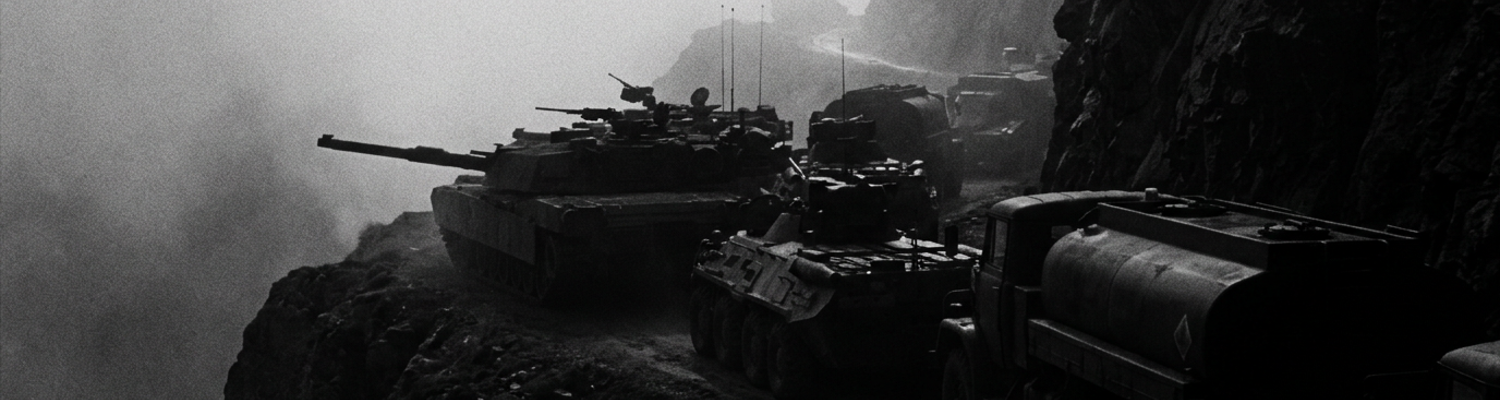

Standstill at the Gnjilane Crossroads
Sabre Six flashed an emergency voice transmission to Falcon Main over tactical frequency thirty-four point eight zero. Forward elements were immobilized at phase line blue. The canyon corridor was sealed by non-combatants. Mobility dropped to zero. Engine temperatures reached critical thresholds.
The advance failed before the armor cleared the initial ridgeline.
When examining the historical record, the opening hours of Operation Joint Guardian exposed the physical limits of mechanized doctrine in the Karadag mountains. Lieutenant Colonel Mike Ryan directed the 1st Squadron, 4th Cavalry Regiment. They served as the cavalry vanguard for Task Force Falcon. Their objective was establishing armored security from the Macedonian border crossing at Blace straight northward through the narrow gorges toward the city of Gnjilane. M1A1 Abrams main battle tanks and M2A3 Bradley fighting vehicles pushed into the mountain cuts along two-lane macadam roads. These routes were never designed for seventy-ton tracked loads. Torsion bars cracked against broken road shoulders. Radiator fans choked on dense dust plumes kicked up by thirty-vehicle serials. Driver crews repeatedly cycled auxiliary power units to clear air filtration pre-cleaners. Command directives from Task Force Falcon headquarters mandated rapid territorial reach to forestall potential Yugoslav territorial partitioning. Cavalry scouts had to secure lateral lines of communication across fifteen kilometers of ridgeline before midday. Maintenance recovery teams in heavy M88A2 Hercules recovery vehicles trailed miles behind. They could not overtake the forward troops along sheer cliff faces where single-track asphalt dropped directly into riverbeds.
Tracked armor requires open space to function.
A close review of operational logs indicates the cavalry flanking screens disintegrated the moment Troop A and Troop B reached the choke points outside Gnjilane. Lead Bradley scouts met a wall of human displacement moving south. This mass moved directly into the path of withdrawing units from the Yugoslav Army Third Army and special police contingents. Over forty thousand ethnic Albanian civilians on foot occupied both asphalt lanes. They were packed into flatbed farm wagons and crowded inside overloaded Zastava automobiles. Threaded through this civilian press were Yugoslav military echelons executing their withdrawal under the Kumanovo Military Technical Agreement. These included T-55 main battle tanks, wheeled BVP M-80 infantry vehicles, and flatbed transport trucks carrying artillery munitions. Drivers on both sides cut their engines. They wanted to avoid crushing non-combatants pressed flat against hull skirts and track assemblies. Gunners locked their turrets in travel clamps. This prevented gun tubes from striking overhead electric cables or fleeing crowds. Cavalry scouts could not peel off into the fields. Adjacent road verges contained unmapped minefields laid during the preceding twelve weeks of ground operations.
Tactical radio nets fell silent. Squadron commanders watched the highway freeze solid.
Archival evidence shows squadron support officers immediately reclassifying the mission. It shifted from combat reconnaissance to crisis containment along the Gnjilane axis. Fuel reserves inside the M1A1 tanks plummeted below one-third capacity. Gas turbine engines burned seven gallons per hour merely idling in place to power thermal sights and communications suites. Supply serials of the 201st Forward Support Battalion were locked thirty kilometers behind the pass. Junior officers on the scene negotiated passage vehicle by vehicle with Serbian officers through hand signals and military interpreters. Hand-drawn route logs compiled by squadron staff officers between 0600 and 0900 hours noted twenty-six mechanical breakdowns across two combat troops. Eleven vehicles suffered complete transmission overheating due to zero-speed operation in high ambient summer heat.
Tactical Communications Breakdown Across Karadag Defiles
Very-high-frequency radio waves do not bend through solid granite.
A close review of operational logs indicates tactical command and control disintegrated. Single-channel ground and airborne radio systems suffered catastrophic line-of-sight failures across the defiles. The signal loss began at grid coordinate EM-348120 inside the southern canyon mouth. RT-1523 transceivers operating in frequency-hopping mode between thirty and eighty-seven megahertz required unobstructed line-of-sight propagation. Eight-hundred-meter canyon walls instantly neutralized this requirement. Lead M2A3 Bradleys in Troop A lost synchronization with their squadron net control station within forty minutes of entering the cut. Radio emissions bounced off sheer limestone cliffs. The signals scattered into multipath interference. This broke the cryptographic hopset synchronization between vehicles. Combat net radios defaulted to late-entry mode. Transmitters could not lock onto the hopping pattern without a reliable time-sync master signal from an overhead relay. Vehicle commanders unbolted OE-254 omnidirectional antenna masts from hull stowage racks. They attempted to lash composite fiberglass elements to roadside guardrails to gain elevation. Steep terrain angles and unmapped anti-personnel minefields on the flanking ridgelines prevented signal teams from establishing high-altitude retransmission stations on surrounding peaks.
Every bend in the asphalt shaved another five kilometers off effective transmission range.
When examining the historical record, squadron and troop elements were severed from real-time brigade telemetry and airborne surveillance feeds. Severe mountainous terrain obstruction caused this blackout. RQ-5A Hunter unmanned aerial vehicles orbiting at ten thousand feet over the Morava valley beamed down live electro-optical surveillance feeds to the Task Force Falcon tactical operations center at Camp Able Sentry. The narrow shelf of the Karadag defiles blocked the line of sight required by forward receiving antennas. Downward microwave downlinks from surveillance aircraft struck the southern crests. Squadron commanders were left blind to Yugoslav armor movements occurring four kilometers north. The Enhanced Position Location Reporting System failed simultaneously. Ground-based ultra-high-frequency relay paths operating in the four-hundred-megahertz band dissolved against the mountain shoulders. Digital tactical displays inside the command vehicles froze. The screens presented vehicle icons in coordinates they had vacated two hours earlier. Brigade staff officers twenty miles south watched static screens. They were stripped of automated position updates from lead cavalry scouts.
Runners moving on foot became the only functioning connection between pinned scout sections.
Archival evidence shows communications platoons improvised analog workarounds as late afternoon approached. Radio operators assigned to the 1-4 Cav communications section parked an unarmored M1097 Humvee carrying a VRC-92 dual-transceiver radio on an exposed hairpin turn at phase line green. This turned the vehicle into a hasty retransmission post. Signal soldiers ran WD-1 field wire through roadside drainage ditches. They spliced lines directly into analog TA-312 field telephones set on Bradley sponsons. The computerized tactical data network had collapsed into hardware developed during the Korean War. Operational logs recorded eighty-four failed digital calls between Troop B and Falcon tactical operations between 1300 and 1700 hours. Troop commanders had to coordinate sector security with Yugoslav officers using hand signals and paper grease-pencil overlays.
Autonomous Troop Engagements and Dispersed Reconnaissance
Radio silence transferred tactical control down to twenty-six-year-old cavalry lieutenants.
When examining the historical record, company-grade officers in 1st Squadron, 4th Cavalry Regiment found themselves stranded beyond the reach of squadron or brigade battle command nets. Left with dead radio frequencies at grid coordinate EM-374138 near the village of Pasjane, Troop A commander Captain Scott Anderson made tactical decisions without authorization from higher headquarters. Encounters with armed Yugoslav Special Police units and trailing elements of the Yugoslav 252nd Armored Brigade forced immediate action. Anderson shifted Bradley crews from standard security posture into hull-down battle positions along terraced hillsides. He positioned 25mm M242 Bushmaster cannons directly on Serbian vehicle columns. He deliberately elevated TOW anti-tank missile launch tubes to avoid provoking return fire. An armed group of twenty paramilitary fighters emerged from a woodline flanking the highway. The lead scout platoon initiated immediate bounding contact drills. They maneuvered two M2A3 Bradleys across an irrigation ditch to cut off the group advance toward the road. Crews executed these maneuvers while clearing mechanical jams. High dust volumes caused feeder jams in the 25mm ammunition chutes. Gunners had to disconnect feed chutes and manually clear jammed 25mm high-explosive incendiary rounds with breach wrenches. Local rules of engagement were drawn directly on grease-pencil maps taped to vehicle skirts. These dictated weapons hold commands and vehicle dispersion distances without a single word of guidance from the tactical operations center at Camp Able Sentry.
Authority resided entirely inside individual vehicle turrets.
A close review of operational logs indicates scout elements improvised buffer zones to halt skirmishes between Serbian military personnel and Kosovo Liberation Army insurgent cells. Positioned at a road junction two kilometers south of Gnjilane, 2nd Platoon of Troop B encountered a confrontation. Withdrawing Yugoslav rear-guard troops faced an armed perimeter established by fifty KLA fighters armed with automatic rifles and RPG-7 rocket launchers. Electronic communications between the scout platoon, adjacent units, and squadron command had failed completely. Platoon leaders set up a physical screening line across three hundred meters of roadway. They placed three M2A3 fighting vehicles broadside between the opposing forces. Dispatches between Bradleys relied on physical runners and visual signaling devices. Scouts displayed international orange VS-17 recognition panels across engine deck grilles. They used M18 hand-held colored smoke signals to designate stop lines for both armed factions. Smoke drifted across the defile. Vehicle commanders utilized green and red chemical lights strapped to antenna tips alongside standard daylight arm-and-hand signals to regulate traffic. Dismounted scouts sprinted five-hundred-meter intervals along drainage ditches under armed observation from surrounding hills to pass coordinates between isolated combat sections. Mechanical vibrations and rough terrain severed the WD-1 field wire laid in the culverts within twenty minutes of deployment. Physical foot movement became the sole link between observation posts.
Archival evidence shows junior commanders conducted twenty-two uncoordinated vehicle inspections and five separate disarming actions between 1400 and 1900 hours. After-action logs completed on vehicle hoods that night recorded twelve live runner dispatches across disputed terrain. They also recorded sixty-four hand-signaled vehicle diversions. The troop command log at EM-389142 closed at midnight with notes on four seized shoulder-fired anti-tank weapons secured inside Bradley ammunition sponsons without squadron authorization.
Supply Line Paralysis Along Route Hawk
When examining the historical record, sustainment failures rapidly superseded maneuver tactics. Heavy fuel convoys stalled in sixty-kilometer civilian gridlocks along Route Hawk. Movement Control teams from the 201st Forward Support Battalion had mapped the highway as a high-capacity main supply route. They believed it capable of sustaining two mechanized cavalry troops and attached armor squadrons. The operational scheme dissolved north of the Macedonian frontier. By midday, sixty continuous kilometers of asphalt between Elez Han and the northern defiles were frozen solid by a tangled mass of civilian and military traffic. Thousands of civilian vehicles, overloaded agricultural flatbeds, and horse-drawn wagons collided with withdrawing Yugoslav Third Army transport columns attempting to meet treaty withdrawal deadlines. Heavy M978 HEMTT 2,500-gallon fuel tankers found themselves wedged between unpowered civilian cars with dry fuel tanks and Serbian military trucks. Tactical commanders who had planned rapid armored thrusts into the interior were forced to halt forward bounds. They redirected their focus toward traffic arbitration. Turbine engines inside the forward Bradley and Abrams elements continued to draw fuel at zero velocity. The supply convoys carrying JP-8 remained pinned sixty kilometers to the rear with engines overheating from endless stop-and-go idling.
A stationary Abrams burns ten gallons of JP-8 every hour merely keeping its electronics alive.
A close review of operational logs indicates single-lane cliff roads prevented recovery assets and distribution trucks from bypassing immobile refugee carts and abandoned civilian transport. Carved directly into the limestone walls of the gorge, the four-meter-wide roadway provided zero lateral clearance for Oshkosh M984 wreckers or M88A2 recovery vehicles attempting to reach obstruction points. Fleeing families had abandoned unserviceable Zastava 101 sedans and two-wheeled timber wagons directly in the single operational lane after running out of petrol or snapping axle pins on broken macadam. Heavy recovery platforms could not shoulder past the obstructions. Vehicle widths exceeded the remaining asphalt margin by half a meter. Pushing civilian wreckage off the cliff face with dozer blades was forbidden by rules of engagement. Displaced persons were camped on the riverbanks directly below the roadway. Mine indicators also restricted off-road recovery movements. Engineering teams could not bypass jams by putting wheels into drainage ditches. Unmapped PMA-2 blast mines and tripwire-activated fragmentation charges remained uncleared along the road verges.
Vertical drop-offs of seventy meters fell straight into the riverbed on the exposed flank.
Archival evidence shows support battalions attempting manual salvage operations that quickly exhausted local maintenance resources. At grid coordinate EM-312094, a blown differential on an M923 five-ton cargo truck locked a fifteen-vehicle supply packet for six hours. Mechanics rigged hand-operated come-alongs to shift the dead chassis against the mountain wall. Winch cables on two M984 wreckers snapped under cross-angle strain when crews attempted to drag seized Serbian transport flatbeds out of the bottleneck. Brake drums on heavily loaded fuel trailers glazed and locked from continuous friction on steep four-percent downhill grades. Convoy commanders dispatched foot patrols along the road shoulders to siphon diesel by hand from rear-echelon utility vehicles to keep lead radios operational. Task Force Falcon support logs concluded at 2200 hours with seventeen heavy supply trucks abandoned along the roadside near Kacanik. Their fuel tanks were drained dry by field mechanics to keep forward combat systems running through the night.
Armored Propulsion Cannibalization and Emergency Refueling
Fuel needles across twelve M1A1 Abrams tanks hit the red empty peg by 2130 hours.
When examining the historical record, armor crews with Troop A, 1st Squadron, 4th Cavalry Regiment at grid coordinate EM-355122 resorted to cross-siphoning and cannibalizing propulsion fuel. This kept critical auxiliary power units and turrets functional. The Textron Lycoming AGT1500 gas turbine engines had burned through their five-hundred-gallon fuel cells after fourteen continuous hours of static idling in the mountain bottlenecks. Tank commanders ordered mechanics to manually drain remaining JP-8 from bottom hull cells into external two-cycle auxiliary power units mounted on the rear sponsons. This prevented Raytheon thermal imaging systems and turret stabilization gyros from losing electrical bus power. By 2215 hours, driver crews disconnected secondary fuel return manifolds using six-inch adjustable wrenches. They drained residual fuel into dented five-gallon jerry cans through severed hydraulic hoses unbolted from dead chassis. Hand-operated rotary transfer pumps failed after fine limestone grit from broken macadam contaminated roadside jerry cans. Bronze impellers seized within minutes of operation. Soldiers pulled fuel through clear plastic tubing with their mouths. They swallowed toxic hydrocarbons in the dark. Deprived of twenty-eight-volt direct current from auxiliary power units into the turret slip rings, main gun traverse drives froze solid. This rendered 120mm M256 smoothbore cannons completely inoperable against surrounding ridgelines.
Dead engines turned forty battle tanks into static pillboxes.
A close review of operational logs indicates priority distribution of JP-8 was strictly restricted to essential communications nodes and medical evacuation assets to avoid complete squadron immobility. Squadron supply officer Captain Thomas Vance issued emergency distribution guidelines from the tactical operations vehicle at EM-332098 at 2300 hours. Only two thousand gallons of JP-8 remained inside three isolated M978 heavy expanded mobility tactical tankers stuck along the gorge shelf. Vehicle commanders who radioed urgent requests for propulsion fuel to clear road shoulders received flat rejections from squadron staff. Quartermasters diverted every available gallon of fuel directly to two high-frequency retransmission Humvees parked on exposed ridgelines and four M113 tracked ambulances staging near the southern defile. Flight crews operating UH-60A Black Hawk medical evacuation helicopters from a gravel pad at Blace received seven hundred gallons from the remaining reserve. This guaranteed emergency casualty extraction flights back to the military hospital in Skopje. Scout sections running low on diesel shut down auxiliary equipment. They held emergency battery power solely for scheduled contact reports.
Batteries died three hours before dawn.
Archival evidence shows Troop B crews conducting improvised cross-siphoning operations along roadside drainage ditches near Pasjane between midnight and 0400 hours. Maintenance teams stripped three disabled M2A3 Bradleys of their remaining five-gallon containers. They pooled forty-five gallons of contaminated JP-8 to restart a single forward command track. Sediment settlement inside vehicle hull tanks caused primary fuel filters on M88A2 recovery vehicles to foul every forty minutes. Mechanics blew out pleated paper elements using compressed air cans from weapons cleaning kits. Improvised bypass lines ran directly from M998 cargo trucks into Bradley auxiliary heater manifolds. These were secured with electrical tape and safety wire. Technical inspectors logged nineteen separate transfer points where contaminated fuel triggered emergency shut-off valves in turbine fuel control units. Squadron maintenance logs compiled at first light recorded that thirty-one of thirty-four forward combat tracks possessed less than thirty gallons of propulsion fuel in their main cells. Eight vehicles were completely drained of fluids to preserve emergency radio relays.
Radiological and Hazardous Material Screening Protocols
Alpha particles do not register on standard combat vehicle thermal optics.
When examining the historical record, technical teams from the 79th Chemical Detachment rushed radiological and hazardous environmental screening protocols adapted from Department of Energy baseline models directly into the Karadag gorge. Military field manuals lacked established peacetime civilian threshold levels for low-yield radioactive scatter. Chemical specialists at grid coordinate EM-328104 adopted emergency radiological assessment algorithms developed by the Department of Energy Remote Sensing Laboratory and Nevada Operations Office. Technicians unpacked AN/PDR-77 radiation detection sets and handheld AN/VDR-2 radiac meters. They taped plastic trash bags over alpha scintillation probes to shield fragile Mylar sensing windows from jagged granite outcrops. Calibration logs reveal the Department of Energy screening templates required surveying sixty-meter grid squares across defile bypass lanes to detect depleted uranium dust generated by earlier aviation strikes against Yugoslav armor. Sensor heads failed repeatedly when battery contacts on the AN/PDR-77 corroded in the damp mountain fog. Teams scrubbed copper terminals with carbon-scraping multi-tools. Task Force Falcon staff officers altered troop movement schedules based on these improvised tables. They forbade dismounted cavalry scouts from establishing prone observation pits in topsoil where background counts exceeded three times the normal environmental baseline.
Suspended limestone dust ruined three probe membranes an hour.
A close review of operational logs indicates specialized teams conducted immediate soil and atmospheric toxic industrial chemical assessments along captured defile routes and abandoned industrial sites near the northern road junctions. M93A1 Fox nuclear, biological, and chemical reconnaissance vehicles pushed past stalled cavalry columns toward disused textile and plastics processing facilities outside Pasjane. Survey parties dismounted under armed security to draw core samples using hand-turned soil augers. They drove stainless steel probe tubes sixty centimeters deep into ditch drainage banks where fuel and industrial runoff had settled. Atmospheric sampling technicians deployed Draeger Multi-Gas detection pumps and M256A1 chemical agent detector tickets inside unventilated chemical storage barns. These barns contained ruptured fifty-five-gallon drums of industrial chlorine, trichloroethylene, and sulfur-based leather treatment solvents. Airborne chemical vapors registered dangerous parts-per-million concentrations in low-lying marshlands bordering the Binacka Morava river. Command teams classified the primary vehicle bypass routes as chemical hazard exclusion zones.
Archival evidence shows environmental survey teams working through the predawn hours to map hazardous runoff channels before morning rain washed contaminants into primary drinking water tables. Chemical staff officers at Camp Able Sentry compiled handwritten toxicity overlays on acetate paper. They cross-referenced Yugoslav industrial manifests against forward soil data collected along Phase Line White. Analysis of sixty-four core samples gathered between 0100 and 0500 hours revealed concentrated heavy-metal residues and volatile organic compounds leaching from destroyed battery reclamation facilities at grid coordinate EM-391152. Pucker-type air samplers running on lead-acid batteries seized up when fine rock flour from heavy tank traffic clogged cellulose collection filters. Mechanics in the rear refused to exchange air filtration cartridges for forward scouting squads until soil toxicity reports confirmed the absence of persistent organophosphate pesticides. Emergency decontamination basins improvised from rubber fuel bladders collected rinse water from thirty-eight contaminated light utility vehicles before daylight.
Test results from borehole nine confirmed twenty-eight parts per million of cyanide gas trapped in the ditch subsoil.
Immediate Lessons in Austere Cavalry Maintenance
Fine limestone dust ground through rubber track pads and intake seals faster than any enemy munition.
When examining the historical record, cavalry maintenance technicians from the 1st Squadron, 4th Cavalry Regiment faced total intake system breakdown across their motorized echelons by dawn. Stationary vehicles parked at grid coordinate EM-342118 ran their primary engines continuously across eighteen hours to maintain electrical power for Raytheon thermal targeting sights and cryptographic radios. This nonstop idling pulled vast volumes of pulverized ambient dust straight into unarmored engine compartments. Textron Lycoming AGT1500 gas turbines inside the M1A1 Abrams tanks consumed six hundred cubic feet of air every minute while stationary. Dense clouds of crystalline silicate thrown up by passing freight columns saturated the cyclonic pre-cleaner tubes. This packed the swirl tubes with compacted particulate. Dust cakes breached the barrier filter seals within hours. Maintenance crews pulling inspection panels on five tanks found micro-abrasive silt coating the first-stage compressor blades. This caused axial erosion that slashed turbine compression by twenty-two percent. Diesel engines fared no better. Cummins VTA-903T powerplants inside Troop A M2A3 Bradleys suffered severe crankcase oil contamination when powdered grit bypassed dry-paper primary air filters. This contaminated engine lubricant with abrasive particulate that ground down cylinder liners and wrist pins.
Steel track pins snapped against bare granite.
A close review of operational logs indicates the physical strain of mountain maneuvering destroyed track assemblies at five times their projected doctrinal failure rates. Macadam mountain shelves and jagged limestone outcrops flanking the southern passes ground directly against the tracked undercarriages. Rubber track pads on the T158LL track shoes fitted to the squadron M1A1 tanks were normally rated for three thousand kilometers of cross-country transit. They wore down to bare steel backing plates across forty-eight hours of friction. Continuous pivot steering along sharp eleven-degree switchbacks ripped outer rubber chevron blocks entirely off their steel pins. Without rubber cushioning, bare manganese steel grousers slammed directly against rock roadbeds. This transferred unmitigated shock loads through the road wheels into the suspension arms. Torsion bar springs in eight Bradleys fractured at the anchor housings near the third and fourth road wheel stations. Maintenance soldiers at the Pasjane holding yard worked around the clock with sledgehammers, pry bars, and pneumatic impact wrenches. They broke rusted end-connectors to splice intact links from dead hulls onto active combat tracks. Spare track sections brought forward on cargo flatbeds were exhausted before noon.
Recovery teams possessed no mechanical tools capable of clearing a seventy-ton tank from a four-meter shelf.
Archival evidence shows forward support elements of the 201st Forward Support Battalion recorded immediate structural deficiencies in recovery gear designed for open European plains rather than confined mountain gorges. Standard heavy-duty M1A1 rigid tow bars required collinear alignment between the stranded vehicle and the recovery platform. This permitted a maximum offset angle of fifteen degrees. Inside the sheer rock corridors at grid coordinate EM-338109, road widths contracted to less than four meters with vertical stone walls on one side and a sixty-meter drop into the gorge on the other. Hercules M88A2 recovery vehicles could not maneuver into direct alignment with disabled hulls. Towing crews attempting to pin the ninety-pound steel tow bars found themselves physically wedged between armored hulls and cliff faces. They were unable to swing the rigid steel arms into the towing eyes. Mechanics attempted off-axis extractions using 1.25-inch main winch cables. The acute fleet angles across fairlead rollers caused the steel cables to fray and shear under seventy tons of static deadweight. Forward support units lacked short-radius articulated tow assemblies, hydraulic side-recovery spades, or crane outriggers that could deploy without slipping off crumbling gravel road shoulders. Squadron work orders logged at 0600 hours classified seventeen armored combat vehicles as non-mission-capable solely due to sheared towing eyes, warped tow bar lugs, and missing track shoes.
Doctrinal Adaptations for Independent Armored Incursions
Before sunrise on June 13, staff officers at Camp Able Sentry were already rewriting armored reconnaissance tables on carbon-copy dispatch paper.
When examining the historical record, initial after-action assessments mandated the organic embedding of high-volume fuel distribution assets directly within forward cavalry troops. Squadron supply reports drafted at grid coordinate EM-332098 revealed relying on brigade-echelon supply packets from the 201st Forward Support Battalion had crippled the lead scout screen within six hours of border departure. Echeloned supply trains operating Oshkosh M978 heavy expanded mobility tactical tankers had remained trapped behind civilian bottlenecks forty kilometers to the south. They were unable to negotiate single-track defiles to service dry combat platforms. Doctrinal revisions submitted by squadron maintenance officers required modifying the basic cavalry troop table of organization and equipment. They incorporated all-wheel-drive 2,500-gallon tactical fuel trucks and armored M548 tracked cargo carriers directly into the scout platoon march order. Field analysts documented how turbine-powered M1A1 tanks and Cummins-powered M2A3 Bradleys had burned their combat fuel reserves while parked motionless at defile road junctions. Mechanics noted centrifugal fuel pumps on trailing supply trucks lacked the pressure ratings required to refuel vehicles uphill along thirty-degree rocky grades. Armored units advancing into closed mountain passes could no longer function as isolated strike prongs while tethered to centralized division supply points.
Tanks without fuel ceased to be combat systems.
A close review of operational logs indicates Army doctrine writers began prioritizing non-line-of-sight satellite tracking architectures over legacy VHF tactical voice nets for armored reconnaissance. Field observers from the U.S. Army Armor Center and doctrine teams stationed at Fort Knox seized upon communications logs documenting the complete failure of single-channel ground and airborne radio systems across the Karadag corridor. Standard RT-1523 transceivers operating across thirty to eighty-seven megahertz frequencies had failed to push frequency-hopping signals past eight-hundred-meter limestone ridgelines. This severed forward cavalry scouts from higher headquarters. Early field evaluations of the Force XXI Battle Command Brigade and Below network immediately superseded tactical FM voice protocols in doctrinal updates. Telemetry data from Task Force Falcon demonstrated low-power L-band satellite links provided real-time vehicle positioning and packet data transfers where terrestrial combat net radios failed. Technicians began planning hull modifications to mount omnidirectional satellite antennas directly onto Bradley turret roofs and Abrams bustle racks. This bypassed ground relays entirely. Field manuals governing cavalry screening missions were altered to replace terrestrial retransmission sites with direct satellite transponders. This eliminated the operational requirement to secure exposed ridgeline relay stations in contested terrain.
Granite cliffs rendered voice networks irrelevant.
Archival evidence shows operations analysts at the United States Army Combined Arms Command compiled forty-two specific doctrinal changes from Task Force Falcon maintenance debriefs before the end of June. Engineers recorded nineteen mechanical drive-train failures where heavy fuel tankers attempting off-camber bypass maneuvers had cracked planetary hub assemblies on boulder-strewn shoulders. Field mechanics filed emergency engineering change requests for high-pressure fuel-transfer hose couplings. They argued existing gravity-fed nozzle assemblies took seventy-five minutes to refuel a single main battle tank in mountain mud. Command logs collected from Troop A revealed eighty percent of tactical messages sent over VHF voice nets had vanished into canyon dead zones without operator acknowledgment. Doctrine developers formally submitted revision requests for Field Manual 17-95. They stipulated future independent reconnaissance formations entering mountain defiles must operate with organic refueling capabilities and satellite transceivers down to vehicle commander levels. The final memorandum filed by the squadron support officer at 0530 hours documented an emergency order for forty-eight commercial satellite transceiver packs to be air-shipped directly to the staging base at Petrovec.