
Desecheo Island Exclusion Zone Security
Petty Officer Second Class Raymond Vance wiped hydraulic fluid from the casing of an AN/SPS-64 surface-search radar receiver (serial number 114-B). He used a dry cotton rag to clean the copper grounding strap. The humidity inside the radar equipment room on the southern perimeter monitoring post hovered above eighty-five percent. Salt air had corroded the contact pins of the intermediate-frequency amplifier. Vance had to reset the rotary gain switch three notches counterclockwise to suppress false returns from ambient wave chop. Analog sweep needles traced faint green lines across the cathode-ray display. The cooling fans rattled against their housing after fourteen continuous hours of operation. The primary power generator outside the bunker skipped a cycle every few minutes, causing the screen to dim momentarily before recovering its bright green intensity.
Equipment failures occurred daily in the Mona Passage.
When examining the historical record, Desecheo Island occupied a specific administrative status that complicated standard military jurisdiction. Located twenty-one kilometers west of Rincon, Puerto Rico, the 1.5-square-kilometer landmass consisted of rugged volcanic terrain and sheer cliffs dropping into deep oceanic trenches. The United States War Department had seized the island during the Second World War for use as an aerial bombing target and naval gunnery range. Decades of heavy bombardment by naval rifles and ordnance drops left the interior saturated with unexploded five-inch shells and aircraft bombs. Federal authorities formally integrated the territory into the Caribbean Islands National Wildlife Refuge under the custody of the United States Fish and Wildlife Service in 1976. The presence of live ordnance forced civilian administrators to institute an indefinite civilian closure. The United States Navy maintained overlapping security authority to safeguard ordnance reserves and prevent unauthorized foreign reconnaissance.
Federal law prohibited any unauthorized landing.
Archival evidence shows that by July 1987, naval patrol doctrine in the Mona Passage had shifted toward an aggressive interdiction posture. Fleet composite squadrons and patrol units operating out of Naval Station Roosevelt Roads executed continuous surface surveillance sweeps across the fourteen-mile maritime corridor between Puerto Rico and Desecheo. Watchstanders maintained round-the-clock surface tracking intervals. They logged every vessel passing within five nautical miles of the jagged coastline. Standard operating procedures dictated that any radar track moving under twelve knots without an active transponder response triggered immediate physical vectoring by fast patrol craft. Tactical officers recorded these passes at fifteen-minute intervals. They alternated between visual binocular sweeps and high-frequency radio queries across international maritime distress channels. Rules of engagement required boarding teams to treat any unidentified craft loitering near the island as a potential explosive salvage operation or hostile intelligence gathering effort.
A close review of operational logs indicates that the standard surveillance grid registered an anomaly on the night of July 22, 1987. At 0214 hours, watchstanders logged an intermittent, low-reflectivity contact drifting along the southern reefs of Desecheo at coordinates 18 degrees 20 minutes 05 seconds North, 67 degrees 28 minutes 30 seconds West. The radar return flickered beneath the sea-clutter threshold. It presented a cross-section too small for an engine-driven launch. Forward watch personnel on an approaching naval patrol boat illuminated the breaking surf with a carbon-arc searchlight five minutes later. The beam caught two dark, rubberized silhouettes maneuvering through the surf zone toward the rocky shoreline. Both swimmers carried neutral-buoyancy equipment packs. They made no distress signals and ignored repeated loudspeaker challenges issued in English and Spanish. Command watch officers immediately reclassified the blip from an adrift navigational hazard to an active perimeter penetration.
The intruders disappeared into the unexploded ordnance zone before patrol craft could deploy boarding teams to the rocks.
Tropical Storage Degradation and Chemical Spoilage
Archival evidence shows that reinforced concrete supply shelters constructed along the southern plateau during early naval exercises became heat traps by the summer of 1987. Unventilated bunker structures (designated Facility 44-A) lacked mechanical air exchange systems or operational dehumidifiers. These units were cataloged as auxiliary storage vaults at coordinates 18 degrees 20 minutes 18 seconds North, 67 degrees 28 minutes 12 seconds West. Salt-laden marine air entered through passive ground-level intake louvers. This drove relative humidity above ninety-four percent. Solar radiation on the exposed blast slabs pushed internal temperatures past 108 degrees Fahrenheit. Heavy condensation dripped continuously from the raw ceiling concrete onto stacked wooden pallets and metal equipment lockers. Galvanized zinc coatings on storage racks flaked away within weeks. Bare carbon steel was exposed to rapid oxidation and flaking rust. Neoprene gaskets and synthetic rubber linings on supposedly airtight field transit chests softened and liquefied. They fused directly to metal sealing rims. This destroyed the pressure barriers protecting dry provisions and sensitive electronics. Cardboard shipping containers holding replacement communications parts absorbed airborne moisture until structural integrity failed. They collapsed under their own weight into rotted mash. Steel latches on ammunition cases rusted solid into their striker plates. Ordnance handlers had to use pry bars and cold chisels to crack open routine supply boxes.
Corrosion destroyed supply stocks from the inside out.
A close review of operational logs indicates that this uncontrolled atmospheric heat systematically ruined the Atlantic Fleet photographic chemistry stockpiled for maritime surveillance units. Standard-issue developer powders (National Stock Number 6810-00-270-9981) degraded rapidly in storage environments exceeding thirty-eight degrees Celsius. These supplies were primarily Kodak D-76 formulations and phenidone-hydroquinone concentrate packets shipped from Naval Support Activity Norfolk. Thermal stress accelerated the auto-oxidation of hydroquinone. Dry crystalline packets turned into dark, insoluble clumps that released sharp sulfur dioxide gas when sliced open with bayonets. Liquid developer stock stored in semi-translucent polyethylene five-gallon carboys suffered an even worse fate. Atmospheric oxygen diffused directly through the thin plastic walls. The clear chemical solution transformed into a muddy brown, completely inactive fluid with an altered alkaline pH balance. Sodium sulfite preservatives broke down under the heat. This prevented the stock from reducing exposed silver halide crystals during subsequent darkroom procedures. Technicians attempted test strips using pre-mixed Atlantic Fleet fixers. Ammonium thiosulfate solutions precipitated thick flakes of yellow elemental sulfur across the test film. The emulsion turned entirely opaque and useless for tactical assessment.
Every chemical canister opened by the processing team produced blank acetate.
When examining the historical record, this chemical failure directly crippled forward intelligence collection during the standoff in the Mona Passage. Reconnaissance doctrine dictated that patrol craft and detachment helicopters equipped with KS-87B framing cameras had to process high-resolution film within forty-five minutes of landing. This speed was required to track foreign sea vessels and unidentified small craft. Photo interpreters required immediate negative enlargements to identify deck-mounted antenna configurations. They needed to read water-level hull registration stencils and verify diver deployment hardware spotted near the reefs of Desecheo. The on-site chemicals had decomposed into inert sludge. Developing attempts produced severely underdeveloped rolls with zero edge contrast and ruined base-fog densities. Forward support technicians at Punta Borinquen lacked fresh chemical reserves to replenish the mobile processors. Emergency supply runs to the fleet depot at Roosevelt Roads, ninety miles to the east, became necessary. Couriers flew replacement developing batches across Puerto Rico. By the time they arrived, the four-hour tactical intelligence window had evaporated. Command staff remained blind to whether the intruders had planted passive hydrophone arrays, buried surveillance monitors, or escaped across the territorial line.
Surveillance flight logs for July 23 recorded seven consecutive operational sorties marked simply as unserviceable due to processing loss.
Improvised High Temperature Push Processing Methods
Archival evidence shows that by midday on July 23, 1987, Navy combat photographers assigned to Fleet Imaging Facility Atlantic Detachment Borinquen faced orders to generate clear reconnaissance prints within thirty minutes of aircraft recovery. Personnel from Patrol Squadron Forty-Nine (VP-49) had delivered canisters exposed during low-altitude passes by P-3C Orion aircraft. Flight crews had pushed camera shutter speeds to one two-thousandth of a second to counteract airframe vibration. This resulted in severe underexposure on the raw negatives. Standard darkroom doctrine mandated twenty-degree Celsius bath temperatures for Kodak Tri-X Pan and Type 2475 high-speed recording films. Lacking functional refrigeration or intact chillers in the mobile processing shelter at Punta Borinquen, technicians discarded standard time-and-temperature charts. Enlisted photo mates used submerged immersion heating coils taken from galley warming units to deliberately boil developer tanks. They pushed mixed Kodak HC-110 dilution A and salvage batches of D-76 to thirty-five degrees Celsius. Raising the chemistry to ninety-five degrees Fahrenheit accelerated development rates fourfold. Required chemical tank agitation cycles dropped from twelve minutes down to ninety seconds. This bath aggressively forced the silver halide response on underexposed frames shot under heavy cloud cover over the Mona Passage. Water jackets holding the stainless steel Nikor processing tanks lacked temperature stabilization regulators. The liquid chemistry fluctuated by as much as six degrees between successive reels.
Gelatin layers softened rapidly under thermal shock.
A close review of operational logs indicates that this extreme push processing triggered severe structural breakdown across the thin emulsion layers of the 35mm and 70mm film strips. Silver halide grains clumped into dense microscopic clusters. This generated excessive optical grain that obliterated resolving power across the frames. The chemical acceleration forced an abnormal gamma curve. Bright exposure zones blew out to absolute silver opacity while mid-tone gray gradients across ocean surfaces and island rock faces were completely erased. Shadow values collapsed into uniform black voids. Acutance dropped below twelve lines per millimeter on standard optical resolution charts. Resolving small deck fittings or identifying swimmer breathing rigs became impossible against the fractured emulsion backdrop. Edge definition along high-contrast boundaries degraded through severe chemical halation and micro-reticulation. Artificial fringing lines formed around dark targets against the water. Micro-fractures split the softened gelatin surface when technicians pulled the wet film from the heated tanks. The base-plus-fog density rose to three times normal tolerance levels. Every negative was coated in an uneven, muddy layer of reduced silver.
Fine target silhouettes disappeared inside the clumping silver.
When examining the historical record, operational commanders bypassed quality verification procedures to speed actionable surveillance files to regional decision-makers. Couriers rushed the damp, dripping negative rolls directly from the wash line into drying cabinets operating at maximum heat. This curled the triacetate base and baked airborne dust particles permanently into the tacky gelatin. Technicians sliced the unwashed negative strips into glassine sleeves without running step-wedge sensitometric strips. They did not log densitometer readings to verify base-plus-fog thresholds. At 1420 hours, a Sikorsky SH-3D Sea King transport ferried these raw, uncalibrated negatives directly to the Joint Intelligence Center photo audit team at Naval Station Roosevelt Roads. The audit team worked under forty-watt fluorescent inspection lamps. They viewed the warped film strips without cross-referencing sun angle tables or camera lens focal lengths. Audit analysts placed the uncalibrated film onto standard light tables without gamma correction data or processing time sheets. Relying on magnifying loupes, the photo analysts attempted to measure shadows cast along the rocks at coordinates 18 degrees 20 minutes 05 seconds North, 67 degrees 28 minutes 30 seconds West. Negative distortion turned small clumps of dark sea kelp and broken volcanic basalt into solid, sharp-cornered shapes. These shapes resembled tactical diving apparatus and sub-surface propulsion vehicles.
Intelligence watch officers at Roosevelt Roads entered the misinterpreted silhouettes into the afternoon tactical summary as confirmed foreign special operations gear.
Film Grain Artifacts and Target Misidentification
Microscopic defects on film became targets on an operations map.
Archival evidence shows that photo interpreters inside the Fleet Intelligence Center at Roosevelt Roads examined the warped 70mm film rolls under Bausch and Lomb SIS-95 zoom stereoscopes at forty-power magnification. The improvised high-temperature push development had destroyed continuous tonal transitions. Gradated shadows were replaced with macroscopic clumping of reduced metallic silver grains. Analysts working the midnight watch at light table alpha viewed these silver halide clusters along the surf line at coordinates 18 degrees 20 minutes 05 seconds North, 67 degrees 28 minutes 30 seconds West. High grain density created false high-contrast edges where none existed in nature. An analyst measured a six-millimeter swath of reticulated emulsion running parallel to an exposed basalt ledge. He logged it as a rigid cylindrical container. The jagged grain boundaries matched the visual profiles of foreign naval hardware stored in Atlantic Fleet recognition manuals. Analysts identified the irregular, opaque grain knots resting on the subjects chests as Draeger LAR V or IDA-71 closed-circuit oxygen rebreathers. Dark linear halide streaks tracing down the swimmers torsos were recorded as folding-stock assault rifles slung across waterproof load-bearing harnesses. These streaks were formed purely by chemical drag marks during rapid processing agitation.
A chemical defect had manufactured a weapon system out of thin air.
A close review of operational logs indicates that the targets under the lenses were actually two civilian long-distance marathon swimmers. They had departed from the coastline of Rincon four hours earlier on an unannounced twenty-mile Mona Passage endurance crossing. Both athletes wore full-body black neoprene wetsuits, dark silicone caps, and low-profile dive masks to protect against box jellyfish and hypothermia during the night swim. Each swimmer trailed a fluorescent orange safety tow-float packed with high-carbohydrate gel packs, freshwater bladders, and battery-powered surface strobes. Under push-processed panchromatic emulsion, the bright safety floats lost all color differentiation. The high-density developer bath rendered the buoyant vinyl canisters completely black. This mimicked the low-reflectivity finish of military-spec demolition charges or tactical communications gear. Watch officers at Roosevelt Roads cross-referenced the anomalous shapes with regional threat matrices. They immediately ruled out commercial divers or recreational mariners. Intelligence staff logged the pair as a specialized combat diver element deployed from an undetected offshore submarine or trawler mother-ship. Command logs classified the contact as an armed covert reconnaissance team executing an infiltration of the naval exclusion zone.
No one checked the chemistry before issuing the warning.
When examining the historical record, the entire assessment proceeded without secondary verification procedures designed to calibrate forward field photography against standard baseline exposures. Fleet intelligence doctrine required photographic evaluation units to inspect pre-exposed sensitometric step tablets developed alongside aerial reconnaissance negatives. This protocol allowed photo interpreters to calculate the exact gamma curve and discount processing-induced base fog or grain clumping before generating target evaluations. Analysts at Roosevelt Roads received negative rolls from Punta Borinquen stripped of technical control tags. No one logged the chemical developer formulation, bath temperature, or tank immersion times. Technicians failed to run transmission densitometers across unexposed margins to evaluate the base-plus-fog threshold. The intelligence team possessed no optical grain comparator reticles calibrated for non-standard forward push processing. Photo analysts treated the severely altered emulsion as a pristine, standard-gamma exposure instead of requesting a secondary sensor flyover or confirming the darkroom parameters with technicians at Punta Borinquen. Tactical intelligence officers used these uncorrected measurements to brief Atlantic Fleet commanders. They asserted ninety-percent confidence that an armed foreign landing team was actively securing a beachhead on the southern bluffs.
At 1540 hours, the tactical action officer at Naval Station Roosevelt Roads issued operational order 87-04. He vectored an armed marine boarding team to intercept the swimmers with live ammunition.
Tactical Mobilization Across the Mona Passage
The scramble order reached the water within six minutes.
Archival evidence shows that Sector San Juan and Commander Caribbean Sea Frontier placed regional military assets on Defense Condition Three status across the western approaches of Puerto Rico at 1546 hours. United States Coast Guard cutter Point Whitehorn (WPB-82364), an 82-foot patrol craft stationed at Mayaguez, received direct orders to intercept at maximum throttle. The vessel churned westward across twenty nautical miles of whitecap swell toward coordinates 18 degrees 20 minutes 05 seconds North, 67 degrees 28 minutes 30 seconds West. Naval Air Station Isla Grande simultaneously dispatched two armed Bell UH-1N Twin Huey gunships carrying elements of Marine Barracks Roosevelt Roads Fleet Antiterrorism Security Team (FAST). At sea level, boarding teams loaded live 5.56mm green-tip ammunition into M16A2 service rifles. They fixed AN/PVS-5 night-vision goggles to composite helmets and prepared heavy-gauge canvas boarding restraints. Combat information center watch officers tracked radar returns across the narrow channel. They established a ten-mile exclusion barrier with instructions to illuminate and isolate the target sector. Engines ran at maximum continuous rating. Shaft vibration shook the deckplates of Point Whitehorn as twin Cummins diesel engines burned ninety gallons of fuel an hour to close the distance. The engineering space reached one hundred and ten degrees as the throttle levers were pushed to the stops.
Rifles were off safe before the searchlight hit the surf.
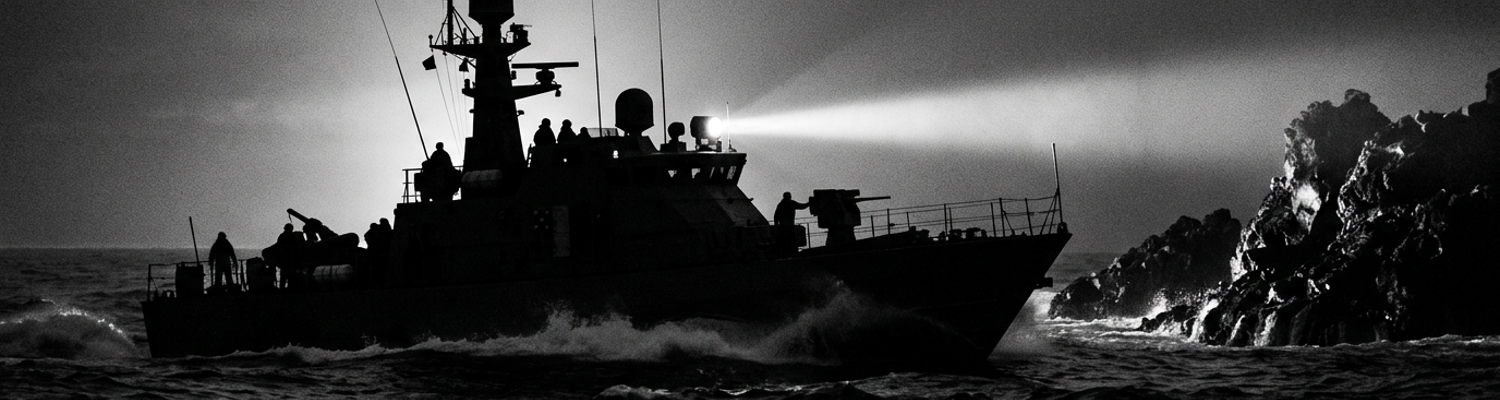
A close review of operational logs indicates that at 1618 hours, Point Whitehorn entered the breaker line two hundred yards off the southern boulder field. The crew trained its bow-mounted Browning .50-caliber machine gun on the rocks while coxswains cut the throttles. Marine boarding personnel in an inflatable Zodiac craft hit the volcanic shingle under cover of high-output xenon deck lamps. They expected fortified automatic weapons positions and military-grade oxygen rebreathers. Boarding personnel instead surrounded two exhausted American marathon swimmers shivering on wet basalt boulders. Both civilians raised bare hands without resistance. Boarding team members immediately confiscated the supposed covert hardware. This consisted of two standard vinyl open-water swim buoys filled with thermal foil space blankets, squeezed tubes of carbohydrate glucose syrup, and plastic bottles of electrolyte water. The slung folding-stock assault weapons identified by analysts in Roosevelt Roads were nothing more than thin elastic nylon tow cords looped across wet rubber suits. Marine search officers unzipped the swimmers gear packs and radioed the inventory across secure tactical channels. The classified alert collapsed into complete silence.
The phantom strike team was two dehydrated athletes.
When examining the historical record, this failure triggered an immediate, structural purge of Atlantic Fleet forward imagery workflows. Atlantic Fleet instruction manuals governing mobile reconnaissance laboratories were completely redrafted within forty-eight hours of the debriefing at Mayaguez. Naval Intelligence Command (NAVINTCOM) mandated that forward processing vans install automated chemical temperature chillers wired to continuous digital alarm circuits. This forbade manual heating elements or uncontrolled push processing under severe punitive penalties. Every developed roll of surveillance film required pre-exposed 21-step calibrated sensitometric control strips run in the exact same chemical bath. These were logged with Macbeth TD-904 transmission densitometers to confirm baseline density and gamma values before any frame could be released for operational analysis. Quality audit directives barred intelligence watch centers from accepting raw reconnaissance negatives that lacked certified darkroom chemistry data logs and micro-densitometry certification tags signed by senior technical non-commissioned officers. Command staff established double-blind photo interpretation protocols. This required independent light-table verification by two separate analytical cells whenever anomalous shapes matched high-threat tactical criteria.
Naval Station Roosevelt Roads filed the finalized chemical audit compliance directive under fleet bulletin 87-19 on August 4, 1987.