
The cost of Operation Taylor Common was tallied in blood. By its conclusion on March 8, 1969, the three-month campaign to clear PAVN forces from Base Area 112 had left a brutal mark on Task Force Yankee. Archival records document 183 Marines killed and 1,487 wounded. Their South Vietnamese counterparts, the ARVN 1st Ranger Group, recorded 100 killed and 378 wounded. The fighting in the mountainous terrain southwest of Hoi An was a grinder of close-quarters ambushes against an entrenched enemy. Operational logs from the 5th Marines show units like Company M, 3/5 Marines sustaining punishing losses. Events between March 3rd and March 6th near Firebase Maxwell were particularly grim. One company was ambushed multiple times while trying to retrieve the bodies of their own men, taking additional casualties in each attempt. The sheer volume of wounded overwhelmed the medical evacuation chain.
This deluge of broken bodies fell squarely upon the Navy corpsmen of the 3rd Medical Battalion.
Operational logs and post-action analyses reveal a medical support system fraying under the strain. Corpsmen assigned to forward units and clearing stations faced a relentless cycle of mass casualty events. The nature of the wounds inflicted in the Arizona Territory and surrounding mountains, predominantly from mines, booby traps, and high-velocity automatic weapons fire, meant many casualties required immediate, complex surgical intervention impossible at the point of injury. An after-action report from the 5th Marines in January 1969 noted a high number of casualties resulted from mines and booby traps, a trend that continued throughout the campaign. The psychological burden on these medical personnel was immense. They were often the last friendly face a dying Marine saw, working with the constant knowledge that their ability to save lives was directly constrained by the availability of a medevac helicopter. Battalion records and anecdotal accounts from the period point to a sharp increase in what was then termed combat fatigue among the hospitalmen. This psychological erosion manifested as heightened anxiety, depression, and a notable rise in alcohol consumption and requests for transfer. The stress was compounded by the fact that corpsmen themselves were frequently targeted and suffered significant casualties. A later study found that injured corpsmen were at a 2.45 times greater risk of developing PTSD compared to their non-injured counterparts.
The tragedy etched into the casualty figures was that many losses were preventable. Post-action reports submitted by units involved in Operation Taylor Common highlighted a litany of systemic failures contributing to the high mortality rate. Medevac helicopters were a scarce resource, often grounded by poor weather in the mountainous operational area or diverted to other tactical priorities, leaving the critically wounded to wait for hours. Communication breakdowns between forward patrols, battalion command posts, and rear medical facilities were a recurring theme, with radios proving unreliable in the rugged terrain. Orders for evacuation could be delayed or lost entirely. A shortage of specific medical supplies, particularly Type O whole blood, plagued the aid stations. A January 1969 report from the 1st Medical Battalion’s clearing station at An Hoa noted that they treated 371 military personnel that month, placing immense strain on their resources even before the final phases of the operation. The geographical realities of Quang Nam Province, with its dense jungle and steep ridgelines, meant even a simple extraction could become a complex, hours-long ordeal.
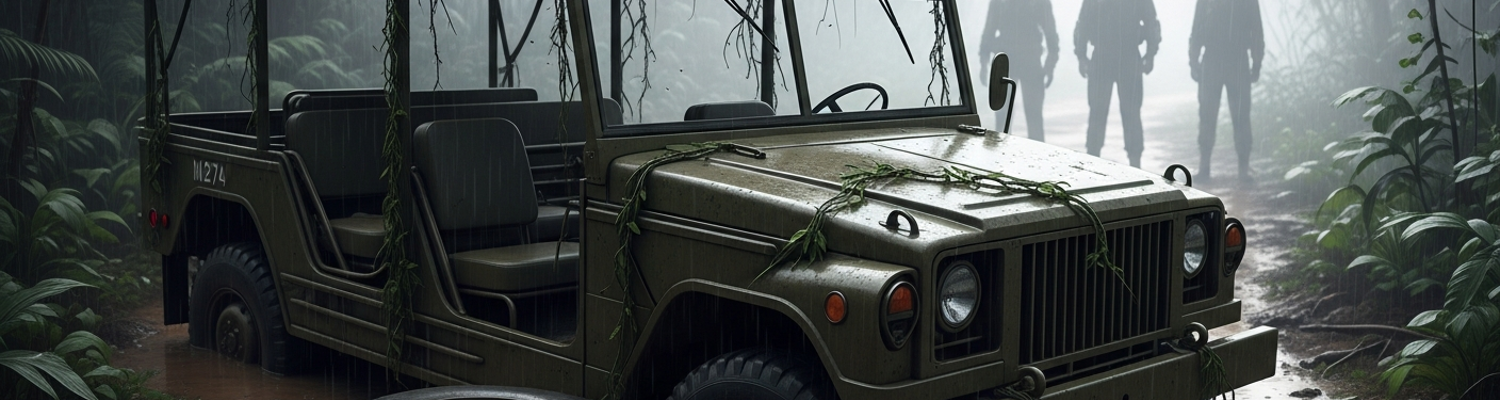
Operational logs from the 5th Marines detail how discrete equipment failures cascaded into a full-blown crisis near Firebase Maxwell. The M274 Mule was a workhorse, a mechanical platform capable of hauling over 800 pounds of supplies or casualties. On March 5th, 1969, a patrol from Company M, 3/5 Marines was attempting to extract two wounded men under fire. Their lifeline was a single M274A2 Mule, its flatbed laden with the casualties. The vehicle, powered by a simple, air-cooled two-cylinder engine, was suited for the narrow jungle trails. It was also notoriously temperamental. As the patrol navigated a steep, muddy wash, the Mule’s Continental-Hercules engine coughed and died. The sudden silence was deafening. The Marines, now immobile and exposed, frantically worked to restart the engine. A fouled spark plug or vapor lock in the fuel line from the intense heat were common culprits. On this trail, under fire, there was no time for diagnostics. The Mule, and the wounded men it carried, had become a static anchor, transforming a fighting withdrawal into a desperate stationary defense.
The mechanical failure was compounded by an electrical one.
With the Mule dead and PAVN forces maneuvering to encircle them, the patrol’s only hope was a medevac. The Radio Telephone Operator, or RTO, unslung his AN/PRC-25 radio, the nearly 23-pound nexus of command and control. He followed procedure, extending the standard three-foot tape antenna and setting the frequency knobs for the battalion’s tactical net. He keyed the handset. Nothing. A check of the battery, a non-rechargeable BA-4386 dry cell, showed it was dead. This was a frequent problem; the batteries had an official average life of 20 hours, but heavy use, coupled with the extreme heat and humidity of Quang Nam Province, could kill one in as little as two or three hours. The RTO tore open a spare. He clipped it into the radio’s lower housing and tried again. A faint crackle of static was the only response. The second battery was also dead, a victim of a short shelf-life and brutal environmental conditions. Without communications, there could be no request for artillery support, no situation report to the command post, and no call for a medevac helicopter. The patrol was alone.
Their isolation was made complete by the disintegration of their security element. The Marine squad had been augmented by a platoon of ARVN Regional Forces. A review of their typical armament shows they were often equipped with older American weapons, like the M1 Garand, and carried far less ammunition than their Marine counterparts. As PAVN machine gun fire intensified from concealed bunkers, the lightly-equipped and less-trained Regional Force soldiers on the patrol’s left flank broke. Their withdrawal was a rout. This action instantly exposed the Marines' flank, forcing the squad leader to divert men from providing suppressive fire and protecting the casualties to covering a wide, undefended arc. The tactical geometry of the fight had inverted. Instead of a protected core moving casualties to the rear, the Marines were now a shrinking perimeter, desperately trying to shield their wounded, their dead radio, and their broken-down Mule from an enemy closing in from a new, unexpected direction.
The primary airframe for medical evacuation in I Corps was the Boeing Vertol CH-46 Sea Knight helicopter. It was the platform tasked with lifting the critically wounded from hot landing zones to the surgical suites of the 3rd Medical Battalion. By 1969, a documented, systemic shortage of these specialized platforms was reaching a crisis point. Maintenance reports from the period reveal a fleet plagued by mechanical failures. The twin-turbine, tandem-rotor design was maintenance-intensive in the hot, humid, and dusty conditions of Quang Nam Province. Structural fatigue and engine performance issues frequently grounded the helicopters, drastically reducing the number of available aircraft for the high tempo of missions demanded by major offensives like Operation Taylor Common. The constant sorties flown in support of the operation, which averaged dozens of daily medevac calls across the entire Task Force Yankee area of operations, pushed the already strained fleet past its breaking point. For the 3rd Medical Battalion, this meant that even when its forward aid stations were prepared for a mass casualty event, the transport to reach them was often unavailable.
Survival was a function of time. A shortage of CH-46s meant that time was a luxury few could afford.
This deficit in dedicated American medevac assets was made worse by insufficient preparation for joint force medical support. The plan for major operations in Quang Nam Province called for extensive cooperation between U.S. Marine units and the Army of the Republic of Vietnam (ARVN), specifically the 1st Ranger Group. Archival evidence shows the logistical and medical planning for this integration was deeply flawed. The American and South Vietnamese medical systems operated almost entirely independently. There was no standardized communication protocol for requesting joint medevac, no shared system for tracking casualties, and a near-total lack of interoperable medical equipment. While U.S. forces relied on helicopter evacuation directly to surgical hospitals, the ARVN system was far less developed. This disconnect created a dangerous vacuum on the battlefield. When an ARVN unit took casualties, the burden often fell to the nearest U.S. Navy corpsman, but the ability to evacuate those wounded depended on navigating two separate, non-communicating chains of command. The 3rd Medical Battalion was staffed and equipped to support Marine forces; it had no organic capability or mandate to create a functioning joint medical system in the middle of a campaign.
An intelligence brief circulated at the command level of the 1st Marine Division before the final phase of Operation Taylor Common painted a bleak picture of their ARVN counterparts. The report detailed chronically low morale, driven by a lack of food, supplies, and mail. It pointed to significant deficiencies in small-unit leadership and basic fieldcraft. This was not an administrative issue; it had direct consequences that stressed the 3rd Medical Battalion’s resources. On the joint patrols that characterized the fighting, ARVN units frequently proved unreliable under fire. After-action reports from the 5th Marines describe multiple instances where ARVN elements, often equipped with older M1 rifles, would break contact and withdraw without orders when engaged by PAVN regulars. This collapse of flank security would leave the Marine squads exposed, multiplying the number of friendly casualties. The poor training meant ARVN soldiers were often unable to provide effective initial first aid to their own wounded, increasing the severity of injuries and placing a greater burden on the handful of Navy corpsmen attached to the patrol. Each failure of ARVN discipline produced more American and Vietnamese casualties who all required evacuation by the same, severely limited number of U.S. helicopters.
Operational orders from the 1st Marine Division, issued late 1968, formally tasked the 3rd Medical Battalion, an organic asset of the Marine Corps, with providing medical support for a massive joint offensive: Operation Taylor Common. This was a mandate. The operation’s framework called for Task Force Yankee, built around the 5th Marine Regiment, to fight alongside the ARVN 1st Ranger Group. Their shared objective was the destruction of People’s Army of Vietnam (PAVN) strongholds in Base Area 112. For the surgeons, corpsmen, and administrative personnel of the 3rd Medical Battalion, this order fundamentally altered their mission. They were now responsible not only for the torrent of Marine casualties but also for the wounded of an allied force with whom they had no shared protocols or communication systems. The battalion was staffed and equipped to support U.S. Marines, following a clear chain of evacuation. The integration of ARVN casualties, who often received substandard initial aid and whose evacuation was coordinated through a separate command structure, introduced immense friction into an already overloaded system.
This operational burden was compounded by a psychological warfare campaign. As Marine rifle companies pushed west into the mountains, aircraft overhead dropped millions of leaflets. These were a key component of the Civil Operations and Revolutionary Development Support (CORDS) program. Archival examples of PSYOP leaflets from the period show many carried a specific message: the availability of advanced American medical assistance. They promised modern medical treatment for civilians, portraying American forces not just as combatants but as healers. The leaflets were designed to drive a wedge between the populace and the Viet Cong infrastructure. The message worked. It also created a “second front” of medical demand, a vast pool of civilian patients with ailments ranging from infections to traumatic injuries from the crossfire of war. This influx descended upon the same 3rd Medical Battalion aid stations already struggling to manage combat losses from Operation Taylor Common. No separate system was established to handle this promised care; the order to support CORDS objectives effectively diverted finite medical resources away from wounded Marines and ARVN Rangers.
The entire enterprise was set in one of the most unforgiving operational areas in South Vietnam. Quang Nam Province in March 1969 was a cauldron of violence. Operation Taylor Common’s target, Base Area 112, was a hardened logistical and command hub for regular PAVN units, including elements of the 2nd PAVN Division. The terrain itself was an enemy. The operational area reveals a landscape of steep, jungle-choked mountains and narrow valleys blanketed in double- and triple-canopy jungle. This topography severely limited radio communications and made helicopter extractions perilous during frequent bouts of poor weather. The fighting was defined by close-quarters engagements against a well-entrenched enemy. Marine and ARVN units fought for every foot of ground against PAVN forces in fortified bunkers and trench systems. The result was a constant stream of casualties with devastating wounds. It was into this meat grinder that the 3rd Medical Battalion was ordered to support two separate armies while simultaneously being advertised as a public health service.
The 3rd Medical Battalion’s operational records for 1969 reveal a system collapsing under flawed logistical assumptions. The interference was not the result of a single enemy action, but a death by a thousand cuts dealt by a supply chain that was both bloated and brittle. For the forward-deployed corpsmen, this manifested as a chronic lack of basic, life-sustaining materiel. A command chronology from August 1968, just before the buildup for Taylor Common, flagged this systemic weakness, noting that lead times for requisitioned items averaged 50 to 60 days and that priority classifications were effectively meaningless. This meant that even when a clearing company could anticipate the need for specific items like chest tubes or Type O blood, the request would crawl through a bureaucratic labyrinth, arriving long after the peak demand had passed. The problem was especially acute for Class IX supplies, the spare parts needed to keep everything else running. A lack of parts for sterilizers could render a surgical tent useless. A shortage of components for refrigeration units meant blood and sensitive medications would spoil. Each of these minor logistical failures sent ripples outward, forcing doctors to make impossible choices and contributing to a higher rate of patients who died after reaching a medical facility.
The breakdown was total.
Nowhere was this cascading failure more apparent than in the maintenance of field equipment. The AN/PRC-25 radio was notoriously power-hungry. The non-rechargeable BA-4386 dry cell batteries that powered them had an official life of around 20 hours, but heavy transmission in the jungle heat could exhaust one in as little as two. Radio Telephone Operators were forced to carry multiple spares, each adding weight. The supply chain, however, consistently failed to deliver fresh batteries. Units were often issued batteries that were already near the end of their shelf life, a fatal flaw that left patrols isolated. This single point of failure, a dead battery, was often the first link in a chain reaction of disaster.
This communications failure was frequently paired with a mechanical one. The M274 “Mule,” a simple, half-ton flatbed vehicle, was essential for moving casualties over rugged terrain. Yet, these workhorses were aging and poorly supported. Their air-cooled engines were prone to vapor lock in the heat, and their simple electrical systems were easily fouled by mud and moisture. A lack of basic repair parts in the Class IX supply block, items as simple as spark plugs or fuel filters, meant that when a Mule broke down, it was often abandoned. For a patrol trying to extract wounded men, a disabled Mule transformed a planned evacuation into a static defense. The casualties, instead of being moved to safety, became bait, pinning the unit in place.
These equipment failures were not random accidents. A 1968 report from the 3rd Medical Battalion itself (NARA Record Group 127) stated that the process for getting equipment evacuated for higher-level maintenance was so broken that items sent to depots in Da Nang or Okinawa were effectively lost to the unit for three to eight months. There was a systemic prioritization within the wider Marine Corps logistics system that favored combat arms over combat support. The demand for Class V supplies (ammunition) and Class VII major end items (tanks and helicopters) consumed the vast majority of shipping capacity. This left support units like the 3rd Medical Battalion fighting for scraps. Readiness reports from the period show a consistent pattern: commanders flagging shortfalls in personnel, equipment, and spare parts, only to be told to make do. A command chronology for the 3rd Medical Battalion in August 1968 noted inadequate staffing of key enlisted logistics roles, including the absence of a Supply Chief. This systemic neglect ensured that the battalion entered one of its most demanding campaigns in a state of perpetual scarcity.
The outcome of Operation Taylor Common prompted an immediate internal medical readiness review by the 1st Marine Division. This was not a routine after-action summary; it was a targeted investigation with a mandate to dissect the cascade of failures that had shattered the 3rd Medical Battalion’s ability to function. The review board drew senior officers from logistics, operations, and the Navy medical command, tasked with examining every facet of the operation. Their focus was forensic, aimed at understanding why so many casualties in Quang Nam Province were dying from wounds that should have been survivable.
The findings were unambiguous.
A deep analysis of the casualty data and after-action reports from units like the 5th Marines revealed that a significant number of the losses were preventable and directly attributable to inadequate joint force training. The operational plan for Taylor Common had fused U.S. Marine units with the ARVN 1st Ranger Group, but the logistical and medical planning for this integration was almost nonexistent. The readiness review documented a near-total absence of interoperability. American Navy corpsmen and ARVN medics had no shared communication frequencies for coordinating casualty collection, no standardized method for marking landing zones, and no common training for initial trauma care. When ARVN units took casualties or broke under fire, the burden fell entirely upon the handful of U.S. corpsmen on site, who were suddenly responsible for dozens of wounded allied soldiers. This disconnect created a fatal delay, as evacuating an ARVN casualty required navigating a completely separate chain of command, often leading to U.S. medevac helicopters being denied permission to transport allied wounded.
The implications of the 3rd Medical Battalion’s experience rippled through Marine Corps doctrine. The review served as a case study in how medical support, when treated as an afterthought in joint operational planning, can lead to mission failure. The immediate result was a series of new protocols for any future combined operations. Planners were now required to establish integrated medical evacuation plans, with shared radio frequencies, pre-designated joint casualty collection points, and clear rules of engagement for medevac assets. A push began for developing simplified, bilingual medical cards that could be carried by allied soldiers to help U.S. medical personnel understand injuries and allergies. The review also forced a re-evaluation of the supply chain, highlighting the need to pre-position critical items like whole blood, IV fluids, and radio batteries based on the intensity and duration of a planned operation, not on baseline consumption rates.