
The Woolley Report and Base Security Failures
Archival evidence shows Tenth Army leadership operating against an unyielding operational calendar from the moment planning began. Joint chiefs designated November 1 1945 as the fixed launch date for Operation Olympic. That target left Island Command engineers barely one hundred and twenty days following the formal end of combat to transform the scarred southern half of Okinawa into an advanced staging platform. Quartermasters processed two million measurement tons of dry cargo. They assembled fifty staging camps. They expanded Kadena and Yontan airfields while active battle operations still consumed line infantry miles away. Service commands rushed cargo ashore at Hagushi Bay. They unloaded supply vessels around the clock. Physical defenses were ignored to beat the autumn typhoon season and meet embarkation schedules.
Every hour spent digging perimeter rifle pits was an hour stolen from offloading artillery shells.
Speed took priority over base security.
When examining the historical record of base administration the consequences of this haste surfaced in the August 1945 Woolley Report (NARA Record Group 338). Compiled after exhaustive inspections of rear-echelon installations the investigation cataloged systematic security collapses across Tenth Army service commands. Inspectors recorded that perimeters protecting depots along the Ishikawa Isthmus consisted of single-strand barbed wire. Some had no physical barriers at all. Depots lacked interlocking fields of fire. They lacked functional trip flares. Basic communications between isolated guard posts and central military police dispatch stations did not exist. Heavy technical gear sat in darkness. Generator allocations favored machine shops and radar huts over perimeter searchlights. Assigned military police companies operated severely understrength. Supply officers pulled untrained ordnance personnel and truck mechanics for perimeter night watch. Guard rosters showed men standing guard duty for twelve-hour shifts immediately following ten-hour shifts unloading ships. Sentry fatigue resulted in soldiers repeatedly falling asleep on their posts while guarding unsecured high-explosive dumps.
Bypassed Japanese forces exploited these exact gaps.
A close review of operational logs indicates rear sectors enduring lethal incursions long after Lieutenant General Roy Geiger declared organized resistance over on June 21 1945. Approximately twenty thousand Japanese combatants and conscripted Boeitai militia retreated into limestone sinkholes instead of surrendering. Nightly raiding parties infiltrated American staging zones. They scavenged food. They cut landline field telephone wires. They engaged sleeping rear-echelon personnel with small arms and Type 97 hand grenades. During July and August snipers killed American drivers traveling solitary stretches of Route 1. They ambushed repair details maintaining the water distillation points near Chimu Wan. At Kadena Airfield armed teams repeatedly breached the perimeter fence line after midnight to destroy parked transport aircraft with satchel charges. Airfield commanders diverted infantry companies from recovery training to conduct sweep-and-clear operations through adjacent ravines. On the night of July 24 an armed squad of eight Japanese soldiers penetrated two thousand yards behind Tenth Army lines near Machinato. They killed four supply clerks before being eliminated by Browning Automatic Rifle fire.
These continuous sabotage raids placed the strategic logistical stockpiles assembled for Operation Olympic in direct jeopardy. Okinawa held the primary ammunition reserves. It held the ordnance maintenance shops. It held fifty-five-gallon aviation gasoline drum farms intended to resupply the Sixth Army during the scheduled assault on southern Kyushu. Japanese demolition parties targeted the massive open-air dumps clustered around Buckner Bay. Thousands of tons of high-explosive artillery shells sat stacked beneath canvas tarpaulins without earthen blast berms. Infiltrators armed with magnetic mines repeatedly attempted to ignite these ordnance caches. They sought to trigger chain-reaction detonations capable of destroying entire supply depots. In one early August raid near the Yonabaru supply sector an enemy demolition team set fire to an aviation fuel dump. They destroyed three hundred thousand gallons of high-octane gasoline. Engineer firefighting detachments contained the flames with chemical foam extinguishers. Military police responding to the breach recovered three unexploded ten-kilogram satchel charges within twenty yards of an adjacent depot containing fifteen thousand rounds of 105mm howitzer ammunition.
Tenth Army Island Command Security Reallocations
Archival evidence shows Tenth Army Island Command attempting to solve the rear-area security breakdown by reallocating units already on the ground. The primary formation caught in this transition was the 511th Military Police Battalion. Trained under standard military police organizational tables for open-country traffic circulation and prisoner escort the battalion spent its initial weeks on Okinawa regulating the heavy flow of two-and-a-half-ton cargo trucks along Route 1. They cleared supply chokepoints between the Hagushi beaches and inland transfer points. Headquarters orders stripped the unit of these circulation posts overnight. Personnel surrendered their traffic batons and white helmet liners. They dug rifle pits and set up barbed-wire cordons across rear-echelon zones.
The 511th Battalion lost its transit mission across southern Okinawa within forty-eight hours.
Not by choice. By direct order.
When examining the historical record of base administration the physical dimensions of the assigned sectors proved unmanageable for security forces. Island Command directed these military police detachments to lock down the forward air installations at Kadena and Yontan. Kadena covered two thousand acres of jagged coral terraces. It contained unfinished taxiways and drainage ditches. Yontan contained five active runways encircled by thick sugarcane fields. Unmapped ravine networks and Okinawan hillside tomb complexes surrounded the perimeter. Company detachments patrolled perimeters extending over thousands of yards. They tried to shield parked Douglas C-47 transports and Marine Vought F4U Corsairs from Japanese raiding teams operating out of nearby limestone fissures.
Security detachments at Kadena patrolled four miles of broken ground with squad-sized details.
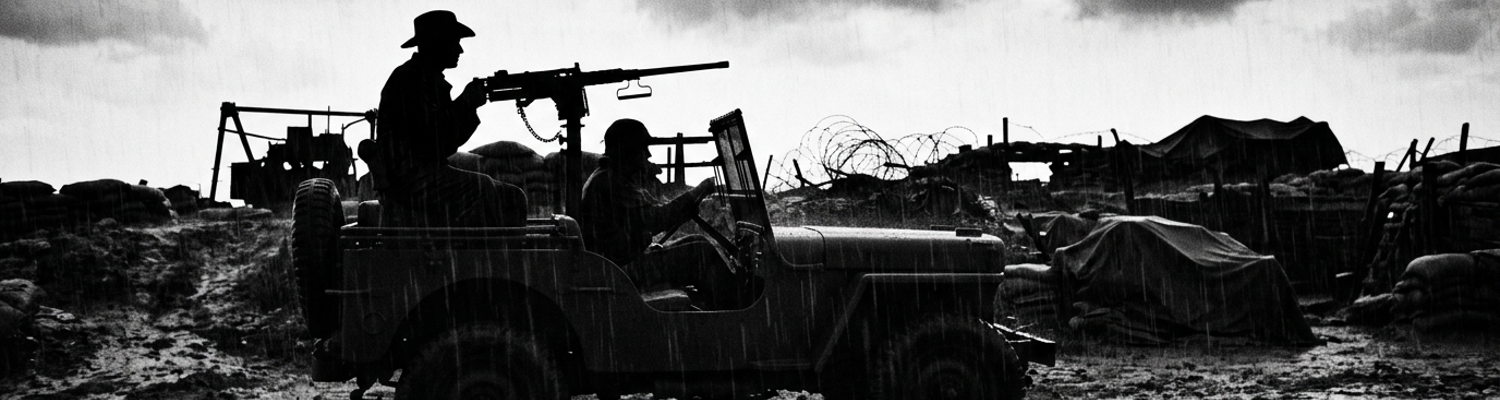
A close review of operational logs indicates Island Command commanders establishing extended linear cordons to cover these perimeters. Single squads held defensive sectors three hundred yards wide. This left gaps where infiltrators crawled between listening posts during heavy rain. Standard doctrine required heavy support weapons to anchor such stretched defensive perimeters. The military police possessed no organic heavy weapons. Assigned weapons consisted of .30 caliber M1 carbines and M1 Garand rifles. They carried Thompson submachine guns and twelve-gauge shotguns. Detachments had no 60mm or 81mm infantry mortars to drop illumination into dead spaces. They had no 37mm antitank guns to fire canister shot across avenues of approach. They lacked rocket launchers to hit snipers in coral outcrops. Mechanics bolted air-cooled M1919A4 machine guns salvaged from wrecked landing craft onto Willys jeeps to generate emergency mobile firepower.
Forward ammunition depots relied on sentries armed with carbines and shotguns.
Night defensive actions quickly dissolved into point-blank skirmishes when Japanese demolition troops hit the perimeter. Sentries stationed along the northern edge of Yontan Airfield spotted Japanese infiltrators crawling toward parked Republic P-47 Thunderbolts only after the enemy closed to within fifteen yards. Lacking mortars to interdict the ravines behind the assault the guards engaged in close-quarters small arms fire. They expended thousands of rounds while three infiltrators reached an aircraft revetment and ignited magnetic charges. Near the Machinato fuel farm two-man foxholes placed hundreds of yards apart allowed a seven-man raiding team to reach an open ammunition yard. This yard held thousands of crates of 75mm artillery fuses. Responding units arrived to find six military police dead in their defensive pits. Their weapons were empty. Two unexploded ten-kilogram satchel charges lay three yards from a burning fuse stack.
Coral Bedrock Fortification and Excavation Deficiencies
Archival evidence shows standard entrenching protocol collapsing along the limestone ridges surrounding Kadena and the Machinato supply corridor. Engineer Field Manual FM 5-15 required security detachments to construct continuous breastworks. They needed drainage ditches and protected approach saps to a minimum depth of four to six feet. This depth shielded troops from incoming flat-trajectory fire. Assigned personnel from the 511th Military Police Battalion attempting to dig these positions struck the upper plate of the Ryukyu limestone shelf within eight inches of cutting through the thin clay topsoil. Standard-issue M1910 entrenching shovels chipped against jagged fossilized reef coral. The impacts sheared rivets and bent blades. Edges dulled within minutes of contact. Forged steel pickaxe handles cracked at the eye when swinging against the dense mineral deposits. Work squads assigned to secure the eastern approaches of the Chibana ordnance depot expended entire six-hour shifts manually clearing less than ten cubic feet of stone per foxhole. Instead of an integrated trench system connecting tactical bunkers the perimeter remained a broken line of disjointed scrape holes. Razor-sharp mineral spurs ringed these holes and cut through boots and field uniforms.
Steel hand tools snapped under the resistance of the petrified seabed.
A close review of operational logs indicates mechanical excavation assets remaining completely unavailable to rear-echelon defensive details. Diesel-powered air compressors and Le Roi motorized utility units went elsewhere. Chicago Pneumatic CP-117 rock breakers were diverted directly to the 117th Naval Construction Battalion and Tenth Army aviation engineer groups. These groups rushed to complete runway extensions at Yontan Airfield. Left without air-driven tools to drill anchoring points base defense commanders authorized the use of heavy demolitions to blast defensive ditches into the rock. Ordnance teams packed half-pound blocks of composition C-2 and standard fifty-percent nitroglycerin dynamite into shallow crevices. They hammered these crevices out with manual star drills. The resulting explosions failed to generate defined trench walls. Shockwaves fractured the brittle porous coral structure across wide radiuses. This reduced perimeter ditches to sliding piles of chalky rubble and stone fragments. Fissures spread twenty feet horizontally through the underlying stone. Trench walls collapsed inward whenever two-and-a-half-ton supply trucks rumbled along adjacent perimeter service tracks.
Heavy blasting turned planned defensive ditches into unstable trenches of loose gravel.
When examining the historical record of base administration these compromised revetments offered almost no protection against midnight raids. The collapsed unstable bedrock prevented troops from excavating deeper than thirty inches. Riflemen remained fully silhouetted whenever they stood to observe their assigned sectors. Burlap sandbags filled with jagged coral aggregate tore open during handling. They spilled loose stone back into the fighting pits. Priority shipments of dimensional pine lumber and heavy corrugated elephant-iron sheets bypassed military police depots. Steel revetment pickets headed straight to maritime offloading docks at Awase and Bolo Point. This diverted material left perimeter weapon pits completely open to the sky without overhead protection. Infiltrating Japanese squads equipped with Model 89 knee mortars and Type 97 hand grenades easily exploited these roofless troughs. During an August 11 attack on the Kishaba fuel distribution depot Japanese raiders lobbed four fragmentation grenades directly into an open three-man fighting pit. The explosion detonated against the solid coral floor. It drove dozens of razor-sharp stone shards into the occupants alongside steel casing fragments.
Monsoon Inundation and Timber Revetment Failures
Archival evidence shows torrential downpours throughout July and August 1945 unleashing over thirty inches of rain across southern and central Okinawa. This weather overwhelmed field engineering projects before earthworks could cure. Lacking imported treated lumber Tenth Army construction details harvested green Ryukyu pine and native scrub oak from adjacent ridges. They used this wood to shore up defensive revetments and retaining walls along perimeter ditches. These freshly cut unseasoned logs held high natural moisture content. They received no chemical preservation or kiln curing. Saturated red clay slurry exerted intense hydrostatic pressure behind the timber revetments ringing the Kadena airfield perimeter and the Machinato supply corridor. Logs bowed outward under the shifting earth. They popped three-eighths-inch steel drift pins and stripped binding wires. Entire twenty-yard sections of retaining walls buckled inward without warning. They buried heavy weapons emplacements beneath tons of liquefied mud and splintered wood. At the 511th Military Police Battalion defensive perimeter near the Futema communication hub two continuous breastworks collapsed into the primary access trench on July 18. This trapped four sentries and destroyed two water-cooled Browning machine guns.
Green pine logs warped and sheared under the weight of liquefied clay.
A close review of operational logs indicates the persistent rain transforming industrial runoff from forward airfields into a major physical hazard for perimeter defense detachments. Runoff from the vast taxiways at Kadena and Yontan swept directly downhill into rear-echelon defensive lines. Service squadrons at these airfields serviced hundreds of Republic P-47s and Marine Vought F4Us. Millions of gallons of stormwater mixed with leaking 100-octane aviation gasoline. It mixed with drained lubricating engine oil and hydraulic fluid from dispersed open-air maintenance pads. This chemical wash collected in the low-lying foxholes and mortar pits excavated by base security detachments. Standing water in fighting positions carried floating slicks of caustic volatile hydrocarbons up to four inches thick. Enlisted personnel occupying these positions developed severe chemical dermatitis. The heavy fumes created extreme respiratory distress and temporary eye inflammation. Sentries could not fire their weapons or discharge illumination flares from inside the pits without igniting the flammable fuel film coating the water surface. On August 3 military police abandoned six fortified perimeter bunkers guarding the southern fuel tanks at Machinato. Toxic gasoline vapors reached flashpoint concentrations inside the flooded subterranean dugouts.
Flooded fighting positions became chemical sumps that burned human skin on contact.
When examining the historical record of base administration the total breakdown of natural drainage forced security personnel into relentless manual labor. They had to prevent the entire trench network from washing away. Constant mud and severe erosion scoured the sides of linking saps and feeder ditches. This deposited thick layers of silt into defensive sumps and weapon bays. Tenth Army commanders ordered military police detachments and attached engineer work details to maintain round-the-clock clearing operations. They did this while simultaneously preserving perimeter vigilance against Japanese night infiltrators. Armed guards rotated directly from four-hour security watches into four-hour excavation details. They waded through hip-deep mud with round-point shovels and five-gallon utility buckets to bail out defensive trenches. Hand clearing failed to keep pace with the sediment accumulation. Saps linking isolated sentry bunkers to central command posts filled with knee-deep mire within two hours of heavy rain. This stalled the movement of ammunition carriers and emergency medical stretchers. Sump pumps allocated to rear-area units broke down rapidly when fine coral grit clogged their impellers. Work parties from Company C of the 511th Military Police Battalion dug bypass drainage ditches by hand under continuous rainfall.
On August 14 over twelve hundred service troops were diverted from guard duty to clear silted drainage canals near Awase.
Biohazard Vector Proliferation and Sanitation Breakdowns
Archival evidence shows unburied casualties rapidly overwhelming Tenth Army rear-echelon areas as summer temperatures climbed past ninety-five degrees Fahrenheit. Across the dense scrub brush and jagged limestone ravines ringing the Machinato and Chibana supply yards hundreds of dead Japanese soldiers from the 32nd Army and local Boeitai conscripts lay decomposing in the open. The high tropical heat and extreme humidity accelerated biological putrefaction within twelve hours of death. Swarms of blowflies and flesh flies multiplied inside the rotting cadavers across unpoliced draws outside base fence lines. Millions of insects surged outward into rear-echelon mess facilities and maintenance sheds. Mechanical fly traps and standard aerosol pyrethrum sprays failed to halt the swarm. Flocks of flies coated open rations. They landed on food utensils and supply crates. Bacillary and amoebic dysentery spread rapidly through the 511th Military Police Battalion and the 71st Chemical Mortar Battalion. Base dispensaries recorded over two hundred daily clinical admissions for acute shigellosis and severe gastroenteritis. This left guard details short of manpower.
Flies coated every exposed tin mess kit within seconds of food distribution.
A close review of operational logs indicates torrential monsoon downpours aggravating these biological hazards by washing directly through uncollected battlefield debris. Saturated limestone slopes along the Maeda and Kakazu ridges funneled sheets of contaminated surface water downhill. This water flowed into the natural drainages feeding Tenth Army water supply points. Organic decomposition products and human waste drained straight into shallow earthen draws where engineers had positioned primary raw-water intake pumps. Potable water catchment basins absorbed this biological runoff. These basins consisted of three-thousand-gallon rubberized canvas bladders erected near base perimeters at Sukiran and Machinato. Field testing by Tenth Army medical laboratory detachments showed extreme concentrations of fecal coliform bacteria and pathogenic intestinal parasites contaminating raw-water intakes. Standard-issue portable water treatment units suffered fouled filter beds within hours. Floating organic slime clogged their diatomaceous earth strainers. Field chlorination tablets proved insufficient to kill heavy amoebic cyst loads. Island command officers placed severe water rationing orders on support units.
Engineers condemned three primary reservoir basins in the Machinato supply corridor within forty-eight hours.
When examining the historical record of base administration attempts to eliminate these biological vectors met armed resistance from bypassed enemy combatants. The 48th Quartermaster Graves Registration Company and attached Tenth Army chemical sanitation teams attempted to collect rotting cadavers and spray DDT emulsions. They encountered fire from concealed Japanese soldiers. Bypassed riflemen from the 24th Division and 62nd Division hid inside Okinawan stone hillside tombs. They used natural karst fissures and camouflaged cave entrances commanding the outer ravines. These hidden shooters specifically targeted body-handling details. They killed unarmed sanitation technicians as they moved through the heavy brush with stretchers and chemical fogging sprayers. Island Command ordered the 511th Military Police Battalion to provide continuous armed combat escorts for every recovery detail leaving base perimeters. Military police deployed in three-man fire teams armed with M1 Garand rifles and Thompson submachine guns. They mounted Browning M1919A4 machine guns on Willys jeeps. They laid down suppressive fire into cave entrances while graves personnel retrieved decomposing bodies. Recovery sweeps turned into small-unit clearing actions. They expended thousands of small-arms rounds to secure fifty yards of scrub.
On August 19 Japanese sniper fire killed two graves registration technicians and wounded three military police escorts during a single recovery sweep near Kakazu Ridge.
Night Infiltration Raids and Strategic Sabotage
Archival evidence shows bypassed Imperial Japanese soldiers from the 32nd Army and naval base units systematically exploiting the natural topography to pierce rear-area security lines. Rather than attempting to cross open ground raiding parties used the extensive network of unpaved agricultural drainage ditches and erosion gullies. These features carved into the limestone hills between Chibana and Kadena Airfield. These ditches ran directly beneath the outer perimeter defenses established by Tenth Army Military Police. Security cordons relied on tripwires strung six inches above the ground. These linked to M48 trip flares and fragmentation grenades. The ditches sat below the tripwire sightlines and blast radii. Moving on hands and knees during midnight rainstorms Japanese infiltrators stripped their uniforms down to loincloths. They blackened their skin with wet charcoal. They guided five-man assault cells beneath the wire cordons without triggering a single mechanical alarm. Sentries posted in static sandbag bunkers fifty yards away looked over open fields of fire. They remained blind to the dead ground directly underneath their positions.
Tripwires hung useless over sunken runoff channels.
A close review of operational logs indicates these infiltrating teams prioritizing high-octane fuel infrastructure required for the pending invasion of Kyushu. The targets were the sprawling bulk aviation gasoline dumps clustered near the Machinato supply corridor and the coastline of Buckner Bay. Millions of gallons of 100-octane fuel rested inside exposed five-thousand-barrel bolted steel tanks and dispersed ten-thousand-gallon rubberized storage bladders. Demolition sappers carried improvised satchel charges assembled from salvaged Japanese picric acid blocks and Type 99 magnetic armor-piercing charges. They used captured American C-2 plastic explosive wrapped in waterproof oilcloth. Slipping past outer military police checkpoints sappers attached the hexagonal Type 99 magnetic charges directly to steel pipeline manifolds and fuel tank valve assemblies. They used friction-ignited time delay fuses cut for sixty seconds. Other infiltrators tossed twenty-pound improvised satchel charges onto the surface of rubber fuel bladders. On the night of July 28 an eight-man demolition team detonated four separate satchel charges across Depot Area 3 at Machinato. They destroyed six rubber fuel cells and incinerated sixty thousand gallons of high-octane fuel. They killed three military police guards with blast fragments.
A single ignited bladder could consume an entire fuel dump within minutes.
When examining the historical record of rear-area sabotage raiding parties repeatedly concentrated their assaults against the mobile field printing plants operated by the Psychological Warfare Branch of General Headquarters. Situated in semi-permanent wood-framed huts and canvas maintenance tents behind Kadena these motorized printing units housed heavy Davidson offset presses. They ran multilith machines twenty-four hours a day. The facilities printed millions of tactical surrender passes and strategic warning leaflets destined for Operation Olympic. Japanese commanders recognized the corrosive effect of this propaganda on troop discipline. Infiltrators bypassed conventional supply sheds to locate the distinctive hum of diesel generators powering the pressrooms. Armed with Type 97 hand grenades and improvised incendiary bottles small raiding groups hit the printing compound on three separate occasions in early August. They killed six press operators from the 67th Psychological Warfare Detachment. They sprayed printing cylinders with submachine-gun fire. They burned crated pallets containing four million Japanese-language leaflets scheduled for shipment to the Marianas.
Company B of the 511th Military Police Battalion established interlocking heavy machine gun nests around the print compound perimeter on August 12. They stationed twenty-four riflemen inside the paper storage revetments. Two nights later responding guards shot four Japanese soldiers crawling with magnetic demolition charges toward the primary rotary press. They recovered five pounds of unexploded picric acid strapped to the body of a Japanese warrant officer thirty feet from the typesetting tent.
Operation Olympic Preparations and Tactical Reorganization
Archival evidence shows Island Command discarding static listening posts in mid-August after Japanese raiding parties repeatedly breached outer depot wire. Engineers laid continuous automated trip-flare arrays across three miles of dead ground flanking Kadena Airfield and the Chibana munitions depot. Technicians anchored steel pickets into coral fissures. They strung high-tensile tripwires four inches above scrub brush to trigger spring-loaded M48 pull-friction igniters. When tripped each canister shot magnesium illumination two hundred feet upward. This bathed natural ravines in forty-thousand-candlepower white light for thirty seconds. Behind these automated trip lines Island Command established twenty-four-hour motorized sweep corridors. Standard patrol units consisted of pairs of quarter-ton Willys jeeps retrofitted with pedestal-mounted Browning M1919A4 machine guns. They accompanied three-quarter-ton Dodge WC-51 weapons carriers packed with six-man rapid-reaction squads. Drivers ran routes over crushed-coral access roads at irregular seven-minute intervals. They alternated speeds and ran with blacked-out headlamps to foil ambush spotters. Whenever a flare ignited mobile teams converged at speeds exceeding forty miles per hour. They saturated terrain depressions with sweeping automatic fire before infiltrators could drop into drainage gullies.
Static sentry boxes disappeared from the perimeter.
A close review of operational logs indicates motorized jeeps alone failing to neutralize entrenched enemy pockets holding out inside subterranean limestone bunkers. To eliminate these fortified positions the 511th Military Police Battalion integrated light armor into coordinated daytime sweeping operations across the southern Mabuni plateau. Island Command attached six-wheeled M8 Greyhound armored cars from divisional reconnaissance troops directly to military police strike teams. Weighing eight tons and carrying an M6 37mm main gun paired with a coaxial .30-caliber machine gun the M8 provided the ballistic shielding and direct heavy fire support that military police formations lacked. Armored crews advanced abreast down narrow cart trails. They fired 37mm canister rounds loaded with eighty steel balls directly into cave openings and stone tomb portals. Dismounted military police fire teams advanced behind the armored hulls carrying M1A1 flamethrowers and twenty-pound composition C-2 satchel charges. Gunners suppressed enemy rifle ports with heavy machine-gun fire until demolition men crawled within throwing distance. They hurled charges into subterranean shafts to collapse cave entrances over remaining occupants.
Mechanized firepower replaced piecemeal squad cordons.
When examining the historical record of theater planning staff officers recognized these base-defense failures threatening to derail the impending invasion of Kyushu. Army planners at Tenth Army and Sixth Army headquarters immediately drafted radical revisions to rear-area security doctrine for Operation Olympic. Intelligence estimates projected three combat divisions staging across beaches at Miyazaki and Kagoshima alongside hundreds of thousands of tons of combustible supplies. This directly exposed staging areas to thirty thousand bypassed Japanese troops and civilian insurgents. Under the revised doctrine rear-area protection ceased being an improvised duty assigned to understrength military police units or tired logistics personnel. The new table of organization mandated dedicated Base Defense Groups for each landing sector. These were structured as self-sustaining combined-arms task forces. Planners authorized these security commands to maintain organic 81mm mortar platoons and integrated tank destroyer sections. They included mechanized cavalry reconnaissance troops and dedicated engineer demolition squads. Communications doctrine was completely overhauled. Every isolated supply dump tied directly into an armored quick-reaction dispatch net via SCR-508 radio vehicles instead of vulnerable landline telephone wires.
On August 28 Sixth Army headquarters finalized Base Defense Plan Olympic. They assigned forty-eight hundred combat-trained troops exclusively to rear-echelon perimeter interdiction across the southern Kyushu beachheads.