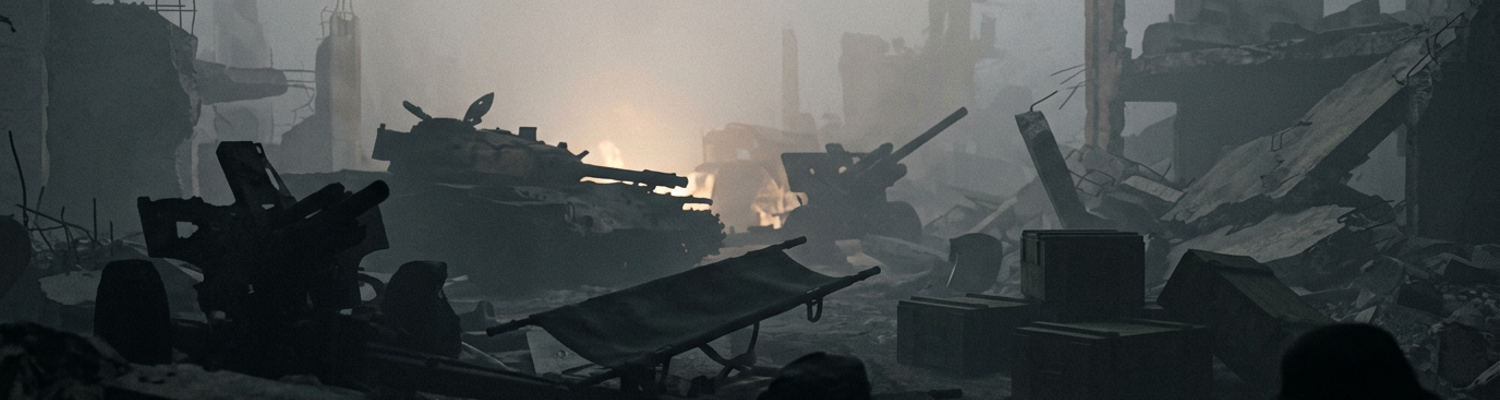

Destruction of Nagasaki Medical Infrastructure
At 11:02 AM on August 9, 1945, the primary communications trunk linking Nagasaki to the Western Army District headquarters in Fukuoka failed. Every direct telephone, telegraph, and military dispatch line went dead. Ground-level personnel across the prefecture lost contact with higher command. In the Urakami river basin, 500 meters above the Matsuyama district, the weapon detonated. The explosive yield equaled twenty-one kilotons of TNT. Archival evidence shows that Nagasaki Medical College sat just 700 meters northeast of the hypocenter. This placed its multi-story reinforced concrete hospital buildings, lecture halls, and anatomical research institutes directly in the unshielded path of the initial blast wave. Overpressure exceeding five pounds per square inch sheared concrete lintels. It shattered reinforced floor plates. It ignited spontaneous timber conflagrations across all twelve main ward pavilions. Over eight hundred medical students, professors, and administrative personnel died instantly. They were pinned beneath thousands of tons of burning masonry. Chemical stores exploded in the anatomy laboratories. Designated municipal emergency aid stations positioned along the central valley road network vanished.
There were no fallback collection points for casualties crawling north along the rail tracks.
The immediate statistical toll explains the subsequent administrative paralysis. Blast displacement and extreme thermal flash radiation killed or incapacitated more than eighty percent of licensed physicians and nurses within an eight-hundred-meter radius. City registry data recorded roughly two hundred and thirty practicing doctors on duty that morning. Less than thirty remained capable of standing. Operating theaters turned into open incinerators. Surgical supplies, plasma stores, splints, and sterile gauze burned in basement depots before orderlies could reach emergency lockers. Surviving medical workers found themselves surrounded by tens of thousands of burn victims. They lacked basic antiseptics or potable water. Many caregivers suffered from ruptured tympanic membranes, severe compound fractures, and thermal burns across their exposed faces. Field logs describe doctors wandering among collapsed wards in complete psychological shock. They attempted to bandage severed arteries using strips of torn, ash-covered uniform cloth. They collapsed from severe internal bleeding and physical exhaustion. Sustained exposure to mass trauma broke the remaining cadre of caregivers. Standard triage protocols dissolved. Medical officers realized no reinforcements, burn serums, or surgical instruments could enter the valley.
Care ceased entirely.
A close review of operational logs indicates that foreign forensic investigation began ten weeks later. United States Strategic Bombing Survey G-2 Intelligence officers and Medical Division field teams arrived in Nagasaki during mid-October 1945. Under the direction of civilian and naval medical analysts, investigators moved through the skeletal ruins of the Urakami district. They brought survey instruments, drafting teams, and field cameras. Their objective centered on reconstructing the precise mechanics of infrastructural failure. Intelligence personnel interviewed surviving staff members from the municipal health department. They recovered charred hospital admission manifests (NARA Record Group 243). They conducted post-mortem tissue analyses alongside Japanese researchers from Tokyo Imperial University. Survey teams mapped the distance from the hypocenter to every perimeter clinic. They recorded structural deflection angles and measured residual soil radioisotopes. Technical analysts cataloged the thermal damage to autoclaves. They examined how pressure blast fronts stripped lead shielding from diagnostic radiology suites. They documented the destruction of municipal water mains feeding secondary aid posts across the prefecture.
Communications Failure and Misdirected Relief Columns
The physical severance of external communications occurred through the mechanical destruction of the primary trunk route along the Urakami River. Blast overpressure sheared forty-eight kilometers of overhead copper lines. It flattened the wooden transmission poles flanking the Nagasaki Main Line railway within two seconds of detonation. Inside the central telephone office in downtown Nagasaki, manual patchboards shorted out. External junctions grounded against collapsed steel superstructures. Copper wires fused instantly under high-temperature flash heat. Regional military telegraph circuits operated by the Western Army District relied on unarmored aerial cables suspended along Highway 34 toward Isahaya. These cables snapped under supersonic shock fronts traveling outward from the Matsuyama epicenter. Terminal repeaters installed at the Michinoo relay station collapsed into burning track ballast. The physical link to the regional garrison network in Fukuoka ceased to function.
Isolation was instantaneous.
Archival evidence shows that local administrative authority disintegrated inside the Nagasaki Prefectural Air Defense Headquarters. This facility was housed in an underground tunnel system blasted into Mount Tateyama. Governor Wakami Nagano and police department communications staff survived behind reinforced concrete blast doors. They found themselves functionally blind. Blast winds tore down the external high-frequency antenna arrays mounted to the hillside exterior. This cut off shortwave reception to the military command center in Omura. Dense, radioactive ash and particulate clouds rising six thousand meters above the valley blocked optical signaling. This created severe radio propagation dead zones. Staff officers lacked working vehicles, reconnaissance aircraft, or functioning dispatch radios to determine the blast center. Prefectural officials spent two hours inside the subterranean galleries attempting to raise municipal police precincts. They used hand-cranked magnetic field telephones over severed lines. They did not deploy motorcycle scouts north toward Urakami.
Not a single scout reached the valley rim before early afternoon.
When examining the historical record compiled by regional military detachments, the lack of early reconnaissance produced catastrophic misdirection of incoming aid. The Omura Naval Hospital relief party and elements of the Japanese Army 12th Independent Mixed Brigade mobilized from bases thirty kilometers to the northeast. They observed a rising column of smoke. The Prefectural Air Defense Headquarters had failed to establish the hypocenter coordinates. Initial telegraphic warnings dispatched through surviving perimeter stations in Isahaya reported heavy air strikes centered on the port docks and Mitsubishi shipyards in the southern harbor. Convoy commanders received orders routing transport trucks and stretcher teams along coastal access roads toward the Dejima and Minami-Nagasaki waterfronts. Military relief units bypassed the burning northern choke point of Urakami entirely. They detoured five kilometers around Mount Inasa toward southern industrial sectors. These sectors suffered only moderate structural damage. Medics treated minor lacerations along the harbor. Tens of thousands of severely burned blast victims lay pinned under flaming timbers across the northern medical college grounds. They lacked saline, morphine, or rescue personnel.
Four hours passed before any field officer identified the error.
Railway logs from the Michinoo station perimeter show that specialized naval rescue trains sent from Haiki Naval Station halted north of the city at 1:55 PM. Warped rails and burning ties blocked the route. Troops disembarked on foot carrying standard-issue field satchels. Marching orders directed them east toward the administrative center at Sakura-baba instead of the incinerated valley floor. Conflagrations across the central rail hub forced relief detachments to divert into narrow mountain passes. They abandoned heavy burn treatment kits and water filtration gear along rural footpaths. The first naval medical detachments redirected their march and entered the northern ruins of Urakami at 4:30 PM. The main firestorm had already consumed the temporary aid shelters around the Shiroyama Elementary School.
Conditions Inside Subterranean Emergency Aid Shelters
Civilian survivors and military stragglers retreated into the unreinforced tunnel networks bored into the hillsides flanking the northern Urakami basin. In the Sumiyoshi district, two kilometers north of the detonation center, approximately thirty horizontal adits excavated into the volcanic andesite of Mount Kompira functioned as makeshift assembly zones. These subterranean galleries were originally cut as rough blast shelters and dispersed production shops for Mitsubishi Ordnance Works. They possessed no mechanical ventilation fans, external generator links, or gravity-fed drainage conduits. Intake shafts choked on dense soot clouds within minutes of the blast. Passive air displacement halted. Ambient temperatures inside the unventilated rock chambers surged past forty degrees Celsius. Hundreds of burn victims crowded the damp dirt floors. There were no latrines, running water, or floor grating. Human waste, vomit, and blood accumulated along the central walking tracks. This mixed with damp clay and stagnant seepage water. Carbon dioxide levels climbed steadily. Airborne ash coated exposed subcutaneous tissue. This caused immediate wound contamination.
Stagnant air inside the adits quickly turned toxic.
A close review of operational logs indicates that the material depletion of emergency supplies proved total within two hours. Blast overpressure had obliterated the forward medical supply depot at the Nagasaki Medical College pharmacy. Thousands of standard Japanese Army five-hundred-milliliter glass bottles of physiological saline and whole blood plasma were crushed. Surviving orderlies arriving from 12th Independent Mixed Brigade field hospital carried only individual canvas first-aid pouches. These contained compressed gauze, triangular bandages, and small mercurochrome vials. Every vial of injectable morphine tartrate was spent by 1:30 PM. The drug went to victims suffering from circumferential full-thickness flash burns. Medical staff scavenged the ruins for usable hypodermic needles. They found only rusted or heat-warped brass barrels. These could not be sterilized over open flame without paraffin fuel. Burn dressings had run out entirely. Doctors resorted to coating charred skin with machine lubricant from damaged lathe stations. They used unfiltered well water drawn from buckled ceramic cisterns. This accelerated systemic hypovolemic shock in patients who had lost skin across more than half their bodies.
No fresh plasma reached the northern valley shelters that night.
The physical severance of the rail corridor through Michinoo Station prevented military doctors from establishing an organized triage clearing station. Over four thousand casualties converged on the Sumiyoshi tunnel entrances without formal dispatch. This overwhelmed the three surviving civilian physicians who reported for duty. Standard Imperial Army casualty classifications divided incoming casualties into walking wounded, surgical candidates, and unsalvageable cases. This system collapsed completely in the dark. Electric power cables were severed throughout the valley. Carbide lamps failed from fuel exhaustion. Medical personnel worked by the light of sulfur matchsticks and smoldering timber splints. Stretcher teams could not penetrate the blocked road network along Highway 34. They could not evacuate patients to secondary naval hospitals in Isahaya or Omura. Dying blast victims displaying severe pulmonary edema lay shoulder-to-shoulder with walking laceration cases on wet ballast stones. They choked the narrow tunnel mouths. Medical officers could not separate infectious cases, traumatic amputations, or terminal radiation sickness patients from civilians who required simple airway clearing.
Field personnel ceased writing patient identification tags after running out of dry paper at dusk.
Psychological Collapse of Surviving Responders
Surviving medical personnel at forward collection points entered states of severe psychological dissociation within six hours of the blast. At Saint Francis Hospital in the Hongō district, roughly 1.4 kilometers southeast of the hypocenter, Dr. Tatsuichiro Akizuki and two uninjured staff members faced an uninterrupted influx of thousands of severely burned civilians. They lacked surgical tools, sedatives, or lighting. Sustained physical exertion and extreme sensory overload triggered acute combat fatigue. Physicians stood over open wounds for thirty-six consecutive hours. Their motor control degraded. They could no longer hold suture forceps or tie arterial ligatures. Shock manifested as functional mutism, emotional blunting, and repetitive, purposeless actions. Doctors scrubbed already clean instrument trays for hours. They wandered through rows of corpses to take pulses on bodies displaying obvious signs of post-mortem lividity. Surviving staff members from the Nagasaki Medical College psychiatric and internal medicine departments documented instances of profound dissociation. Uninjured orderlies sat frozen on dirt paths. They stared blankly at the flames. They failed to respond to direct spoken commands from senior officers.
Sleep deprivation destroyed their capacity to make basic triage decisions.
Archival evidence shows that municipal governance collapsed completely inside the Mount Tateyama blast shelter. Simultaneous fire fronts converged across the city. Governor Wakami Nagano and Nagasaki Prefectural Air Defense staff received conflicting reports from northern precincts. They issued zero tactical deployments between 11:30 AM and 5:00 PM. Conflagrations broke out across twenty-four separate ward sectors simultaneously. Broken household gas mains and wooden building collapses along the Urakami basin fueled the fires. Civil defense wardens belonging to the Keibodan neighborhood associations abandoned designated rally points. Municipal water distribution pressure dropped to zero across all fifteen pumping stations. Prefectural police inspectors lacked real-time situational maps. They were unable to direct five incoming regional fire squads arriving along Highway 34. Senior administrators sat in unventilated subterranean conference chambers. They were paralyzed by conflicting casualty figures. They could not confirm whether the southern harbor docks remained intact. Orders dispatched to local neighborhood chiefs consisted of contradictory instructions. They ordered simultaneous evacuations east toward Mount Hikonosan and defensive holds along the burning Nakashima River canal.
The city government ceased functioning as a coherent decision-making body before sunset.
When examining the historical record compiled by United States Strategic Bombing Survey medical teams, the secondary wave of responder attrition began seventy-two hours after the explosion. Over one hundred student nurses from the Nagasaki Medical College Nursing School and volunteer orderlies from the Omura auxiliary detachments had worked continuously without protective gear. They cleared corpses and dressed suppurating flash burns directly over contaminated ground zero soil. Initial exposure to direct gamma radiation and neutron flux caused rapid hematological failure. Continuous inhalation of irradiated dust particles suspended in the Urakami atmosphere accelerated this physical breakdown. By August 12, on-duty caregivers began vomiting uncontrollably during routine wound dressings. High fevers exceeding forty degrees Celsius swept through the temporary recovery barracks at the Shinkōzen Elementary School aid station. White blood cell counts among previously healthy nurses plummeted below one thousand per cubic millimeter. Orderlies carrying stretchers down the Michinoo rail tracks collapsed mid-stride from spontaneous petechial hemorrhages. They bled into their oral cavities and gastrointestinal tracts.
Replacements refused to enter the valley floor.
Autopsies performed in late August by pathology teams from Tokyo Imperial University confirmed severe bone marrow aplasia. They documented near-total destruction of lymphoid tissues in forty-two responding nurses who died while still wearing their canvas service aprons. Red Cross field units dispatched from Saga Prefecture recorded a forty percent mortality rate among their own frontline personnel within twelve days of arrival. Medical field registers simply recorded their names with red ink and closed the books.
Secondary Trauma Among Army Medical Evaluators
Personnel assigned to the United States Strategic Bombing Survey Medical Division experienced debilitating psychological distress within forty-eight hours of initiating physical field examinations in Nagasaki. Entering the blast zone in October 1945, team members led by Army Medical Corps pathologists were tasked with categorizing tens of thousands of acute blast injuries. They documented extreme thermal flash patterns across the Urakami basin. Captains and field technicians trained to assess conventional shrapnel wounds and standard artillery trauma found themselves unprepared for the visual and olfactory reality of mass thermal decomposition. Officers spent eight-hour shifts measuring hypertrophic keloid formations. They documented severe flexion contractures that bound chins directly to chest tissue. They recorded widespread blast enucleations among pediatric subjects. Field notebooks kept by survey physicians reveal acute combat fatigue, pervasive nausea, sustained insomnia, and severe gastrointestinal distress. Handling necrotic tissue during post-mortem exams in makeshift morgues triggered these symptoms. Several evaluators vomited repeatedly while photographing flash burns that covered eighty percent of living patients' surface areas.
Evaluating war wounds under laboratory conditions did not shield the medical officers from psychological breakdown.
Army Counter Intelligence Corps investigators and medical evaluators systematically recorded signs of deep psychological collapse while questioning surviving Japanese physicians. When interrogating clinical staff who had staffed Nagasaki Medical College Hospital and the Omura Naval relief stations, American intelligence officers observed persistent fugue states, catatonic pauses, and functional depersonalization. Surviving surgeons like Dr. Raisuke Shirabe responded to basic diagnostic queries with long stretches of dead silence. They stared fixedly past the American officers at the wooden floors of temporary field offices. Japanese doctors displayed a fragmented sense of time. They were able to recall minute inventory numbers of adhesive tape before detonation. They were completely incapable of establishing the chronological sequence of their triage decisions during the four days following the blast. Interrogation logs cataloged involuntary tremors, functional mutism, and sudden dissociative episodes. Japanese medical personnel abruptly ceased speaking and compulsively wiped clean field tables with their bare hands. Evaluators noted that these clinicians operated under total emotional detachment. They described the death of their entire nursing cadres with the flat, mechanical cadence of an equipment manifest.
Memory failed at the exact point where triage became impossible.
Detailed clinical surveys captured the terminal stages of unmedicated radiation sickness in hundreds of civilians crowded into the Shinkōzen Elementary School aid depot. United States Army medical teams tracked the systemic physiological deterioration of patients who received no antibiotics, blood products, or intravenous hydration. Inspecting physicians recorded daily body temperature charts spiking above forty-one degrees Celsius. They noted widespread epilation where scalp hair detached under light manual traction. Dense fields of purpuric petechiae spread across patient torsos. Blood smears processed by field microscopists revealed complete marrow aplasia. Total leukocyte counts collapsed below two hundred cells per cubic millimeter. In the absence of penicillin or whole blood plasma, patients experienced necrotizing ulcerative stomatitis, gangrenous pharyngitis, and massive gastrointestinal sloughing. This led to fatal hypovolemic collapse within twelve to fourteen days of exposure. Survey teams documented that surviving staff could offer these individuals nothing beyond persimmon-leaf tea and boiled well water.
Field inspection logs ended with tabulated hematology counts and microscopic marrow cross-sections.
Strategic Bombing Survey Assessments on Medical Catastrophe
United States Strategic Bombing Survey teams led by Dr. Ashley Oughterson and Captain Shields Warren focused their primary forensic analysis on the structural assumptions of Japanese civil defense. Pre-war planning across Japanese prefectures relied entirely on centralized civil defense hubs. This doctrine concentrated firefighting headquarters, specialized surgical units, and whole-blood pharmacies within dense urban cores. Detonation over the Urakami basin at 32 degrees 46 minutes 26 seconds North and 129 degrees 51 minutes 48 seconds East instantly crushed this operational framework. Blast overpressure exceeding 5.5 pounds per square inch ripped through the Nagasaki Medical College hospital complex 700 meters from ground zero. It flattened all twelve operating wards. It crushed the central equipment depot beneath three thousand tons of unreinforced concrete lintels. Survey teams recorded that municipal planners had situated eighty-five percent of the city's surgical apparatus, blood storage refrigerators, and specialized medical personnel within a single 1,200-meter target radius. Concentrating these assets at the core meant the initial thermal flash and pressure wave erased both the coordination nodes and the field supplies in under two seconds. Outlying satellite stations along the perimeter hills possessed no autonomous triage authority or reserve dressings. Thirty thousand severely injured civilians were left without an operational chain of care.
Centralized emergency doctrine assumed the administrative center would survive to direct its perimeter.
When examining the historical record compiled by General Headquarters Far East Command, official G-2 technical reports detailed the lethal compound effect generated by severed civil-military lines. Japanese administrative divisions maintained strict bureaucratic boundaries between Governor Wakami Nagano's prefectural police apparatus inside the Mount Tateyama tunnel and the Imperial Army Western Army District stationed forty kilometers away. Field telephone wires connecting the subterranean command bunker to the military dispatch center at Omura shorted out upon detonation. Neither civil defense directors nor regional army commanders established alternate joint radio channels. Civilian officials spent five hours attempting to verify damage reports through broken wire conduits. They did not cede operational routing to military signals units. Convoys from the 12th Independent Mixed Brigade and Omura Naval Hospital entered the city limits without joint liaison officers. They drove ten-ton supply transports down secondary streets choked with burning electrical poles. Army transport officers lacked prefectural maps showing that the central valley route was completely impassable. Relief vehicles idled for hours while burn victims entered irreversible hypovolemic shock. G-2 analysts calculated that uncoordinated transit and jurisdictional delays accounted for nearly four thousand preventable deaths. Patients succumbed to untreated blood loss and airway burns before military field dressings reached clearing depots.
Inter-service friction left military trucks idling while civilian casualties bled to death in roadside ditches.
A close review of operational logs indicates that USSBS medical data was funneled directly into the Armed Forces Special Weapons Project and the newly formed Federal Civil Defense Administration. This data was used to overhaul American continental defense doctrine. United States Army Medical Research and Development planners realized that conventional military triage was impossible in a nuclear exchange. Conventional doctrine prioritized saving the most critically injured patients through extensive surgical intervention and prolonged whole-blood transfusions. Planners discarded traditional World War II field hospital doctrines. They adopted strict, high-volume classification systems. These systems categorized casualties based on estimated absorbed radiation dosage and burn surface area. Continental Army Command field manuals issued in the early 1950s for operations like Desert Rock integrated Nagasaki casualty density curves to set triage thresholds. American medical officers were instructed to categorize casualties displaying whole-body radiation exposures exceeding six hundred roentgens or thermal burns covering more than forty percent of their body surface area as expectant. Field directives ordered staff to withhold sterile dressings, blood expanders, and scarce penicillin from these unsalvageable cases. All supplies were diverted toward ambulatory blast casualties who could return to defense duties within seventy-two hours. Project East River incorporated these exact Nagasaki mortality curves into federal civil defense planning directives in 1952.