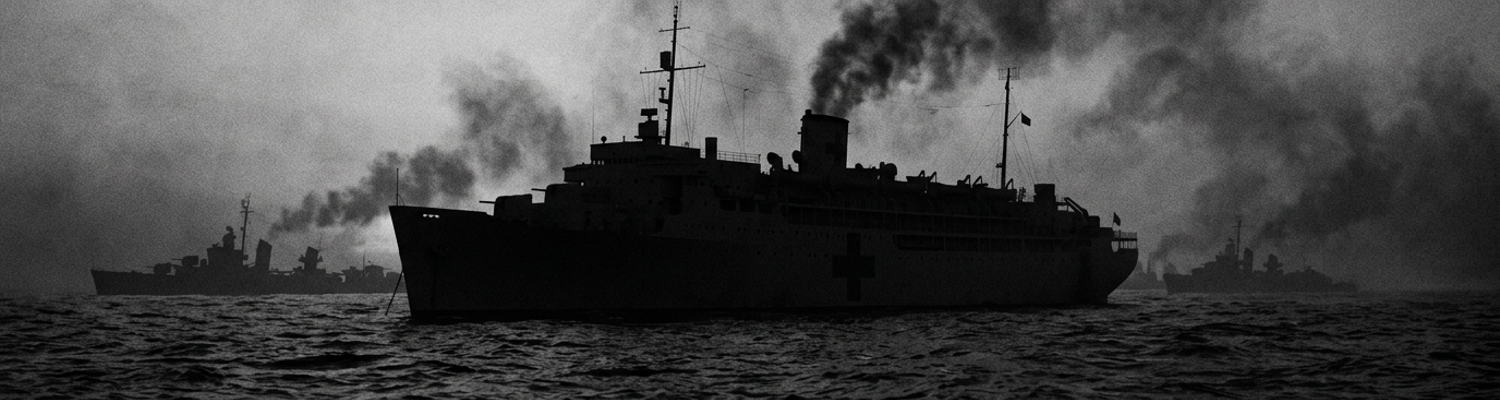

Anchorage Conditions off the Hagushi Beaches
Twenty-four thousand pounds of high-capacity explosive charges per broadside from Colorado-class battleships hit the coastline. Armor-piercing projectiles weighing 1,900 pounds struck limestone. Five-inch antiaircraft fragmentation rounds detonated overhead. Hundreds of thousands of Mark 13 aerial torpedoes and 500-pound general-purpose demolition bombs converged on fifty square miles of coral. By early June 1945, naval task forces arrayed off the Ryukyu Islands had expended tens of thousands of tons of ordnance to crack the Japanese Thirty-Second Army subterranean positions across southern Okinawa. Tenth Army casualty lists climbed toward fifty thousand dead, wounded, and missing. Fleet supply lines funneled explosive tonnage into the shoreline at an unprecedented daily rate. This saturated the coastal roadsteads with spent propellant casings, burning aviation fuel, and drifting cordite residue.
The hospital ship sailed straight into the impact area.
Archival evidence shows the arrival of USS Relief (AH-1) off the Hagushi beaches on June 5, 1945, created an extreme operational compromise. Built in 1920 as the first vessel constructed from the keel up specifically for medical care, the 480-foot auxiliary had already logged twenty-five years of service. Pacific Fleet routing orders directed her into the contested waters off the western coast of Okinawa. Captain H. W. Knowles dropped anchor in Transport Area South. The ship sat less than three nautical miles off the mouth of the Bishi Gawa. Shoreward, the fighting around the Oroku Peninsula and the Kunishi Ridge generated catastrophic volume for the surgical wards.
Enlisted hospital corpsmen stood on the weather decks watching artillery flashes ignite the ridges.
Landing craft, mechanized (LCMs) and DUKW amphibious trucks chugged across the swell. They carried hundreds of blast and fragment trauma cases straight from the beach evacuation stations.
Sunsets triggered general quarters across the anchorage.
A close review of operational logs indicates Condition Red sounded almost every twilight as incoming Japanese air groups approached from Kyushu and Formosa. Blackout protocols took effect across every compartment without exception. Damage control parties bolted heavy steel deadlights over the portholes. They cut all exterior illumination and locked battle hatches. Interior air circulation halted immediately. Engine spaces and lower-deck surgical suites saw internal temperatures climb past 105 degrees Fahrenheit in ninety-percent humidity. Surgeons and corpsmen soaked in sweat as they struggled to maintain sterile fields.
Across the anchorage, escorting patrol craft deployed heavy chemical smoke screens.
Deck crews ignited fog oil and chlorosulfonic acid-sulfur trioxide generators to blind enemy pilots. This acidic white haze rolled over the weather decks of the hospital ship. It entered through auxiliary ventilator intakes and settled directly into the unventilated ward spaces. Postoperative patients coughed through saturated throat dressings and burned their eyes.
Archival evidence shows USS Relief swung at anchor directly among active combatants.
These included fleet repair vessels, high-speed transports, and screening destroyers of Task Force 51. The Hagushi roadstead lacked space to isolate noncombatant vessels. The unarmed hospital ship sat trapped inside the defensive firing arcs of combat warships. When Japanese kamikaze strikes penetrated the outer radar picket lines, surrounding destroyers opened up with their 5-inch/38 caliber dual-purpose guns. Quad 40mm Bofors and 20mm Oerlikon mounts fired simultaneously. Concussive blasts from five-inch mounts firing at low elevations hammered the unarmored hull plating directly.
Shockwaves reverberated across steel bulkheads.
These blasts knocked surgical instruments off trays and snapped electrical conduit mounts. Corpsmen lost their balance as they attempted to secure intravenous needles into collapsed veins.
Every five-inch muzzle blast outside cracked fresh suture lines below the waterline.
Corpsman Exhaustion Before Mass Casualty Intake
Archival evidence shows junior enlisted Pharmacist Mates inside the hull of USS Relief had spent forty-eight consecutive hours without restorative sleep by the morning of June 6. Forced ventilation blowers across the lower berthing compartments failed under the continuous friction of eighty-five-degree salt air. This left compartments C-201-L and C-204-L without fresh airflow. Steel bulkheads conducted radiant heat outward from the boiler casings. Temperatures inside the lower medical quarters reached 108 degrees Fahrenheit with relative humidity pegged near saturation.
Breathing this trapped atmosphere produced acute sodium depletion.
Sailors suffered heat cramps and repeated bouts of nausea as they swallowed salt tablets from bulk dispensary tins. Medical division officers kept all hands awake to scrape flammable bulkhead paint, reposition surgical tables, and inventory narcotics. Enlisted corpsmen suffered from visual tremors and auditory lapses. They repeatedly miscounted units of morphine tartrate and stumbled into iron stanchions while carrying enamel washbasins.
Delirium set in well before the first wounded soldier crossed the gangway.
A close review of operational logs indicates the ship general alarm shattered preparatory work routines at least fourteen times across a single thirty-six-hour period. Radar picket destroyers anchored thirty miles north on Picket Station 1 regularly detected low-flying Japanese Army Ki-43 fighters. Navy dive bombers broke through the outer fleet perimeter. Every time the bridge sounded Condition Red, corpsmen dropped their instruments. They pulled on fire-resistant flash hoods and secured ten-pound M1 steel helmets.
They dogged down every watertight hatch across the third deck.
Working compartments plunged into darkness until auxiliary circuits engaged the low-wattage red battle lanterns overhead. High-pressure steam lines feeding the ship autoclaves had to be secured manually at the manifold valves. This prevented fatal steam releases if suicide planes struck the unarmored hull. The action instantly aborted sterilization cycles for surgical drape sets and scalpel handles. Once the all-clear sounded, corpsmen had to unseat the heavy dogging wrenches. They vented condensation lines and restarted the full thirty-minute sterilization sequence from room temperature.
Every false alarm erased hours of sterile instrument processing.
When examining the historical record, the physical conversion of the enlisted mess spaces into an emergency overflow triage ward shows the severe spatial limits of the 1920-built auxiliary. Junior corpsmen dragged two hundred wire-basket Stokes litters and collapsible canvas Army stretchers into the central mess hall. They lashed them four tiers high against steam piping and exposed cable runs. Passageways measuring barely forty-four inches in width were lined on both sides with wooden packing crates. These held five-yard rolls of petrolatum burn gauze, compressed cellulose dressings, and hundreds of individual paper packets of crystalline sulfadiazine.
Corpsmen taped fifty-milliliter glass bottles of distilled water directly to mess table stanchions.
Cardboard cartons containing dried normal human blood plasma and rubber-tubed infusion sets sat nearby. Wire-cutters hung from overhead conduit hangers beside shelves of three-grain morphine syrettes and glass ampoules of sodium pentothal. Between these supply walls, the clear walking path along the C-deck centerline shrank to fourteen inches. Medical personnel had to move sideways while carrying metal canisters of ether, rolls of plaster splints, and heavy Thomas leg-traction splints.
The lower decks choked with trauma gear before the first casualty boat left the reef.
Casualty Evacuation from Kunishi Ridge and Mabuni
Archival evidence shows amphibious evacuation chains running from the southern beaches completely overwhelmed the offloading stations along the port side by midday on June 12. Six-wheel GMC DUKW-353 amphibious trucks and thirty-six-foot Landing Craft Vehicle Personnel operated by the 53rd Amphibian Tractor Battalion shuttled survivors out from the jagged coral shelves. These craft originated below Kunishi Ridge and the Mabuni escarpment. At Kunishi, infantrymen of the 1st Marine Division had spent days pinned beneath interlocked Type 99 machine-gun bunkers and 47mm antitank positions.
Assault battalions hauled casualties out inside the cramped crew compartments of M4A3 Sherman tanks.
They transferred them to waterborne craft at the reef edge. Further south, Tenth Army soldiers from the 7th and 96th Infantry Divisions cleared cave networks across Mabuni under continuous mortar barrages. Heavy six-foot swells repeatedly slammed these wooden and light-gauge steel landing craft directly into the ship welded hull plates. The impacts broke mooring lines and twisted the steel litter-hoist frames operated by deck force sailors.
Winch operators swung heavy wire basket slings down to the bobbing cargo decks.
They lifted four litters per hoist cycle. Deckhands hauled soaked, mud-caked men eighty feet upward to the weather deck entry ports without pausing between boat rotations.
Salt spray mixed with unrefined bunker exhaust across the landing ladder.
A close review of operational logs indicates the physical injuries presenting on the main deck diverged sharply from standard bullet wounds treated earlier in the island campaign. Japanese artillery crews firing 150mm Type 96 field howitzers and 320mm spigot mortars from reverse-slope emplacements on Mabuni showered exposed coral draws with high-velocity fragments. This produced irregular lacerations that tore through bone. The blasts drove mud, split rock, and shredded utility dungarees inches deep into muscle cavities.
Traumatic amputations were frequent.
Buried Type 93 pressure mines and hand-thrown satchel charges detonated inside the confined limestone fissures of Kunishi caused these injuries. White phosphorus exposure presented the most difficult surgical hazard for the triage teams. Phosphorus fragments driven beneath dermal tissue continued to combust at temperatures exceeding 2,700 degrees Fahrenheit when exposed to atmospheric oxygen. This produced dense chemical smoke from open flesh.
Pharmacist Mates poured cold saline and five-percent copper sulfate solutions over bubbling burn tracts.
They coated the embedded particles with black copper phosphide. This allowed surgical teams to excise the smoldering chemical deposits with metal forceps before the compounds poisoned the patient liver and kidneys.
The odor of scorched skin filled the lower ventilation intakes within ten minutes.
When examining the historical record, the vessel primary casualty receiving room and adjacent central mess deck reached absolute saturation forty minutes after the first DUKW secured alongside. Every designated examination table filled with hemorrhaging patients. Junior pharmacist mates established emergency sorting points across the bare exterior gangways and narrow centerline transit ways. Stacking teams slotted canvas litters directly into three-tier and four-tier pipe frames welded along the bulkhead walls.
This left less than eighteen inches of vertical clearance between stretchers.
Corpsmen moved down these narrow corridors on hands and knees. They checked carotid pulses, assessed pupillary reflexes, and printed grease-pencil priority numbers onto exposed foreheads. Sucking chest wounds were sealed with vaseline gauze taped down on three sides. Corpsmen rigged three-hundred-cubic-centimeter bottles of dried blood plasma from overhead wire hangers using friction tape.
Patients designated as hopeless cases lay side by side with shock cases needing immediate limb ligations.
They wedged beneath auxiliary electrical trunks and high-temperature steam bypasses while the ship rolled five degrees in the coastal ground swell.
Corpsmen stepped over discarded tourniquets to reach the second tier of stretchers.
Surgical Suite Overload and Depleted Medical Supplies
Archival evidence shows surgical division teams locked into a continuous twenty-four-hour operating schedule across all four primary surgical tables in compartment B-204 by June 13. Operating room teams cut intervals between major surgical cases to less than four minutes. One surgical crew secured the final retention sutures on a high-explosive traumatic limb amputation from the 6th Marine Division. Corpsmen dragged the next patient onto an adjoining table to begin ether drop anesthesia.
Orderlies splashed three percent cresol solution across the rubber table pads.
They scraped clotted blood toward the deck scuppers with rubber squeegees. They laid down fresh unbleached muslin drapes without waiting for surfaces to dry. Surgeons performed debridements, intestinal resections, and skull trephinations under hundred-watt overhead operating lamps. These lights pushed table-level temperatures past one hundred and twelve degrees Fahrenheit.
Medical officers worked thirty-six-hour rotations without leaving the suite.
They washed their hands between procedures in porcelain basins filled with dilute mercuric chloride solution. Freshwater rationing limited running tap scrub-downs to thirty seconds per man.
Blood pooled against the scuppers faster than the gravity drainage lines could pull it out.
A close review of operational logs indicates the sheer rate of traumatic shock cases depleted the vessel primary medical stores at three times the calculated expenditure curves. The supply hold initially contained eight hundred units of dried normal human blood plasma packed in vacuum-sealed glass bottles with distilled water diluent cans. By the third night of the Kunishi Ridge fighting, fewer than forty units remained on the inventory sheets. Corpsmen tore through forty boxes of sterile saline flasks in twelve hours. They flushed pulverized coral, mud, and shredded combat fatigues from open peritoneal cavities.
Factory-sealed rolls of sterile absorbent cotton and five-yard gauze bandages gave out on June 14.
Dispensary staff took unsterilized utility bolts of broadcloth from the ship general stores. They sliced them into strips using heavy tailoring shears and loaded them into copper autoclave drums for emergency pressure cooking. Medical officers restricted remaining plasma units strictly to casualties presenting with imperceptible radial pulses and systolic blood pressure readings below sixty millimeters of mercury. Men suffering from moderate blood loss received direct infusions of unbuffered five-percent dextrose in river water distilled through the auxiliary steam evaporators.
Shipboard stocks of three-inch compressed battle dressings hit zero forty-eight hours before fleet supply auxiliaries arrived from Kerama Retto.
When examining the historical record, surgical staff and maintenance ratings improvised missing hardware and structural accommodations to prevent complete system paralysis. Tool and die machinists in the ship repair shop ground down half-inch brass rod stock and automotive copper tubing. They produced blunt tissue retractors, rib spreaders, and suction tips after commercial surgical trays ran short during back-to-back thoracic cases. Corpsmen clamped bent automotive needle-nose pliers over severed femoral arteries when nickel-plated Rochester-Pean hemostatic forceps broke under metal fatigue.
Topside, division officers ordered the complete evacuation of enlisted crew berthing compartments C-202-L and C-203-L on the third deck.
They stripped four hundred standard canvas bunks to build an emergency overflow intensive care facility. Corpsmen bolted two-inch angle iron between three-tier pipe racks to create rigid beds for traction cases. They hung sixty-pound sandbags from telegraph wire over overhead ventilation ducts to maintain continuous tension on fractured femurs. High-flow oxygen tanks from the ship underwater welding locker were hauled down the forward ammunition hoists. They were fitted with commercial rubber gas masks and tied with telephone drop wire directly to stanchions beside patients recovering from blast-induced bilateral pneumothorax.
Enlisted sailors slept on the bare steel deck plates of the anchor windlass room to leave six additional bunk tiers open for penetrating abdominal trauma cases.
Nocturnal Air Raids and Kamikaze Threat Protocols
Archival evidence shows Tenth Army naval commanders suspended standard Geneva Convention illumination protocols across Transport Area South to protect the anchorage. Under tenth-article provisions of the 1907 Hague Convention, hospital ships normally operated under brilliant illumination at night. They ran three-thousand-watt deck floodlights to display their white-painted hulls, green longitudinal stripes, and scarlet crosses to all combatants. Off the Hagushi roadstead, that illumination turned into a tactical liability for the fleet.
Amphibious staff determined an illuminated noncombatant vessel provided Japanese pilots with a visual reference point.
They used it to line up bombing and suicide runs on adjacent ammunition carriers and troop transports. Commander Knowles received orders to strip the ship of her visible noncombatant status every evening at 1830. Deck crews secured canvas tarpaulins over topside red cross emblems. They extinguished every external incandescent lamp and locked the ship down under total blackout conditions.
Stripped of light, the auxiliary drifted in the darkness.
The unarmored, unarmed four-hundred-and-eighty-foot target blended directly into the screen of high-speed transports and fleet auxiliaries.
International maritime law vanished the moment the sun dropped behind the Kerama Retto.
A close review of operational logs indicates this mandatory darkness forced surgical units and wounded men into suffocating physical confinement below the ship waterline. Japanese Army Ki-67 twin-engine bombers and naval Ginga dive bombers initiated nocturnal attack runs out of airfields in Kyushu. Damage control crews swung heavy steel watertight hatches shut across decks two and three. They dogged the levers down with two-foot steel wrenches.
Lower-deck compartments lost all natural ventilation.
Fans ceased operating to eliminate thermal exhaust trails. This sent ward temperatures past one hundred and ten degrees while humidity condensed into brown droplets on bare overhead beams. Inside primary operating room B-204, medical officers worked solely beneath the faint, directional glow of filtered red battle lanterns. Unarmored hull plating measured less than one-half inch thick. Corpsmen and anesthetized patients felt every external weapon discharge directly through the steel deck plates.
Concussive vibrations from nearby screening destroyers firing their 5-inch/38 caliber batteries rattled scalpels against metal instrument trays.
The blasts shook drainage tubes loose from plasma bottles. They drove the mechanical roar of diving aircraft engines directly through the ship frames. Men sealed six feet beneath the harbor surface could hear the low whistling of falling ordnance and waterborne fragmentation bursts. They did not know if the next detonation would blow open their compartment bulkheads.
No one below decks could see the sky.
When examining the historical record, the most severe exposure fell on the immobilized orthopedic casualties packed into auxiliary ward spaces C-202-L and C-203-L. Over ninety Marines and soldiers occupied these berths suspended in rigid traction frames. Their fractured femurs, crushed pelvises, and shattered vertebrae locked in place by heavy Kirschner skeletal wires and Steinmann steel pins driven directly through living bone. Plaster-of-Paris spica body casts, weighing up to forty pounds each when wet, encased soldiers from their armpits down to their ankles.
This rendered them completely incapable of turning or sitting upright.
Pharmacist Mates rigged complex systems of iron angle brackets, heavy pulleys, and thirty-pound lead counterweights suspended over overhead pipe racks to keep these compound fractures stabilized. If a kamikaze penetrated the weather deck or a low-running aerial torpedo ruptured the forward cargo spaces, rapid evacuation was physically impossible. Standard fleet damage control doctrine ordered compartment doors dogged shut from the outside within forty seconds of a hull breach to isolate flooding. Corpsmen lacked the cutting shears to split thick plaster casts or the bolt cutters required to release tension cables.
Two junior corpsmen oversaw forty traction frames with four standard wire-cutting pliers and eight canvas transfer sheets.
Psychological Collapse Among Enlisted Medical Personnel
Archival evidence shows the sustained operational tempo fractured the psychological endurance of the enlisted medical staff by the second week of June. Medical division rosters (NARA Record Group 24) recorded a sharp spike in combat fatigue cases among junior Pharmacist Mates. These men operated in a continuous state of sensory overload. The combination of suffocating heat, the pervasive smell of gangrenous tissue, and the relentless concussions from nearby naval gunfire degraded their cognitive functions.
Sleep deprivation destroyed their short-term memory.
Corpsmen working in the lower triage wards began experiencing auditory hallucinations. They heard the distinct shriek of the ship general alarm even when the anchorage was quiet. Men dropped sterile instrument trays and reached for their flash hoods based on phantom sirens. Medical officers documented instances of enlisted personnel freezing in the narrow passageways. They stared blankly at hemorrhaging patients while holding unused tourniquets.
The breaking point arrived quietly in the dark.
A close review of operational logs indicates the claustrophobic conditions during blackout hours accelerated these breakdowns. Trapped behind dogged steel hatches, corpsmen absorbed the panic of the wounded men they treated. Blinded patients with severe facial burns thrashed in their canvas litters during air raids. They screamed for updates on the incoming aircraft. Corpsmen had to physically restrain delirious Marines who attempted to tear out their intravenous lines and crawl under the mess tables for cover.
The physical exertion of holding down terrified, muscular infantrymen exhausted the medical staff.
By June 15, several corpsmen had to be relieved of duty and sedated with sodium amytal. They were placed in empty bunks in the anchor windlass room. Their hands shook too violently to administer morphine syrettes or start plasma infusions. The constant fear of a kamikaze strike penetrating the thin hull plating created a baseline of terror that never dissipated.
Every sudden vibration sent a jolt of adrenaline through their exhausted nervous systems.
When examining the historical record, the lack of any visible escape route compounded the psychological trauma. Infantrymen on the ridges of Okinawa could see their enemy and fire back. The medical personnel sealed inside the hull of USS Relief could only wait in the sweltering darkness. They listened to the battle raging above them. They processed the mangled results of that battle hour after hour.
There was no rotation off the line.
The ship was the line. Corpsmen who collapsed from heat exhaustion were revived with cold water and salt tablets. They were sent back to the operating suites within twenty minutes. The sheer volume of casualties arriving from the Hagushi beaches meant no man could be spared for recovery.
They worked until their bodies simply stopped functioning.
Patient Manifest Clearance and Mariana Evacuation
Six hundred and thirteen litter and ambulatory casualties pushed the vessel past every safety standard written for naval auxiliaries.
Archival evidence shows Captain Knowles received urgent routing dispatches from Commander Task Force 51 by June 16. The orders directed the ship to clear the Hagushi roadstead before incoming typhoon swells collided with renewed enemy air activity. Nominal berthing stood at 550 bunks. The actual intake surged past 650 critically injured men drawn directly from the 1st Marine Division and the Army 7th and 96th Infantry Divisions. Stacking crews bolted temporary two-tier pipe bunks into every available foot of deck space along the starboard and port working passageways on C-deck.
Canvas litters blocked access to the crew mess, machine shops, and auxiliary dynamo spaces.
Triage officers rejected ambulatory cases with superficial fragment injuries. They reserved remaining intravenous sets and surgical sponge stocks for penetrating chest and abdominal trauma cases. Shore evacuation craft dumped the last wave of casualties onto the weather deck even as deckhands weighed anchor. Steam winches dragged the heavy ground tackle upward out of the coral mud. Three LCVPs circled the vessel stern.
They transferred thirty-eight additional blast-concussion cases directly across the gunwales before the ship swung its bow south-southeast.
Open ocean brought zero relief from the heat.
A close review of operational logs indicates the 1,200-nautical-mile passage across the Philippine Sea toward the Marianas presented an immediate post-surgical crisis. Heavy eight-to-ten-foot ocean swells caused the 10,000-ton hull to roll twelve degrees every eight seconds. This threw unrestrained post-operative patients against bulkhead braces and tore open fresh retention sutures. In ward C-201-L, five corpsmen spent seventy-two continuous hours wedging kapok life jackets and rolled wool blankets beneath plaster hip spicas.
This prevented skeletal traction pins from tearing through fractured femurs.
Salt-air condensation dripped into open abdominal drains. This triggered localized peritonitis that forced emergency bedside debridements while the deck pitched beneath the medical teams. Distillation units in the lower engine room clogged with calcium scale. This cut the fresh water allowance to two pints per patient every twenty-four hours. Pharmacist Mates boiled irrigation water over electric hot plates in the galley pantry.
Over fifty patients developed refractory gas gangrene and clostridial myonecrosis during transit.
They required continuous drip infusions of sodium penicillin and bedside muscle fascia incisions conducted under flickering DC battle lanterns.
Sleepless delirium settled over the surgical staff as the ship neared the Mariana chain.
When examining the historical record, the clinical accounting compiled upon arrival at Apra Harbor, Guam, and Tanapag Harbor, Saipan, demonstrated the sheer scale of trauma handled within the hull. Surgical teams had completed 284 major operations during the eleven-day operational cycle. This included eighty-two traumatic limb amputations, forty-seven exploratory laparotomies, and twenty-three cranial trephinations to relieve intracranial pressure from shell fragments. Operating rooms consumed 1,120 units of dried blood plasma and 340,000 units of intramuscular penicillin while running surgical tables around the clock.
Despite the severity of incoming blast polytrauma, only fourteen patients died aboard the vessel between embarkation off Hagushi and debarkation at Fleet Base Hospital 103 on Guam and the 148th General Hospital on Saipan.
That survival rate exceeded ninety-seven percent. Pharmacist Mates transferred the final litter case down the gangway into a waiting GMC ambulance at Saipan at 1420 on June 20, 1945. They had thirty-six hours to scour dried pus and blood from the deck gratings before taking on fresh bunker oil for the next turnaround run back to the Ryukyus.