
War Department Intelligence Operations in Riga
Solder melted inside the high-frequency radio receiver as a sudden power surge cracked the porcelain vacuum tube sockets across the monitoring desk. Staff Sergeant Miller grabbed a dry wool coat to smother the smoldering transformer coils while the duty officer yanked the lead battery cables directly off their copper terminals. Technicians scraped charred insulation from the circuit boards within minutes, desperate to restore contact before Baltic port traffic logs slipped past their antenna array. Nonrecognition policies barred official American observation posts in Moscow, forcing the War Department to depend on peripheral listening posts in the Baltic border states. Prior to formal diplomatic recognition of the Soviet Union in 1933, the War Department Military Intelligence Division operated its primary Soviet collection hub out of the American Legation in Riga. Army attaches working inside the cramped Baltic legation had to rebuild their damaged receivers by hand because replacement parts took three months to arrive by sea from Washington.
Sea transit delays forced the intelligence officers to salvage replacement tubes from local Latvian repair shops to keep the listening post alive. Operators resumed sorting through stacks of Soviet railway manifests and dockyard testimonies the moment the repaired receivers powered on. Army attaches established file series MID 2503 to systematically document the material reconstitution of the Red Navy across both the Baltic and Black seas, typing detailed specifications for retrofitted Tsarist dreadnoughts, new river patrol hulls, and drydock repairs into numbered carbon copies each evening. Friction flared almost immediately between the War Department and naval officials in Washington, who argued that land-based Army officers possessed no business analyzing naval architecture or maritime gunnery. Naval attaches stationed in western Europe refused to share their Baltic vessel sighting logs with the Riga office, forcing the Army team to purchase merchant marine gossip and harbor fuel bills out of their own discretionary funds. Captain Reynolds locked each newly cross-referenced ledger entry inside an iron safe before dispatching couriers with the findings.
Couriers carried the sealed envelopes across European railway lines to the War Department General Staff, where bureaucratic rivalry stalled operational distribution. Office of Naval Intelligence directors complained directly to the Secretary of War that MID 2503 infringed on maritime authority, demanding that the Army burn its ship identification cards. Army analysts in Washington refused to destroy the files, pointing out that Navy scouts possessed no stationed personnel along the Soviet border to verify whether the Baltic Fleet had restored its boilers. Bureaucrats compromised by locking the duplicate files in separate War Department cabinets, preventing tactical fleet planners from consulting the Riga reports during joint defense conferences. Colonel Harry Hodges ordered his Riga attaches to bypass the interservice dispute entirely by expanding their physical reconnaissance runs along the Gulf of Finland. Attaches packed heavy field glasses and tripods into an unheated touring car to observe Kronstadt naval traffic from windswept coastal dunes.
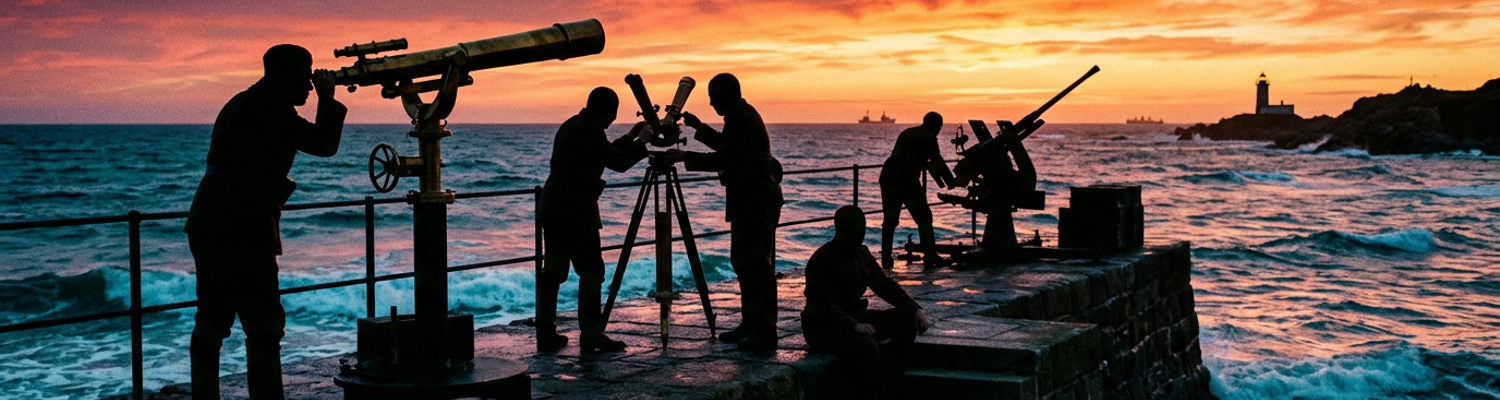
Dunes of wet gravel churned under the touring car tires along the coastal road toward the Estonian border, where spotters mounted their brass observation scopes against the stone sea wall. Officers sketched the profiles of Soviet destroyers clearing the channel, logging smoke signatures, deck gun configurations, and machinery exhaust patterns onto waterproof pads. Latvian border guards provided local patrol timetables and merchant clearance sheets, which gave the American team precise departure schedules for Red Navy vessels training near Leningrad. Army attaches compiled these field notes into supplementary technical folders for MID 2503 alongside cross-checks on Black Sea submarine production obtained from Romanian informants. Clerks indexed the final hull tallies into steel filing drawers back at the legation, preparing another batch of unacknowledged maritime intelligence for shipment to an obstinate War Department.
Navy Disputes and Jurisdictional Friction
War Department mailrooms received the canvas sacks carrying those indexed Baltic folders, triggering an immediate institutional fight with the sea service down the hall. Officers from the Office of Naval Intelligence repeatedly contested the War Department mandate to evaluate foreign warships, claiming exclusive statutory authority over maritime analysis. Naval bureau chiefs argued that decades of tradition and direct executive orders granted their department sole responsibility for inspecting naval ordnance, armor plate thickness, and foreign fleet maneuvers. Soldiers attempting to analyze naval architecture struck sea service commanders as unqualified intruders who misunderstood basic shipyard construction, marine boilers, and gun mountings. Navy officials formally demanded that the Army cease collecting maritime intelligence and turn over every existing Baltic vessel profile to naval custodians for immediate evaluation or destruction. Army administrators refused to surrender their work, locking the carbon copies in War Department vaults and passing the Riga naval dossiers straight to the War Plans Division for review.
Army review boards inside the Military Intelligence Division defended their Riga naval reporting by emphasizing that the Office of Naval Intelligence maintained no resident naval attaches or independent collection infrastructure accredited in Latvia. Military planners pointed out that American naval attaches operated only out of major western embassies in London, Paris, and Berlin, leaving the entire eastern Baltic coastline without a single accredited Navy observer. Field officers stationed at the isolated Riga legation were providing the only firsthand intelligence on Soviet Baltic Fleet repair yards, destroyer gunnery trials, and submarine refits taking place behind closed borders. Staff officers stressed that halting these observations would leave American war planners completely blind to Red Navy expansion across northern European waters. Army leaders insisted that collecting regional port data was essential for understanding ground defense in the Baltic border states, where amphibious landings could alter land campaigns. Navy planners responded by dismissing the Army reports as amateur hearsay, refusing to enter the Riga data into their official vessel registers.
Registers containing official Navy estimates landed beside the rejected Riga reports in joint committee rooms, exposing deep divisions between the two branches. Interservice friction produced competing, contradictory estimates of Soviet naval strength within the War Department General Staff and the Department of the Navy. Navy analysts concluded that the Soviet Union possessed only derelict, rusted hulks incapable of operating beyond shallow coastal waters because communist sailors lacked spare parts, machine tools, and disciplined engineering officers. Army files from Riga contradicted that optimistic assessment directly, presenting detailed eyewitness evidence of operational battleships, active destroyer flotillas, and expanding drydock facilities at Leningrad. Technical specialists from both services clashed over whether retrofitted Tsarist dreadnoughts could fire their heavy main battery guns without cracking their reinforced deck girders. War Council members sitting across shared conference tables argued over irreconcilable ship lists, unable to agree on whether the Soviet fleet posed a genuine strategic danger to northern Europe.
Europe remained the primary focus as typists inside the Riga legation ignored the bureaucratic stalemate in Washington, rolling fresh carbon sheets into their Underwood typewriters to record incoming Baltic sightings. Military Intelligence Division leaders instructed their Baltic attaches to bypass naval objections and keep tracking every foreign warship hull entering the Gulf of Finland. Attaches purchased commercial shipping manifests from Latvian port captains, copied harbor master logs by hand, and cross-checked crew gossip from visiting merchant sailors. Officers compiled these waterfront observations into comprehensive technical folders, documenting the real waterline depths, gun calibers, and boiler smoke colors of passing Red Fleet patrols. Couriers picked up the newly sealed packets from the legation courtyard each week, keeping the unauthorized maritime intelligence pipeline running across the Baltic frontier.
Latvian Intelligence Pacts and Defector Networks
Frontier outposts expanded that Baltic courier pipeline by negotiating bilateral intelligence exchanges directly with the Latvian General Staff. Captains from the Military Intelligence Division met Latvian staff colonels in quiet conference rooms near Riga Castle, trading American logistics manuals and foreign ordnance charts for raw reports compiled by Latvian listening posts. Latvian wire teams tapped Soviet military telegraph circuits running out of Leningrad and copied daily railway manifests, giving American analysts hard figures on coal deliveries, marine boiler parts, and coastal artillery shipments that legation staff could never collect on their own. Attaches spent their nights translating these Russian and Latvian dispatches into English summaries, plotting the patrol routes of Bolshevik torpedo boats and tracing the repair schedules of Baltic destroyers. Officers initialed each verified page before pressing steel paperclips across the margins and sorting them into numbered dispatch folders.
Folders containing these dispatches grew thicker as veteran captains and marine engineers who had fled Kronstadt during the civil war met American attaches in rented apartments along the Daugava River, sketching warship engine layouts from memory. These informants identified former imperial cadets and warrant officers who had chosen to serve the new regime, pinpointing which red commanders understood boiler mechanics and which men held command solely through Communist Party patronage. Exiled sailors also relayed reports brought across the border by commercial seamen, describing widespread discontent among conscript crews, political infighting inside sailor committees, and slow work rates inside the Leningrad shipyards. Interrogators copied every name, shipyard strike, and machinery breakdown directly into canvas field notebooks to prove that dockyard revolts and broken equipment were crippling Soviet naval construction.
Construction delays and roster assessments of Soviet naval officers filled the MID 2503 files, cataloging their Czarist naval lineage, technical proficiency, and political reliability into systematic reference cards. Legation typists transferred data from the notebooks onto heavy paper cards, recording graduation classes from the Saint Petersburg naval academy, wartime combat ribbons, and foreign language skills for every identified red fleet commander. Blue pencil marks indicated former imperial officers who possessed real navigation skills but endured constant surveillance by political commissars, while red marks highlighted fanatical party appointees who lacked basic ocean piloting experience. Attaches filed these index cards alphabetically, giving War Department planners an exact picture of how internal suspicion and technical incompetence crippled the command structure of Soviet flotillas. Captain Reynolds stamped each finished sheet with file markings before locking the duplicate sets into fireproof drawers for courier transport to Washington.
Washington bound steel dispatch cases carrying those personality registers traveled west on European passenger trains, delivering the unauthorized maritime dossiers directly into the War Department basement. Military Intelligence Division analysts carried the Riga officer rosters straight into joint defense conferences, using the defector debriefs to dispute optimistic Navy estimates of Soviet sea power. Naval liaison officers reacted with open fury, insisting that soldiers had no training to judge battleship captains and demanding that the War Department leave fleet personnel assessments to naval authorities. Army colonels refused to withdraw the dossiers, setting the Latvian interview records onto the oak conference table to prove that political purges and mutinous crews left the Red Navy incapable of sustained offshore combat. Clerks locked the contested registers inside the War Department vault each evening, securing the Baltic dossiers behind heavy combination dials while waiting for the next courier delivery from Riga.
Aircraft Carrier Report Controversy
Riga couriers unlocked leather transit pouches inside the War Department vault the following morning, delivering the next bundle of files directly into the hands of military intelligence staff. The Riga Military Attache forwarded MID Report 4896 in November 1925, transmitting alleged Soviet design plans for a heavy aircraft carrier. Folded blueprints inside the packet outlined a light fleet carrier purportedly under construction in Leningrad, complete with flight deck dimensions, hangar elevators, and high-pressure steam turbines. Army intelligence officers in Washington immediately hailed Report 4896 as undeniable proof that their Baltic outpost could uncover premier maritime secrets without Navy assistance. General Staff planners quickly circulated copies of the carrier plans across the War Department, preparing to present the intelligence to their naval counterparts at the next joint conference.
Conference tables became battlegrounds when blueprints from Report 4896 landed on the desks of naval technical specialists, who immediately subjected every measurement to severe engineering scrutiny. Bureau of Construction and Repair draftsmen measured the draft lines, internal compartment bulkheads, and deck weight calculations with precision slide rules. Naval technical specialists rigorously dismissed Report 4896, proving that the propulsion machinery arrangements and hull displacement ratios were physically impossible. Bureau engineers demonstrated that fitting high-output boilers and heavy reduction gears into such narrow lower compartments would exceed the 7,550-ton displacement limit and cause the top-heavy hull to capsize in moderate seas. Analysts recognized the purported blueprints as an amateur swindle, manufactured by Baltic fabricators who had spliced commercial cargo hull cross-sections onto fictional flight deck outlines to extract American dollars.
Dollars wasted on the exposed fabrication gave officers from the Office of Naval Intelligence the ammunition to launch an aggressive bureaucratic counterattack against their Army rivals. Naval officers cited the flawed carrier dossier to argue that Army generalists lacked the basic maritime literacy required to evaluate naval technology. Naval liaison chiefs drafted formal memorandums asserting that ground intelligence officers could not distinguish between sound naval architecture and waterfront confidence tricks. Fleet commanders demanded that the Joint Board revoke the War Department mandate to evaluate foreign warship designs and strip the Riga legation of funds used to purchase maritime documents. Army intelligence leaders pushed back against the demand, arguing that occasional false leads were the unavoidable cost of operating in a denied espionage environment.
Espionage clerks stamped red cancellation markings across the master folder of Report 4896 before locking the discredited carrier blueprints deep inside the basement archives. War Department administrators quietly barred the carrier document from future fleet estimates, but the embarrassment lingered over every joint planning session that followed. Naval officers routinely brought up the phantom carrier whenever Army attaches submitted fresh reports on Soviet destroyer refits or Baltic shipyard schedules. Attaches in Riga recalibrated their local informant networks to focus on verifiable harbor departures and drydock repairs, trying to rebuild institutional credibility through tedious manual observation. Captains adjusted their coastal observation scopes on the sea wall near the Gulf of Finland, logging the real coal smoke of passing Soviet patrols while ignoring the lucrative promises of local blueprint sellers.
Submarine Reconditioning and Joint Intelligence Friction
Sellers of false blueprints faded away as brass eyepieces on those observation scopes revealed low, narrow silhouettes cutting through the gray Baltic chop rather than the tall masts of battleships. Attaches tracked these submerged hulls directly to Leningrad shipyards, where Bolshevik salvage teams were hauling sunken vessels off the seafloor to rebuild the Red Fleet. MID 2503 successfully tracked the salvage and reconditioning of Czarist Bars-class and AG-type submarines despite the ongoing interagency clashes over surface ship designs. Informants in the Kronshtadt repair yards smuggled out grease-stained inventories showing machinists replacing corroded battery plates, rebuilding seized diesel engines, and recasting bronze ballast valves. American officers compared these drydock parts lists with harbor sighting logs, verifying each reactivated hull as it completed sea trials in the shallow gulf waters. Clerks filed the verified hull numbers, battery recharge timetables, and torpedo tube layouts into the expanding Baltic folders for shipment across the Atlantic.
Atlantic transit brought these Army reports to Washington, where analysts accurately concluded that Soviet naval policy favored coastal defense, minelaying, and undersea warfare over major surface fleet expansion. Military Intelligence Division analysts noted that the Kremlin lacked the heavy steel foundries, skilled shipwrights, and coal reserves needed to construct modern battleships or heavy cruisers. Soviet dockyards concentrated their scarce labor on loading older destroyers with moored contact mines and outfitting patrol craft with depth charges to block the maritime approaches to Leningrad. Ground attaches in Riga pointed out that these light coastal craft, combined with reconditioned submarines, formed a layered perimeter designed strictly to protect Bolshevik territory against foreign amphibious landings. General Staff planners in Washington read these Baltic assessments and integrated the coastal minefield charts directly into their European defense scenarios.
Scenarios drafted by ground forces met immediate resistance when Navy officers dismissed those coastal minefield charts during joint staff conferences, refusing to accept that soldiers could map foreign naval waters or decipher undersea doctrine. Bureau chiefs from the Office of Naval Intelligence insisted that ground personnel lacked the technical schooling to assess underwater ballast systems or torpedo reload mechanisms, shelving the Riga reports without circulating them to fleet commanders. The bitter institutional impasse between MID and ONI in the Baltic demonstrated the critical hazards of uncoordinated military intelligence prior to World War II. Interservice suspicion hardened into standard operating procedure, as naval authorities hid their own foreign port inquiries while the War Department locked its Baltic submarine files inside Army safes. Neither service agreed to establish a shared clearinghouse to cross-examine foreign naval data, leaving American war planners with divided, contradictory estimates of European sea power. Staff colonels and naval captains traded sharp memorandums over jurisdictional boundaries, deadlocking joint intelligence committees and banishing the Riga submarine files to locked storage rooms.
Storage rooms in the basement archives of the State, War, and Navy Building received the contested Baltic folders as couriers stacked the unread submarine logs alongside discredited blueprint cases. Clerks turned the heavy combination dials on the steel vault doors each evening, sealing away accurate assessments of Soviet undersea warfare that no naval architect had agreed to review. Attaches stationed along the Gulf of Finland continued logging the exhaust trails of Baltic patrol boats and copying railway freight slips from Kronstadt, sending their solitary dispatches across the ocean to an intelligence establishment divided against itself. Spotters on the coastal sea wall kept their brass scopes trained on the gray water, recording dive times and surface speeds into their field books before sealing the sheets into another courier pouch for Washington.