
Yonpo Airfield Night Interdiction Sorties
United States Marine Corps doctrine manuals published at Quantico instructed pilots that close air support functioned within stable daylight corridors. These corridors required unobstructed radio links. They relied on predictable weapon ballistics. Subzero blizzards sweeping off the Sea of Japan into Yonpo Airfield during the first week of December 1950 shattered every line of that doctrine.
A close review of operational logs indicates that flight crews from Marine Aircraft Group 12 faced unprecedented environmental degradation. Ground mechanics scraped sheets of salt-spray frost off pierced-steel planking runways. Temperatures plummeted past twenty degrees below zero. Night fighter squadron VMF(N)-513 operated twin-engine Grumman F7F-3N Tigercats and radar-equipped Chance Vought F4U-5N Corsairs off these frosted strips. Engine oil congealed inside radial crankcases within twenty minutes of shutdown. Ground personnel burned aviation gasoline in cut-down oil drums beneath the engine cowlings. This prevented hydraulic lines from cracking under brittle contraction.
Takeoffs down the unlit runway near Hungnam forced aviators to lift heavy ordnance loads directly into blinding squalls. They relied entirely on early Sperry attitude gyros. These instruments regularly tumbled in the freezing air.
Frostbite claimed flight line armorers before their shifts ended.
Archival evidence shows that Marine commanders modified their weapons loads specifically to deny Chinese infantry the ability to use frozen defiles as staging routes around Funchilin Pass. Standard high-explosive aerial bombs simply cracked the permafrost. They left debris fields that enemy units bypassed on foot. VMF(N)-513 armaments crews began loading AN-M1A1 cluster adapters packed with M83 butterfly anti-personnel bomblets. They paired these with general-purpose M64 500-pound bombs fitted with long-delay M123 and M124 tail fuzes. Weapons officers calibrated these chemical-delay fuzes to detonate randomly between two and thirty-six hours after impact.
Dropped into the sheer granite clefts of the Changjin River gorge, these mixed loads transformed natural choke points into lethal barriers. The unexploded butterfly canisters snagged in alpine scrub along the canyon walls. This armed sensitive vane wires that detonated on the slightest disturbance. Beneath the snow crust, heavy delayed-action ordnance detonated at unpredictable intervals throughout the dark hours. These blasts collapsed ice bridges over river bends. They triggered localized avalanches that buried narrow goat trails.
A single frozen valley swallowed entire supply columns without warning.
At 0215 hours on December 8, an F7F-3N Tigercat piloted by Captain William Geuss crossed the southern crest of Funchilin Pass. He flew blind beneath a seven-hundred-foot ceiling of driving snow. AN/APS-19 radar returns lit up on the back-seat intercept officer scope. The radar identified an assembly of Chinese 20th Corps infantry massing on the frozen riverbed three miles south of the destroyed water-gate bridge at Choto-ri.
Geuss committed to a sixty-degree dive at 0217 hours. He navigated through a mountain notch where sheer rock walls rose eight hundred feet above his wingtips. He released eight M83 fragmentation canisters and two delayed M64 bombs into the gorge. At 0219 hours, the aircraft pulled five Gs to clear the opposite cliff wall. The Tigercat suffered immediate hydraulic pressure loss. Cold-cracked seals in the port wing blew open. Down in the canyon, the cluster bomblets scattered across five hundred square yards of packed ice. They detonated continuously as trailing Chinese companies stepped onto the target grid.
The enemy assault route ceased to exist in five minutes.
That localized strike fractured the Chinese flanking advance toward the retreating 1st Marine Division column. Daylight broke over the mountain corridor hours later. Aerial spotters reported zero troop movement across the lower river defile. Forty shattered transport sledges and abandoned mortar baseplates lay frozen into the ruptured ice. Marine transport drivers and retreating infantry pushed past the Funchilin choke point without drawing defensive mortar fire from the valley floor. Armorers at Yonpo were already loading fresh clusters of delayed ordnance onto idling Corsairs for the next dusk sweep over the ridgelines.
Subzero Equipment Failures and Tactical Isolation
Environmental destruction of communication gear crippled operations before aircraft even approached the ridgelines. Ground temperatures across the mountain corridor dropped past minus thirty-five degrees Fahrenheit on December 8, 1950. This caused immediate chemical and physical breakdown inside United States Marine Corps radio apparatus. Forward air control parties operating BC-1000 field sets found their BA-70 dry-cell battery packs depleted within minutes.
The aqueous ammonium chloride electrolyte paste inside the zinc-carbon cells congealed into solid ice. Terminal voltage output dropped from ninety volts down to zero. Operators could not transmit fire-control coordinates.
Inside aircraft chassis and vehicular command shelters, the failure struck deeper components. Piezoelectric quartz crystals inside the multichannel AN/ARC-1 and SCR-522 VHF transceivers physically contracted under the subzero chill. Mounting pins shifted. Quartz slivers cracked across their focal axes. Thermal contraction detuned transmitter resonant frequencies by dozens of kilocycles. Ground transmitters operating on the standard 116.1 megacycle air support channel drifted completely out of alignment with the receivers inside incoming VMF(N)-513 cockpits.
Radio chassis became blocks of inert steel.
When examining the historical record, this physical destruction triggered a complete failure of radio command links between forward Tactical Air Direction Center posts and night-strike flight crews. Controllers at the forward air direction post situated on the perimeter of Koto-ri attempted to vector inbound Grumman F7F-3N Tigercats toward Chinese roadblocks guarding the water-gate bridge near Funchilin Pass. The high-frequency and very-high-frequency command nets fell silent. Granite spires rising four thousand feet on both sides of the narrow gorge created total line-of-sight screening. The frozen ground stations lost generator power when lead-acid storage batteries cracked open from internal freezing.
Forward air controllers attached to the 1st Battalion, 1st Marines occupied sub-ridge positions above Choto-ri. They watched enemy battalions maneuver through defiles below them. They lacked any method to transmit target elevations or run-in headings to orbiting Marine aviators. Inbound flight crews circled blindly in the blizzard ceiling above the pass. They sent out repeated radio checks across four pre-assigned strike channels. They received only flat white noise over their headsets.
Coordinated close air support evaporated across the entire northern sector.
Flight leaders had to discard standard ground-directed terminal attack procedures. They initiated autonomous target searches over hostile territory. Aviators flying F4U-5N Corsairs descended below the minimum safety altitudes established by 1st Marine Aircraft Wing safety orders. They threaded blind between the sheer rock faces of Hill 1081 and the Choto-ri gorge without radar ground control. Forward ground personnel resorted to firing red pyrotechnic hand flares from M18 grenade launchers to indicate Chinese concentration points. They hoped circling pilots might spot the chemical burning through snow squalls.
Chinese infantry units responded rapidly. They began igniting decoy bonfires and firing captured signal flares across empty ravines. This deliberately pulled American ordnance away from primary assault pathways. Marine strike crews carried out diving gun runs using dead reckoning calculated from the last known beacon fix at Yonpo. They dropped their high-explosive ordnance purely on brief visual glimpses of muzzle flashes breaking against the dark snowfields below.
Pilots calculated release points by counting seconds after clearing the southern ridge crest.
Parachute Flare Malfunction Over Funchilin Gorge
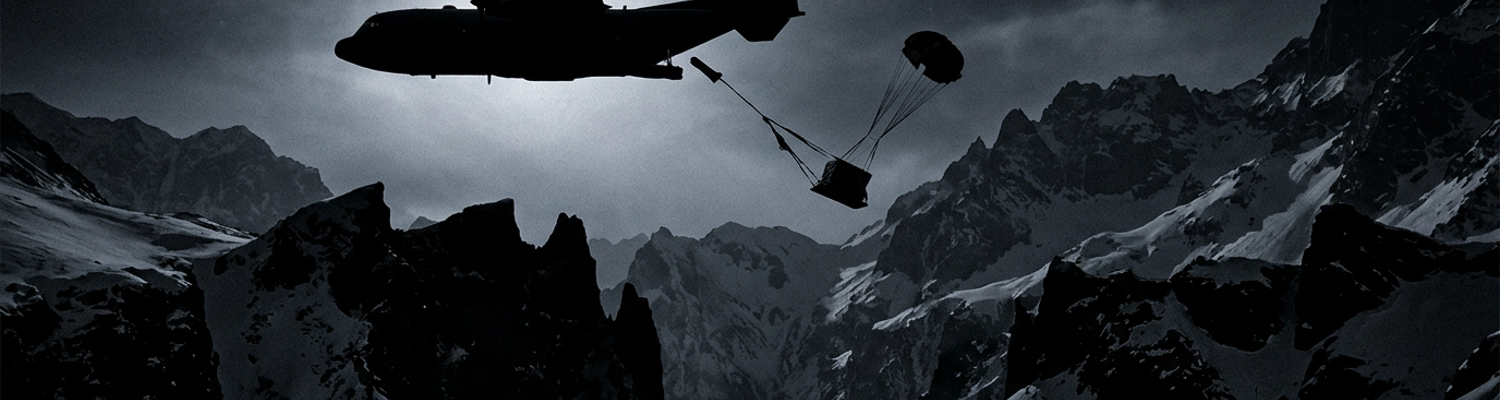
The illumination breakdown over Funchilin Gorge originated in the mechanical failure of Mark 6 aircraft parachute flares. An orbiting Douglas R4D transport from Marine Transport Squadron 152 dropped these flares. The aircraft flew at four thousand feet above the granite shelf of Hill 1081. The crew pushed three hundred-pound magnesium flare casings through the cargo door to light the canyon for incoming strike flights.
The subzero atmosphere at altitude recorded at thirty-eight degrees below zero. This caused the mechanical clockwork time fuzes on the casings to bind.
Static lines tripped the deployment assemblies. The braided cotton suspension cords had frozen solid. This prevented the twenty-foot rayon parachutes from blossoming in the slipstream. The unretarded canisters tumbled unchecked down the vertical rock face. They failed to decelerate and produce their rated one-million-candlepower burn for three minutes at five hundred feet above the gorge floor.
Two candles struck the western cliff wall at terminal velocity. They shattered into non-combusting chemical chunks. The third ignited for four seconds before plunging into a five-hundred-foot snowdrift beside the ruptured concrete foundation of the water-gate bridge. The light extinguished instantly. Pitch-black mountain shadow enveloped the entire gorge and the single road bench supporting the 1st Marine Division vehicle column.
The entire target basin went completely dark in less than five seconds.
A close review of operational logs indicates that this sudden loss of illumination triggered an acute five-minute crisis starting at exactly 0226 hours. Two VMF(N)-513 F4U-5N Corsairs had already tipped into their thirty-degree attack dives from an entry altitude of three thousand five hundred feet. First Lieutenant John E. Vance section-led the flight. Vance had throttled back his Pratt and Whitney R-2800 radial engine to reduce supercharger scream. He armed eight five-inch High Velocity Aircraft Rockets under his wings. He intended to use the expected three-minute flare illumination to align his pipper against Chinese machine-gun emplacements dug into the north shoulder of the bridge abutment.
The flare vanished. His windscreen frame looked out onto absolute blackness. The jagged vertical limits of the canyon rim remained invisible. Cockpit barometric altimeters lagged actual altitude by as much as four hundred feet. These instruments were calibrated for sea-level pressures and warped by subzero mountain drafts. Aborting the dive by pulling straight up carried the danger of striking the sheer three-thousand-foot granite face of Hill 1081 rising directly ahead. Maintaining the attack run meant flying at two hundred and forty knots directly toward unmapped rock outcrops without visual depth perception.
Vance kept his nose down.
Radio logs from the forward air control post at Koto-ri reveal that flight leaders had no choice but to calculate their release points strictly through cockpit instrumentation and elapsed stopwatch seconds. Vance held his dive for four seconds into the void. He watched for the faint red signatures of Chinese Type 24 heavy machine guns firing toward the gorge floor from Hill 891.
At 0229 hours, seventy feet above the estimated terrain elevation, he pickled all eight rockets into the dark defile. He wrenched the stick back into his lap. The Corsair pulled six Gs. Centrifugal force drained blood from the pilot eyes. His wingman followed three seconds behind on the identical descent vector. Second Lieutenant Robert Kelly used Vance exhaust flames as his sole directional reference. Kelly discharged four rounds of twenty-millimeter cannon fire along the eastern bridge slope. Ground observers on the Koto-ri perimeter reported rocket detonations shaking the snow off nearby bunker revetments at 0231 hours. This confirmed direct impacts along the Chinese perimeter without a single Marine aircraft striking the canyon walls.
Dead-Reckoning Mine Delivery Along Chosin Defiles
Strike coordinators inside the Koto-ri perimeter ordered VMF(N)-513 crews to deploy delay-fuzed aerial mines directly into the defile without visual verification. This occurred immediately after the parachute flares failed over the gorge. Captain Donald L. Stiver piloted a twin-engine Grumman F7F-3N Tigercat. He carried four 500-pound Mark 36 aerial mines modified with mechanical impact and long-delay tail assemblies for ground-denial interdiction.
Heavy snow squalls obscured the gorge bed completely below four hundred feet. Standard Marine tactical doctrine required visual alignment on ground marker flares. The sheer canyon walls eliminated any possibility of orbiting at low level to verify terrain features.
Flight crews had to rely exclusively on dead reckoning. They computed release points through compass headings held steady from the Koto-ri perimeter fire-pot marker. They combined this with elapsed seconds measured on mechanical Waltham A-11 cockpit chronographs.
Cockpit windscreens frosted over within three seconds of leveling off above the canyon floor.
Archival evidence shows that the critical five-minute sequence began at exactly 0233 hours. Stiver crossed the northern edge of the Koto-ri defensive perimeter at an indicated airspeed of two hundred and ten knots. He set a compass heading of one hundred and seventy-eight degrees magnetic toward the narrowest slot of the Chosin defiles. Freezing condensation inside the pitot tube caused his airspeed indicator needle to oscillate wildly between one hundred and eighty and two hundred and forty knots. The pilot maintained throttle position purely by engine manifold pressure settings of forty-two inches.
His radar operator in the rear compartment tracked elapsed time on a mechanical dash stopwatch. Master Sergeant Edward Radcliff called out five-second intervals over the interphone net. Forty-seven seconds out from the perimeter marker, Stiver kicked left rudder to account for an estimated twenty-knot crosswind blowing down the gorge axis.
At 0236 hours, twenty-two seconds after crossing the invisible crest of Hill 1081, the pilot pulled the mechanical salvo handle. He released all four delay-fuzed mines into the black void at six hundred feet above ground level.
A three-second calculation error would drop the entire salvo directly onto the retreating column.
Company command reports from the 3rd Battalion, 1st Marines confirm that Chinese infantry had infiltrated within eighty yards of the rearguard defensive line defending the road cut. Two platoons from George Company were pinned inside shallow snow scrapes along the lower rock ledge. They took sustained fire from Chinese 20th Corps listening posts and assault squads established on a reverse-slope terrace.
The falling ordnance struck the packed snowpack along that forward terrace at 0237 hours. This was sixty yards beyond the pinned Marine positions. Detonation of the delay-armed fragmentation casings scattered high-velocity steel shards directly across the Chinese machine-gun outposts. Upward and outward concussive shockwaves expended their energy across three concealed enemy staging points. The reverse-angle rock shoulder shielded the friendly trenches below.
Not a single fragment penetrated the Marine foxhole revetments eighty yards to the north.
Ground observers reported secondary detonations continuing along the defile floor through 0238 hours. The sub-surface delay mechanisms triggered additional fragmentation bursts against Chinese reserve paths. Surviving Chinese squads abandoned their heavy water-cooled Maxim guns. They withdrew two hundred yards up the eastern canyon face. George Company gathered three wounded riflemen. They recovered their field telephone lines. The unit resumed its withdrawal south toward the Funchilin bridge abutment without sustaining additional small-arms fire from the ridge. Maintenance crews at Yonpo subsequently recorded that Stiver port engine experienced complete cylinder failure during the recovery approach. Congealed oil starvation in the rocker-arm housings caused the engine to seize.
Aerial Denial Zones and Hungnam Perimeter Extraction
First Marine Aircraft Wing planners established continuous box-pattern interdiction grids across the four-mile defile between Koto-ri and Chinhung-ni. This blocked Chinese 20th and 26th Corps reinforcements. VMF(N)-513 teamed with night-capable VMA-121 Corsairs and Douglas AD-4 Skyraiders flying from Yonpo and escort carriers offshore. They laid a saturation belt of Mark 77 napalm tanks, 260-pound fragmentation bombs, and delay-fuzed 500-pound general-purpose munitions.
Strike aircraft dropped ordnance directly into the narrow fissures of the gorge. They broke stone shelves and collapsed switchbacks where Chinese infantry columns attempted to flank the single-lane road. Frost-hardened rock surfaces deflected bomb splinters horizontally along ravine bottoms. This maximized the burst area across enemy approach routes.
Ground observers from the 1st Battalion, 1st Marines confirmed that repeated low-level passes cut the three primary pack-mule trails snaking down from Hill 1081. Chinese forward units attempting to cross the cratered ice beds of the Changjin River encountered delayed-detonation bomblets. These erupted under foot traffic every six to twelve minutes throughout the dark hours. Detonations across the permafrost halted Chinese reserve regiments north of the blown bridge site.
The defile became an impassable barrier for Chinese troop movements.
A close review of operational logs indicates that the withdrawal corridor stabilized during a five-minute window between 0341 and 0346 hours on December 9, 1950. An orbiting F4U-5N Corsair piloted by Captain Robert J. Graham picked up automatic weapons flashes along the southern lip of the water-gate gorge at 0341 hours. Two Chinese companies had established an interlocking fire nest forty feet above the temporary Treadway bridge assembly. Graham descended through freezing fog down to three hundred feet terrain clearance. He tipped the Corsair into a forty-five-degree glide path.
Mechanical failure struck at 0343 hours. The cockpit electrical bomb release shorted out from condensation freezing across the master armament solenoid. The pilot depressed the auxiliary mechanical salvo lever. Four five-inch High Velocity Aircraft Rockets and two five-hundred-pound bombs struck the cliff-face bunkers at map coordinate 372-815.
Concussive displacement severed the power cables of three heavy machine guns. It dropped twelve tons of shattered shale over the reverse-slope firing positions. The Corsair cleared the granite face of Hill 891 by twenty-five feet at 0346 hours. Graham leveled off as defensive fire from the ridge ceased completely.
Not a single Chinese weapon fired on the bridge for the next six hours.
This sustained aerial suppression opened the route for over one thousand vehicles and ten thousand soldiers and Marines to cross the four spans of the Treadway M2 bridge. Division engineers from Company D, 1st Engineer Battalion guided ambulances, tank-recovery vehicles, and ammunition trucks past the sheer drop-off at two miles per hour. They took no direct fire from the heights. Strike flights from Marine Aircraft Group 12 maintained overhead stacks at two-thousand-foot intervals. They relayed real-time terrain updates directly to the rearguard commander of the 3rd Battalion, 1st Marines at Chinhung-ni.
The column passed clear of the final defile onto the coastal plain on December 11. They transferred traffic control to the 3rd Infantry Division holding the fortified intermediate line outside Hamhung. Marine controllers directed continuous air cover directly above the road until the final elements passed inside the outer artillery perimeter of the Hungnam enclave at coordinate 412-708.
By 2100 hours on December 11, 1950, the last tactical elements of the division had integrated into the perimeter defense anchored by Task Force Dog.