
Initial Marine Corps Deployments 1965
March 8, 1965. The boots of Battalion Landing Team 3/9 hit the sand at Red Beach 2, north of Da Nang. This was the public face of the American ground war's commencement. Simultaneously, Battalion Landing Team 1/3 arrived by air, securing the Da Nang Air Base. Together, the 3,500 men of the 9th Marine Expeditionary Brigade (MEB) formed a new reality. Pulled from Okinawa, their training was grounded in amphibious assault doctrine, preparing them to take islands, not to hold a static defensive line in a counter-insurgency.
Their initial orders were restrictive. Confined to a tight perimeter around the airbase, they were forbidden from launching offensive search and destroy missions. The strategic calculation in Washington was that a visible American presence would free up Army of the Republic of Vietnam (ARVN) units for offensive operations, stabilizing the region. By May, the 9th MEB was re-designated as the III Marine Amphibious Force (III MAF), and the full headquarters of the 3rd Marine Division arrived to command the I Corps Tactical Zone.
There were no front lines.
The first patrols moving beyond the concertina wire of the Da Nang perimeter found a deceptive landscape of rice paddies, sandy coastline, and small villages. Operational logs from April 1965 (NARA Record Group 127) show sporadic, small-scale contacts. A patrol from 3rd Reconnaissance Battalion made contact near Binh Thai village, nine miles from the base, resulting in one enemy killed and one Marine wounded. The airbase itself remained vulnerable. A Viet Cong sapper attack in July destroyed several aircraft and killed multiple personnel, a clear signal that the perimeter was porous.
The enemy was an invisible force, striking with ambushes before melting back into the population or the terrain itself. Yet the most formidable challenge was not visible at all. As patrols pushed further out, they began to encounter an extensive and sophisticated network of Viet Cong tunnels. These were not the simple spider holes of past conflicts. Archival evidence describes multi-level complexes with reinforced trap doors, command bunkers, and ventilation systems disguised as anthills.
The soil itself was an ally to the enemy. The laterite clay of I Corps, when dried by the sun, became as hard as concrete, making tunnels resistant to collapse from conventional artillery. For a force trained in maneuver warfare, this presented an entirely new tactical problem. An enemy could absorb a barrage from underground, emerge behind an American position, and then vanish. The entrances, often no larger than two by three feet and perfectly camouflaged, were nearly impossible to detect and frequently booby-trapped.
Early attempts to counter this threat were improvised and costly. Lacking doctrine or equipment, Marines used standard explosives, which proved useless against the resilient construction. The first men to enter these complexes were chosen for their small stature, armed with only a pistol and a flashlight. These unsupported forays into the dark represented a lethal learning curve. After-action reports from mid-1965 detail a force struggling to adapt its mindset to an asymmetric battlefield where the enemy controlled the ground from beneath their feet.
Viet Cong Tunnel System Underestimation
Pre-deployment intelligence from Military Assistance Command, Vietnam (MACV) was not blind, but it was myopic. MACV J-2 summaries from late 1964 acknowledged subterranean structures, but framed them as small, isolated caches, a holdover from the French Indochina War. Reports from ARVN field commanders detailing larger systems were frequently dismissed by American advisors as exaggerations. There was no doctrinal appreciation for the possibility of vast, interconnected subterranean networks capable of supporting entire regiments.
Briefings for incoming units like the 3rd Battalion, 3rd Marines, and the 2nd Battalion, 4th Marines, focused on conventional threats and the security of the Da Nang and Chu Lai air bases. The analytical failure was one of imagination. Planners in Saigon envisioned isolated hiding spots, not a parallel underground infrastructure that could render conventional ground-clearing operations obsolete upon arrival.
These were not just tunnels; they were the logistical and strategic backbone of the insurgency in I Corps.
The networks functioned as complete, self-contained operational bases. They were barracks, command-and-control centers, supply depots, and hospitals. A single complex could stretch for miles, with multiple levels descending deep into the earth. This subterranean battlespace allowed Viet Cong units to maneuver undetected, bypass Marine defenses, stage surprise attacks, and then disappear. For an enemy with no airpower, the tunnels negated American technological superiority, allowing them to control territory and dictate the timing of engagements.
The operational surprise for infantry units was total. Patrols from Da Nang in the summer of 1965 reported receiving fire from areas just swept and declared clear. The discovery of the first major tunnel systems during Operation Starlite in August 1965 was a tactical shock for the 7th Marines. On the Van Tuong Peninsula, the 1st Viet Cong Regiment absorbed a massive preliminary bombardment from naval guns and aircraft while safely underground, emerging from camouflaged fighting positions to engage the landing force.
During the six-day battle, Marines from 3/3 and 2/4 found themselves clearing huts and trench lines only to be hit by fire from unseen enemies. The Viet Cong used the interlocking tunnels to reposition, resupply, and re-engage American units from the rear. After the main fighting, Lieutenant General Lewis W. Walt extended the operation for five more days specifically to search for the hidden bunkers. This phase confirmed the shocking extent of the subterranean defenses. The entrances were protected by grenades, punji stakes, and even venomous snakes. The battle resulted in 614 confirmed enemy killed, but for the 45 Marines killed and 203 wounded, it was a brutal education in a new form of warfare.
Specialized Equipment Deficiencies
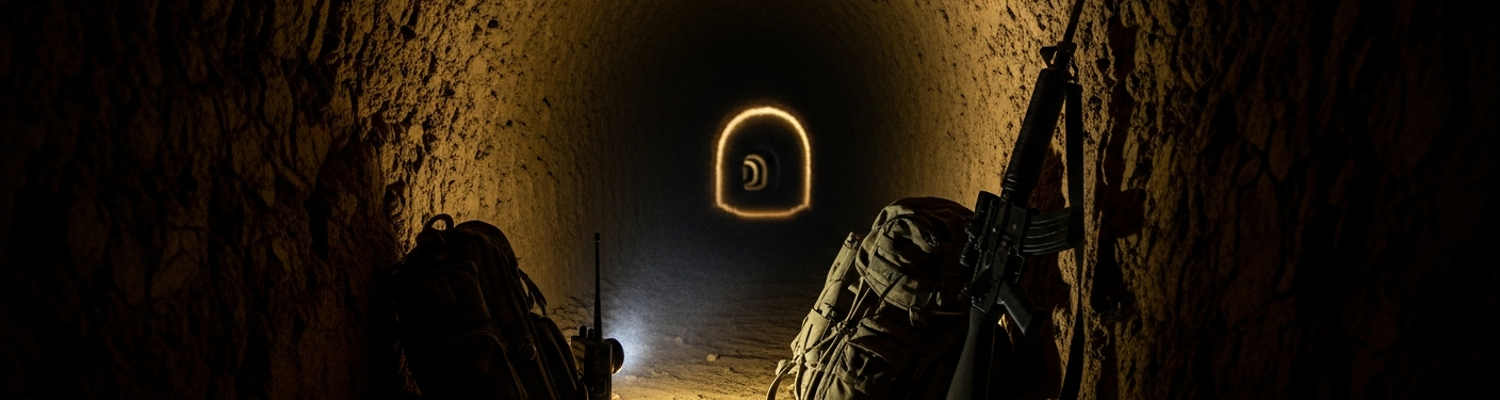
The first men sent into the earth were not specialists. They were simply the smallest infantrymen in the platoon, chosen for their size. Armed with a standard M1911 .45 caliber pistol and a military-issue MX-991/U flashlight, they were sent into darkness.
An examination of III MAF operational logs from mid-1965 shows a force critically unprepared for subterranean combat. The M1911, a powerful sidearm in open combat, was a liability underground. Its deafening report and large muzzle flash in the packed-earth corridors caused temporary blindness and disorientation. The M14 rifle was entirely too long for the narrow, twisting confines. Early attempts to use AN/PRC-25 radios failed; the dense soil blocked their signals, isolating the Marine below. This forced a reliance on paying out a communications wire, which could easily snag or be severed.
Their only tools were a pistol and a flashlight.
The atmosphere inside was a weapon. Viet Cong construction often included U-shaped bends to trap gas and sections with poor ventilation to create oxygen-deficient deathtraps. The air quality degraded rapidly from dust, gunpowder, and smoke. After-action reports from Operation Starlite show Marines exiting tunnels not because of enemy action, but due to dizziness and shortness of breath. There was no dedicated breathing apparatus. The standard M17 gas mask was designed to filter chemical, biological, and radiological agents, not supply oxygen. A Marine wearing an M17 in an oxygen-poor tunnel would still suffocate. While CS gas was used to flush tunnels, this required the clearing team to wear masks, which restricted vision and amplified the sound of their own breathing.
The hard-packed clay of I Corps rendered conventional demolitions ineffective. Engineering units attached to Marine infantry discovered that placing standard Composition C4 demolition blocks at an entrance typically resulted in the blast venting harmlessly back out the opening. The sun-baked earth absorbed the force, leaving the network intact. This prompted urgent requests for specialized charges. Engineer field reports from late 1965 (NARA RG 338) show experimentation with ad-hoc solutions. Bangalore torpedoes were too long to maneuver by hand in confined spaces. Another approach involved pumping acetylene gas and oxygen into a tunnel and igniting it, a slow and dangerous process. The development of effective chemical agents and shaped charges was still months away, leaving infantry to clear tunnels by hand.
Logistical Supply Chain Failures
The paper trail of failure is documented in III MAF requisition logs from the third and fourth quarters of 1965. The discovery of complex tunnel networks during Operation Starlite triggered a cascade of Urgent Operational Needs requests for equipment that did not exist in the standard Marine Corps inventory. The bureaucratic lag between a field request and its fulfillment became a massive tactical problem.
A need identified by a platoon near Da Nang had to be formalized, sent to MACV for approval, forwarded to the Pentagon, and then passed to procurement agencies. This process took months. As a result, the first generation of Marines tasked with clearing tunnels in I Corps fought with what they had, not what they needed. The gear did not arrive in time for the bloody encounters of 1965.
This was a war of improvisation.
Even when specialized items were identified, they arrived in critically insufficient quantities. The logistical pipeline was choked by the conventional demands of the American buildup, pushing niche requirements for tunnel warfare to the bottom of the priority list. An infantry battalion might receive only a handful of suppressed pistols or prototype explosives. This scarcity forced commanders into impossible choices. A limited supply meant only one or two tunnel entrances in a complex could be addressed with the correct equipment, while the rest had to be entered by Marines with the inadequate .45 and a standard flashlight. This rationing of gear directly contributed to higher casualty rates.
The equipment that did arrive was often inappropriate for the environment. The combination of extreme humidity, monsoon rains, and abrasive soil was destructive to hardware. The MX-991/U flashlight shorted out in the dampness. Radios were useless. The most glaring failure was in respiratory equipment. The M17 gas mask offered no protection in an oxygen-deficient environment. A Marine wearing one would still suffocate, a fact that made its use in unventilated passages a lethal gamble. Many tunnel rats chose to enter with no mask at all rather than be encumbered by gear that deadened sound and restricted vision without providing breathable air.
Tactical Delays and Command Reports
The time lag between tactical need and logistical fulfillment is a consistent theme in the III MAF command chronologies for the period. An urgent requirement for suppressed pistols identified by a 7th Marines platoon leader south of Da Nang in August would not see a systemic solution before the year's end. The result was a dangerous and often fatal period of improvisation for units on the ground.
This failure forced company-grade officers into a state of constant, high-risk adaptation. The standard-issue M1911 pistol's muzzle blast in a narrow space would temporarily blind the user. The MX-991/U flashlight required one hand to operate and featured a broad beam that illuminated the Marine holding it as much as the passage ahead. Its batteries, not designed for extreme humidity, corroded and failed without warning. After-action reports from engineer units document the repeated failure of C4 demolitions, forcing them to experiment with dangerous field-expedient methods under the constant threat of ambush.
The documentation of these deficiencies in official command reports served as a grim accounting of the increased risk to individual Marines. The chronologies draw a direct line between the absence of adequate resources and the casualties sustained during tunnel clearing operations. The lack of a suitable breathing apparatus was one of the most glaring failures. This fact, documented in unit medical reports, forced tunnel rats into an impossible choice: enter a tunnel with a mask that restricted vision and hearing without providing breathable air, or enter with no protection at all. Many chose the latter. The scarcity of the few specialized items that did trickle into the supply chain meant they were rationed, directly multiplying the risk of casualties for most of the clearing teams.
Washington's Intractable War Perception
The raw data from the field began its bureaucratic journey. A company commander’s after-action report, detailing the failure of Composition C4 explosives against laterite clay tunnel walls near the An Hoa Basin, would be sanitized and aggregated at each command echelon. Regimental, divisional, and then Corps headquarters would compile these individual reports into summaries. By the time the data reached Secretary of Defense Robert McNamara’s desk, it was no longer a story of individual Marines facing death in a dark tunnel. It was a statistic in a growing list of equipment shortfalls and unmet requisitions.
This aggregation of failures, from the M1911 pistol’s blinding flash to the inability of standard radios to transmit through dense earth, created a grim mosaic for Washington’s analysts.
For McNamara, a man who approached warfare with a belief in statistical management, the reports from I Corps were deeply troubling. The metrics were pointing in the wrong direction. The constant requests for more troops, which President Johnson approved throughout 1965, were not being matched by a proportional degradation of enemy capability. Instead, field reports documented an enemy that could absorb massive bombardment by sheltering in tunnel systems, only to emerge and inflict casualties. This created a perception in the Pentagon that the United States was being drawn into an intractable war of attrition, one where its technological superiority was systematically negated. An internal belief began to form that the war might be militarily unwinnable under the current strategy.
The influence of these field realities on high-level thinking was profound. The documented fact that the hard-packed clay of I Corps could render standard demolitions useless was not just a problem for combat engineers; it became a symbol for the entire conflict. It demonstrated that American industrial might could be defeated by dirt. The reports of Marines suffocating in oxygen-deficient tunnels because their M17 gas masks were designed to filter agents, not supply air, highlighted a fundamental disconnect between available equipment and the operational environment. These failures forced a strategic reckoning, providing powerful evidence to those within the Johnson administration who questioned the efficacy of a purely military solution.
Disengagement Versus Escalation
Inside the White House, the data points from I Corps were weaponized by two opposing factions. The same set of facts produced entirely different conclusions.
On one side were officials like Secretary of Defense Robert McNamara, who viewed the conflict through a quantitative lens. For them, the persistent equipment failures and the high expenditure of resources for limited gains were data points in a failing equation. This perspective empowered a small but vocal group arguing for a managed withdrawal.
Undersecretary of State George Ball became the administration’s most prominent internal dissenter. In a series of memoranda to the President in mid-1965, Ball used the operational difficulties from the field as evidence that the entire strategic undertaking was flawed. He argued that committing hundreds of thousands of American troops would not solve the political instability of South Vietnam. From his perspective, the reports of Marines being unable to secure ground, only to be attacked from the rear by enemies emerging from tunnels, were not tactical problems to be solved with new gear. They were proof of the war’s futility. Ball warned President Johnson that continued escalation would lead to a bloody stalemate that would damage American credibility.
The opposing view, held by the Joint Chiefs of Staff and military commanders like General William Westmoreland, interpreted the same facts differently. For them, the intractability of the Viet Cong was justification for a massive increase in force. The argument was that the initial troop deployments were insufficient for the scale of the task. If Viet Cong forces could survive bombing by hiding in tunnels, the answer was to increase the intensity of the bombing, as was being done in Operation Rolling Thunder. Westmoreland’s strategy was predicated on attrition, believing superior American firepower could inflict casualties at an unsustainable rate for the enemy. Every Viet Cong ambush and every costly tunnel clearing operation was presented as evidence that a more aggressive posture was needed.
In July 1965, McNamara, despite his growing private doubts, recommended a substantial troop increase. President Johnson authorized the deployment of 44 U.S. battalions, escalating the total commitment toward an eventual peak of over 500,000 personnel.