
Operational Mandate of OSS Detachment 101
Archival evidence shows the timeline presented to Allied commanders in the China Burma India theater in early 1942 presented severe tactical disadvantages. Japanese forces had advanced through central Burma rapidly. They crushed the British retreat. They drove Joseph Stilwell out on foot across the mountains to India. They severed the Burma Road in April 1942. Stilwell demanded a counteroffensive capability before the monsoon broke. Planners had roughly six weeks to fabricate an unconventional sabotage unit. They had to deploy it across the Pacific, establish a forward operating base in the Assam jungle, and infiltrate enemy held territory. William Donovan picked Major Carl Eifler to execute the order. Eifler received his marching orders on April 14, 1942. Detachment 101 activated eight days later.
Donovan gave Eifler no established supply chain.
He gave him a strict deadline. Eifler gathered twenty one personnel, boarded the troop transport Hermitage, and set course for Karachi. The clock was running out on northern Burma.
Nazira took shape in an abandoned tea plantation.
A close review of operational logs indicates Eifler structured Detachment 101 as a deep penetration unconventional warfare apparatus. Operating hundreds of miles behind the frontline, their targets were the heavily defended supply nodes feeding Japanese logistics across northern Burma. Eifler set up Camp Danzig inside the Assam border. He secured cargo capacity through the newly established Tenth Air Force. The technical obstacles arrived immediately. Standard military radio transceivers like the SCR-284 proved too heavy and fragile for the sodden jungle canopy. Their vacuum tubes routinely exploded or corroded in eighty percent humidity. Detachment technicians assembled custom water resistant shortwave transceivers operating on low wattage with long wire antennas. By late 1942, Eifler pushed small teams deep into enemy territory via hazardous parachute insertions from C-47s into jungle clearings. They sabotaged railroad tracks, mined supply roads, and collected weather intelligence for Allied bombers.
They built an indigenous intelligence network from scratch.
When examining the historical record, the detachment reached high operational effectiveness through its integration with the indigenous Kachin populations. Known locally as the Jinghpaw and organized militarily as the Kachin Rangers, these highland fighters harbored deep hostility toward the Japanese forces occupying their homelands. American handlers supplied the Kachins with M1 carbines, submachine guns, British Bren light machine guns, plastic explosives, and United States silver coins. The tactical objective centered on the Japanese 18th Division. This was the veteran formation of the 1941 Malayan Campaign and the fall of Singapore, commanded by Lieutenant General Shinichi Tanaka. Headquartered around Kamaing and fighting Stilwell advancing Chinese divisions down the Hukawng Valley, the 18th Division depended on a single supply route running between Kamaing and Mogaung.
Kachin Rangers operated in squads of five to fifteen men.
They ambushed Japanese courier columns. They spiked single lane dirt roads with bamboo punji sticks. They placed pressure detonated M1A1 anti tank mines along gravel paths used by Japanese motorized supply units. In one coordinated action along the Tanai River, Kachin reconnaissance teams pinpointed an entire battalion depot of the 18th Division. They radioed coordinates back to Nazira through hand cranked generators. They watched Tenth Air Force B-25 Mitchell bombers destroy the fuel dump and ammunition stores within forty minutes. They tracked Japanese patrol movements with high precision. They reported battalion headquarters locations within Japanese 56th Regiment sectors. They slipped back into the ridgelines before Japanese artillery could zero in on their firing positions. By early 1944, over five thousand Kachin Rangers were operational behind Tanaka lines. They tied down entire Japanese infantry battalions merely to protect their telephone cables, footpaths, and river transport barges.
Tactical Siege of the Nhpum Ga Ridge
Archival evidence shows the tactical posture of the 5307th Composite Unit Provisional broke apart under sudden pressure by March 28, 1944. Lieutenant Colonel George A. McGee Jr. established the 2nd Battalion atop the 2,800 foot ridge at Nhpum Ga. He intended to block Japanese approaches toward the Hukawng Valley. Elements of the Japanese 18th Division moved faster than Allied reconnaissance anticipated. Two battalions of the Japanese 114th Infantry Regiment slipped through dense jungle tracks along the Tanja River. They severed the single trail running four miles north to Hsamshingyang. By March 30, Japanese infantry had closed the ring around McGee perimeter. They trapped roughly six hundred American soldiers and hundreds of pack mules on an exposed oval hilltop measuring barely four hundred yards long by two hundred yards wide.
Mule carcasses piled up along the foxhole lines within forty eight hours.
Japanese gunners wheeled Type 41 75mm mountain pack guns onto higher adjoining spurs. They began systematic direct fire barrages against American foxholes dug into brittle shale. A continuous barrage of 81mm mortar rounds tore through the splintering teak canopy. This sent wooden shards down into open slit trenches. The primary water source fell directly beneath cross locking Japanese Type 92 heavy machine gun fire. This water seep was situated three hundred yards down a ravine on the eastern slope. American riflemen crawling down with canteens took heavy casualties. Colonel Frank Merrill suffered a second heart attack on March 29. He passed tactical command of the 5307th to Lieutenant Colonel Charles N. Hunter. Hunter relief columns from the 1st and 3rd Battalions stalled against entrenched Japanese roadblocks south of Hsamshingyang.
Thirst incapacitated entire machine gun squads by April 2.
A close review of operational logs indicates the encirclement would have collapsed entirely without the irregular screen lines maintained by OSS Detachment 101. Operating far beyond the static lines of the 5307th, Detachment 101 field teams led by Captain William Wilkinson deployed five hundred indigenous Kachin Rangers into the deep jungle surrounding Nhpum Ga. These guerrilla scouts formed an early warning buffer across a ten mile arc. They patrolled flanking trails that connected the Tanai River basin to the main siege perimeter. Japanese scouting parties attempted to outflank Hunter relief force at Hsamshingyang. Kachin riflemen armed with suppressed M3 submachine guns and M1 carbines ambushed the lead squads. They stripped Japanese officers of map cases. They transmitted precise Japanese battalion coordinates back to Allied air liaison officers.
Dense jungle canopy blocked all line of sight observation from the air.
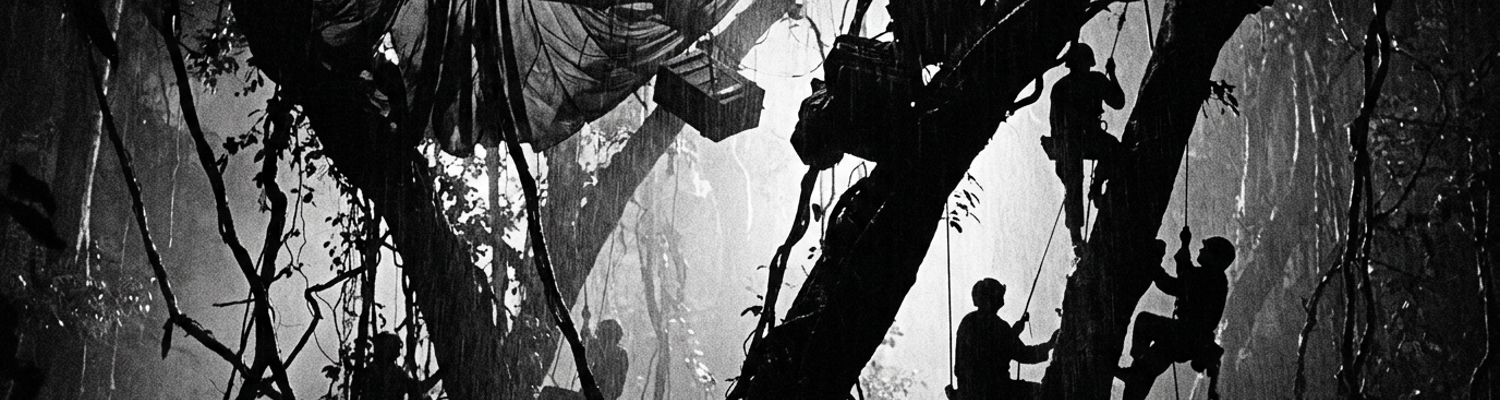
When examining the historical record of field improvised drop zones, Detachment 101 personnel systematically resolved the supply failure that threatened to starve McGee ridge. Flying without visual reference over dense foliage, Tenth Air Force C-47 Skytrains from the 2nd Troop Carrier Squadron could not identify individual American defensive positions without drawing concentrated ground fire. Detachment 101 scouts moved along jungle ravines. They felled giant bamboo with machetes to clear fifty yard drop zones hidden from Japanese observation posts. Rangers laid orange fluorescent fabric strips on river gravel bars. They burned damp teak leaves in rusted gasoline drums to produce controlled pillars of gray smoke. Heavy airdrop canisters containing plasma, .30-06 belted ammunition, and five gallon water cans hung up eighty feet high in ironwood trees. Kachin scouts scaled the trunks using hand tied vine stirrups to recover the cargo under sniper fire.
Two supply canisters crashed directly through McGee command dugout at 1415 on April 3.
Prewar Rigging Standards and Environmental Vulnerability
When examining the historical record, Allied supply failures during the opening stages of the Nhpum Ga airlift originated directly in peacetime bureaucracy. The supply officers of OSS Detachment 101 inherited aerial delivery protocols formalized in 1940 by the War Department at the Holabird Quartermaster Depot. These peacetime specifications relied exclusively on flight tests conducted across the temperate farmlands of Virginia. The standardized A-4 aerial delivery container and the 24 foot G-1 cargo parachute system relied on flight tables calculated for level drop corridors over flat terrain. Planners in Washington calibrated drop speeds and rip cord static line lengths under the assumption of twenty percent ambient humidity. Field units arriving in Assam found themselves bound to training manuals that treated supply drops as controlled warehouse transfers executed at four hundred feet.
Canvas stitching dissolved within forty eight hours inside Assam packing sheds.
Archival evidence shows the physical chemistry of prewar parachute materials collapsed when introduced to the northern Burma borderlands. Standard issue G-1 cargo parachutes distributed to the Nazira supply base were fabricated from continuous filament cellulosic rayon. Nylon was reserved exclusively for personnel canopies. Rayon suspension lines possessed a dry breaking strength of roughly three hundred and seventy five pounds per strand. Ambient relative humidity surged above ninety percent in the mountain passes leading to Nhpum Ga. The molecular structure of the cellulose absorbed atmospheric moisture directly into the weave. Saturated rayon lost between thirty and forty five percent of its baseline tensile capacity. Douglas C-47 transports from the 2nd Troop Carrier Squadron throttled down over the razorback ridge at 130 knots. Pilots fought violent thermal updrafts rising out of the Tanja River canyon.
Thermal shear pitched the cargo planes sideways over the drop circle.
A close review of operational logs indicates this turbulence induced severe pendulum like oscillation the instant the parachutes deployed into the prop wash. Cargo containers fell away from the cabin doors. Opening shocks hammered the dampened rayon lines with dynamic loads exceeding six Gs. The weakened shroud lines snapped in rapid sequence under tension. Canopies tore along radial seams or turned inside out. They failed to arrest the downward velocity of three hundred pound metal cylinders packed with 81mm mortar ammunition and blood plasma. Unchecked cargo crashed through the jungle canopy at two hundred feet per second. This destroyed the contents on impact or buried the steel cannisters deep in the river mud below McGee perimeter.
Untreated cotton duck webbing suffered an identical mechanical breakdown.
Rigging specifications dating back to 1940 mandated that detachment quartermasters secure freight containers using heavy duty Type VIII unbleached cotton harnesses. These were laced through plain cadmium plated steel friction buckles. Airborne spores of mold and mildew colonized the untreated organic fibers within days of crates arriving by train from Calcutta. Fungal enzymes broke down the cotton fibers. They stripped the webbing of its structural integrity before riggers at Nazira even threaded the straps through the metal D-rings. Airdrop crews kicked lashed bundles of K-rations and five gallon water cans into the slipstream over Nhpum Ga on April 1, 1944. The corner seams of the canvas harnesses ruptured across the rivet lines. Crates burst apart in mid air. This showered tin cans and broken wooden slats across three miles of inaccessible Japanese occupied ravines.
Signal Intelligence Operations and Radio Deterioration
Signal intercept teams in the Tanai River valley fought physical hardware failure before they ever decoded an enemy transmission.
Archival evidence shows northern Burma ambient humidity destroyed the internal circuitry of standard SCR-284 transceivers within seventy two hours of uncrating. Detachment 101 signal specialists stationed along the jungle perimeter near Hsamshingyang found moisture seeping past vulcanized rubber gaskets directly into the BC-654 receiver transmitter chassis. Airborne fungal spores settled on the phenolic octal bases of vacuum tubes. Green copper oxide corrosion encrusted the eight nickel plated connection pins on 1N5 and 1A7 tubes. This disrupted low voltage filament circuits and broke ground contacts. Sockets molded from early Bakelite cracked under expanding fungal colonies. This shorted the high voltage plate leads to the aluminum chassis. Humidity condensed across the interleaved aluminum rotor and stator plates inside the variable tuning capacitor assemblies. This water film altered the air dielectric constant. It sent oscillator frequencies drifting wildly across the 3.8 to 5.8 megacycle band. Salt deposits from soldier sweat accelerated the mechanical breakdown of the transmitter 307A power output tube. Its fragile filament snapped during high drain keying sequences. Operators turned the manual tuning dials. Micro arcs skipped across the narrowed air gaps between warped plates. This scorched the tuning coils and immediately disabled forward communications.
Technicians scraped tube pins with bayonet points to restore signal reception.
When examining the historical record of signal intelligence operations around Nhpum Ga, Detachment 101 intercept operators faced complete tactical blindness whenever their direct current power supplies decayed. Field teams operated specialized listening sets to eavesdrop on localized amplitude modulated voice traffic and continuous wave transmissions generated by the Japanese 114th Infantry Regiment. Monitoring these short range tactical networks demanded uninterrupted clean electrical current. Hand cranked GN-45 generators produced mechanical noise and jagged voltage spikes that washed out faint Japanese signals. Pristine BA-48 and BA-38 dry cell battery packs became an absolute operational necessity. Tropical heat accelerated internal chemical reactions inside these multi cell packs. This boiled the ammonium chloride paste electrolyte against the thin zinc outer casings. The 1.5 volt filament cells ruptured first. They coated the canvas carrying bags in alkaline sludge. Corrosive paste leaked outward. It ate paper separators and caused catastrophic internal short circuits before supply drops even left the cargo bays at Dinjan. Without a stable ninety volt plate supply, receiver sensitivity collapsed. This drowned out the localized communications of Japanese mortar spotters.
A fifteen millivolt drop in filament supply killed the listening post completely.
A close review of operational logs indicates monitoring Japanese assault timing required batteries kept dry inside sealed lead foil linings. Japanese company commanders directing artillery spotters against McGee defensive perimeter transmitted brief low wattage mortar fire coordinates over Type 94 tactical field radios from forward observation posts along the Tanja River. Detachment 101 monitors lacked fresh dry cells. The weak receiver filaments failed to pick up these localized Japanese signals from the surrounding bamboo thickets. American intercept specialists could not warn the 2nd Battalion about incoming Type 41 75mm mountain gun barrages or flanking maneuvers moving down the eastern ravine toward the water point. Signal personnel at Hsamshingyang prioritized battery requests over rifle ammunition on incoming C-47 manifests. Signal crews opened twelve dropped battery crates in succession on April 2. They found eleven waterlogged and ruined by internal acid leakage.
The final functional battery pack carried sixty hours of operating life.
Aerial Supply Insertions in the Teak Forest
Archival evidence shows flight crews of the 2nd Troop Carrier Squadron encountered extreme atmospheric disturbances the moment their twin engine Douglas C-47 Skytrains crossed the Patkai Range into the Hukawng Valley. Midday solar radiation heated the damp valley floor. This generated vertical convection currents that slammed into the transports as they descended toward tree level. Flight leaders brought their aircraft down to an altitude of one hundred and fifty feet above the jungle cover. They attempted to compress the drop trajectory over McGee tight perimeter. At airspeeds throttled back to one hundred and ten miles per hour, pilot controls went soft in the turbulent air. Updrafts surging out of the Tanja River gorge repeatedly lifted twenty six thousand pound airframes fifty feet in a fraction of a second. This was followed immediately by severe sinking downdrafts that pushed wings within yards of the upper branches. Pratt & Whitney R-1830-92 radial engines strained as flight crews applied full throttle bursts to prevent low altitude stalls. Kickers braced inside the open cargo doors.
Flight controls shuddered violently against the pilots hands.
A close review of operational logs indicates the physical geometry of the Nhpum Ga ridgeline turned low level cargo delivery into an extreme mechanical hazard. Pilots flew blind runs along narrow approach corridors bounded by rising terrain on three sides. The Japanese 114th Infantry Regiment maintained overlapping machine gun positions on surrounding peaks. Incoming transports could not circle or make gradual approaches. Drop crews pushed bundles out by hand while standing on ribbed metal floors slick with leaked hydraulic fluid and engine oil. The sudden center of gravity shifts caused by ejecting six heavy containers in three seconds forced copilots to rapidly re trim the elevators. Sudden thermal air pockets dropped the aircraft suddenly just as static lines snapped taut against the overhead anchor cables during multiple instances on April 3. These violent jolts buckled fuselage ribs. They ripped cargo tie down rings out of the cabin walls. They left kickers clinging to structural bulkheads to avoid being thrown out through the unlatched doorways.
Six tons of metal plummeted toward the trees.
When examining the historical record, severe cargo drift turned every supply run into a high rate loss event over the drop zone. Upward thermal drafts rising along the steep slopes caught the twenty four foot canopies the instant they deployed beneath the fuselage slipstream. Containers drifted hundreds of yards off course into primary teak canopies exceeding sixty feet in height instead of dropping vertically into McGee four hundred yard clearing. Thick interlocking branches of virgin teak trees intercepted the descending bundles before the parachutes could collapse. Three hundred pound steel containers packed with water, dry plasma, and .30-caliber ammunition hung suspended fifty to seventy feet in the air. They wedged firmly into the high branch forks. Suspension cords wrapped around dense hardwood limbs. This locked the payloads far out of reach from the forest floor. Ground troops caught inside the perimeter watched whole supply runs dangle uselessly overhead while Japanese snipers zeroed their sights on the bright cloth canopies.
Rifle companies starved beneath full water containers.
Recovery parties from the 5307th Composite Unit paid a severe price attempting to retrieve the suspended cargo. Detachment 101 Kachin scouts used handmade vine loops and climbing spikes to scale the massive teak trunks. They hauled heavy ropes up through the lower branches under constant sniper fire from Japanese positions across the ravine. Cutting the suspension lines dropped the heavy metal cylinders sixty feet straight down. This frequently burst the internal water cans or crushed soldiers waiting below. Recovery teams retrieved less than thirty five percent of the dropped containers intact during the supply runs flown between April 1 and April 5, 1944. Japanese 75mm artillery crews systematically targeted trees displaying tangled parachutes. They fired shrapnel shells directly into the high branches to kill the climbing scouts. Three consecutive container bundles dropped by the lead transport vanished into an untouched teak stand four hundred yards outside the defensive wire at 1640 on April 4.
The Five-Minute Static Line Crisis
Archival evidence shows the tactical crisis crystallized at 1512 hours on April 4, 1944. This occurred inside Lieutenant Colonel George A. McGee defensive perimeter at Nhpum Ga. Dug into brittle shale on the 2,800 foot ridge, signal operators monitored the final minutes of their only operational radio power source. The battalion command post depended on a single SCR-284 radio set. This radio maintained the operational link with the relief column at Hsamshingyang and the air liaison teams of the Tenth Air Force. Direct current meters mounted on the BC-654 transmitter chassis registered a steady voltage drop. The needle on the Weston gauge dipped below 1.1 volts across the primary filament lines. This destabilized the master oscillator. It degraded carrier wave strength. Outside the perimeter, infantrymen from the Japanese 114th Infantry Regiment launched aggressive reconnaissance probes against the southern rifle pits. They deployed Type 89 grenade dischargers to test defensive fire patterns.
Static hiss rapidly overwhelmed the battalion command network.
A close review of operational logs indicates terminal battery exhaustion posed an immediate threat of frontline signal silence. Tropical heat and high humidity had accelerated internal chemical decomposition inside the multi cell dry batteries. This caused the ammonium chloride paste to boil and expand against the zinc casings. The 1.5 volt A-battery circuit decayed to 0.8 volts under continuous operational draw. This circuit was tasked with heating the filaments of the 1N5 and 1A7 receiver tubes. Once plate voltage sank below seventy volts, the BC-654 receiver lost sensitivity to weak amplitude modulated signals coming across the mountain passes. McGee possessed zero field telephone lines to the outside world. He had lost landlines on the first day of the encirclement. Total radio failure meant losing the ability to direct defensive barrages from 75mm pack howitzers positioned four miles north at Hsamshingyang. Forward air controllers could not vector incoming P-51 Mustang dive bombers against Japanese mortar spotters positioned along the Tanja River without outbound Morse traffic. Japanese assault squads pushed steadily through the bamboo thickets. They advanced within thirty yards of the American wire.
Every defensive sector faced complete electronic isolation within minutes.
When examining the historical record, aerial relief appeared at 1514. A Douglas C-47 Skytrain from the 2nd Troop Carrier Squadron approached the ridgeline at an altitude of one hundred and fifty feet. Flight crew kickers shoved an emergency wooden crate packed with fresh BA-48 battery sets through the cargo door into the slipstream. A mechanical failure struck the drop mechanism at the fuselage threshold. The cadmium plated steel static line shackle bound against a metal burr on the guide rail. It twisted forty five degrees inside the anchor shackle housing. This friction distorted the deployment vector. It prevented the static line from cleanly peeling the deployment bag away from the packed cargo canopy. The twenty four foot rayon parachute opened two seconds late and fifty yards downwind. This was well outside the planned drop clearing. The descending bundle drifted horizontally on thermal updrafts rising out of the eastern ravine instead of descending into the battalion redoubt. Heavy rayon suspension lines tangled directly into the high branches of an eighty foot teak tree. This left the heavy battery crate suspended sixty five feet above the ground.
The suspended battery pack hung immobilized between American foxholes and Japanese rifle squads.
Archival evidence shows recovering the crate required an immediate infantry action under observed fire. Detachment 101 Kachin scout Zing Htung Naw sprinted forty yards into the dead zone along the eastern slope at 1516. He carried climbing spurs and a recovery rope. Japanese riflemen from the 114th Infantry Regiment opened direct small arms fire from concealed positions across the gully. They struck the teak bark around him as he climbed the trunk. Working sixty feet above the ground with Japanese light machine gun rounds striking the foliage, the scout severed the fouled static webbing with a combat knife. The supply container plunged through the lower brush at 1517. It landed fifteen feet behind the forward rifle pits. Battalion signal personnel hauled the cracked wooden crate into McGee dugout. They swapped the corroded wiring leads onto a fresh BA-48 power pack. They restored Morse communication on 4,800 kilocycles as Japanese mortar fire struck the forward revetments.
Canopy Rigging Recovery Under Japanese Fire
Five minutes separated the stranded battery crate from the advancing Japanese patrol.
Archival evidence shows an eight man reconnaissance patrol from the Japanese 114th Infantry Regiment broke into the ravine forty yards east of McGee perimeter wire at 1513. Armed with Type 38 carbines and a Type 96 light machine gun, the Japanese riflemen moved uphill through dense dwarf bamboo toward the base of the teak tree. Detachment 101 operative Zing Htung Naw had to clear the open ground, scale sixty feet of vertical trunk, and drop the cargo before the patrol reached the base clearing. Field logs indicate McGee perimeter riflemen could not lay down suppressive fire without exposing their own revetments to Japanese Type 41 mountain guns zeroed on the tree line. Naw left his M1 carbine at the perimeter parapet to reduce climbing weight. He carried only climbing irons strapped to his canvas boots and a heavy steel bladed rigging knife in his belt scabbard. He reached the trunk base at 1514 as Japanese lead scouts entered the clearing seventy feet below him.
Sixty feet of branchless hardwood offered zero physical cover from ground fire.
When examining the historical record, the physical properties of mature Tectona grandis presented severe mechanical obstacles to an unassisted ascent. The trunk measured four feet in diameter at the base. Its dense outer bark was slick with afternoon humidity and moss growth. Naw drove wrought iron climbing spurs into the fibrous wood. He hauled his body weight upward through three foot vertical lunges while gripping rough fissures in the bark. Japanese riflemen spotted his movement through the canopy break at 1515. They opened direct small arms fire from forty yards down the slope. High velocity 6.5mm rounds struck the outer sapwood. This threw splinters across Naw face and arms. One round punched directly through the loose canvas of his left trouser leg without striking bone. The Japanese light machine gunner set his bipod on an exposed mud shelf. Naw swung around to the blind side of the trunk. He used the thirty inch tree core to absorb repeated rifle strikes while continuing his upward ascent toward the cargo harness.
The Japanese squad closed within twenty yards of the root base by 1516.
A close review of operational logs indicates the crate hung locked in a crotch formed by three lateral teak branches sixty five feet above the ravine floor. The cadmium plated D-rings of the Type VIII cotton suspension harness had jammed into a deep cleft. This wedged the three hundred pound crate against the bark so tightly that manual release levers could not open. Japanese machine gun fire shredded the upper foliage. It clipped leaves and secondary branches directly over the rigger head. Naw braced both climbing spurs into the main fork. He locked his left arm around a lateral limb. He drew the curved blade rigging knife from his belt. He drove the serrated blade across the tensioned multi ply cotton webbing instead of attempting to unthread the jammed steel buckles. Saturated canvas fibers resisted the initial cuts until heavy downward strain caused the severed strands to fray outward under tension. Naw made three rapid diagonal slashes across the main riser straps. He severed the final load bearing webbing at 1517. The wooden crate dropped clean through the lower branches. It crashed directly into the brush twenty feet behind McGee forward foxholes. Two soldiers from the 5307th Composite Unit dragged the batteries into the command redoubt.
Tactical Reconnection and Post-Mission Doctrinal Shifts
Solder paste smoked inside the battalion command trench at 1518.
Archival evidence shows signal technicians immediately ripped open the wooden packing slats. They stripped lead foil to expose the functional BA-48 battery cells. Clamping insulated copper alligator leads directly onto the terminal posts of the BC-654 transceiver, the operators watched the direct current Weston gauge needle surge back to 1.45 volts across the low voltage filament lines. Receiver hiss cut out clean. This restored stable signal reception across the 3.8 to 5.8 megacycle band. Radio operator Corporal Roy Miller grounded the long wire antenna. He tapped the telegraph key. He locked onto the 4,800 kilocycle emergency channel connecting Nhpum Ga to the 5307th Composite Unit base at Hsamshingyang. Japanese shock troops from the 114th Infantry Regiment had advanced within thirty yards of McGee southern foxholes. They prepared to breach the wire along the Tanja River ravine. McGee snatched the hand microphone. He called in defensive fire coordinates directly onto his own forward parapets. Battery A of the 99th Field Artillery Battalion answered within ninety seconds. They fired four M1A1 75mm pack howitzers from Hsamshingyang. High explosive shells armed with quick acting point detonating fuses slammed into the narrow approach corridor. Shrapnel swept the ravine floor. It detonated Japanese knee mortar ammunition satchels and tore through the dense dwarf bamboo. Over eighty Japanese soldiers fell in twelve minutes. This broke the infantry charge and sent the surviving elements scrambling down the rocky stream bed.
The southern wire held.
When examining the historical record of the Nhpum Ga perimeter, the disastrous supply recovery rate between April 1 and April 5 triggered an operational reckoning at the Nazira base. Quartermasters counted a seventy percent cargo loss across eighty transport sorties. They traced the catastrophic failures to peacetime War Department packaging specifications. Cellulosic rayon suspension lines on standard G-1 cargo parachutes had saturated in the ninety eight percent jungle humidity. This dropped line tensile strength from 375 pounds to less than one hundred and eighty pounds. Opening shocks of six Gs snapped the softened fibers the moment cargo bundles cleared the C-47 doorways. Untreated cotton harness webbing succumbed to airborne fungal enzymes within hours of uncrating in Assam. It tore straight through cadmium plated friction buckles at drop speeds of one hundred and ten miles per hour. Ruptured battery casings, soaked dry cells, and shattered plasma bottles littered the inaccessible ravine bottoms. Major Carl Eifler halted all unvetted packaging shipments to forward sectors. He ordered detachment supply officers to re engineer aerial delivery equipment inside an abandoned tea drying shed at Nazira.
A close review of operational logs indicates detachment personnel dismantled condemned personnel parachutes to scavenge braided nylon suspension cords. Riggers replaced continuous filament rayon with Type III synthetic nylon cordage. This nylon possessed a dry breaking strength of five hundred and fifty pounds. It had an elasticity factor of thirty percent. It had complete immunity to water absorption and fungal decay. Canvas tie downs gave way to heavy gauge nylon webbing treated with copper naphthenate to prevent microbial rot under continuous jungle dampness. Technicians discarded plain pine packing crates to shield dry batteries and radio vacuum tubes from atmospheric moisture. Workers wrapped electrical components in multi ply asphalt laminated kraft paper. They slipped them inside heat sealed rubberized fabric envelopes made from cut up rain ponchos. The Quartermaster Corps and the Tenth Air Force formalized these field innovations into standardized aerial delivery doctrine across the China Burma India theater. Revised technical orders out of the Calcutta air depot mandated synthetic nylon suspension harnesses and waterproof asphalt barrier liners for all aerial resupply missions drop bound for northern Burma.
A single C-47 drop test over Ledo on June 12, 1944, recorded zero parachute structural ruptures across fifty consecutive containers.