
Operational Directives for Rabaul Containment
At 0640 hours on November 1, 1943, primary high-frequency radio transmissions failed completely. This severed frontline landing teams of the 3rd Marine Division from theater headquarters during the initial shoaling run into Cape Torokina. When examining the historical record of Operation Cartwheel, this communications blackout exposed the extreme isolation demanded by the Combined Chiefs of Staff directives. Allied planners finalized these orders at the Quebec Conference two months earlier. They formally rejected an amphibious storming of Fortress Rabaul.
Calculations indicated a direct assault on the Gazelle Peninsula would consume five combat divisions.
Hundreds of assault craft would face 97,000 entrenched Japanese troops. Six airfields supported the defenders. Joint command directives substituted frontal combat with systemic starvation. General Douglas MacArthur and Admiral William Halsey received orders to encircle the base. They needed to seize flanking positions across the Solomon Sea. Simpson Harbour required neutralization through relentless bombardment. Bougainville formed the outer ring of this perimeter.
Bypassing Rabaul left the Japanese fortress intact.
Four operational airstrips and thirty heavy naval berths remained fully active. Rear Admiral Frederick C. Sherman received operational orders to shield the assault forces at Empress Augusta Bay. These directives drove Task Force 38 into the hazardous littoral shelf off the western coast of Bougainville. Archival evidence shows that operating the fleet carrier USS Saratoga and the light carrier USS Princeton in these restricted waters violated standard carrier doctrine. Doctrine required hundred-mile oceanic buffers. Commanders needed this space to maneuver into the wind.
Confined between shallow shoals and uncharted volcanic reefs at latitude 6 degrees 15 minutes South, the task group possessed almost no sea room.
Flight operations became highly restricted. Destroyer Division 99 escorts ran active sonar sweeps along narrow bathymetric contours. Steam plants burned heavy fuel oil at punitive rates. Saratoga depleted her fuel bunkers down to 35 percent within seventy-two hours. Saltwater contamination inside forward bunker valves caused severe mechanical issues (Bureau of Ships Radio Log 44-A). Soot choked the boiler fires. Engineers scrubbed fuel oil heaters by hand while underway. They performed this maintenance under continuous combat air patrol conditions.
A close review of operational logs indicates the extreme tactical danger locking Sherman into these coastal waters.
Vice Admiral Takeo Kurita arrived at Simpson Harbour from Truk on November 4. He brought seven heavy cruisers. Atago, Takao, Maya, Chokai, Suzuya, Mogami, and Chikuma formed the strike group. Their specific objective involved sweeping south down the Bougainville coastline. They intended to pulverize the unprotected transport anchorage off Torokina. Land-based Allied air units at Munda and Guadalcanal lacked the range to break these warships. Halsey ordered Sherman to launch an immediate full-deck strike on November 5.
Ninety-seven aircraft launched from Saratoga and Princeton.
They flew directly into concentrated antiaircraft fire over Rabaul. Torpedo Squadron 12 and Bombing Squadron 12 damaged four heavy cruisers. Maya suffered a cracked engine room. Takao took a punctured hull. This aborted the Japanese counterattack against the Marine beachhead. Sustained strikes continued on November 11. Aviation gasoline consumption reached 21,000 gallons per hour. Munitions handlers hoisted 1,000-pound general-purpose bombs from wet magazine spaces. They lacked mechanized hoists. Sherman retired toward Espiritu Santo with dry aviation fuel bunkers. Boiler reserves hovered under twenty percent capacity.
Navigational Hazards in Blanche Channel
Bathymetric data available to Rear Admiral Frederick C. Sherman came from outdated 1914 British Admiralty charts. These documents relied on nineteenth-century German commercial soundings (Admiralty Chart Series 1914-B). Blanche Channel stretched between the southern coast of New Georgia and the barrier islands of Rendova. It presented a maze of steep coral pinnacles. Limestone structures rose vertically from depths exceeding two hundred fathoms. Peaks stopped less than eighteen feet below the surface.
Lead-line surveys and early fathometers failed to detect these hazards.
A ship had to pass directly overhead to register the depth. Displacing 43,500 tons fully loaded, USS Saratoga drew thirty-two feet of water. Her turning radius exceeded one thousand yards at standard speeds. Deep draft left barely two to six feet of clearance over submerged coral heads. Mid-tide channels near the Montgomery Island shallows offered minimal safety margins. Combat Information Center plotters tracked chart corrections radioed from local scout craft.
Watch officers stationed lookouts on the forward catwalks.
These men wore polarized filters to spot water discoloration. Color shifts indicated submerged coral shelves. Shoals shrank usable operating boxes from standard forty-mile ocean sweeps down to ribbons of clear water. Some passages measured less than two miles wide. This severely restricted the carrier force from turning into prevailing southeasterly trades. Launch and recovery cycles suffered constant delays.
When examining the historical record, operating inside these narrow passages broke basic fleet anti-submarine doctrine.
United States Navy tactical doctrine mandated the execution of Zigzag Plan No. 6. Plan No. 10 also applied whenever capital ships operated within range of enemy submarines. These protocols required automated periodic course shifts. Helmsmen turned twenty to forty-five degrees off the base track every five to twelve minutes. Blanche Channel denied Sherman the sea room necessary to complete these lateral excursions. The deep-water trench narrowed to twelve hundred yards. Fringing reefs off Rendova bordered one side. Barrier reefs off Munda Bar bordered the other.
Executing a standard thirty-degree turn to starboard displaced the hull eight hundred yards laterally within ninety seconds.
This thrust the carrier directly toward uncharted coral shoals. Captain John H. Cassady ordered the rudder locked on dead-straight courses through the narrows. Defensive zigzagging ceased entirely. Japanese submarine I-181 patrolled the approaches during this period. Destroyers USS Lardner and USS Farenholt held station less than five hundred yards ahead of Saratoga. They pinged with QC sonar gear. Reverberations and false echoes flooded the receivers. Sound bounced off the submerged vertical limestone walls. Acoustic torpedo detection became impossible.
Archival evidence shows that danger multiplied during high-speed nocturnal runs through the channel.
Japanese land-based G4M Betty torpedo bombers operated from Kahili and Ballale. These threats forced Sherman to conduct transits between 2200 and 0400 hours. Sustained speeds reached twenty-seven knots. Steaming through confined coastal channels at this velocity in complete darkness introduced severe grounding risks. Early SG surface-search radars suffered land clutter. Five-thousand-foot volcanic peaks on Rendova generated heavy radar shadows.
Phantom coastal returns masked true shoreline boundaries.
Navigators could not ping active sonar without alerting enemy shore listening posts. Watch standers depended on dead reckoning. They monitored engine revolution counters and intermittent visual sightings of darkened headlands. Saratoga covered one nautical mile every one hundred and thirty-three seconds. A rudder failure would run the carrier aground at high speed. Steering casualties in the hydraulic telemotor lines carried the same risk. A five-degree navigation error meant striking volcanic basalt. This would tear open double bottoms and flood forward machinery rooms.
At 0215 hours on November 2, Princeton narrowly avoided the shoal waters off the southern spit of Rendova.
Port propeller blades picked up turbulence from coral heads. Six feet of water separated the keel from the reef. The carrier executed an emergency fifteen-degree turn to sea. All eight Babcock and Wilcox boilers maintained maximum steam pressure during the maneuver.
Fueling at Sea Mechanics and Equipment Failures
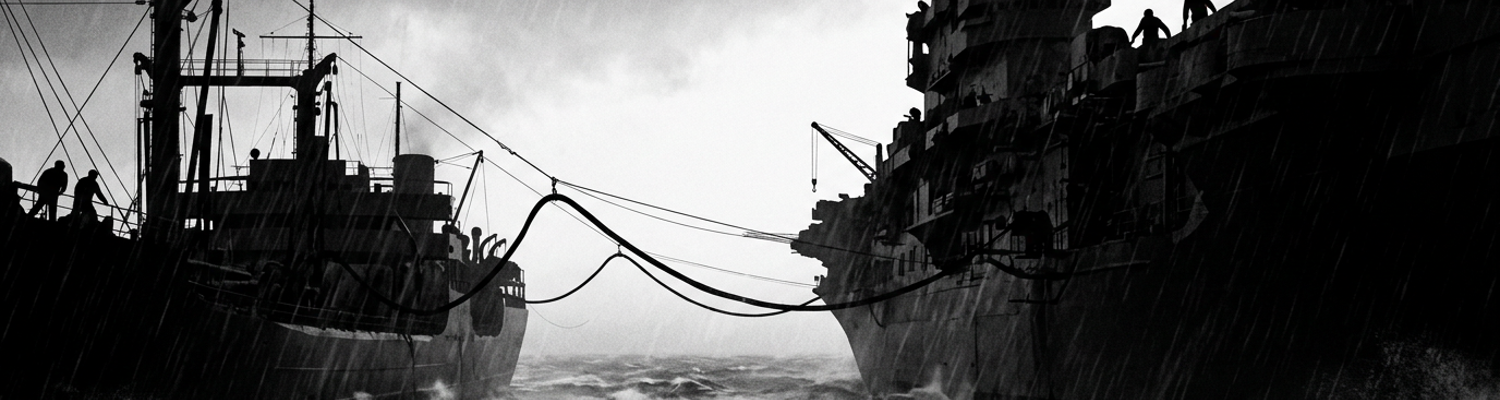
Steam-driven deck machinery on fleet auxiliary oilers proved incapable of absorbing violent lateral forces. The Solomon Sea generated unpredictable wave patterns. Fueling approaches occurred south of Treasury Island at latitude 8 degrees 45 minutes South. USS Kankakee and USS Lackawanna contended with long-period oceanic swells. Waves measured twelve to sixteen feet high. A 43,500-ton fleet carrier and an auxiliary oiler rolled asynchronously.
Arcs reached eighteen degrees.
Distance between the hulls fluctuated by thirty feet within seconds. Cast-bronze spur gears fitted inside the Lidgerwood steam deck winches bore the direct brunt of these erratic movements. Designers originally built these gears for calm Atlantic coastal anchorages. They possessed insufficient tensile strength. Sudden twenty-ton dynamic shock spikes transmitted through the high-line tackle (Naval Sea Systems Command Maintenance File 882). Steam piston relief valves lagged.
Pressure failed to exhaust in time when Saratoga surged outward.
Gear teeth stripped completely off the driving pinions. Loud mechanical cracks echoed across the decks. Drums locked in place. Heavy line rigs stranded mid-transfer. Repair crews cleared pulverized bronze filings from deck casings by hand. Oilers wallowed in the trough of heavy swells during these repairs.
A close review of operational logs indicates the physical separation of tensioned rigging posed constant danger to weather-deck personnel.
Standard fueling configuration required stringing seven-eighths-inch plow-steel span wires. Crews ran these between the oiler kingposts and the receiving ship padeyes. These wires suspended heavy six-inch synthetic rubber fuel hoses. Unpredictable South Pacific roll periods repeatedly exceeded the elastic tolerances of the wire rope. Steel cables under fifteen tons of continuous tension snapped violently. They whipped across fueling stations. Velocity proved sufficient to slice through steel stanchions.
Four-ply Buna-N synthetic rubber fueling hoses failed concurrently.
Manufacturers built these to conserve wartime natural rubber stockpiles. The material could not endure cyclical twisting and jerking forces. Hose carcasses ruptured along seam lines. Some ripped free from their brass end-flanges. Transfer pressures exceeded eighty pounds per square inch during these failures. Thousands of gallons of viscous Navy Special Fuel Oil geysered into the open air. Petroleum smothered catwalks and extinguished boiler intake drafts. Flight deck crews found themselves coated in blinding black liquid.
Mechanical catastrophes slashed fuel delivery volumes far below operational safety thresholds.
Standard fleet doctrine specified a sustained delivery rate of twenty-five hundred barrels of fuel oil per hour. Dual span-wire hoses were required to meet this metric. Equipment casualties dropped actual transfer rates. Manually cranked winches slowed the process. Engineers throttled pump discharge pressures down to thirty pounds per square inch to prevent hose blowouts. Delivery fell to fewer than eight hundred barrels per hour.
Task Force 38 could not remain tied to oilers on predictable courses at eight knots.
Full replenishment required six to eight hours. This exposure invited submarine ambushes. Japanese boats patrolled the western approaches to Bougainville. Sherman aborted replenishment operations early. Ships took on less than half their designated capacities. USS Farenholt and USS Lardner returned to the combat screen carrying barely twenty-eight percent usable fuel in their bottom tanks. Destroyer engineering divisions burned contaminated fuel-oil dregs. Emergency boiler shutdowns kept turbines turning during high-speed nocturnal fighter interception runs.
Aviation Gasoline Deficits on USS Saratoga
USS Saratoga arrived off Bougainville with 132,000 gallons of 100-octane aviation gasoline. Five armored internal storage tanks held this supply. Sustained flight operations on behalf of Air Group 12 quickly outpaced replenishment projections. Grumman F6F-3 Hellcats of Fighting Squadron 12 burned up to one hundred and fifty gallons of fuel per hour. Combat climbs required full throttle. Douglas SBD-5 dive bombers of VB-12 consumed heavy fuel loads.
Grumman TBF-1 Avengers of VT-12 hauled torpedoes and half-ton bombs across the northern Solomons.
Saratoga conducted continuous launch and recovery rotations near latitude 6 degrees 35 minutes South. These operations shielded amphibious forces at Cape Torokina. Each cyclic launch emptied more than three thousand gallons from the forward gasoline manifolds. Constant high-speed maneuvers burned twenty-six thousand gallons per twenty-four-hour cycle. Reserves plunged below twenty percent by November 7. Less than twenty-four hours of combat fuel remained in the lower saddle tanks.
When examining the historical record of the engineering spaces, structural stress from continuous thirty-knot turns shattered fuel distribution machinery.
Design specifications dictated an Aqua-system water-displacement network. Seawater displaced high-octane fuel from below-waterline stowage into overhead lines. High-frequency hull vibrations caused cast-iron casing fractures. Two main electrically driven fuel-transfer pumps failed in the forward pump compartment (Engineering Logbook Entry 11-04-43). Seawater seeped past worn packing glands. Brine and sediment contaminated aviation fuel lines. Carburetor filters choked on the debris.
Aviation boatswain mates could no longer drive fuel up to flight deck fueling risers under mechanical pressure.
Deck divisions resorted to manual labor. Sailors hauled fifty-five-gallon drums of 100-octane fuel out of deep hold compartments by hand. They rigged block-and-tackle gear from overhead beams. Teams manually wrestled four-hundred-pound steel drums up steep vertical escape trunks. Narrow bomb-elevator shafts provided the only upward path. Men worked in unventilated passageways. Gasoline fumes concentrated to toxic thresholds.
Crews used brass hand-cranked rotary pumps.
They emptied individual drums directly into aircraft wing tanks. Complete blackout conditions complicated the process. Archival evidence shows that this handling bottleneck forced immediate fuel rationing. Sherman capped total aviation fuel consumption at eight thousand gallons per day. He needed to avoid grounding his defensive interceptors entirely. Task Force 38 staff canceled scheduled strike missions against secondary air installations at Buka on November 8.
Armed search missions across the Shortland Island anchorages disappeared from daily flight orders.
Air Group 12 retained only bare minimum Combat Air Patrol coverage. Eight Hellcats remained aloft over the fleet. Sixty strike planes sat parked across the hangar deck with empty dry tanks. Mechanics siphoned dregs from damaged SBD Dauntless wings. They poured the liquid into five-gallon metal cans. This kept a single division of fighters fueled on the catapults. Sherman preserved fifty-six hundred gallons solely for fleet defense. He refused all requests from 3rd Marine Division forward controllers. Close air support strikes along the Piva River ceased on November 9.
Combat Air Patrol Turnaround Delays
Turnaround cycles for Grumman F6F-3 Hellcats aboard USS Saratoga disintegrated. Doctrine mandated forty-five-minute evolutions. Operations decayed into chaotic two-hour delays between November 5 and November 8. Fighting Squadron 12 required twelve hundred gallons of 100-octane gasoline to turn each six-plane fighter division around. Twenty-four hundred rounds of .50-caliber ammunition were also necessary. Station-keeping over Empress Augusta Bay demanded constant readiness.
Main aviation fuel pumps possessed cracked casings.
Pressure lines remained dry. Aviation boatswain mates in the V-4 Division relied on manual wobble pumps. Brass hand cranks supplied less than six gallons per minute directly into wing cell ports. Gravity-fed hose nozzles regularly lost suction. Ships heeled into sharp turns at twenty-eight knots. Armament divisions faced identical blockages along the deck edge.
Ordnance personnel carried twenty-pound ammunition trays containing linked armor-piercing and incendiary belts.
They climbed narrow escape ladders from fourth-deck magazines. Forward pneumatic weapons hoists lacked line pressure (Ordnance Bureau Report 1943-7A). Loading six wing-mounted Browning M2 heavy machine guns per aircraft required extreme manual effort. Jammed feed chutes needed clearing. Sailors safety-wired firing pins individually by flashlight.
A close review of operational logs indicates physical exhaustion degraded basic operational reflexes.
Plane handlers and ordnance crews worked back-to-back eighteen-hour watches. Surface temperatures on the flight decks reached one hundred and twelve degrees Fahrenheit. Equatorial sun baked the teak planks. Flight quarters sounded before dawn. Operations ran uninterrupted past midnight. Men received barely three hours of broken sleep. Berthing compartments sat directly beneath scorching uninsulated flight deck armor.
Salt depletion and dehydration affected the entire crew.
Toxic fumes from leaded aviation gasoline caused disorientation across deck divisions. Handling crews pushed twelve-thousand-pound Hellcats manually. Teak planks grew slick with hydraulic fluid and salt spray. Tractors sat parked to conserve engine gasoline. Men dropped loaded ammunition cans onto steel catwalks. Fingers were crushed in wing-folding hinge mechanisms. Mechanics suffered carbon monoxide poisoning while guiding aircraft engines running at high idle.
Flight deck officers reported handlers falling asleep standing up.
Sailors collapsed against ladders while holding live fuel hoses. Compounding delays severed continuous Combat Air Patrol coverage over the carrier task group. Standard South Pacific defensive doctrine called for a standing umbrella of sixteen to twenty-four F6F Hellcats. These fighters stacked between ten thousand and twenty-five thousand feet. They intercepted enemy raids out of Rabaul. Extended deck servicing stretched turnaround intervals past ninety minutes on November 7.
Airborne fighter strength over Saratoga collapsed down to two operational Hellcats.
Both aircraft displayed low fuel warnings. Fleet radar operators monitoring the SK search set detected forty-two Japanese aircraft. A mixed strike group of Mitsubishi A6M Zeros and Aichi D3A dive bombers closed from Simpson Harbour. Range dropped to thirty miles. Saratoga held twelve armed fighters chained to the flight deck. They could not scramble. Fuel hoses remained coupled to manual hand pumps. Destroyers Farenholt and Lardner opened emergency antiaircraft barrages. Five-inch 38-caliber guns fired in local control. Two lone airborne Hellcats engaged twelve Japanese dive bombers unassisted above the fleet screen.
Breakdown of Voice and High-Frequency Communications
Very-high-frequency Talk-Between-Ships voice radio networks aboard Task Force 38 ships collapsed. Severe mechanical fatigue and equatorial atmospheric interference caused the failure. Navy Model TBS-4 and TBS-6 transceivers operated within the sixty to sixty-six megahertz spectrum. These units depended on fragile glass vacuum tubes to maintain channel frequencies. Continuous hull shudder from sustained twenty-eight-knot evasive maneuvers shattered cathode filaments. Power amplifier tubes failed repeatedly.
Sudden electrical load surges from auxiliary deck machinery blew paper-dielectric capacitors in the modulator chassis.
Saltwater intrusion corroded coaxial antenna feed lines run along open catwalks. This introduced massive impedance mismatches. Extreme thermal inversions and torrential cloud layers over the Solomon Sea produced intense tropospheric ducting. VHF ground waves trapped within lower air boundaries ricocheted across the water. Tactical channels filled with howling carrier interference. High-amplitude atmospheric hash drowned out speech.
Radiomen turned receiver squelch controls to maximum attenuation.
They needed to suppress deafening screeching. This completely suppressed genuine incoming voice signals between carrier bridges and escort destroyers. High-frequency command links between Task Force 38 and South Pacific land-based air commands disintegrated. Day and night operational windows offered no relief. High-frequency transmitters relied on three-to-eighteen megahertz skywave propagation. They needed to reach Air Command Solomons at Munda and headquarters in Noumea.
Violent solar ionization and tropical cloud decks blocked the signals.
Intense D-region absorption during midday hours killed long-range radio signals entirely. Primary continuous-wave Morse channels dropped for up to ten hours at a stretch (Signal Corps Technical Manual 11-452). Task force communication officers could not synchronize flight schedules. They failed to coordinate fighter sweeps with Army Air Forces P-38 Lightnings. Marine Corps F4U Corsairs flying from Henderson Field remained disconnected.
Strike notifications and target coordination data arrived at the decoding desk six to eight hours late.
Japanese cruiser position reports from amphibious reconnaissance units suffered identical delays. Air group plotters planned offensive sorties against Simpson Harbour using outdated dawn reconnaissance summaries. They lacked knowledge regarding friendly escort arrival times. Archival evidence shows that strict emission control protocols prevented troubleshooting. Sherman mandated absolute radio silence under Condition Baker.
He intended to deny Imperial Japanese Navy direction-finding stations at Rabaul any electronic bearings.
Fleet orders barred radiomen from keying transmitters to measure antenna output. Technicians could not align replacement quartz crystals or calibrate line tuners between ships. Diagnostics occurred inside sweltering below-deck compartments. Technicians used hand-held volt-ohm meters. They worked completely blind to whether repairs actually broadcasted a legible signal beyond the hull.
Visual tactical signaling failed to bridge this electronic blackout.
Torrential equatorial squalls reduced visibility across the formation to less than four hundred yards. Rain blotted out fifteen-inch signal searchlights. Yardarm blinker lamps vanished in the gloom. Signal flags hoisted to carrier halyards hung soaked and motionless. Dead-air rain pockets prevented flags from unfurling. Escort commanders could not read urgent course changes during nocturnal torpedo evasions.
Blind Strike Operations in Contested Airspace
Air Group 12 launched from USS Saratoga at 0730 hours on November 8. Eighty-four aircraft climbed straight into heavy overcast at latitude 6 degrees 18 minutes South. They received no vectoring from the fleet. Rear Admiral Sherman enforced strict emission control under Condition Baker. CXAM-1 radar operators could not transmit intercept tracks or bearing corrections to airborne flight leaders.
SBD-5 Dauntless dive bombers crossed the western Bougainville coastline.
TBF-1 Avengers followed along pre-calculated dead-reckoning lines. Planners drew these lines three hours prior to flight quarters. Below-deck Combat Information Center controllers watched volcanic land clutter from Mount Balbi erase all radar returns. The strike wave vanished from screens within ten minutes of departure. Carrier aircrews received no updates on maneuvering Japanese cruisers exiting Simpson Harbour. Incoming fighter sweeps scrambled from Buka Airfield went unreported.
Flight leaders leveled off at twelve thousand feet inside blind cloud layers.
They relied on rudimentary cockpit magnetic compasses. Mechanical drift meters guided heavily laden bombers across three hundred miles of contested airspace. When examining the historical record, the joint strike plan devised between Task Force 38 and Air Command Solomons collapsed. Basic equipment incompatibility and schedule drift caused the failure. Army Air Forces P-38 Lightnings operated on pre-set crystal-controlled VHF frequencies.
Marine Corps F4U-1 Corsairs used the same bands.
These radios could not communicate with primary ship-to-plane radio sets. Dispatchers at Munda airfield scheduled thirty-two fighters to rendezvous with the Navy strike package over the Treasury Islands at 0815 hours. Task Force 38 launched forty minutes ahead of schedule to catch favorable deck winds. Navy formations reached twenty-five miles north of the rendezvous point before the land-based escort cleared New Georgia. Marine flight leaders arriving over Treasury found empty airspace.
They orbited until auxiliary drop tanks ran low.
Major General Nathan Twining possessed no direct teletype connection to the carrier bridge. Neither command post could adjust flight plans once engines were turning. Air Group 12 pressed northwest past the Crown Prince Range completely alone. Lack of escort cover exposed unescorted carrier bombers to direct Japanese fighter interception. Eighteen Douglas SBD-5s passed the northern coast of Bougainville.
They encountered thirty Mitsubishi A6M5 Zero fighters from the 201st Kokutai descending from twenty thousand feet.
Fighting Squadron 12 F6F-3 Hellcats had drifted fifteen miles east while skirting a severe cumulonimbus squall line. The dive bombers flew isolated. Japanese pilots made head-on firing passes into the stepped-down bomber boxes. They directed 20mm cannon fire into Wright R-1820 radial engine cowlings. Unarmored wing-root fuel junctions took heavy damage (Air Group 12 Action Report).
Radiomen in the rear cockpits fired twin .30-caliber Browning machine guns from flexible ring mounts.
They exhausted hundred-round ammunition drums while tracking diving targets through severe tropical turbulence. Three SBD-5s suffered severed control cables and burning fuel cells within ninety seconds. Lieutenant Commander Robert B. Derickson led the surviving bombers into a steep descent toward the tree canopy. They jettisoned high-explosive bombs directly into open water to maintain airspeed.
Supply Chain Dictates of Carrier Warfare
Operational tempo across Task Force 38 answered directly to oiler arrival intervals. Tactical combat readiness became a secondary concern. Rear Admiral Frederick C. Sherman held ninety operational aircraft aboard USS Saratoga and USS Princeton. Fully staffed flight crews stood ready. Air wings remained tethered to the arrival coordinates of fleet oilers steaming out of Espiritu Santo.
Escort destroyers consumed thirty-five barrels of heavy fuel oil per hour.
Holding twenty-knot patrol stations reduced their operational endurance to seventy-two hours. Auxiliary oilers USS Kankakee and USS Lackawanna frequently faced thirty-six-hour transit delays through the Solomon Sea. Combat sorties over Bougainville stopped during these waits. Carrier flight decks sat idle. Strike planners scratched scheduled bombings against Japanese bastions at Buka and Kahili. Fuel reserves fell under twenty-five percent.
Sherman had to break contact with the enemy.
He withdrew forty miles south of Treasury Island. The task force steamed toward oceanic coordinates 10 degrees 00 minutes South simply to wait for civilian-crewed oilers. A close review of operational logs indicates mechanical disasters suffered during the Bougainville campaign forced immediate modifications. Heavy-weather fueling rigs and deck winch mechanisms required complete redesigns. Service crews at Espiritu Santo stripped out the brittle cast-bronze spur gears.
They replaced them with forged chrome-nickel alloy steel drive gears.
These new components handled forty-ton shock loads without stripping teeth. Naval engineers overhauled hydraulic braking assemblies. They inserted rapid-exhaust relief valves directly into steam cylinder heads. This prevented surging high lines from parting during fifteen-foot sea swells. Deck divisions abandoned rigid span-wire setups. They adopted counterbalanced trolley rigs suspended on one-inch improved plow-steel wire rope.
Ripped four-ply synthetic hoses went to the scrap heap.
Six-inch multi-ply wire-braided rubber lines reinforced with internal steel coils took their place. Rigging crews mounted newly fabricated bronze Robb quick-release couplings to the end of every fuel hose. Deck crews could drop pressurized transfer lines within four seconds using a single hand-lever strike. These mechanical modifications formed the empirical foundation for standardized underway replenishment protocols (Pacific Fleet Service Force Directive 44-1).
Service Squadron 10 adopted these methods in early 1944.
Commodore Worrall R. Carter codified uniform underway refueling procedures across the Pacific Fleet. He eliminated improvised line handling. Strict station-keeping guidelines mandated receiving warships maintain an alongside separation distance of eighty to one hundred and forty feet. Ships held a steady velocity of ten knots. Standardization teams installed continuous phone-and-distance lines between ships.
They marked sixty-foot intervals with color-coded cloth banners.
Bridge watchstanders gauged beam separation visually without electronic rangefinders. Fuel transfer stations on all capital ships received uniform deck padeyes. Pre-rigged saddle wire falls became standard issue. Identical twenty-four-volt sound-powered telephone connections coordinated manifold valve pressures directly between engineering pump rooms. Service Squadron 10 packaged these drills into Fleet Replenishment Standard Operating Instructions. Chaotic South Seas deck evolutions transformed into a fixed twenty-four-hour industrial routine. Standardized fueling lines transferred three thousand barrels of fuel oil every sixty minutes.