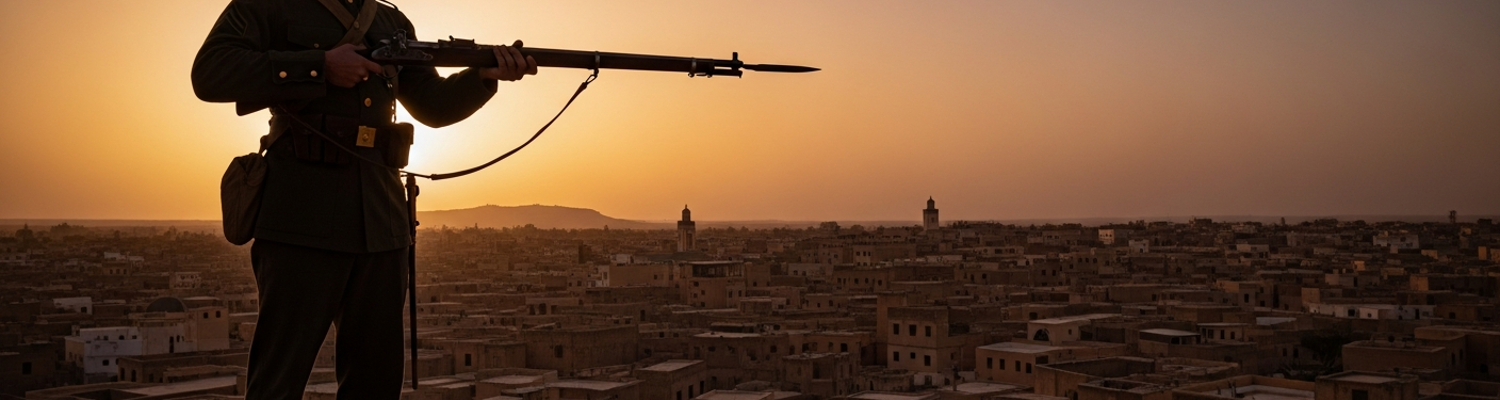

In May 1801, axemen acting on the orders of Yusuf Karamanli, the Pasha of Tripoli, chopped down the flagpole at the American consulate. This act severed diplomatic ties and signaled the start of the First Barbary War. The young United States, heavily reliant on maritime trade, could no longer purchase safe passage for its merchant ships with tribute. President Thomas Jefferson dispatched a naval squadron to the Mediterranean, but the conflict demanded more than sea power. It required a persistent American presence on hostile shores, within the very cities from which the corsairs operated. This mission fell to small, detached squads of United States Marines. Posted to the fledgling U.S. consulates in Tunis, Algiers, and Tripoli, these men became the nation's first diplomatic security forces, operating in extreme isolation at the nexus of diplomacy, espionage, and open warfare.
The Isolated Post
The assignment of Marines to consulates was a solution born of stark necessity. American consuls, such as William Eaton in Tunis, James Cathcart in Tripoli, and Richard O’Brien in Algiers, were political appointees operating on sovereign, yet hostile, territory. Their legations were not embassies in the modern sense but rented compounds, islands of American interest in cities governed by volatile autocrats. To protect these men and the sensitive national intelligence they handled, the Marine Corps provided small guard detachments. A typical unit consisted of a single Non-Commissioned Officer, a sergeant or corporal, leading six to eight privates. These men were separated from their parent command by thousands of miles of ocean, their only link to the outside world the sporadic arrival of a U.S. Navy frigate.
The daily existence of a consular Marine was a grinding routine of guard duty, weapons maintenance, and close-order drill, all conducted within the stifling confines of the consulate. Their quarters were cramped and rudimentary. Their diet consisted of standard naval rations of salted meat and hardtack, supplemented by local market food that was often a source of disease. They wore their regulation uniforms, including the uncomfortable high leather stock collar, in the oppressive heat of the Maghreb, a constant, sweat-soaked reminder of their foreign status. Their primary weapon was the Model 1795 Springfield flintlock musket, a reliable but slow-firing arm that demanded constant cleaning in the dusty environment. Beyond their formal duties, these Marines became integral to the consular mission itself. They served as couriers, orderlies, and a visible symbol of American military resolve, their disciplined bearing intended to give weight to the consul's words in tense negotiations.
Defending the Flag
The role of the consular guard was far from ceremonial. These Marines were an active deterrent and a last line of defense. Their readiness for violence was tested on multiple occasions. William Eaton, the American Consul in Tunis, was a former Army captain with a confrontational style that frequently angered the Bey of Tunis, Hamouda Pacha. During one severe dispute over tribute payments, local authorities threatened to storm the American legation. Eaton’s Marine guard, likely no more than eight men, immediately implemented their defense plan. They barricaded the consulate's entrances and took up firing positions at the windows and on the roof. Their disciplined preparation and the sight of their muskets transformed the diplomatic residence into a small, defensible fort. Faced with the certainty of a bloody fight to enter the compound, the Tunisian forces backed down, and the issue returned to the negotiating table. The Marines' credible threat of force gave Eaton the security he needed to conduct his duties without being physically intimidated.
In Tripoli, after the war's conclusion in June 1805, a Marine detachment remained with Consul Tobias Lear. This unit, sometimes referred to as the 'Tripolitan Guard,' provided essential security during a fragile peace. The city was still tense following the conflict, and the memory of the captured crew of the USS Philadelphia, which included 44 Marines held as prisoners, was fresh. The guard’s presence ensured the safety of the consul and facilitated the complex negotiations for the release of American prisoners. They were a constant, physical reminder of the consequences of breaking the new treaty, helping to stabilize the post-war environment and secure the American diplomatic foothold.
The expeditionary ethos of these guards found its ultimate expression in the actions of Lieutenant Presley O'Bannon and his detachment of seven Marines. In the spring of 1805, they joined William Eaton’s overland expedition, marching nearly 500 miles across the Libyan desert from Alexandria, Egypt. Alongside a mixed force of Greek and Arab mercenaries, O'Bannon's Marines led the assault on the fortress of Derna on April 27, 1805. Their charge was the decisive action in the battle. Raising the American flag over the captured fortress marked the first time the Stars and Stripes flew in victory on foreign soil in the Old World. While not a consular defense, this offensive action was a direct extension of the strategic need for reliable American ground troops, a need first filled by the isolated sentinels in the Barbary consulates.
The Weight of a Foreign Shore
Service on the Barbary Coast was a punishing experience that took a heavy toll. Marines were immersed in a culture entirely alien to them, governed by laws and customs they did not understand. They faced the constant, invisible threat of endemic diseases. Dysentery, typhoid, and malaria were common killers, and the periodic outbreak of bubonic plague could empty a city. Medical care was virtually nonexistent, limited to whatever rudimentary skills a Navy surgeon might possess if a ship was in port. A Marine's health depended on his own constitution and sheer luck.
The psychological pressure was immense. The deep isolation, coupled with the low-grade, persistent stress of potential violence, wore men down. Every interaction outside the consulate walls was fraught with risk. A simple street argument could escalate into a diplomatic incident, while a moment's hesitation during a real threat could result in the consul’s death and the loss of the legation. These enlisted men and their NCOs were forced to make complex judgments on the use of force, decisions normally reserved for commissioned officers. They had to manage the often-difficult personalities of their own consuls while navigating the opaque political landscape of their host cities.
The danger of capture and enslavement was not a remote possibility but a tangible reality. Every Marine knew the fate of their comrades from the Philadelphia, who languished in Tripolitan prisons for nineteen months. This knowledge lent a grim purpose to every hour spent on sentry duty. Service in these consular detachments demanded an extraordinary blend of combat discipline, cultural adaptability, and mental resilience. In their lonely vigil, these first diplomatic guards forged a core competency for the Marine Corps, proving that a handful of determined men could project American power and protect its interests on the world's most distant and dangerous frontiers.