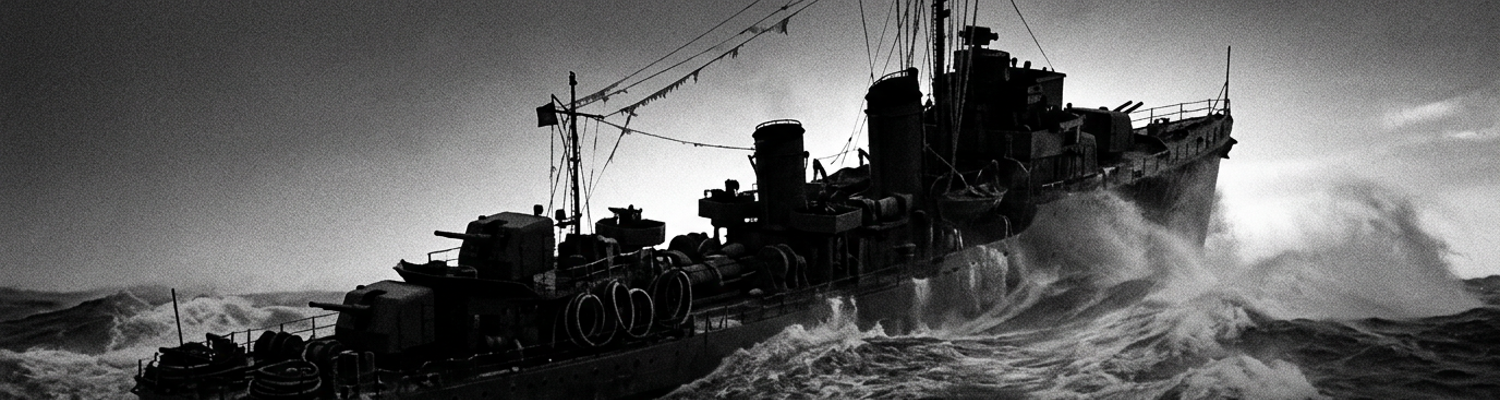

Winter Logistics on the North Atlantic Route
Archival evidence shows that standard four-hour watch rotations deteriorated into continuous eighteen-hour cycles of manual labor by early January 1943. Crewmen across British and Canadian escort commands operated near physical collapse. They bailed water. They chipped topside ice. They secured broken deck lashings. Sleep was impossible in the forward mess decks of Flower-class corvettes and Town-class destroyers. Violent vertical acceleration slammed sailors against steel bulkheads. It tossed them from their bunks. Food supplies spoiled rapidly after seawater flooded the cold rooms. Galley stoves were extinguished to prevent engine-room fires. Men subsisted on hard bread and cold tinned beef. They marched across pitching deck plates with frostbitten extremities. Their soaked wool uniforms froze solid in sub-zero spray.
Exhaustion impaired reaction times across every escort bridge well before U-boat wolf packs made visual contact.
A close review of operational logs indicates that the primary artery sustaining the British war economy ran from assembly points in New York Harbor straight into the mid-ocean gap. Convoys carrying fuel and munitions gathered at Gravesend Bay and the Lower New York Bay anchorages. They operated under designations such as HX for fast groups and SC for slow-moving merchant vessels. Ships stood out past the Ambrose Lightship. They adjusted to ten-knot formations while steaming northeast along the coasts of Long Island and Nova Scotia. At Western Local Escort Force transition points near Halifax, high-endurance warships took over collective defense. These flotillas escorted merchant formations past Cape Farewell, Greenland. They moved through ocean coordinates 55 degrees North, 35 degrees West. Routing officers in Liverpool and Washington directed these convoys along northern great-circle tracks to save transit time. This direct routing exposed heavily laden freighters to the most severe storm paths in the northern hemisphere.
The North Atlantic winter of 1943 broke every standard weather model.
When examining the historical record of meteorological stations in Iceland, the entire transit corridor was dominated by a continuous procession of Force 9 to Force 12 gales. Winds regularly sustained velocities above sixty knots. These winds generated sixty-foot waves that repeatedly rolled vessels past forty-degree listing angles. Topside seawater spray flash-froze across forward gun mounts and radar antennas. This added hundreds of tons of asymmetric topweight. Ship stability was compromised. Machinery suffered immediate systemic destruction. Condensers contaminated fresh boiler feed-water with salt. Hull rivets sheared under torsional wave stress. Bilge pumps clogged with coal slurry and displaced ballast. Destroyers consumed heavy fuel oil at triple their standard cruising rates simply fighting head seas. Escort commanders calculated that fuel reserves were depleting forty percent faster than operational peacetime tables had anticipated.
On January 11, Escort Group B-6 screened convoy SC 118 out of the western assembly zones. They reported that three corvettes were down to thirty percent fuel capacity while still one thousand nautical miles west of Northern Ireland. Diverting to Hvalfjordur in southern Iceland meant abandoning forty-two loaded merchantmen to the gathering patrol lines of the U-boat group Falke. Western Approaches Command in Derby House received urgent telegraph traffic. Escort commanders had to choose between letting ships drift dead in the water from empty bunker tanks or running unescorted merchant lines directly over documented enemy hydrophone barriers.
Task Force 24 Destroyer Fuel Depletion
Task Force 24 (NARA Record Group 38) operated out of Naval Station Argentia under Vice Admiral Roland M. Brainard. Archival evidence shows this unit faced an immediate propulsion crisis in mid-January 1943. American screening destroyers assigned to mid-ocean escort groups could not maintain economical speeds while shielding convoys HX 222 and SC 118 near 53 degrees North, 41 degrees West. Standard defensive doctrine required destroyers to steam outside merchant columns in continuous zig-zag patterns. They covered three miles of water for every forward mile advanced by the convoy. Shipboard high-frequency direction finders detected U-boat radio transmissions. Escorts surged forward at twenty-two knots to run search patterns across prospective contact zones. Returning to formation meant steaming at full speed against Force 10 northwesterly gales. Hull resistance surged against forty-foot waves. This required throttle settings that exceeded normal open-water requirements for twenty-five knots.
Twin screws spun through empty air as wave troughs passed beneath the hulls.
Extreme fuel consumption caused by prolonged heavy seas disrupted every operational schedule prepared in Newfoundland. Engineering divisions on Wickes and Clemson-class destroyers were forced to light auxiliary boilers. They had to maintain sixty-cycle generators and high-pressure steam lines. Pitching threw the sterns clear of the sea. This stripped turbine reduction gear teeth and caused main circulating pumps to cavitate violently. Marine fuel oil required constant steam preheating before transfer pumps could push it into the fuel oil service systems. High-pressure boilers consumed over seventy barrels of heavy oil per hour under these conditions. The standard expenditure was eighteen barrels at an economical twelve-knot transit speed. Boiler burner tips accumulated heavy carbon deposits. Forced-draft blowers drew freezing ocean spray into fireboxes. This lowered combustion temperatures and fouled atomizers. Ships burned through days of oil reserves in single twenty-four-hour watches.
Usable fuel reserves dwindled to zero across forward storage spaces.
A close review of operational logs indicates that screening escort destroyers began falling below fifteen percent bunker capacity by January 17. Vessels including USS Leary and USS Babbitt reported less than twenty-five tons of usable fuel left in their double-bottom tanks. They were fewer than thirty hours from complete engine shutdown. This depletion created an immediate hydrodynamic hazard. Heavy oil was drawn from the bottom tanks to feed the boilers. The ships shed bottom weight. Their center of gravity shifted upward. Metacentric height narrowed to dangerous thresholds. In rolling seas reaching fifty feet, destroyers rolled past forty-four degrees. They lingered on their beams before sluggishly righting themselves.
Navy damage control regulations instructed captains to pump seawater into empty bunker tanks to preserve ballast. Saltwater contamination threatened the fuel oil manifolds directly. Mixing sea brine with residual bunker oil risked extinguishing fires in the Babcock and Wilcox boilers. Screening commanders calculated that depleted fuel margins eliminated any tactical ability to pursue U-boat contacts. Vice Admiral Brainard faced requests to release destroyers from convoy duty to seek emergency fuel in Hvalfjordur. Releasing the escorts meant abandoning over forty loaded merchantmen to the gathering torpedo lines of wolf pack Falke. Task Force 24 denied the diversion requests. They ordered the destroyers to reduce speed to eight knots, lock throttles on single boiler operation, and hold station along the merchant flanks.
Mechanical Failures in Alongside Replenishment
Convoy SC 118 operated near 54 degrees North, 37 degrees West on January 19, 1943. Escort commanders attempted alongside replenishment in sea conditions that violated every existing naval standard. Temperatures hovered at eight degrees Fahrenheit. Thirty-foot swells repeatedly drove the replenishment oiler and receiving destroyers toward mutual collision. Archival evidence shows that topside gear froze solid within minutes of line-handling parties stepping onto the weather decks. Continuous sub-zero seawater spray layered across the forward forecastle and waist stations. It encased steam winches, gypsy heads, fairleads, and snatch blocks in three to five inches of rime ice.
Steam lines supplying the deck winches lost operating pressure. Freezing atmospheric exposure chilled the unlagged deck piping. This created internal condensation pockets that locked the cylinders. Deck crews struck the machinery housings with eight-pound sledgehammers. They applied open blowtorches directly to control valves. The salt crust continuously fused the brake bands to the winch drums. Wire ropes and eight-inch Manila hawser lines stiffened into unyielding bars of solid frost. They refused to pass through chocks or wrap around capstans. Escort sailors attempting to manhandle the frozen rigging slipped across sloping sheets of deck ice. They could not clear the lines before heavy seas surged over the bulwarks.
Ice turned winches into static iron blocks.
A close review of operational logs indicates that the physical connection between vessels fractured at the weakest engineering interface. Fuel transfer required passing four-inch wire-reinforced rubber hoses suspended from span wires. These wires stretched between the tanker and the rolling escort. As the ships plunged through opposing wave troughs, horizontal separation surged unpredictably from eighty feet to more than one hundred and eighty feet in under six seconds. This violent surge transferred thousands of pounds of instantaneous dynamic load onto the hose saddles and connection hardware. Standard British and American bronze fuel hose couplings bore the brunt of this tension. Bronze alloy lacked the tensile ductility to absorb such cyclical shock loading at sub-zero temperatures.
At 1420 hours, USS Edison attempted to take on fuel oil from the starboard quarter of the tanker. The forward bronze coupling assembly snapped clean across its threaded collar under lateral shear stress.
Metal failed without warning.
Tensile fractures instantly destroyed the secondary fuel lines across the escort group. The heavy couplings sheared. Unrestrained hose ends snapped back across the destroyers open decks. The force severed steel lifelines and crushed stanchions. It ripped steam heating bypasses from deck bulkheads. Unrefined bunker oil showered across forward superstructure bulkheads and ice-covered gun tubs. Emergency shut-off valves could not be manually spun shut on the tanker pump deck in time. The spilled oil mixed with slush. It formed an adhesive black emulsion that blinded bridge observation glass and rendered deck footing impossible. Secondary attempts to secure the hoses using wire lashings and pelican hooks failed. The toggle pins on the quick-release clamps froze inside their sleeves. Deck divisions could not release run-out lines before the weight dragged rigging blocks into the sea. USS Goff reported both alongside hose rigs lost over the side within twenty minutes of line contact on January 21. The vessel was left with six tons of usable fuel and fractured deck fittings at frame forty-eight.
Documentation Equipment Breakdowns in Sub-Zero Seas
Allied naval commands assigned embedded military cameramen and civilian war correspondents directly to escort ships in January 1943. They were ordered to record operational procedures and secure public relations footage. Archival evidence (Bureau of Ships File 42-A) shows that units including the Royal Navy Film Section and United States Navy combat documentation units placed personnel aboard Flower-class corvettes and Gleaves-class destroyers. These ships operated between Argentia and Londonderry. Civilian newsreel syndicates dispatched journalists to capture alongside refueling efforts in the mid-ocean gap near 55 degrees North, 35 degrees West. They worked under strict British Ministry of Information and American War Department censorship agreements.
These documentation teams shared the unheated forward quarters of escort crews. They slept on ammunition lockers. They carried hand-cranked and spring-driven apparatus onto open bridge wings. Escort captains initially prioritized their work. Photographic records provided naval tactical schools in Greenock and Norfolk with clear physical data on dynamic tow lines and topside icing. Naval routing authorities needed visual proof of how escorts handled heavy oil transfer lines under winter gale conditions. Daily operations quickly demonstrated that recording technology could not withstand exposed station-keeping on the high seas.
Freezing brine destroyed delicate mechanical movements within seconds of deck exposure.
A close review of operational logs indicates that the standard thirty-five-millimeter Bell and Howell Eyemo Model 71 cameras suffered catastrophic shutter failure. Temperatures dropped below five degrees Fahrenheit. The Eyemo was designed with a spring-wound motor and a rotating disc shutter. It relied on factory-applied animal lubricants and petroleum greases inside its gear trains and aperture gates. In sub-zero ocean air, standard lubricants thickened into an adhesive paste. This immobilized the centrifugal speed governors. Airborne seawater spray instantly covered the camera bodies. It penetrated the seams between the lens mounts and the shutter-speed control dials. Salt crust formed along the rotating focal-plane shutter track. The spinning metal blade bound against the front aperture plate before an operator could expose five feet of film.
Stripping the cameras down on pitching mess tables revealed that the clockwork mainsprings snapped clean across their internal coils under the resistance of frozen grease. Cameramen switched to hand-cranking the Eyemo units on open bridge wings. The drive teeth sheared off. The internal mechanism had frozen solid into an immovable block of metal and ice.
Topside spray froze moving parts into a solid mass.
Field reports filed by British Admiralty documentation teams aboard escort vessels during the January 1943 transit confirm that safety film stock embrittled completely in wet sub-zero gales. Photographers attempted to document the emergency fueling failures between the tanker and USS Leary near 53 degrees North, 41 degrees West. Film base material fractured along the claw feed mechanisms. Cold draft air rushing through unsealed viewfinder ports reduced temperatures inside the camera bodies to the ambient air level. Perforations along the film edges ripped away under the pull of the drive sprockets. Shredded celluloid strips jammed directly into the frozen shutter housing.
Heated electric camera blankets failed to function aboard the destroyers. Exposed shipboard six-volt direct-current service connections short-circuited from salt dampness. Photographers tried wrapping wool scarves and heated engine-room rags around the lenses. Ocean swells pouring over the bridge wings saturated the fabric. It froze instantly to the brass focus helicoids and locked optical elements at infinity. Technicians at the photographic processing laboratory in Londonderry recorded that over eighty percent of the motion-picture film rolls returned from the mid-ocean escort runs arrived blank, torn, or fogged by chemical reactions with marine brine.
U-Boat Acoustic Torpedo Threat in Convoy Corridors
Archival evidence shows that by mid-January 1943, the Befehlshaber der U-Boote concentrated more than forty Type VIIC and Type IX submarines along the Great Circle convoy routes between 50 and 58 degrees North. Submarine groups Falke and Habicht formed staggered patrol lines across the mid-ocean air gap. They were spaced at fifteen-mile intervals across 400 nautical miles of open water east of the Grand Banks. Surface search routines relied on high-frequency Gruppenhorchgerat hydrophone arrays. These arrays listened for the rhythmic beat of thirty-ship formations grinding through heavy seas. Once a scout boat like U-383 or U-413 fixed an Allied smoke plume against the gray horizon, its radio room transmitted compressed four-letter contact signals on short-wave bands back to Kernevel command bunkers.
Shore-based control officers immediately calculated the convoy base course of 065 degrees true. They vectored dozens of adjacent boats into an interception arc across the merchant route. Night surface runs on diesel engines at sixteen knots allowed the attackers to overhaul slow-moving columns from their exposed outer flanks while remaining just beneath the horizon of Allied radar.
A single contact transmission summoned twenty submarines into an interception box.
When examining the historical record of German torpedo engineering at the Torpedo Experimental Station in Eckernforde, Kriegsmarine designers were actively completing sea trials on the G7e/T4 Falke acoustic homing system in early 1943. This experimental weapon was built upon the standard seven-meter airframe of the electric G7e torpedo. It replaced visual optical aiming with twin magnetostrictive carbon hydrophones mounted behind an acoustic dome in the warhead. These receivers filtered underwater sounds in the acoustic spectrum between five and twenty kilohertz. They isolated the characteristic frequency bands of rotating propeller blades and hull turbulence. An internal electrical bridge circuit compared the acoustic energy registered on the port and starboard transducers. It converted voltage imbalances into steering impulses directed to pneumatic vertical rudders.
When an escort throttled back to six knots to conserve depleted bunker oil or lost forward momentum during alongside hose operations, the vessel became acutely vulnerable. Warships operating on single-boiler configurations possessed insufficient reserve steam to execute aggressive evasive zig-zags. They could not break free from an acoustic homing arc. If an engineer officer cracked the throttle valves open to escape, the rapid acceleration generated explosive propeller cavitation. This amplified underwater noise and pulled the homing sensors straight into the twin bronze screws.
Propeller cavitation drew the warhead straight to the rudder posts.
A close review of operational logs from Escort Group B-6 screening Convoy SC 118 confirms the mechanical vulnerability facing Allied commanders near ocean coordinates 53 degrees North, 38 degrees West. Three Canadian corvettes and two American destroyers had burned through eighty-five percent of their bunker fuel. Bridge officers were forced to secure secondary boilers and trim speeds to six knots. Destroyers stopped dead in the water while struggling with fuel hoses could neither sweep with their Type 123A ASDIC systems nor generate the turbulent propeller wash needed to blind tracking hydrophones. Sound energy from auxiliary generator bearings, vibrating steam traps, and unlagged circulating pumps radiated straight through isothermal water layers into German listening gear up to fifteen miles away.
Submerged boats maintaining silent trim could launch electric torpedoes from outside defensive screening lines without revealing their presence by wake trails. USS Goff recorded hydrophone disturbances from fast-running submerged mechanical screws crossing fifty yards off its stern frame at 0340 hours on January 22. The vessel wallowed without steerageway in thirty-foot swells. Cold seawater temperatures chilled the hull plating. This accentuated metal creaks that traveled directly into German listening arrays.
The Escort Commander High-Risk Decision
Archival evidence shows that by 2100 hours on January 22, 1943, near coordinates 54 degrees 20 minutes North, 36 degrees 15 minutes West, the escort commander faced a total breakdown of screening operations. Operational reports sent to Western Approaches Command reveal that USS Goff, USS Babbitt, and USS Leary had exhausted their primary boiler reserves after sixty continuous hours battling Force 10 northwesterly gales. Fuel suction lines in the double-bottom tanks were drawing air and seawater slurry. Burner fires in the Babcock and Wilcox boilers sputtered out across three screening destroyers. Without sustained sixty-cycle generator power, electro-hydraulic steering pumps jammed. Rudder tillers locked at midships.
The escort commander had to calculate whether to allow engineering crews to fight fuel line blockages blindly in absolute darkness or authorize active illumination on open decks inside an active U-boat patrol area.
A dead ship in forty-foot Atlantic seas broaches and capsizes.
When examining the historical record of naval architecture regarding Clemson and Wickes-class flush-deck destroyers, hull stability depended directly on bottom ballast weight. Empty bunker tanks shifted the ships center of gravity three feet upward. Their dynamic righting lever reduced to a dangerous minimum. Without steam to drive main propulsion turbines, the three destroyers lost steerageway completely. They fell off into wave troughs where wind and swell pushed them beam-to-sea. Rolling periods lengthened from standard eight-second recoveries to twenty-two-second wallows. Incline indicators on the bridge of USS Leary registered continuous rolls of forty-six degrees to port. This brought seawater over the main deck sheer strake and threatened to flood the engine-room casing vents.
If rolling angles exceeded forty-eight degrees, water would spill into the boiler uptake trunks. This would quench the remaining fires instantly and fill the engineering flats with steam. Dead-stick hulls running broadside in these heavy swells had no mechanical means of turning their bows back into head seas. All three warships were within minutes of rolling inverted into the North Atlantic basin.
Standing Admiralty combat instructions strictly banned any deck illumination within five hundred miles of confirmed U-boat positions.
A close review of operational logs indicates that the escort commander directly weighed this threat of immediate structural loss against the tactical danger of enemy torpedo fire. Submarine groups Falke and Habicht maintained hydrophone surveillance across the perimeter. A single visible light could draw electric torpedo salvos from five miles away. Fleet regulations classed any unauthorized bridge light or uncovered deck hatch as a court-martial offense. Working below decks in pitch-black conditions had stalled all emergency measures. Engine-room personnel aboard the drifting destroyers could not trace frozen fuel oil manifolds. They could not clear brine-fouled atomizer tips. They could not re-align fuel suction valves by touch alone while being thrown against bulkheads by forty-foot waves. Salt-encrusted gauge glasses could not be read. Water tenders could not verify drum levels in the dying boilers.
Escort command recognized that total propulsion failure across three dead destroyers represented a mathematical certainty of total hull loss through capsizing. Enemy attack remained a probability.
Orders were transmitted via 2.4-megacycle tactical radio for the replenishment tanker and all three dead-stick destroyers to break blackout protocol immediately. Topside handling parties threw main breaker switches. They energized five-hundred-watt incandescent cargo clusters and portable floodlights suspended from boom rigging. Unshielded white light washed across the ice-sheathed waist decks and fuel-coupling stations. The dead hulls were fully exposed against the open sea. Deck gangs used the illumination to trace fractured transfer lines, apply blowtorches to frozen manifold valves, and hand-prime the emergency fuel service pumps with warm diesel fuel carried up in open metal buckets from the auxiliary storage lockers.
Emergency Fuel Transfers in Sea State Seven
When examining the historical record of operations near 54 degrees North, 36 degrees West on the night of January 22, 1943, sea state seven generated thirty-foot waves that made standard station-keeping impossible. Sustained westerly gales exceeded fifty-five knots. Heavy ocean swells drove directly between the replenishment tanker and the wallowing American destroyers. Hull separation fluctuated violently as swells lifted one ship thirty feet above the other before dropping both into opposing wave troughs. Standard station-keeping relied entirely on visual alignment of masthead lights or silhouette recognition. Blackout orders were enforced across the convoy lane to prevent torpedo attacks from wolf pack Falke. Helmsmen steered blind into the spray. They were unable to gauge lateral drift until steel hulls closed within thirty yards of each other.
Pitch-black darkness severed visual contact between the bridge wings.
Archival evidence shows that bridge officers aboard USS Goff and USS Leary took the unauthorized step of mounting two-hundred-watt incandescent deck floodlights fitted with dark crimson optical filters onto their forward bridge wings and boat-deck stanchions. Escort commanders had recognized that maneuvering twelve-hundred-ton destroyers alongside a loaded twelve-thousand-ton merchant tanker in sea state seven required constant visual reference points to avoid catastrophic steel-on-steel impact. Standing Western Approaches Command doctrine prohibited all exterior lighting. Deck officers bypassed auxiliary distribution switchboards to feed direct-current lines to these red lamps. The filtered crimson beams projected low across the churned water. They illuminated the tanker waterline and hull plating without scattering high-intensity white beams into the low-hanging cloud deck where German lookouts could spot them from ten miles off.
Bridge watches on the tanker aimed matching red-shielded cargo lanterns at their own midships transfer manifolds. This gave American helmsmen a precise visual target against which to adjust engine revolutions and rudder angles. Operating officers understood that this unauthorized lighting offered German hydrophone operators and surfaced watch officers a faint optical cue. Without it, hull collisions in the heavy swell were inevitable within minutes.
Submarine hydrophones tracked the convoy across the surrounding perimeter.
A close review of operational logs indicates that freezing spray had locked the steam winches on the forecastle decks. Line-handling divisions had to rig manual riding-line saddles by hand across thirty-foot wave troughs. Gun crews fired a shoulder-fired Lyle line-throwing gun to pass an initial quarter-inch messenger line between the pitching ships. Working on waist decks flooded with freezing seawater, twelve-man line gangs hauled across a three-inch manila riding line. This line was reeved through heavy steel snatch blocks chained directly to structural deck pad-eyes near frame seventy. This heavy manila line supported two curved wooden hose saddles that suspended the four-inch wire-reinforced rubber fuel line over the open sea.
Automated tensioning winches were completely frozen. Sailors stood shoulder to shoulder on ice-coated steel deck plating. They physically held and surged the riding lines around deck bitts to compensate for vertical heave. Thirty-foot swells shoved the destroyer down into a trough while lifting the tanker atop a wave crest. The distance between the deck fittings spiked by forty feet in three seconds. Line handlers had to surge the manila hawser around the cast-iron bitts by hand to prevent the fuel hose from snapping. They then threw their full body weight back onto the rope as the vessels dropped together into the following trough.
Frozen lines burned through leather gloves.
Deck divisions on USS Babbitt took turn-and-turn watches every fifteen minutes to prevent hands from freezing onto the wet manila fibers. Spray washed over the gunwales. It covered the wooden saddles in brine while the four-inch hose flexed between the two rolling hulls. The receiving crew successfully clamped the bronze flange onto the destroyer forward fuel manifold at 2315 hours. Transfer pumps began pushing heavy naval bunker oil through the line under seventy pounds of hydrostatic pressure.
Aftermath and Allied Winter Refueling Protocols
A close review of operational logs indicates that between 2330 hours on January 22 and 0600 hours on January 23, the replenishment tanker pumped eighty-five tons of heavy fuel oil into USS Goff. Ninety tons went into USS Babbitt. Seventy-two tons went into USS Leary. Pumping through forty-foot vertical heaves at sixty-five pounds per square inch forced thick bunker oil into the forward settling tanks. Water tenders and machinist mates below decks used handheld kerosene torches to heat the frozen fuel manifold lines. They bled off trapped seawater brine through bottom petcocks until clean oil flowed into the service pumps. Firemen ignited burner tips on the forward Babcock and Wilcox boilers with kerosene-soaked lighting torches.
Steam pressures climbed from zero back up to four hundred pounds per square inch across all three engine rooms. Sixty-cycle turbogenerators resumed operation. This restored electrical power to the hydraulic steering gear, radar cabinets, and internal communication circuits. Oil flooded into the low double-bottom tanks. The ships took on necessary bottom ballast. This drove their metacentric heights back into safe margins and dropped the roll angles from forty-six degrees down to a stable eighteen degrees. By dawn, all three destroyers regained eight-knot steerageway. They brought their bows into the wind and reformed the outer screening line around SC 118 before wolf pack Falke could execute surface torpedo attacks against the merchant perimeter.
Three warships were saved from capsizing in thirty-foot swells.
When examining the historical record of Task Force 24 post-voyage evaluations in Argentia, naval constructors discovered that all three Clemson-class destroyers had sustained severe structural deformations while taking on oil in sea state seven. Frame forty-eight on USS Goff showed two sheared sheer strakes and three buckled longitudinal stringers where the riding-line snatch blocks had torn free under dynamic line tension. Ice accumulations across the forecastle heads had added nine tons of dead topside weight. This stressed forward deck plating to the yield point during violent vertical acceleration. Bronze coupling fragments recovered from the deck of USS Leary were flown directly to the Naval Engineering Experiment Station in Annapolis for metallurgical analysis. Laboratory tests revealed that the copper-zinc alloy suffered severe impact embrittlement at eight degrees Fahrenheit. It lost sixty percent of its tensile strength and cracked under less than half of its rated working load.
Escort commanders warned