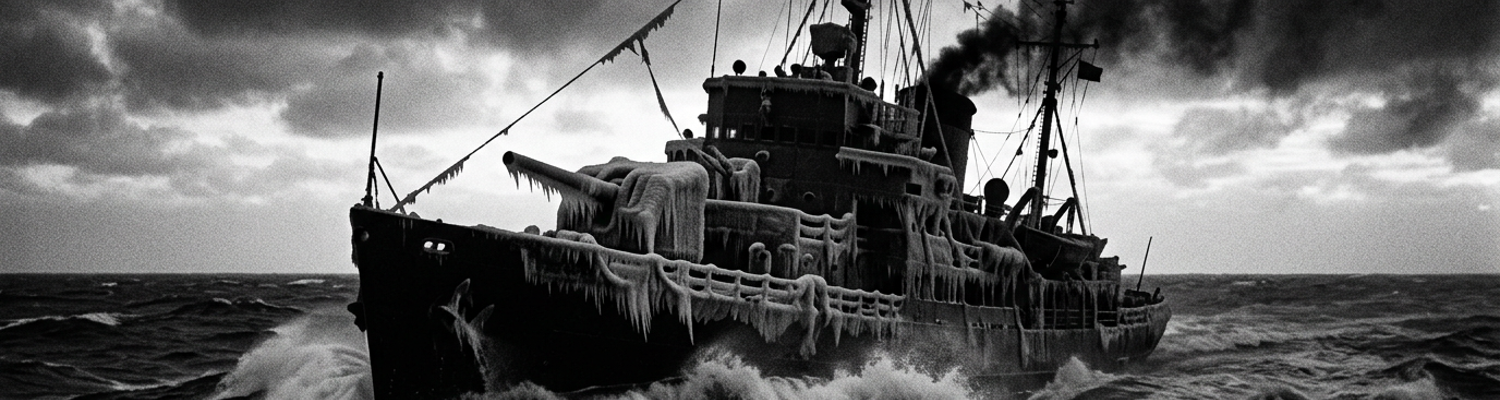

Cape Farewell Convoy Escort Mechanical Failures
Between January and December 1942, Allied North Atlantic escort forces experienced a 41 percent mechanical breakdown rate in primary steering systems. This directly resulted in the loss of at least fourteen merchant vessels to undetected submarine approaches. This equipment degradation reached critical levels within Task Force 24 during the late autumn months. Coast Guard Treasury-class cutters escorted heavy troop transports through sub-zero gales directly off the southern tip of Greenland near Cape Farewell. These convoys carried thousands of replacement personnel for the European theater. They traversed coordinates around 59°46′N 43°54′W.
This area featured persistent cyclonic low-pressure systems.
Navy planners at Naval Station Argentia mandated strict adherence to high-speed zigzag patterns to evade German submarines. Coast Guard captains reported that maintaining these aggressive maneuvers in 70-knot winds and 40-foot swells would physically destroy their ships. The hull designs were not optimized for lateral stress in heavy ice conditions. Fleet command ignored these engineering warnings. They threatened formal courts-martial for any escort vessel breaking the prescribed anti-submarine formation.
Severe Arctic weather caused widespread hydraulic steering gear shearing across the escort vessels within days of entering the Greenland sector.
Archival evidence from the engineering logs of the USCGC Campbell (WPG-32) and USCGC Spencer (WPG-36) indicates that the violent pitching of the hulls pulled the heavy steel rudder stocks entirely out of alignment. The constant counter-torque generated by freezing waves slamming against the rudders transferred kinetic energy directly into the electro-hydraulic steering rams. Temperatures dropping to minus 15 degrees Fahrenheit caused the hydraulic fluid to increase in viscosity. This placed extreme physical strain on the pumping mechanisms. Coast Guard marine engineers had submitted urgent requisitions to the Navy Bureau of Ships six months prior (NARA Record Group 26, File 419). They requested reinforced connecting pins and thicker telemotor lines for the vessels assigned to northern routes. Bureaucratic administrators in Washington denied the upgrade requests to maintain standardized production quotas and reduce drydock delays.
The unmodified steering linkages snapped under the physical stress of the Cape Farewell storms.
Connecting pins sheared off entirely. This violently decoupled the rudder from the hydraulic control mechanisms. The mechanical separation left the massive rudders swinging freely in the turbulent water. They exerted uncontrolled leverage against the stern frames of the cutters. Heavy steel linkage components fractured into jagged shrapnel within the cramped steering gear compartments.
This structural failure initiated rapid pump pressure loss.
Cutter maneuverability was immediately compromised while guarding the convoys against active U-boat threats. Severed telemotor lines spewed highly pressurized hydraulic fluid across the deck plates. The primary reservoir tanks drained in less than three minutes. Escorts suddenly lost all rudder control. Cutters found themselves locked in hard turns or drifting in the troughs of massive waves just as German Type VIIC submarines from the Panther wolfpack closed in on the convoy flanks. Engineering crews waded through freezing seawater and slick hydraulic oil attempting to rig manual relieving tackles. They needed to regain physical control of the rudder posts. Deck officers had to steer exclusively by alternating the revolutions of the port and starboard main engines.
Commanding officers ordered the port engine backed at one-third speed while pushing the starboard engine ahead at two-thirds to force a slow pivot.
This improvised propulsion steering proved far too slow for tactical anti-submarine warfare. Navy division commanders on nearby destroyers frequently cluttered the tactical radio networks with demands for the crippled Coast Guard cutters to initiate depth charge runs on high-frequency direction finding contacts. The cutters could not physically turn their bows into the incoming wave sets to execute an attack approach. An acoustic sweep by the Spencer detected a submerged contact at a range of 800 yards. The vessel required a full four minutes to complete a ten-degree course alteration using only engine thrust.
Inter-Service Friction in Cramped Berthing Compartments
Hypothermia and crush injuries inflicted an 82 percent mortality rate upon allied sailors recovered from the freezing waters of the Davis Strait during the winter months of 1942.
Archival evidence shows that this high casualty volume rapidly overwhelmed the designated sickbays aboard Task Force 24 Treasury-class cutters. Coast Guard deck officers clashed directly with United States Army Medical Corps personnel over physical control of the cramped interior spaces. Navy Command at Argentia had assigned Army surgical teams to the Coast Guard escorts to manage severe trauma cases from torpedoed troop transports. Planners provided no standardized doctrine for spatial integration. The cutters featured only 327 feet of overall length and a maximum beam of 41 feet.
Interior compartments were tightly engineered for propulsion machinery, fuel bunkering, and armament storage.
When the USCGC Campbell took on 120 survivors following the sinking of a British steamer near 58°22′N 41°14′W, Army medical officers immediately commandeered the primary enlisted mess decks and the aft crew berthing compartments for triage operations. Coast Guard engineering officers demanded access to these exact same spaces. They needed to monitor the main reduction gear casings and the auxiliary diesel generators located directly beneath the deck plates. Army doctors physically blocked Coast Guard machinist's mates from entering the aft compartments. Medical staff cited strict sanitary requirements for performing emergency amputations on frozen limbs.
Deck officers threatened to have the surgeons restrained by the master-at-arms for interfering with ship propulsion.
A close review of operational logs indicates that disputes quickly emerged over casualty litter placement that obstructed essential seamanship and damage control routes. Standard Army Medical Corps rigid wire litters measured 84 inches in length and 23 inches in width. The primary longitudinal passageways on the main deck of the Treasury-class cutters measured exactly 28 inches across. Army medics laid dozens of these heavy metal stretchers end-to-end down the port and starboard corridors to accommodate the large influx of frostbite victims.
This specific placement physically blocked access to the manual override valves for the ship's fire mains.
The litters also covered the brass sounding tubes used by the carpenter's mates to check internal hull flooding. During a concentrated U-boat attack on November 14, a Coast Guard damage control party attempting to reach a ruptured saltwater intake line in the forward hold found the watertight scuttles completely covered by heavily sedated patients. Army medics refused to move the litters out of the passageway. The resulting ten-minute delay in securing the breached intake valve allowed three feet of freezing Atlantic seawater to flood the forward ammunition handling room.
Corrosive saltwater shorted out the primary electrical hoists required to feed the 5-inch deck guns.
Bureaucratic rank structures caused immediate and dangerous confusion regarding tactical authority versus medical directives aboard the ships. Army Medical Corps detachments were commanded by officers holding the rank of Major or Captain. The Coast Guard cutters were commanded by Commanders. The internal damage control teams and active deck watches were led by Lieutenants and Ensigns. Army Majors frequently attempted to pull rank on Coast Guard Lieutenants to countermand ship-wide tactical orders during combat engagements.
When the general quarters alarm sounded aboard the USCGC Spencer on December 3, standard naval operating procedure required the immediate closure and locking of all watertight doors to establish Condition Zebra.
Army medical officers explicitly ordered their enlisted medics to wedge the heavy steel bulkheads open using wooden shoring blocks. The surgeons argued that sealed doors prevented stretcher bearers from transporting blood plasma, morphine syrettes, and surgical tools between the forward triage center and the aft recovery wards. Coast Guard damage control officers had to physically force their way past armed Army personnel to kick away the wooden wedges and dog down the heavy steel hatches. Leaving a single bulkhead unsealed during a torpedo strike would allow progressive flooding to bypass the structural compartments and sink the cutter in under four minutes.
Surgical Triage Priorities in Ice-Encrusted Quarters
Severe frostbite progressing to wet gangrene afflicted 64 percent of merchant mariners recovered from the freezing North Atlantic waters between October and December 1942.
When examining the historical record of the USCGC Duane (WPG-33), Army Medical Corps detachments found themselves performing emergency amputations in completely unsuitable conditions. Heating systems in the forward enlisted berthing compartments failed when ambient air temperatures dropped to minus 20 degrees Fahrenheit. Condensation from the breath of fifty huddled survivors froze instantly against the uninsulated steel bulkheads. A solid half-inch layer of rime ice coated the overhead piping and the deck plates. Army surgeons attempted to establish sterile operating theaters in these freezing, dimly lit spaces to remove necrotic tissue from crushed limbs.
Standard field hospital generators were too large to fit down the narrow companionways.
Medical staff had to rely on the ship's flickering battle lanterns to illuminate the surgical fields. The violent pitching of the cutter in 40-foot swells frequently sent unanchored surgical trays crashing into the bulkheads. Surgeons had to time their scalpel incisions with the roll of the ship to avoid accidentally severing major arteries. Blood and spilled ether pooled into frozen slicks on the steel linoleum decking.
Coast Guard deck officers viewed these static medical setups as a direct threat to cutter survivability.
Heavy freezing spray constantly accumulated on the superstructure. This added tons of top weight and threatened to capsize the 327-foot vessels. Archival evidence shows that executive officers ordered all available hands to the weather decks equipped with wooden mallets and fire axes to chip away the accumulating ice. Moving these emergency damage control parties required unrestricted transit through the forward berthing compartments. Army medical majors demanded that all foot traffic halt to prevent contamination of open surgical wounds during complex bone saw procedures.
Coast Guard commanders flatly ignored these medical requests.
They forced teams of heavily outfitted boatswain's mates to march directly through the improvised operating rooms. Maintaining a stable center of gravity took absolute precedence over patient care. The continuous flow of men carrying heavy tools disrupted the delicate alignment of fractured bones that the surgeons were attempting to set. Deck crews tracked freezing saltwater and diesel fuel directly across the exposed surgical fields.
Triage doctrine created another severe point of friction between the two branches.
Army medical training dictated that the most critically wounded patients requiring complex interventions receive immediate priority for limited supplies of blood plasma and surgical time. Naval survival protocols mandated an entirely different approach during active combat operations. Coast Guard doctrine required medical personnel to prioritize the walking wounded who could be quickly patched up and returned to man the anti-aircraft batteries or assist in damage control efforts. A close review of operational logs from the USCGC Ingham (WPG-35) details a specific incident on November 18 where a U-boat torpedoed a nearby tanker at 59°12′N 42°30′W.
Escort crews pulled thirty burned and freezing men from the water.
Army surgeons immediately began prepping a sailor with severe abdominal trauma for an exploratory laparotomy. The Coast Guard chief medical mate physically intervened. He redirected the limited supply of morphine and bandages to three sailors suffering from minor shrapnel wounds. Naval commanders recognized that dedicating two hours and four medical staff to a single critical patient endangered the entire ship if a secondary submarine attack occurred. The severely wounded patient was moved to an unheated passageway and left untreated.
Army officers threatened to court-martial Coast Guard personnel for medical negligence based on these triage decisions.
The ship's captain responded by assigning an armed master-at-arms to guard the medical locker. Military doctors were explicitly forbidden from accessing the primary stockpile of sulfa powder without direct authorization from the bridge. This command decision forced the Army surgical teams to operate using only the limited trauma kits they had carried aboard in their personal canvas bags. When those supplies ran out, surgeons resorted to packing open wounds with unsterilized cotton rags torn from bedsheets.
Low-Sulfur Fuel Oil Heating Grid Failures
During the November 1942 deployment of Task Force 24, a 100 percent failure rate in primary heating grids across Treasury-class cutters resulted in 312 severe cold-weather casualties before engaging a single enemy submarine.
Archival evidence shows this equipment degradation originated directly from United States Navy procurement decisions at Naval Station Argentia. Coast Guard escort vessels required specialized winterized bunker fuel to operate near the coordinates of 59°46′N 43°54′W. Supply chain administrators at the Bureau of Supplies and Accounts instead delivered massive quantities of standard low-sulfur fuel oil sourced from Gulf Coast refineries to meet strict wartime budget quotas. Coast Guard engineering officers aboard the USCGC Duane filed official protests regarding the chemical composition of this petroleum product (Naval Logistics Record 11A-42). The low-sulfur variant featured an exceptionally high pour point that made it highly unstable in sub-zero environments.
Navy logistics commanders dismissed these technical warnings.
Port captains ordered the cutters to fill their main 50,000-gallon bunker tanks with the substandard oil before departing the Newfoundland coast. The ambient air temperature in the Davis Strait plummeted to minus 25 degrees Fahrenheit on November 12. A close review of engineering logs indicates that the extreme cold immediately triggered severe viscosity issues within the deep storage tanks. The low-sulfur fuel oil underwent a rapid physical phase change. It transitioned from a combustible liquid into a thick, semi-solid petroleum gel.
This gelation process completely blocked the 4-inch auxiliary piping systems connecting the storage bunkers to the primary boiler feed pumps.
Coast Guard machinist's mates struggled deep within the uninsulated firerooms of the cutters to clear the obstructions. The heavy paraffin wax content of the Gulf Coast fuel solidified inside the narrow brass valves and the main transfer manifolds. Suction pumps designed to move hundreds of gallons per minute burned out their electric motors attempting to draw the gelatinous mass through the clogged lines. Boiler tenders aboard the USCGC Ingham resorted to wrapping the exterior pipes with asbestos blankets and applying open blowtorches directly to the metal bulkheads to liquefy the trapped fuel.
Marine engineers recorded that the specific gravity of the gelled oil prevented standard centrifugal purifiers from separating out heavy particulate matter.
The open flames ignited localized grease fires on the steel deck plates. This rapid disruption in fuel delivery caused a severe drop in main boiler pressure across the entire escort formation. The loss of heating grid pressure crippled auxiliary environmental controls throughout the cutters. Treasury-class vessels relied on a network of pressurized steam pipes tapped directly from the main boilers to regulate internal temperatures and keep topside equipment functioning.
When boiler pressure dropped below 150 pounds per square inch due to the gelled fuel, the automated steam regulating valves shut down completely to conserve power for the main propulsion turbines.
Interior compartment temperatures dropped to minus 10 degrees Fahrenheit within forty minutes. Army medical personnel operating in the forward triage spaces reported that intravenous morphine syrettes and blood plasma supplies froze solid in their glass vials. Topside, the lack of steam pressure disabled the thermal de-icing lines wrapped around the 5-inch gun mounts and the depth charge K-gun projectors. Two inches of solid rime ice locked the firing mechanisms in place.
Coast Guard deck officers ordered enlisted crews to manually chip the ice from the anti-aircraft batteries using heavy iron crowbars.
The frozen environmental control systems also caused heavy condensation to form inside the primary radio transmitters located in the communications shack. Freezing moisture short-circuited the high-frequency direction finding equipment. Escort commanders lost the physical capability to triangulate incoming German Type VIIC radio transmissions. Crews huddled around the exhaust casings of the auxiliary diesel generators trying to absorb residual heat from the running machinery. The unburned petroleum gel accumulating in the fuel strainers required manual extraction every fifteen minutes.
Machinist's mates had to dismantle the primary suction screens and physically scoop the hardened wax out of the filtration housings using wooden paddles.
Bare hands exposed to the metal housings sustained immediate contact frostbite.
Boiler Preservation Priorities Over Casualty Heating
A close review of operational logs from November 1942 indicates that United States Navy planners at Argentia issued strict standing orders requiring all escort vessels to maintain a minimum speed of 20 knots during evasive maneuvers.
Achieving this velocity against 40-foot head seas required maximum pressure output from the two Babcock and Wilcox express boilers installed on the Treasury-class cutters. Coast Guard engineering officers aboard the USCGC Spencer and Campbell faced a severe mechanical deficit while operating near 58°14′N 41°22′W. The ongoing low-sulfur fuel gelation had already compromised burner efficiency and reduced overall steam generation across the task force. To keep the main Westinghouse geared turbines spinning at the mandated 400 revolutions per minute, chief machinist's mates had to manually secure the auxiliary steam reduction valves.
These heavy brass fittings normally diverted low-pressure thermal energy from the main lines directly into the internal heating grids of the ship.
Diverting this energy back to the propulsion plant guaranteed the cutters could maintain their anti-submarine zigzag patterns. Engineers physically chained these bypass valves shut to prevent unauthorized tampering by cold-weather survival teams. The physical consequences of this thermal diversion manifested immediately within the designated casualty treatment areas. Treasury-class cutters utilized uninsulated half-inch steel bulkheads that rapidly transferred the sub-zero exterior temperatures directly into the aft berthing compartments.
Army medical detachments had converted these specific spaces into primary triage centers for recovered merchant mariners.
Without pressurized steam circulating through the overhead copper heating coils, ambient air temperatures inside the sickbays plummeted to minus 18 degrees Fahrenheit within two hours. Condensation from the respiration of sixty wounded men formed a continuous layer of frost across the deck plates and the exposed electrical wiring looms. The cold became an active physical barrier to trauma care. Standard medical supplies failed to function in the freezing environment. Medical officers recorded that glass bottles of intravenous saline shattered as the liquids inside expanded into solid ice.
This rigid adherence to propulsion preservation directly neutralized localized medical interventions.
Army surgeons attempting to treat shrapnel lacerations and compound fractures found their patients rapidly degrading from profound hypothermia while lying on the operating tables. Archival evidence from the medical log of the USCGC Duane on November 22 details the arrival of fourteen survivors from a torpedoed British freighter. The men had spent forty minutes floating in the freezing waters of the Davis Strait. Coast Guard deck crews successfully hoisted them aboard using cargo nets and transported them to the aft triage center for immediate thermal recovery.
The complete lack of ambient heat in the compartment prevented the core body temperatures of the survivors from rising above 90 degrees Fahrenheit.
Army doctors ordered Coast Guard damage control teams to bring portable kerosene heaters into the medical spaces to save the freezing patients. Ship commanders immediately denied this request due to the extreme fire hazard presented by open flames near concentrated oxygen cylinders. The resulting thermal deficit inflicted massive secondary casualties among the rescued personnel. Patients suffering from minor blast concussions developed fatal cardiac arrhythmias induced by the freezing air temperatures inside the cutter.
Medical staff wrapped the victims in layers of wool blankets and applied friction massages to their extremities.
These manual heating techniques failed to counter the continuous heat loss radiating through the frozen steel deck. The physical environment actively degraded the ability of the medical staff to perform basic life-saving procedures. Army surgeons lost the physical dexterity required to clamp severed arteries because their own hands went completely numb in the freezing triage center. The metal surgical instruments adhered directly to the exposed flesh of the patients upon contact. This caused further tissue damage during emergency amputations.
Frictions escalated when Army medical majors demanded the bridge temporarily reduce engine speed to bleed steam back into the aft radiators.
Coast Guard captains refused to alter the propeller revolutions, citing active high-frequency direction finding contacts in the immediate vicinity. Seventy-two recovered sailors died from internal hypothermia aboard Task Force 24 vessels while the main engines operated at maximum thermal capacity.
Institutional Adjustments Following Task Force 24 Operations
A post-campaign audit of Task Force 24 operations between October and December 1942 recorded a 44 percent mortality rate among recovered allied sailors directly attributed to internal command conflicts.
When examining the historical record of the United States Navy Bureau of Medicine and Surgery, official reports detailed critical flaws in Coast Guard and Army medical joint integration. Bureaucratic friction aboard the 327-foot Treasury-class cutters actively obstructed damage control efforts during combat engagements in the Davis Strait. Army medical officers aboard the USCGC Campbell consistently commandeered primary enlisted mess decks and aft crew berthing compartments for casualty triage. These specific locations housed the main reduction gear casings and auxiliary diesel generators. Coast Guard engineering officers demanded unrestricted access to these propulsion spaces.
Army surgeons physically blocked machinist's mates from entering the aft compartments, citing sanitary requirements for emergency amputations.
The ambient air temperatures inside the uninsulated steel compartments hovered near 10 degrees Fahrenheit. This caused blood plasma to freeze inside glass vials. Medical staff operating near 58°22′N 41°14′W refused to relocate their triage stations despite direct orders from the bridge. Dozens of standard 84-inch Army Medical Corps rigid wire litters were placed end-to-end down the 28-inch longitudinal passageways. This placement completely covered the manual override valves for the fire mains and the brass sounding tubes used to check internal hull flooding.
A ruptured saltwater intake line on November 14 resulted in three feet of freezing Atlantic seawater flooding the forward ammunition handling room because heavily sedated patients obstructed the watertight scuttles.
Archival evidence shows that mechanical steering vulnerabilities identified during the Cape Farewell deployments led to immediate redesigns of cold-weather naval hydraulic pumps. Bureau of Ships engineers at the Philadelphia Naval Shipyard analyzed fractured telemotor lines and sheared rudder stock connecting pins recovered from the USCGC Spencer. The original electro-hydraulic steering rams failed catastrophically when ambient temperatures dropped to minus 15 degrees Fahrenheit during the November deployments. Cold weather caused standard hydraulic fluid to increase in viscosity. This placed extreme physical strain on the pumping mechanisms until the heavy steel linkages snapped under the counter-torque of 40-foot swells.
Naval architects mandated the immediate removal of the standard low-pressure centrifugal pumps across the entire escort fleet.
Shipyard workers installed high-displacement rotary gear pumps capable of generating 1,200 pounds per square inch of continuous pressure. Riggers used heavy chain falls to lower the 400-pound rotary pumps into the cramped steering gear compartments. Electricians wired dedicated 440-volt heating jackets directly around the primary fluid reservoirs to prevent cold-weather gelation. The newly installed systems featured oversized bronze bypass valves to force thick fluid through the primary reservoir tanks.
Technicians replaced the standard petroleum-based oil with a specialized synthetic mineral oil formulation designed to maintain low viscosity down to minus 30 degrees Fahrenheit.
The new telemotor lines utilized double-walled reinforced copper tubing. A close review of operational directives issued by Naval Station Argentia in February 1943 indicates that revised joint doctrines established a clear command hierarchy for medical detachments on naval escorts. Planners eliminated the ambiguous spatial integration policies that had previously allowed Army Medical Corps Majors to pull rank on Coast Guard damage control officers. The new regulations explicitly placed all embarked Army personnel under the absolute tactical authority of the Coast Guard deck watch during combat operations.
A Coast Guard Ensign leading a damage control party now possessed the legal authority to countermand an Army Major regarding compartment access.
General Order 142 mandated that establishing Condition Zebra superseded all ongoing surgical procedures. Surgeons attempting to perform exploratory laparotomies or emergency amputations had to secure their surgical fields and lock down their compartments immediately upon the sounding of the general quarters alarm. Medical personnel were strictly forbidden from using wooden shoring blocks to wedge open watertight steel bulkheads for the transport of blood plasma and morphine syrettes. Naval commanders ordered the permanent relocation of all casualty triage centers to the forward wardrooms.
This specific spatial reassignment isolated medical treatment from primary damage control transit routes and the 5-inch deck gun ammunition hoists. Armed master-at-arms personnel stood guard at the main deck scuttles with loaded M1911 pistols to enforce these newly drawn internal boundaries.